An Introduction to Performance-based Hiring

Lou Adler describes performance-based hiring: define jobs by measurable outcomes (KPOs) instead of skills and experience. For a Product Marketing Manager role, that means creating a PRD, launching within 90 days, and getting executive sign-off. Screen candidates through work history, accomplishment deep dives, and problem-solving questions.
Chapters
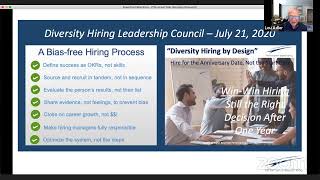
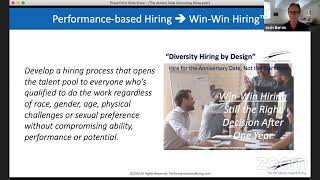
Okay, I want to use this session to summarize the idea of how to create a performance based job description. Specifically the major KPO that answers the question, what does a top person in this role need to do to be considered successful in this job? Again, great candidates might have all the skills, experience and competencies listed on your job description, but often those people are not fully motivated to do the actual work. They might be competent to do it, but not fully motivated. Worse, there are many great people who can do the work who have a different mix of skills and experiences. The that's why we define work as a series of performance objectives rather than list the skills and experiences. The idea being, as long as we can prove the candidate can do that work, he or she is fully competent and motivated to do the work. So that just opens a talent pool to more high potential people, people with different mix of skills and experiences, including a lot of diverse candidates, without ever compromising performance. The methodology again starts by creating a performance based job description. We're going to assess what people do with what they have, not what they have. And the idea is if they can do the work, they have all the skills and experiences needed in the right mix. The driver is the work itself. The skills experiences are variables. Most people don't get that right. Skills and experiences are not fixed or variable based on the competency and motivation of the person. So we define work as a series of performance objectives. What does a person need to do to be successful? During the work history review, we map their skills. Let me just restate that. We review their work history to see if they've worked in areas that are comparable to the work we need done and they've been recognized for doing great work. Doing similar work we just want to see on a fitness scale and a focus basis. And this is in the exploratory interview. If they're work history seems reasonable, we're going to start digging into their accomplishments. If the work history is not reasonable, we don't need to continue the interview. That is part of the exploratory phone screen. But one thing I always do is ask candidates, tell me about your major accomplishments related to one of the key performance objectives. And if I really like it, I might dig into one or two more performance objectives to see if they're reasonable candidates. Obviously, in the full interview I'm going to dig into an accomplishment for all of the performance objectives. But in the screen I might just pick one or two. If I really like the candidate and I think they're a good fit, I might Ask what we call the problem solving question. Said, hey, one of the big things is we have to accomplish this task. One of the real tasks on the KPOs and I described some constraints. If you were to get this job, how would you address this problem? And I'm not even looking for the specific example. It's just does a person understand how to begin? Do they understand how to ask questions? And more importantly, just do they have the process of figuring out a solution rather than the solution itself? So this is the basic performance based interview. But the key is you got to build the job description as a series of performance objectives, not a list of skills, experience and competencies. And ChatGPT can help you in all steps of the way. Building the performance based job description and creating the interview. Let me show you how that's done at this point in time. So the question I have for the hiring manager is I've got a job description listing skills, experience and competencies and I'm going to make the statement is this is not a job description, this is a person description. A job description doesn't have skills, experience and competencies. That's what a person has. Let's put the person description in the parking lot and first define the job as a series of performance objectives. So that's the first step. So for this job, which is called a product marketing manager, I asked the hiring manager what's the biggest thing this person needs to do to be successful. And I might say introduction. Every single job in the world can be defined by six to eight key performance objectives, some major debt objectives, and then some steps along the way. But for this point, let's just define a major performance objective for our product manager. What does success on the job look like? And it's always an outcome. So let's assume that one of them is complete. The product requirements document and launch plan for new product line. Obviously it's getting the project launch might be the major objective, but that's a pretty important one. Complete the product requirements document and launch plan. So at least I've got an output, not an input. Five years of experience, I might say. What does that five years of experience look like? Oh, they got to build the product requirement document. End build the product roadmap. At least I want to talk about outcomes. What action for this specific job in completing the product requirements document is important. If the person's a technical person, it would be collaborating with the team. If the person's leading the team, it's probably a little bit bigger than that. In this case, this person's leading the team. So it's coordinate with tech team and the ops team and obtain agreement at a certain period of time and a detailed build schedule. Now we're getting into a little bit more detail. Let's define the result, let's measure it. What does success look like in terms of a deliverable, a metric or a KPI? Well, we got to get full approval by the executive group with the roi. Well, that might not be for the product requirements document. It might be with a full plan, but at least we're talking about the realistic plan. How long should it take to get the prd? Let's get the date figured out, let's understand and the constraints. They got to get the PRD done in 90 days to meet the plan. And we got to get full approval by July. It could be six months. So now we're starting to really understand this job as a series of performance objectives. I want to take it one step further. I often ask in the environment, are there any situations or challenges this person is going to face that could affect the results of getting this done? Oh yeah, we got a lot of competition. We got time frame. Normally this would take six to eight months. We got to have it compressed schedule. Okay, we got a tight time frame given the competition. So now I've got all the pieces to create a major KPO which is actually probably covered a lot. But now I'm going to do a little twist here. I'm going to go to ChatGPT, ask this question. Create a performance based job description for a product manager. Now in this case, I created a fake one to lead the worldwide launch of our groundbreaking AI based product designed to revolutionize the way families prepare healthy, unprocessed meals. And I didn't create this. I said create a performance based job description. But here's what it came up with. I mean it created the product requirements document as one of them in one to three months. I don't think I gave any deadlines or guidelines, but that's what it came up with. Pretty typical. Conduct market research in the first month, prepare the product, roadmap development in months 1 to 3. Put the specific PRD together within 90 days. Current product, evaluate the current state of this product being built. I think there was a few more here. Collaborate with the cross functional team, submit the plan for executive approval in one to six months and then we have a 90 day plan of action. That's pretty cool. This is what ChatGPT did and all I gave it was a general statement. The point of this and I think there's two points made with understanding how to create a major kpo. I think it's pretty clear for someone in a product marketing management position that these are the steps involved. You don't start building a product until you get everybody in agreement of what you're doing, building and what the competition looks like. I'm going to contend there's a direct parallel to this in creating a performance based job description for a specific job. This is what you need to do. I mean, hiring a new person isn't based on skills, experience and competencies. It's based on what a person really needs to do. So there's a direct parallel in creating a performance based job description for any job and how that compares to building a product. There's a sequence of steps involved. You got everybody agreed and you don't go forward until everybody agrees to what you're building. Well, to me, you don't go forward hiring someone in IT unless everyone understands what this person needs to do on the job. That's the value of a performance based job description. There's a bigger value is ChatGPT enables you to create these instantly. Now, this is not the final working document. What I would do is give a template of this job. Say this is a rough draft. Give, give it to the hiring team, get everybody to agree. Maybe the dates aren't right, maybe the teams aren't right. Whatever it is, you get everybody to agree to it before you go forward. Then when we find a candidate, we're going to ask that candidate to give us examples of work he or she has done related to this. That's how you open up the town pool to everybody. And you also determine if the candidate is competent and motivated to do the work. But this starts with building a great performance based job description that everybody needs to know and agree to. But answers the question, what does this person need to do to be considered success over the first six months to year two years, you do those things right, you'll start hiring stronger people, more diverse talent and more high potential talent. Let's get into the next step in this process on understanding how to create these performance based job descriptions for different types of jobs.