Lou Adler - The Almost Daily RECRUITING Show
Transcript of a Lou Adler webcast (The Almost Daily RECRUITING Show) featuring Lou Adler interviewing Jerome Ternynck (CEO, SmartRecruiters) about hiring strategy, performance-based hiring, and diversity-by-design. Key themes: shift from skill-based “must-haves” to performance-based “must-achieves”; structured interview scorecards and diverse hiring teams to reduce bias; embedding post-hire success into pre-hire processes (hire for the anniversary date); treating talent acquisition as sales & marketing (recruiter = marketer, hiring manager = salesperson); proactive sourcing and targeted outreach (attract vs. post-and-filter); collaboration and technology (modern TA platform, shared scorecards) to scale disciplined hiring practices; and measuring hiring velocity and net hiring score rather than only time-to-fill. The tone is practical, evidence-driven, and tactical—focused on process changes, metrics, and cultural shifts to enable more objective, diverse hiring.
Chapters
And then I'm going to ask you a question, Jerome, about diversity hiring by design. But the big opening question, once I show your picture on the screen here in your book is, and this is a question I really like. I don't know that we're going to answer it today, but the question I really like to answer is, why is it so hard to hire diverse talent? That's the kind of the question we'd like to ask. Let me kind of go to the next deck here.
And.
Formally introduced Jerome Ternek. I've met Jerome a number of times at different meetings. Jerome's written a remarkable book called Hiring Success. Jerome's the CEO of Smart Recruiters. Jerome, your microphone is muted, so you might want to double check that. But let me ask you two questions or first, make an opening statement. Can you kind of give a quick highlight of your book, what it includes and then a general overview of. Hey, we've been talking about diversity hiring for years. I mean, the laws were written in the 80s and 90s. Technology has come out to focus on that. But from my perspective, I don't think much has changed in diversity hiring. People spent lots of money on trying to hire more diverse talent, but there's issues. So the book and your perspective on the world of diverse hiring.
Yeah. Thank you, Luan. So the, the book Hiring Success really is written for the C Suite who generally want to hire great talent, but they don't know how to empower their TA team. They're still measuring TA on faster and cheaper cost per hire, time to field faster, cheaper. And they're not looking at talent acquisition as a strategic sales and marketing function. And so. And it's hard for TA leaders to make the case, hey, I want to increase our cost per hire. I want to spend more in hiring. And you know, there's going to be a good return on investment. And that case has been hard. And so I really wrote this book for the C Suite to understand how TA works. What drives hiring success, which hiring success is the ability to hire amazing talent on demand, which is, of course, what every C suite wants. And that actually has been well received. And it's a book that TA leaders can read, obviously, but it's a good gift for the C Suite for the CEO because if they read the book, they definitely are going to look at recruiting in a different angle. And one of the things I talk about in the book is, of course, diversity hiring. And as you said, Lou, I think the way I look at it is we've been trying to move the needle for decades. But it's not a needle that we need to move. It's a behavior, it's a DNA, it's a market. And I think this is going to take a lot more than needle moving if we actually want to change the way people are able to include diversity hires at all levels and especially with black diversity in the US but that applies across all the demographics and I think TA has a real role to play there. And yes, of course you want to build an inclusive culture, you want to build a diverse organization, but it starts with ta and it's a good opportunity for cheerleader to step up and be agents of change.
Okay, so let me kind of ask this question and I've got a few ideas here. So I want to make a statement. It's kind of a wordy statement, so I'm going to let people read it. Then I want you to interpret it. And this is, I learned early on, not early on. I was telling a story yesterday about my first job, 50, I hate to say it was 52 years ago when I first worked as an engineer and was an engineer in a missile program. And my boss said, before we let you out and do any work, you have to answer this question. Why does E equals MC squared and what does you can't push on a rope mean? And I told him, as a 22 year old engineer, I said, well, I can answer that question right now. I don't need any. He said, no, meet everybody in a group and Thursday we'll take you out to lunch and we'll discuss those two things. Well, obviously there's a technical component to it and there was a management and a leadership, well, let's call it a project management, a collaboration issue, which is you, no matter how good you are, technically you can't accomplish much. And it tends to be that people get hired for their technical skills, but it's their organizational and management skills that gets them ahead. So I'm going to contend that part of the problem with diversity hiring is too much focus on technical skills and not enough on everything else that makes a person successful. So I'm going to give you the words for this initiative. Everyone else can comment. I know it's a long but this is what I would say, the diversity hiring by design initiative. I know it's wordy, but it's trying to capture everything. So Jerome, if you could just look at it, and I'm going to ask you to say, what do you think that means? And is that possible? And I think there's strategic issues Tactical issues, human issues, technology issues, design issues. I mean, there's so many things going on here. It's like five or six dimensions. It's not even one or two dimensions, multiple dimensions. So I'm going to turn it over to you, Jerome. What's your take on this concept and is it even achievable? I'm kind of. I hope it is, but I don't know.
You know, I think it is very achievable. And it goes back to, it goes back to performance based hiring. It goes back to hiring on the basis of must achieves and not must haves, which is a concept I develop in the book as well. A lot of organization, a lot of hiring managers are giving to their recruiters a list of must have, a shopping list. And the list of must have is effectively a list of all the reasons why no diverse candidates ever gonna make it. If you focus your interview scorecards, your criteria, your hiring criteria on mustachieves. So must have 10 years of experience in writing good Java code versus must be able to write amazing code. Like does it matter that you went to Stanford to learn Java or that you actually learned it on Udemy? I don't care, as long as you can actually write amazing code. That's what I'm looking for. So must achieves, not must haves. I think the moment that hiring managers in particular translate their mustaches because they want an outcome into a must have, which is their interpretation of what does it take to actually do the job properly. I think this is where bias is introduced and that's where diverse candidates get eliminated by design.
I think you're 100% right. Let me kind of show what I to me and this is what I say, that it's kind of a paradigm shift. As I say embed post hire success in a pre hire process. What does a person need to do to be successful? What you just said is what they must achieve. Now here's what I've seen, Jerome. I've been, and you know, I'm an old guy, everyone knows it doesn't take a lot of insight to figure that part out. But I've been in recruiting for 42 years and when I ask hiring managers what does this person need to do to be successful? And it's controlled and we get them to agree to works, it's hard work, but it gets it to work. But once you start doing it multiple times, and even I remember one company we had, the CEO was totally embedded in it and for 30 or 40, his first 30 or 40 people he did it, but once he had managers having to do it, the system fell apart. So the idea of why don't they do that? I say the first one is, well, here's the part I've got here. It's item three. We probably go back through these in random order. But let me just say, why is it so hard to scale that, Jerome? Because I agree with you and personally that's what I do, but it doesn't seem to work. And this is the cynical part. I mean, I'm doing a lot of years. Why does it always fall apart once number time you get a new TA person, you get a new CEO, they say, forget that we're doing it this way. Why is it so hard to achieve what I seems to see a logical business outcome that makes sense and it doesn't seem to ever work. And maybe I'm just too cynical now, but to me that's the key to hiring diversity. People, what's your take?
Yeah, my, my take on this and for, for the audience, I don't know that there is a, that there is a, a miracle or silver bullet to that. But I think at the heart of what you're talking about, Louis, the lack of collaboration inside hiring teams. Hiring is treated in many organization as a back office process where applicants are tracked in systems where it's like boxes moved through a factory floor. The disconnect between internal recruiters and hiring managers is really, really high. And therefore hiring managers get a pass and hiring teams get a pass for making subjective, biased decisions, which is like, hey, you interviewed Lou yesterday. What did you think? He's a good guy. We both went to the same school. Let's hire him. Great, I'll produce. The offer is how hiring decisions are being made in many, many organizations. And there I really encourage organization to apply a simple principle which I applied at Smart Recruiters some years ago and served me well. I said two things. When we open a job, I want to see a hiring team. I want to know who is on the hiring team, and I want that hiring team to be diverse and to include peers, so I control the hiring team. Second, I, I want to see the scorecard, the interview scorecard. And if you don't have a good scorecard focused on your mustaches and you don't have a hiring team that has diversity, I'm not opening your job. Go away. Like, I literally, I empowered my TA team to refuse to start working on any job that does not have those simple criteria, which is I know what I'm looking for and I Know who's going to make the decision. And if you apply this consistently, then you are forcing your organization across the board to make professional, unbiased, like objective decisions. And the last one, of course with the interview scorecard is of course that the interview scorecard is filled in. So I say interviewing at Smart Recruiters or for Smart Recruiters is a privilege and we would love for you to be an interviewer. And the only thing we ask is that you fill in the scorecard. If you cannot fill in the scorecard, there's no problem. You're just not going to interview candidates anymore. And we literally remove people from hiring teams when they're unable to give feedback. By now, everybody looks at being allowed to interview as a privilege and they really spend a good amount of time fitting in. Scorecard. If you have the right scorecard and the right team, you're going to make the right decision. And then you're only dealing with your sourcing problem, which is a whole other thing, which is diversity sourcing and then the pre screening. Right. But if you're talking about the interview stage and organizing good decisions by design, that's what it takes. A good team, good collaboration and structured feedback. Scorecard.
Yeah. And I would actually say, Jerome, I agree. I can almost hug you when you said that. I've met dozens of people who work at Smart Recruiters and they're remarkable people. I didn't know how you pulled it off, but what you just said. See that I've had it almost has to be at the CEO level, say, this is the way we're going to do it. But what I've seen is at the CEO level, it's that discipline of, hey, once you have more vice presidents and more people, at some point in time, that cultural approach or business approach seems to break down. It hasn't broken down there at Smart Recruiters. But why do you think it's all of a sudden it's night? No, I don't want to totally say that. What would it take to scale that concept? Jerome, what you just said to me. Bottle. What you just said is the right thing to do. How do you scale it so it makes sure at the hiring manager level. So let me just kind of point here because it was real interesting that you said, and I remember this is probably 25 years ago, maybe 20 years ago, we were doing work with AIG Insurance, Big Insurance company, and they were implementing performance based hiring, which is digging deep into the person's accomplishments. And they were using behavioral interviewing. The problem they had, which I thought Was quite interesting was they said the hiring managers only used behavioral interviewing when they didn't like somebody. So they could fill in a scorecard to say why they didn't like them.
They.
When they put in the scorecard, it was different than your scorecard. When they filled in the scorecard for people they like was all generic. A good guy. Right. School. It was interesting. They only use behavioral interviewing when it. When they didn't like somebody. But. Sorry. Sorry to break your train of thought, but I had to throw that idea. Why is it so hard to scale that or keep it going? What would you recommend?
I think I would. So I would start by saying you need a system. Like, I'm really here. I'm going to be selfish because I design and sell a talent acquisition suite. But it's like, how do you build collaboration without Slack or messaging? How do you actually have an online good remote meeting without zoom? Like, you need technology. And right now, most of the organizations are still running recruiting on an outdated applicant tracking system. Right. And it's like other managers using your system and every recruiter is like, oh, no, we tried. Right. But it's not designed for hiring managers, not designed for collaboration. Okay, so how do you actually run the process? Oh, we email the resume to the managers. Okay. And how do you collect feedback? Well, you know, we have this form that people have to feel like if you don't organize collaboration with good where in a system where managers are where you have good scorecard and you apply discipline in it, then you're not going to be successful. And if you're not doing that, you're going to be hiring. And it's not only diversity, bias, decision, diversity, it's also you're just hiring. You're making mediocre decisions, mediocre hiring decision. So as a CEO, and this is in the book Loud and Clear, just make put collaboration between hiring managers and recruiters at the heart of your design.
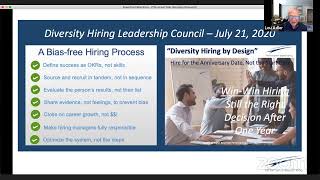
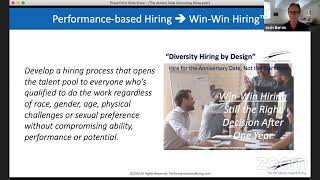
Okay. So it's hard work. I don't want to say. Yes. Conceptually, that's the way to do it. I will also recommend I like using smart recruiters as well. It allows you to do all these kinds of things. So it makes perfect sense from my perspective to, hey, if you're going to get one, you got it. If you're going to make an applicant tracking decision, you have to put smart list on your short list of one or two. So that's my plug for you guys. I want to kind of go through what I see as what I call no compromise hiring. And I use the term diversity hiring without compromise meaning, and I've asked a lot of black people, I guess half a dozen people, some of them thought it was a little offensive. I then explained it as no compromise is hey, you're going to proactively do it. You have to do it. And the no compromise is hey, if they can do the work the must have versus if they can achieve the accomplishments, build the team, grow sales, upgrade the technology. If they can do that work, I don't care if they're black or white, green or yellow, old or young, physically challenged or not, what race they are, what religion they are, what their sexual preferences are, if that's objective criteria. Now, a lot of HR people say, oh no, no, no, the law doesn't say that. Well, the law does say that. And I actually have the number one labor attorney in the country, the co chair of the OCC OFCCP practice at Little Mendelssohn, the number one law firm. David Goldstein, who's written a book, who's written a white paper in my book, the Essential Guide for Hiring and Getting Hired. Probably not as good as Jerome's book, but it's a a book there. Number one, the reason that is good a book because I can't type. So my I've got 23 keyboards and are all wrong. They don't type properly. But he said objective criteria could be a performance objective. And when you have a skills objective like five years experience, that's not necessarily predictive at all. It's they got to be great Java code to write a user interface that accomplishes A, B and C fine. That's what they've got to do. Don't compromise on performance. Give people a. Let the mix of skills be a subset of the performance criteria. That's how you hire people without compromising performance. Let me kind of talk about this one right here, which you kind of relate. Let me kind of talk about number one and number six here, Jerome. I make the contention that you can't use a surplus of talent strategy assuming there's excess talent talent and weed out the week and expecting to apply. Instead you have to go attract the best in a very proactive approach to attract people in based on career opportunity and career growth. And it's got to be very, very proactive. And to me, if you weed out the week based on the application people applying, none of the best people are going to apply because they don't need to. So just from a strategy standpoint, I say, hey, you got to look at supply demand and you gotta attract the best rather than weed out the weak. What's your take on just that strategy concept or what is your take? Doesn't have to be that strategy. What's your take on the strategy side of talent acquisition?
Yeah, you know, I think what's interesting about the crisis or the talent surplus that we are in today is that I think it's gonna see the end of job advertising as we know it. Because it just doesn't make any sense to post your job and wake up next morning with a thousand applicants and then try to pick the five you want to talk to without pissing off the 995 that you're not going to answer to. That model is just flawed. And so I think we're going to increasingly see organizations adopt your model, which is you actually post your jobs to the pre qualified candidates to people that you have already engaged with. I think, you know, the, I don't know mortgage companies, they don't actually offer mortgage to everybody and then say no to everybody. Right. They have criteria and they bring you in and their marketing is designed to actually bring the right people in. And so here you have, I think a shift of talent acquisition efforts from advertising spray and pray and filtering to we are more intentional about how we market and we are more intentional about who we market to. Which goes back to your diversity. Go and market to the groups that are underrepresented in your organization today and then advertise your job to those groups first. Right. So I think we absolutely should embrace the attract in talent strategy as you have it here, which if you talk to your cmo, like if the TA leader goes to the CMO and asks them, you know, this is what I'm trying to achieve. The CMO will be like, yeah, I mean this is like, yeah, it's an easy task for a marketer to actually do that. Right. So I think I really encourage TA leaders, especially in this time, to step out of the post and filter into more of a marketing function where they're proactively targeting people, especially diverse talent.
No, I think so I'm going to go back to bottom one. This is the sixth item on this list here. I contend that sourcing, which is a subset if strategy drives tactics. And now you talk about chief marketing officer putting a track program in. I'm also going to say at the sales level, the sales level is you got to identify a good person and you have to which is the sourcing piece. Then you have to contact that person. It's almost the pre sales of the qualification. So I Contend, you have to do sourcing and recruiting in tandem, not in sequence. It's just like I'm working with another client, helping them find a VP marketing. But the VP marketing has all the sales development reps, actually bigger team. So they're the ones who, they qualify the customer. But they actually talk to the decision maker. They actually set up the meetings for the salespeople. So to me, sourcing and recruiting has to be in tandem. You can't just get a list of great names. You have to not only get that list of great names, you have to contact those people, pre qualify them. And my definition of a pre qualified candidate, because you have two buyers. One buyer is a candidate, the other buyer is a hiring manager. So I have three criteria for sourcing and recruiting in tandem. Number one is the person's performance qualified, meaning he or she can do that work. And you look at their accomplishments. Number two, they have what I call the achiever pattern and indicates they're clearly in the top half, top third or top quartile of their group. They meet those two conditions. High probability the hiring manager would see the person if you get them on the phone and talk to them. Number two, the candidate also has to see the job as a career move or you'll have to overpay or they won't be interested in what you have to offer. So then you have to reach out and find those people. So my whole focus is identify a few great people who meet those three conditions and recruit the heck out of them and then engage the hiring manager at the same time. It's almost the sourcing, recruiting and the hiring manager all have to be kind of done. I don't want to say exactly in sequence, but certainly you can't separate them step by step by step. And hopefully you have a good process. It's almost embedding all the steps more closely together. How does that sound conceptually to you? Jerome? Sorry for going on so long that.
Yeah, no, I don't want to be.
Emotional about that one.
Yeah, there's a lot to unpack here. But I think conceptually. It is a teamwork, right? And the teamwork is really that the hiring manager and the recruiter are working together for a good outcome. Two things I would add or comment on what you just said. One is think about the recruiter is the marketer and the hiring manager is the salesperson. This is a sales and marketing process, right? The recruiter is here to bring leads and the manager is here to close. Of course the recruiter has a big role to play in the final closing. But that tandem is interesting, right? And if you position your work with a manager in this way, it actually works well. The other thing that I've seen work very well in this is historically we are measuring time to fill as the time metric and we're giving this to recruiters and they're in charge of time to fill and they agonize over running faster. And I would argue you actually flip this model on its head. You actually change your time metric to hiring velocity, which is the percentage of jobs that are filled on time. So we need to hire 20 engineers this quarter. How many did we hire? We hired 10. That's 50% velocity. Very simple. And as you see you, I understand velocity is business velocity because if I only have half of the engineers, I'm going to have half of the product I wanted to have. Right? So actually this velocity translates well. And you give the velocity metric to the manager because it's the VP engineering's job to ensure that they have the 20 engineers on time. Otherwise, guess what, they're going to get fired because they cannot produce the product. Right? So actually you give the velocity metric to the manager and you give the quality metric, which we measure as a net hiring score. It's like an NPS on quality of candidates. It's a pulse survey. It's actually a really easy one to do. You give the quality metric to the recruiter. So now you have a dynamic where the manager is in charge of running fast and the recruiter is like, whoa, hold on a minute. Maybe we could find another better comes the bar raiser and the manager becomes the accelerator. And that dynamic is really good. It works beautifully.
Well, I think it's an interesting idea. Let me kind of throw another on top of that. But you said make the manager responsible. So I'm going to say I have this idea called win win hiring. And it happened long ago and it was not an altruistic thing. But as a contingency recruiter, when I just started my practice and this was in the early 80s, so a long time ago, one of my clients said, why don't you give me a one year guarantee and I'll give you all my business, but it's still contingency. But I made eight to 10 placements at the company a year. So that. Okay, but when I. And it was the idea was when I had this win win hiring outcome, meaning at the anniversary date, the hiring manager said, yes, I like this person. The candidate says, I like this job. I'm glad I took it that is hard to achieve. As opposed to hiring for the start date, you hire for the anniversary date. Then you start doing all of this extra work during the interview process to make sure the job makes sense, the sourcing makes sense, this partnership makes sense. And you also make the hiring manager responsible for that. So it's not only responsible for the fill rate, but also responsible for the candidates on the job success. And I don't think hiring managers are rewarded for hiring a great person or that person being successful. So that changes the performance measure of a hiring manager and their performance review. Hey, you got to hire good people and they got to be successful. Now that kind of changes the dynamic again. How would you think of that and what metric would you come up with for that one, Jerome? Hiring velocity or hiring acceleration maybe or something?
Yeah, I think so. Managers are being rewarded for hiring great people, and they're rewarded in the best form. They actually get promoted. Like who you hire defines who you are as a leader. It defines everything in an organization. It defines who you are as a leader. So if you hire amazing talent, what happens to you next? You get promoted because you're successful. So I think the incentive for hiring managers to actually hire great people is there. What is wrong is that the incentive for recruiters is to hire fast is. But since it's actually, I don't care if this person is good or bad, I only care that I close my search. And that's what you, you solve by saying hire for the anniversary date. Because you're saying, no, no, no, no, recruiter. You're not trying to fill a seat. You're trying to hire someone who's going to be successful a year later. And I think that's critically, critically important.
Yeah. So I would actually say that when I interview a hiring manager, and I think so let me. This is kind of off topic, but I think it's on topic. Most interviewers focus on a candidate's individual skills. When I hire managers, one of the first questions I ask is, hey, tell me about who's on your team? How did you hire them? How would you rank that team? And when I'm looking at individual contributor, I say, okay, what kind of teams you've been on? How'd you get on that team? What was that role on the team? And I contend that too many people focus on the individual technical brilliance of the person, not that person's to be, manage other people, develop other people, promote other people and be parts of critical, important teams. And you can just look at their growth and team skills. And understand if this person really is collaborative, is cross functional in thinking, has the capability to assess talent properly. What's your take on that kind of focus of, hey, let's focus on technical. I mean, still got to do it, of course. And more focus on team and management skills. What's your take on that?
I think managers being able to build great teams is the only thing that matters because at the end of the day, you don't need to be strong. Technically, if you're able to hire amazing talent, that's going to do a great job for you. Who cares? Yes, of course it's nice if you can also make a good espresso, but if you're actually great at hiring the best baristas in town and make the team happy and hire, you know, I hire great people. I mean, there's only two types of baristas. There's the one that welcomes you with a hello, how are you today? Do you want a latte like yesterday and gets you to come back tomorrow with a smile on your face? And the other one who looks grumpy and doesn't remember you. Those are two baristas and they, they make a big impact on the revenue that Starbucks makes and therefore the success of the store manager. So as a store manager, if you're amazing at hiring and retaining excellent baristas, then do you really need to know how to make an espresso? I'd argue no.
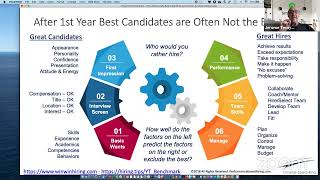
Interesting. Actually, I worked with In n Out Burger 30 years ago when they were just expanding and pretty much the same thing you said about that. They want people who are friendly and et cetera, et cetera. I want to show this one of those slides because I think this is important. Then I'm going to open, I'm going to ask you some questions about it, Jerome, and then let's. We'll open it up. So JJ and Brian, if you guys are there, let's monitor the questions. If we have any in our. We have people watching this in the Zoom webinar. We also have people watching at LinkedIn Live, Facebook Live, Zoom, YouTube Live. But I make this contention and fundamental issue is I think most job descriptions and most hiring processes are focusing on finding great candidates, not great hires. And here's what I make the statement as. And I think you made the point earlier. Most job descriptions list skills, experience, academics and competencies. And I basically say most job descriptions are not job descriptions, they're person descriptions. A job doesn't have skills, experience. A job has a list of performance objectives of what you Said Jerome, what they have to achieve. However. And I asked hiring managers question, have you ever met a great person who has a different mix of skills? And they always say, of course. I said, is everyone who has those skills a great person? Of course not. So right away we set a filtering which has got a lot of false positives and a lot of false negatives. However, then the recruiter gets the candidate on the phone who applies, and they first box check compensation. Is this your compensation range? The candidate actually has to negotiate compensation before he or she even knows what the work is. I mean, that's idiotic in my mind. Then the candidate gets through all of those filters and then somebody makes a judgment about the person's first impression. If they like the person, great, they ask easy questions. They don't like the person, they ask hard questions. After a behavioral interviewing, people they don't like, they ask behavioral questions. People they do like, they ask about, hey, what school did you go to and why do you like this? What are your hobbies and what do you ask? Inane questions. But they ask softball questions and ignore negative information or they also ignore positive information from someone they don't like. Now I'm going to contend when I ask managers in a win win hiring, what determines a great hire. So a year from now, tell me about the people you've hired that are great, who've worked for you. You truly are great. And this is what they say. They deliver the results, they make it happen. They don't make excuses, they solve technical problems that they need to. They got great collaborative and team skills. They can lead and develop teams. And they're good managers, manage themselves, manage their team. They can plan, they organize, control the budget. Then I just ask hiring managers this question. Who would you rather hire? Someone who's got all the skills on the left or someone can deliver the results? And Jerome, I don't know if you're from New Jersey, because I don't want to offend you if you are. I've asked this question to 30,000 managers over the last 30 years. Only one person said, Someone on the left. And that guy was in New Jersey. I don't know, and I don't want to offend anybody from New Jersey. But if you've been to New Jersey, you've probably met that person. But now the real question is, and I think this is the issue, and I ask hiring managers, how well do the factors on the left predict the factors on the right? And everyone said, of course they don't. A lot of false positives A lot. Everyone you promote doesn't meet the criteria. On the left, diverse candidates can do all the work, but they have a different mix of skills and experiences. The best candidates aren't going to make a judgment about what they get on the start date. They're going to make a judgment about, hey, if I can put myself on a better career trajectory in a year from now, I have make more money. Hey, that's a better game plan. So to me, this is a fundamental core difference. It's too much focus on the stuff on the left and not enough focus on the stuff on the right. What's your take on this whole thing, Jerome? I'm sorry for explaining it, but this is the one I wanted to get to this, get your viewpoint and then open it up for some questions.
You know, I do some volunteering in prison for the last few years, and I've gotten involved with formerly incarcerated individuals and the whole topic about second chances. And at an event at Smart Recruiters, where we brought in about 40 formerly incarcerated individuals along with recruiters in a reverse recruiting movement, we had this guy and the conversation was, so, what are some skills that you pick up in prison that are applicable to the world, right? And this guy raised his hand and, you know, he's been incarcerated for a long time, like 25 years or so. And he says, you know, I think I'd be a good customer support agent because, I mean, you know, if there is tension in the room, I know I know how to diffuse it. Like, I know how to handle tension. I have no problem with that. And, you know, I also have resilience because I guess you don't spend 25 years behind bars and come out a better human if you don't have resilience. And then he goes on with another know, couple of really good examples. And he closes by saying, and you know, Lars, but where I'm at in my life, if an employer is going to give me a second chance, man, I'm going to work so freaking hard for these people. They have no idea, right? And by the end of this 90 second pitch, I was kicking my head of support who was standing next to me. I was like, kevin, let's go hire him, right? There is no way on earth that this person would have actually made it through your step 1, 2, 3, over there. But by now, they're definitely making it through your step four, five, six, right? Because, yeah, that person proved to be a great hire. But there's no way that by looking at the must haves, I would actually be Able to make that decision, but by focusing on the must achievements like. Oh, actually, yeah, you're right. You could be an amazing customer support agent. Let's get you on board. Right, so I think it's critical that people look at the mustachieves and at your four, five, six over there.
Yeah. So let me ask you this. And I so to me this, to pull that off requires a lot of changes in the process. And I think the one that I look at when I just look at this, there's more than one. But the one that stands out to me is we hire strangers differently than we hire acquaintances. If you've worked with a person or know a person, you know a lot about them. Their character, their work ethic, how they work with teams. You've seen them on the job and you tend to promote those people. When you hire a stranger, the bar is totally different. They got to have the right skills, they got to agree to the compensation, they got to make a good first impression. None of it predicts performance. So how do you break that gap? You broke it, Jerome, because you had that person talk to you for 90 seconds or whatever it was. You started saying, no, I know this person at a different level. And that's what. And it's like game changing. It is a paradigm shift. And so how do you make this shift? And this is where I say in my mind we should throw away job descriptions and throw away resumes and let people put a little, hey, we need someone to build a new product. We need someone to design this. Tell me what you've designed and put it in a two minute video and we'll see if it's any good. Let's almost throw away and restart it. That might be radical, but hey, we haven't done anything better yet. So what's your take on that? Let's be real radical as radical. I don't want to overdo it.
But radical is radical is screen people for your for. You want them what you want them to achieve, not what you think they should have done in the past. You know, it's like looking at my past is not a predictor of my future. It actually might be the opposite. Like right now, if you look at my resume, you'd say, oh, this guy actually would be a great CEO of a recruiting tech company. I'm like, okay, do I really want to be CEO of another recruiting tech company? I've done two. Sure, if I don't have a choice, but I wouldn't be motivated. Right. But actually if you say, Jerome, we have this nonprofit that's looking at second chance employment opportunities. And, you know, would you consider this? And I'd be like, hell, yeah. And, you know, my. And I'll apply everything I learned into this new mission and I'll deliver amazing results. But I have never been in a nonprofit before. Does that. Yeah. So you need to shift your selection criteria. Not what you think the person should have, but what you evaluate the person can deliver.
Okay, so let's take what you just said there, because I think that's pretty interesting. If I was interviewing you for this nonprofit, I would be looking at your decision making criteria. The ability to manage cross functional teams, to understand how to manage and develop people, how to set a hiring process in place, the fact that that platform is. Now, I might also look at if it was a marketing spot. Hey, is your sales and marketing appropriate for the industry? It doesn't have to be identical, but it could be. Hey, this is not a recruiting product, Jerome. But it's a different technology product. So I would say that's probably the case. But there's a certain set of conditions where you say your management skills, your team skills, your vision, your leadership skills would be appropriate for this, not profit. And I think it's. That kind of thing is we look too much at these technical skills themselves, not enough at the management, the decision making, the collaborative skills.
And.
And also the other point is the motivation skills. The motivation of why are you going to do this job? And I make the statement is if you're not motivated to do this work, you can't motivate someone to do work he or she doesn't want to do. But if you can get them to be motivated and they're smart enough, they'll figure it out themselves, how to get it done without having to push them. What's your take on that? Wait, before you go, jj, please look at some questions. And everyone else asks questions. Jerome, I apologize for interrupting you, but I just want to make sure we get some questions. We have a few minutes left here.
I have a bunch lined up. Lou, whenever you're ready.
Let's go. Let's go, Janine.
Okay, great. So we've got a question from our. From one of our LinkedIn audiences, and you talked about technical skills versus team skills and leadership skills, which some qualify as soft skills. Technical skills are easy to measure, but how do you measure those kind of soft skills in interview to make sure you're hiring somebody who. Who can build their team and support their employees and their customers?
You want to take that first?
Yeah, I mean management skill is a technical skill. It's leadership is maybe a given like something you have or you don't, something you can build. But management is a technical skills. So I assess management as a technical skill and if I want to say, you know, if one of my criteria is this person has to be able to hire, train, develop amazing talent as part of their team, that's what I need them to achieve. So this is the mustache. Then my questions are going to be. So tell me about your one on ones with your team. Tell me about what, how do you optimize your hiring process? What would you do in. In. In. In a situation where somebody has, has reached their, their maximum and you need to either split their job or layer them off. What like I would ask technical questions about management. Management in many. It's not an art like this. There's some real technical skills in being a good manager.
Yeah, I would actually I don't necessarily totally agree with the fact that it's a technical skill because I don't think it's cut and dried. I think it's a human skill and I think it's a critical. It's number six. There is. How do you manage a group of people? How do you budget? Did you make your budget? How big was the team? Are you managing managers? And what I found real interesting drone. This has happened to me maybe personally but it probably didn't stick. But there's a point when you're an individual contributor when you get more satisfaction and you become a manager and all of a sudden you get more satisfaction from the success of your people rather than your own personal success. It's visible. So that's first level manager. I then look at if I'm looking for a director, I not only want that but I want someone who can manage managers to develop that same kind of skill. So to me I don't consider it as techn. It doesn't matter, that's a word. But I clearly look at the school scope and scale of the job. Has a person achieved those thresholds? And if I'm looking at a VP level, it's not only managing managers, it's also cross functional strategic issues, getting at business issues. So there's a sequence of steps that people go through from individual contributor to manager to managing managers to managing functions to being general managers, et cetera, et cetera. But it's clearly understanding the job, the scope and scale of the job and asking people hey, give me examples of where you built a team of about this size to accomplish this task and then dig deep into it. And as far as I'm concerned, I am really colorblind with that. If a manager says, I need someone who can accomplish this task, they'll do it. I don't care if they're black or white, green or yellow, they've got to pass that. And I'll go to bat for that candidate. 99 out of 100 times too many managers make superficial judgments with the comm. Not humble enough, just doesn't fit. And then you got to fight that battle. Jj, is there another question I could go on as you know, for hours on that same topic?
Yeah, we actually have a few more questions. The next question comes from one of our Zoom attendees. What is the best way to train hiring leaders on the importance of diversity and unconscious bias during the selection process? Is it a mandatory training? Is it a one on one conversation, the beginning of every search? What is that way?
That's a great question, Jerome. You want to take that?
I think it's mandatory training. And so it's mandatory training for just awareness and in particular in the issue of racism. That is an important point. Like if you have a white interviewer who does not understand or accept white privilege, then you have a problem. And you need to solve that problem before the interview, not after. Second, I'd say do it by design, by having a diverse hiring team. If you organize diversity in your hiring teams, if you make sure that underrepresented minorities or groups in your company are overrepresented in hiring teams, guess what's going to happen over time, right? You're going to hire more and more of this underrepresented group. Start by having more of these underrepresented groups in your TA team and then extend this to the hiring teams themselves. And once you do that with a diverse hiring team, have them fill in a structured interview, scorecard, cards down so you don't see other people's opinion before you put in your own opinion. And then at the end you end up with a very objective evaluation of a candidate based on must achieve and on the criteria. And this leaves no room for bias, conscious or unconscious, right? And I had the example myself was like three years ago we were hiring this sales leader for region and smart recruiters, five people on the team, three men, two women on the hiring team, right? All three of us, three males were like, fuck yeah, this is an amazing guy. We're like, he's one of us. He's going to crush his number. We love him. Right? And the two women on the panel were like he's a bit of a bully. And we're like, really? And he got like, oh yeah, yeah, yeah, yeah. No, no, no, no. Literally they were just like oh no. Right. And had we not have a structured feedback with a diverse team, we were heading straight into hiring your typical sales bully who might deliver a number but actually create more damage in the company than create good. So diverse hiring team, good scorecard and make it transparent. But training is the place to start.
Yeah. And I think, let me kind of leverage what Jerome said. What you've said, Jerome, is you've really created a system that prevents bias from occurring. And it's a system. So it's. I think the training has to be that you have to be aware of it. It's got to be how you ask questions. I have, what I call the divide and conquer approach is I don't let anybody, even the hiring manager make the decision, him or herself alone. Which you basically kind of said that it's also evidence based assessment. So I remember this was many, many years ago where a CFO was a real important client for me. A candidate for a cost manager went into all the interviews. The hiring manager was a cfo, was a real bear. He said, this guy could never work in our company. And after hours of interviewing controller, the accounting manager, the planning director, everybody loved this candidate. But the CFO thought he was too soft. 10 minute interview. I called the CFO and we had a bit of an argument, but I needed the account. So I. But he was yelling and screaming at me as why I was a terrible recruiter and wasting everybody's time. And then he said this, which was kind of stupid, but after a while taking the abuse, I decided. He said, My 16 year old son has better cost accounting skills in that candidate. And I said, you really? True. Would you mind sending his resume because I think I have a better job than the one you guys are offering. Well, the CFO just stopped and. What are you talking about? I said, ed, you blew this whole idea. This guy implemented the first ABC cost accounting system on an SAP platform in the world at the Rouge plant at Ford Motor Company. He was asked to do this collaboratively across the world. Yes, he's soft spoken, but this guy can accomplish a lot. And you've just walked away from a three year plan to implement exactly what you want at your company. And he said, I just thought it was too soft. I'll interview him again tomorrow. He interviewed him the next day. He asked about the guy's accomplishments and he realized that the guy was A perfect candidate for his set of circumstances. So I think recruiters have to push back. It's that big thumb is not always big is not always the right thumb. And by an evidence based process, like Jerome said, that systematized, you actually can prove it. But you gotta be influential. If you feel you got a good candidate as a recruiter, you gotta fight for it. And you gotta fight hiring manager, making dumb decisions. Because if you don't do that, you're gonna wind up exactly where you are for the last 25 years. Last question, JJ. If there is one, I'll give it to Jerome. And then we're off to. I don't know, we're off to, but we're off somewhere.
We actually have quite a few questions around cultural fit because often candidates are rejected because they're not a cultural fit, which. Which is a potential barrier to diversity by design. So how can you reconcile hiring for cultural fit plus diversity by design?
I'll let you talk.
Yeah, absolutely right. And it actually goes right back to what you were just saying. Right. We need to understand that job interviewing is not a likability test. It's not like, do I like you? Who cares if I like you? Right. This is not about do I like you. Are we blue? And I. Okay. We're both white. We both work in recruiting. We've met each other. We know a lot of people in common. If we're going to have a likability test, we're going to have a great time chatting, and I'm going to walk out thinking, oh, Lou is a good guy. Who cares? Who cares? This is not the job. Interviewing is about evaluating a human's ability to perform a job. There's nothing to do with whether you like that person or not. And cultural fit is at the heart of that. Right. Because cultural fit is often cultural cloning. And you really here are in danger of replicating a type of people. What you need to be looking for here is the intersection of behaviors, communication, and backgrounds that creates the company culture and screen for candidates. If you're screening for cultural fit, screen for candidates who are going to add to this culture, Screen for candidates who are going to make this culture more rich, more diverse, yet people who share those values. Right. So you're screening for values but trying to get different culture. And I think cultural assessment is critical as part of the interview process, but it has nothing to do with fit as we normally know it. It's really about values.
Yeah. I think what Jerome's saying is that people, it's not about Likability. But what I use as a proxy, I'm pretty clinical when I do this cultural fit in my mind. Pick when you try to put a person in for a year that they're both going to be happy. I say criteria one is the pace and rate and change and complexity of the organization. If they haven't been in an organization with those same kind of pace issues and intensity issues, they're probably going to have a problem. Whether you call it culture or not. Number two is the decision making process. How are decisions made in your company? And if one is slow and bureaucratic with deep resources and the other one, you have to make them instantly the person's not going to be a fit. The third one is the hiring manager's leadership style and development style. Do they. Because the hiring manager really represents 50 to 80% of person's culture. If you like the hiring manager, they'll break walls for you. If you don't like them, they'll mess you up. So to me, if you get that proxy and then you focus on hey, do you expand that approach? Can this person fit in our culture? Have they worked with teams like they need to work with? Have they influenced people like they need to work with? And it's a very and it is to me mine. It's an evidence based assessment based on those values, not on, ah, great person. I can play basket. You can be on our softball team or something like that. Jerome, thank you very much. I'm going to get you on another daily show sometime in the, maybe not the, well, near future. We'll do it. I greatly appreciate it. Thanks to everybody who's on this class on this webcast. If you have other. We are recording this, I believe. I can't stop it. Yes, I see the screen is being recorded. We'll go live, we'll promote it. Jerome, have a great day. I look forward to seeing you again and sometime in San Francisco at some time in the future. But I don't know when that future is. Be good. Thank you very much.
In the cloud. Thank you. Thank you. Bye bye.