Win Win Hiring Benchmarking Best Practices
Lou Adler explains Win Win hiring: measure success at the one-year mark by tracking both performance and satisfaction. The method replaces volume hiring with outbound sourcing of top-half talent, defines roles by 5-6 key performance objectives, and closes candidates on career growth rather than compensation.
Chapters
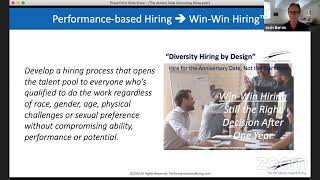
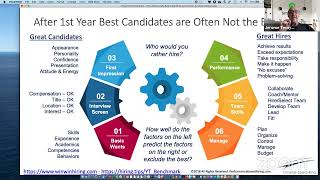
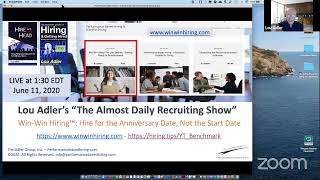
Introduce you to Win Win hiring and make the claim that it represents the future of hiring. In fact, Win Win hiring is even more important given all of the hiring challenges we're now facing today to ensure we don't have to face them again tomorrow. The big idea behind Win Win hiring is that the measure of success needs to be made on the first year anniversary date, not the new employee's start date. This means that after working together for one year, the hiring manager still considers a person a top performer and the new employee is still fully satisfied with the role. While a Win Win hiring outcome is remarkable, achieving it consistently requires a lot of things to change at the process level. This covers the gamut from how candidates are sourced and recruited to how they're interviewed and onboarded. One especially big problem that needs to be addressed when making an offer is that there is just too much focus on the compensation package and not enough on the actual work itself and and the career opportunity it represents. One way to get started quickly is by benchmarking how these Win Win outcomes have occurred in the past in order to figure out what needs to be done to achieve the same results on a consistent basis in the future. A quick summary of this benchmarking process is shown in the infographic. To fully understand the steps involved, we first need to recreate the graphic step by step. Let's get started with that now. So as we look at the entire process of benchmarking, let's use this blue circle as representative of the total talent market. First, I'm going to divide it in half. The green is the top half, the orange is the other half. And I think most people, including hiring managers, recruiters, want to hire people in the top half, especially the top third, top quartile. Those are the most qualified people. Unfortunately, a lot of people apply to our jobs who don't even meet the criteria of the bottom half from a skills qualified standpoint. But let's just call them the unqualified. We don't want those people. Unfortunately we have to spend a lot of time weeding those people out who shouldn't have applied to begin with. But even in the process of people who are fully skills qualified, when you really look at our job descriptions, all they represent are ill defined. Lateral transfers are just jobs. We don't even describe what the actual work is. We just hey, if you want another job like the one you had, apply here. And it's a very high tech transactional process. The most qualified people do not need to go through that process. In fact, the most qualified of the most qualified, all are looking for careers. They might engage in a conversation with you if the job represented a career move, but they're not ready to apply in that hiring people who are in the top half, particularly those are most qualified, is a very high touch process. A little slower, more conversations with the recruiter and the hiring manager to see if the job does in fact represent a career move. When you look at who applies though, it's probably 3 to 5% of the people who apply to a job actually get interviewed and only 1% get hired. So that's a pretty transactional process. Low yield from the candidate's perspective as well as the company's perspective. And we don't find a lot of great people of the people who apply. Fundamentally different process. Let's look at some of the results though, as we go through this. I contend a win win hiring outcome requires going after the most qualified people who see the job as a career move. It's an outbound process. We're finding the best people who are available and trying to attract them. Many of those are referred candidates or direct source candidates. But once we engage with someone, it's always about a discovery process. Let's understand your background, let's talk about the job. Let's see if the job represents a career move and if it does, we close on the career opportunity. Obviously compensations needs to be competitive, but nonetheless the career has got to be the best of competing alternatives. If we hire that way, it is a high satisfaction objective and it's usually achieved if the job is what we thought it was. There's lower turnover because we've offered the person a an important role, one that's highly satisfying to the person. We've measured quality of hire up front and the focus is on ROI impact. What's the value of hiring a top person hiring in the bottom half? We don't get a lot of great people. It's problematic if the person will be successful. The focus is on weeding out the week amongst the people who have applied. Very transactional process. In fact, money becomes the key determinant if we should even talk to a person or if the person will even talk to us. So the results of that tend to be low satisfaction, high turnover. You just look at Gallup's results for the last 20 years. Job satisfaction over the past 20 years of people who are hired this way tends to be about a third. That's people who are fully satisfied with the role when they apply to a job this way, but partially because it's transactional and the focus is on cost per hire and time to fill, not on improving quality of hire. And I'm going to make a contention is if you use Win Win hiring process you will be able to maximize quality at the same cost, the same time to fill. But we're going to spend more time with fewer people. And that's really the key. Performance based hiring is Win win hiring. The big idea is to embed post hire success into the pre hire process. And if you want to hire a great person you got to start with a great job. And a great job is not a laundry list of skills. That's for people in the bottom half. If you want to hire people in the top half, you have to offer a great job. And any job can be defined by five or six key performance objectives or OKRs objectives and key results. The focus is on what does a person need to do to be successful, not the skills they have. Obviously in the interviewing process we have to determine if they can do the work, but if they can do the work, they obviously have the right set of skills. Our sourcing is we're going after semi finalists. These are people been recognized for doing work that we need done and would also see the jobs accrue move during the interview. We not only determine if they're competent and motivated to do that work, we also determine if the job represents a good career move for them. In the closing process we're emphasizing the growth and career opportunity, not necessarily the compensation. Yeah, I know the compensation has got to be competitive, but we really want to close on this is the right career move. And during onboarding we have to clarify those expectations. And to hire the person we obviously have to deliver on the promise month 1/4, 1/4 2 and the full year. You do those things, you will be able to raise the talent bar. That's what Win win hiring is all about. It does require an understanding of that there are two talent markets. One group looking for careers, the other group looking for jobs. At the beginning of this video I suggested that Win win hiring was the future of hiring. The big idea behind this is the recognition that there are two job markets. One that offers ill defined lateral transfers and the other career growth and job satisfaction. The challenge in making this common sense shift is first accepting the idea that you can hire people who are interested in career growth by forcing them to endure a process designed to fill jobs with everyone and anyone who applied to the job posting. With this recognition you then have to do something about it. But the result of making the shift is fewer hiring mistakes and building a more talented, more diverse and more highly motivated workforce. That's a pretty amazing outcome and why I contend that Win Win hiring is the future of hiring now. Feel free to contact me if you want to get started. I guarantee it will be a remarkable journey.