Lou Adler - The Almost Daily RECRUITING Show
This is a recorded live conversation (LinkedIn Live/Zoom) between Lou Adler and Kevin Parker (CEO of HireVue) about using on‑demand video interviewing and assessments to improve hiring at scale and support diversity hiring. HireVue’s on‑demand interviews let candidates record answers any time (mobile friendly), typically ~30 minutes with 5–6 questions; the platform has completed ~15 million interviews and interviews about 1 million people every 90 days. The discussion covers structured interviewing, human and machine‑assisted scoring, game‑based assessments, candidate preparation resources, and ways to reduce bias and scale screening.
Questions this video answers
~15 million total on‑demand interviews completed (speaker statement).
About 1 million people every 90 days (speaker statement).
Interviews are generally about 30 minutes long with five or six questions (speaker statement).
About 40% (speaker statement).
Chapters
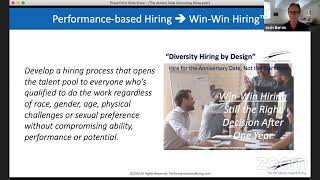
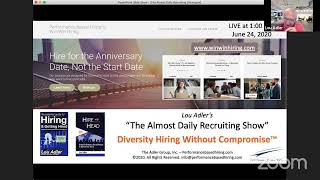
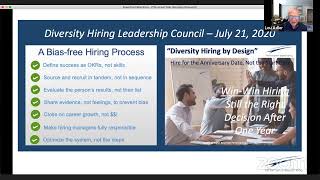
To make sure I know we're live. Here's the problem is we have people on site. They're in the Zoom meeting. Deborah M. Carpenter, newschan and Pamela, we get your question in real time. The problem is the people on LinkedIn Live. It's about 30 seconds late, so I can't be 100% sure when they're coming in. So they're kind of. There's a time sequence here, Kevin, which. Oh, that's a good question. But you should ask it 14 minutes ago. But, but that's the problem. And I am seeing the LinkedIn live come through here. Brian, are you seeing the LinkedIn live? The questions coming in there, the comments, I mean logging in and finding it. So I will be in a sec. Well, I've got it, so we're good. I'm gonna. Well, you guys can still see the screen, right, J.J. yes, we can still see your screen. Okay. Okay. Hi, Everybody. This is LinkedIn Live. I'm here with Kevin Parker, the CEO of HireVue. Let me go back one slide. I don't want to get too far ahead of myself. We're going to talk about a lot of issues with respect to hiring. I really kind of want to focus on diversity hiring in particular, because I think it's a real challenge and we. Our program is called Diversity Hiring by Design. How do you hire outstanding people, irrespective of race, creed, age, sexual orientation, color? I don't care if they're from Mars or Jupiter. And actually I think we're starting to get a few guests from there. I think somebody just launched a program to Mars, but I don't want to say who did that. Nonetheless, that's we're going to talk about. Let me introduce Kevin Parker. Kevin Parker is the CEO and chairman of HireVue. I'm going to let Kevin introduce himself, make sure the technology works and what I want you guys in that if you're on watching us Live or in the Zoom meeting, we have two feeds we're getting here. Please ask questions. And it can be any kind of questions. They can be from a job seeker perspective, a diverse candidate perspective, a hiring manager perspective, a recruiter. It doesn't matter what your perspective is, but ask a question. We'll kind of figure out based on the question where it is and we'll throw in a lot of questions as I'm interviewing Kevin here. So Kevin, with that semi formal introduction, give us a quick overview of you, who you are and what HireVue is, and then I'll kind of ask you A few other questions with respect to that.
Sure, Lou, and thanks for having me here this morning. I appreciate the opportunity. I'm looking forward to the conversation. As Lou said, I'm Kevin Parker. I'm the CEO and chairman of the board here at Hireview. I've had a pretty interesting career and started out as an accountant in public accounting at Pricewaterhouse in Boston in the 80s and quickly migrated to technology, worked at PeopleSoft, have been through a number of CEO jobs for the enterprise software, and landed at HireVue here in Utah about four years ago. HireVue, if you don't know, is the market leader, as we describe it, in what we would refer to as video or on demand interviewing. We interview about a million people around the world for our customers every 90 days. We just completed our 15 millionth on demand interview and have really brought some new focuses and new structure to the goal of hiring great talent and finding great talent and using technology to break down barriers as well. So looking forward to the conversation today and glad to share a little bit more about HireVue and our view of hiring by design for diversity.
So, Kevin, when you say you've interviewed a million, how does this work? How does it kind of go through the. It's not the detailed technology, but give us experience. If you were a candidate going through what's it like?
So for most of our candidates, you'd either apply online to a company and get sent a link, and that link would be to an on demand interview. And by on demand, you can take that interview any hour of the day, any day of the week that you want. And so it really takes away the challenges of scheduling and coordinating scheduling with the recruiters and with the candidates as well. Interviews are generally about 30 minutes long, five or six questions gives you a chance to talk about yourself and to share some information about yourself. We also put a lot of emphasis on structured interviewing, and we're going to talk about that here this morning. But it's the value of having every candidate get asked the same question the same way, and that really brings a lot of fairness into the process. Today, about 40% of our interviews take place on mobile devices, so you can interview on your phone. I've seen candidates do fantastic interviews sitting in the front seat of their car because that's when they have time and that's when.
Not driving or just sitting in the front seat?
No, not driving. But 80% of our interviews take place outside in normal work hours. You know, I look at the interview volumes every day and, you know, 7,000 people interviewed for jobs on the Fourth of July. And so you can really sort of change the dynamics and get access in ways that you can't when you're limited to a 9 to 5 schedule. The interview is just generally the starting point. Sort of a top of the funnel interview for most of our customers. And you know, just to give you a sense of it, many of our customers interview 1,000, 2,000 people a day. We had one customer a couple of weeks ago interviewed 10,000 people for jobs in one single day. So it just, the scale is pretty impressive.
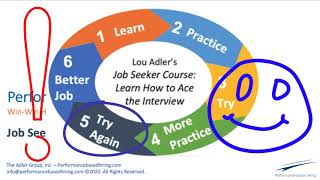
Okay, so let me kind of. Now, I wouldn't have thought of that, but so let me. I'm going to go back a second here to a first slide which I went through very, very quickly. And this will be good for not only people listening, but also for you, Kevin. I didn't realize it was that structured, but that's immaterial. We've created a class and it's free for job seekers. If you go to win win hiring.com www.WinWin hiring, you'll see a class that says getting ready to be interviewed. And what that interviewing technique is. It's over the years, as I've been a recruiter, Kevin, I've always prepped my candidates because I never trusted my hiring manager to ask the right question. So I backfilled it. I said, hey, if the hiring manager goes off track, just ask the hiring manager, tell me a little bit about the job and I'll give you some examples of work that I've done. I call those forced choice questions. So it goes here to how does a candidate get ready for an interview? How to ask those questions, how to answer those questions. Would that work for yours? I mean, I might even have someone on your team take a look at it and say, would this help them go through your thing or is it?
We'd be delighted to have a look at it. And it's very timely in the sense that we are putting a lot of thought into helping candidates, whether it's, you know, preparing people for those types of questions. I think we're all familiar with sort of the star technique of asking of answering interview questions around situations and task action and result. A lot of the questions our customers are asking are thoughtful questions and open ended questions too about, you know, tell them to give me an example, tell me about how you worked as a team, those sorts of things. So yeah, anything that can help candidates prepare for those questions is really important. It's also a very candidate friendly experience, recognizing that many of our customers Allow candidates to rerecord their answers to have practice questions. So we're trying to make it as accessible as we possibly can, but use technology to break down the logistical and time and place barriers.
How is it scored? How do you know what a good answer is? I mean, it was not done by a person, right? Or is it.
Well, the majority of answers are scored by people. So you know, as a hiring manager, you may interview, you may see 50 interviews, but they've all been asked exactly the same question, if that's, and that's important. And so as you look through the answers, you can record ratings and include your ratings and make decisions about candidates should they proceed to the next step. You know, is this a yes, no, or maybe, you know, some companies use star ratings so you can be watching the interview and right in the context of the interview, listening to the answer and recording your notes right in the application itself. We also encourage people, as you think about this, let's say there's six questions for every candidate and every candidate's asked six identical questions. It's really important to reduce bias to make sure you watch every candidate's answer to question number two, then every candidates answer to question number three. And if you do it sequentially like that, it actually brings some fairness into the process. If you watch every candidate all the way through, if they gave a great answer to question number two, it actually unconsciously influences your rating of question number three. And so psychologists would tell you watch every question in, for every candidate in, in parallel rather than in series.
How do you. I guess I'm just almost blown away by the, Somebody has to look at a million. You said how many did you do in the last 90 days?
So we've done it. We've done a million interviews in the last 90 days. So that, you know, that's an important point. We've actually created technology and when we're solving one problem, we're inadvertently creating another. We're democratizing the process so more people can apply. But now the recruiter has to watch all of these interviews, which isn't going to work anyway. So they're not, they're going to get tired, they're not going to get a fair review of that. So we've created technology and assessment technology embedded right into the interview so we can, using machine learning and data science, analyze the answer. We can also include game based assessments that test for a variety of skills, whether it's learning, agility, visual spatial, reasoning, a whole variety of things that are embedded right in the interview. And so we can provide that assessment, looking, analyzing the candidate's answer to and analyzing a variety of other components that we can get from the gameplay.
Okay, so I had it. This is interesting and it might be similar. I was talking with a company that's building a chatbot for recruiters where it would reach out and say, hey, I'm trying to set up a meeting with this recruiter on the chatbot. I'm that person's assistant. I have a few questions to ask you. And I did it. And I said, I, as a recruiter don't want to talk to anybody. It's not at least in the game. So they asked me, I said, what would be in the game? Well, one is the scope and size of the team. So the question would be is how many people have you managed? What was your biggest budget? What was the biggest project? And it was A, B, C. And then I said, okay, if they get a, B and C right, I need to talk to them. If not, we'll put them in the queue. But so it was a way to at least minimize me having to look at who I talked to. Everyone. So what do you think of that concept? I mean, it seemed logical to me, but it doesn't seem totally consistent.
I think it's a very logical idea. And you know what I think most companies in Hirevue included are doing? Looking at this process, and particularly the phone screen process for many people, really unproductive. And so you can automate or bring structure to that, asking complicated questions about teamwork or availability to work nights and weekends, or a whole variety of things to almost present a curated list of candidates for the hiring manager or the recruiter to work with. To say, these people are almost pre qualified. They either have identified they're available those days or this salary meets their requirements. They've managed a team of a particular size. They have international experience. So that I think is very appropriate. Now, I think there's going to be different modalities, whether it's a chatbot or an interview question or multiple choice. But all of that is really designed to take this applicant pool and curate it down to the people that are most qualified.
Okay, so let me. I'm going to do two. I'm going to ask our participants. I know some of you are in a zoom meeting. We have a number of people. Feel free to ask questions in your chat. I have. JJ and Brian are going to be monitoring those. If you're on the LinkedIn live again, I can see you're asking questions. I think I lost them. I don't know where they went, but they were here a while ago, so I probably could find them. No, I don't know. Even.