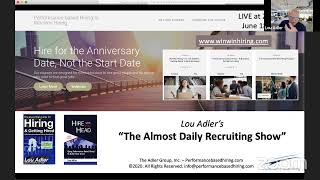
Lou Adler argues companies should hire for the one-year mark, not day one. Define jobs by 5-8 measurable objectives, source 15-20 strong candidates, and interview for accomplishments and motivation. Success depends on onboarding that delivers on promises made during hiring.
Chapters
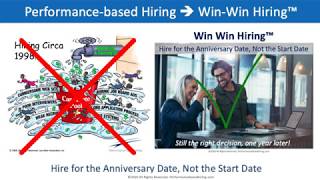
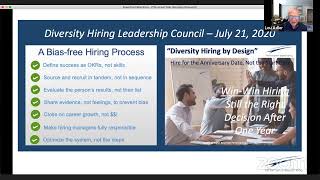
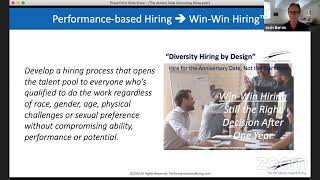
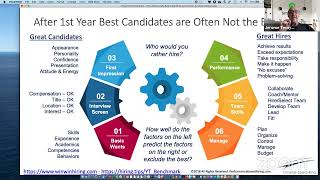
Hey. Hi everyone, this is Lou Adler. In this brief lesson, I want to give you an introduction of performance based hiring and the Win Win hiring concept. The Win Win hiring concept means we're hiring for the anniversary date, not the start date. In these conditions, both the hiring manager and the candidate agree it was the right decision. One year into the job, hiring manager says, I'm glad I hired that person. Candidate says, I'm glad I took that job. Now I've been writing books about hiring for 20 plus years. My first book was Hire with youh head, written in 1997. And at that time I had this cartoon drawn. Basically this was a summary of the state of the technology. At that time I made the contention we were wasting a lot of money on sourcing and advertising and not getting the best results. It took too long to apply. The interviewing was not accurate, candidates were not satisfied. And as I look back on this and wrote multiple books, two more editions of Hire with youh Head, another book called the Essential Guide for Hiring and Getting Hired, and put together a bunch of training programs. I realized not much has changed. And I'm going to contend the root cause of the problem is we got the wrong talent strategy. Most people are focusing on a surplus of talent strategy, making the assumption that we can weed out weak people and find some good people. I'm going to contend you can't use that strategy when there isn't a surplus of good talent. In that case, you have to use a scarcity of talent strategy where you attract the best in, not weed them out. Now everybody in the world wants to hire great people. It's been that way ever since I've been in the hiring game. 40, 50 years ago, people wanted to hire great people. Last week people wanted to hire great people. We always want to hire great people. But I'm going to make the contention that if you want to hire a great person, you have to start with a great job. And a great job is not a laundry list of skills, experiences and competencies. In fact, that's not a job at all. That's a person description, not a job description. A job description. What a person needs to do to be successful. So in the intake meeting, I suggest to recruiters and hiring managers in general to define success. What would it take for this person to be successful on the job? And I discovered that every single job in the world, from an entry level job to the chairman of the Board, can be defined by five or six, maybe seven or eight key performance objectives, KPOs or OKRs objectives, and key Results that define the task, define the action required, and some measurable result. That's a great job. And if a candidate sees that as a career move, he or she is more likely to respond. And from that perspective, you don't need a lot of candidates to screen. All you really need is 15 to 20 people at the top of the funnel who meet this condition. They're performance qualified, meaning they can do that work. They possess the achiever pattern, which indicates from the top half, top third, top quartile or better of their peer group, and they would see the jobs or career move. It's relatively easy now to find people like that. Now you have to work hard and you have to persist to get them into the game. But once you do, you'll wind up with four or five or six candidates and the hiring manager can pick three or four to interview and meet and you'll likely hire one of those people. That's how you can conduct sourcing. Spend more time with fewer people. Now, during the interview process, we're going to dig deep into that person's background, look into their accomplishments and see if they're qualified to do this work, if motivated to do this work, and would see this job as a career move. That's what we mean by the career gap. Does this job represent a true career move in comparison to everything else the candidate's looking at during the closing process? That's what we're going to sell. Not the start date, not what the person gets in terms of compensation, title, location and a company name, but what that person is going to be doing over the course of the full year. That's how you create a win win hiring outcome. Focusing on the anniversary date, not the start date. But to pull it off, you have to clarify expectations during the onboarding process. Clarify what's been discussed for the two to three or four weeks during the assessment and evaluation and negotiating process. And then you have to deliver on the promise. That's what women hiring is fundamentally. Embed successful post hiring performance into the pre hiring process. Define success as a series of outcomes, not as a series of skills and experiences. Follow the process. Spend more time with fewer people. You do those things, you will be able to raise the talent bar. You will be able to hire more diverse candidates who have a different mix of skills and experiences enlisted on the job description, but clearly can do that work. You will hire more high potential candidates who see that job as a career move but have less skills and experience. That's what makes them high potential. And you'll hire more non traditional candidates who can not only do that work, but find it motivating and career focused. That's how you raise the talent bar. That's how you achieve win win hiring outcomes. That's what this whole program is about. We look forward to working with each and every one of you, hiring great people every time.