How to Use the Performance-based Hiring Quality of Hire Predictor
Lou Adler walks through a tool that measures quality of hire using performance-based job descriptions. The formula predicts whether a candidate will succeed in the role by matching their background to the actual work required, not just credentials.
Chapters
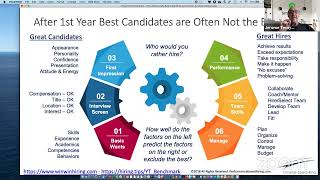
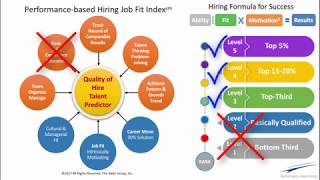
Hey. Hi everyone, this is Lou Adler. I want to introduce you to a very important tool to measure quality of hire. I make the contention that if you can't measure quality of hire up front and throughout the recruiting and hiring process, you cannot improve quality of hire. That requires metrics at every step. That's the essence of any feedback process control system. If you don't know where you're going, you'll never get there. So in this course I want to introduce you to quality of hire and I'm going to make the statement that quality of hire is actually very easy to measure as long as you use a performance based job description. A performance based job description defines the work the person needs to do as five or six performance objectives, defining the task, the action and the result required. Let's get right into it. Our performance based hiring job fit index is a great predictor of pre hire quality. It's based on our hiring formula for success, which we've covered in another lesson very quickly. The hiring formula for success says that ability to do the work in relationship to fit is what drives motivation. Because motivation is so important, it's squared that equals on the job performance or results. And I'm going to contend all of those factors can be measured with our one question interview and confirm with the second question. But I won't get into that today. Let me just go through the process we use when we train hiring managers. Whenever I start one of our hiring manager training courses, I always ask this question. Would you at least see a candidate from one of your recruiters if he or she had a track record of doing work comparable to what you need done? They always say of course they would. I say, well, you have to define the work you need done before you can see a person who has a comparable track record. And they kind of agree to that. I then say, what? What if the person has a track record of solving job related problems and can in real time solve job related problems and has had a track record of making very similar decisions to what you need done? Would you see the person if they had those two criteria and they all basically say of course they would. I then ask this next question. I say, what if the person has the achiever pattern? The achiever pattern indicates the person's been in the top half or top third or top quartile of their peer group for the bulk of their career and and has a track record of growing responsibility and growing impact. They said we'd probably hire that person. I said, well, we're not done yet, but we're certainly in the game. Let me add another criteria. What if the person has been on cross functional teams just like the teams the person needs to work on in your job, has been assigned to important teams, has led important teams and has developed people. If the job's a management job, just like the people you need done, they said, we'll hire that person. I said, well, we're not done yet. But I want to ask another question before that. It's obvious if a person has done all of that, they have all the skills and experience and education needed to do the job right. They said, of course. I said, but quite frankly, it will probably be different to what you have listed on your job description. In fact, there will be a lot of people you wouldn't see if you filtered them based on your job description. So they kind of ponder that, but they say, yeah, you're probably right. I said, so the first step we have to do is eliminate skills based job descriptions and define real job requirements as a series of performance objectives to measure all of that criteria and they buy into that concept. I then say, but we're not ready to hire the person. The person has to fit with the company culture, the pace, the resources available, the politics and has to fit with your management style. They say, agree with that. Number two, the candidate has to see the work as intrinsically motivating. If the person doesn't want to do the work required, the person won't naturally go out of his or her way to do it at peak performance levels. And they agree to that. I said finally, we're not going to hire this person. This person is a top 25% person or top third person and they're a passive candidate. We're not going to hire them unless we can give them a career move. We got to give them a 30% increase. They said, oh boy, dead silence. I said, but this 30% is non monetary, consists of job stretch meaning a bigger job could be part of the 30% job impact, meaning a more important job. Job satisfaction, meaning the mix of work is more satisfying and the growth rate of the opportunity is faster than what he or she is experiencing today. That's how we get to 30, get all those things right. We're going to measure quality of hire and all we have to do is measure on a one to five scale. Our one to five scale says hey, level one is the bottom third person. We tend to hire people like that because we've conducted a superficial interview. We were biased. We box checked a few skills, they fit the salary requirements they were hungry for the job and we conducted a quick assessment. Level two is a person who's qualified in skills and experience basis but doesn't generally fit, doesn't meet all the other criteria. But we hire people like that when we do box checking and behavioral interviewing. What I want to suggest is we're going to go level three people. These are top third people can do all the performance requirements in the job and get at least a 3 or better on all those criteria. That's a great hire. A level four is a top 15 to 20% person, awesome hire. But you better give them a level four job or their lead. And a top 5% higher is a world class all star. But if you don't give them a level five job, they'll leave. But if you do give them a level five job, they'll probably be your boss in two to three years. That's the ranking system. You rank all those Factors on a 1 to 5 scale and add them up and you've now measured pre hire quality of hire. The beauty of this is you can also use those same factors to measure the candidate after he or she is hired at 30, 60 and 90 day intervals. Because we're comparing all those factors in relationship to real job needs. What we've seen, whenever there's a variance, it's because managers or interviewers have made the judgment too quickly. Or if they didn't make it too quickly, they changed job needs or the style of the manager conflicted with the style of the new hire. However, if you address all of those things, you can improve the process in real time. That's what this entire course is about. Building a process control feedback system to hire great people every time. Let's get started.