Lou Adler - The Almost Daily RECRUITING Show
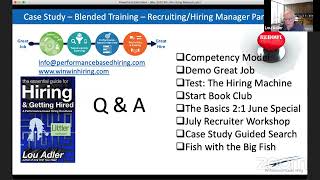
Lou Adler says hiring is broken: job postings attract the wrong people and waste time. Instead, define jobs by 5-6 performance objectives, source 8-10 strong candidates directly, and ask about their most significant accomplishment. ATS data shows only 1% of applicants get hired, proof the system fails.
Questions this video answers
About 10am on May 28, 2020 (Southern California).
About 330–350 million pieces of data; ~3% of applicants get interviewed; ~1% get hired.
www.WinWinHiring.com
Chapters
Good morning, everybody. Well, good afternoon or good evening, depending on where you are in the world. For me, it's 10am on May 28th in Southern California, 2020. I think we are now LinkedIn live. I can actually tell. So to some degree, some of these initial moments of a LinkedIn Live meeting make no sense. Well, they make sense. They're just kind of inappropriate and less professional. So once you guys can hear me, what I'd like you to do and if you can hear me is type in the chat area on this meeting notice where you're from and any hiring challenges you might be facing. And I am going to get the meeting notices here so I can see what's going on. I do have somebody. We're now live, so I know we're live. Jj, can you want to say a word here? What we didn't figure out, jj, which we're going to do yesterday is prevent anybody's picture other than mine from being there. We didn't quite get that figured out, did we? No, you're not talking to me now, J.J. again. So let's take a look at why.
Thank you. Now I can unmute. Now I can. Yes.
So let me as before we go officially live on LinkedIn, because we're live on LinkedIn as well. JJ, any thoughts? And you're going to monitor, as I gather, you're going to monitor the. Let me just do this. I don't want the Zoom chat. I'm not going to look at Zoom Chat. I can't do everything. Hey guys, now that we're live on LinkedIn, I'm going to go start officially in about a minute. But rather than just put in, hi, I'm from India, why don't you say hi, I'm from India and I'm trying to find a job or hi, I'm from India and I'm trying to find a full stack engineer to develop something DevOps program to do some high powered business intelligence or I'm looking for somebody like that. So put in some kind of context to the job regarding hiring, seeking a job. So as I go through what I'm about to talk about today, there'll be some relevance to your specific needs. And JJ is our producer. She's going to be monitoring those chats and interrupting me as important and as often as necessary so I don't go telling some off color jokes which JJ knows. I've never done that before.
Never.
Lou. Right. So given that welcome and again, if you're just listening to this and you don't know that it's live. It is now May 28, 2020, about 10, just about 10 o' clock in Southern California. So it's eight hours minus GMT. And some of you, it's an evening. So I welcome you all to this show. I want to kind of start off by saying we are hiring in uncertain times. Someone from LinkedIn just asked me this morning what should recruiters and hiring managers and candidates do in these uncertain times? And my big comment and she only knew that I had been through a couple of recessions, the one in 2008, and I guess there's another one in 2011. She forgot because she's a lot younger than I am, that she was also I was also in the dot com boom of 2000 recession of the dot com bust in 2001 and 2003, plus since 1978, four or five different recessions. And I reminded her of this physical law of hiring which says what goes down must go up. I don't know that that's the exact wording of the law, but it seems appropriate given our circumstances. So things will get better. I think we have hit a trough. But I want to say don't go back to the old ways of doing things. And that's really the theme of what I talk about. Let's do something totally different. And the reason I want to do that is, well, that's not really what I wanted to do. But I've written a lot of books about this subject. I've been around a lot of years. We have a free course for candidates to get ready for the interview because we really train hiring managers and recruiters and companies on how they should interview properly, even those that we've trained. And it's probably 50,000 people around the world. That's not a lot of people. Most interviewers, recruiters included, and hiring managers will not conduct a proper, any objective assessment of your background if you're a job seeker. So to overcome that, job seekers need to take matters in their own hands. We have a free course with respect to that. You can find it at www.WinWinHiring.com and you can sign up and take the class, but I'll show you what you should do. Why did they do that? I'm going to try to show you what you should do and start off by making this general statement, which is something I learned when I first became a manager. And quite frankly, I first became a manager and I'm going to Contend it was 19, it was 1972, I believe I was 26 years old. I actually know that I was 26 years old. I accepted the job, transferred from Southern California to go to Michigan and two days after I got there as a manager of capital budgeting, I was asked to be on the MBA corporate recruiting program. And I had to go out to the University of Michigan. And my boss called me in the morning and said, Lou, you got to get out here the afternoon. We got too many candidates to interview for MBAs, for financial analysts. You got to get over here. And I said, I can't do it. I got too much work to do. We got to report the next morning. And he said he's somewhat profane, but the bottom line, he said, hiring top talent is the most important thing you'll ever do. Everything else can wait. I believe that. Then we went to University of Michigan, spent all day. I learned how to interview in 30 minutes. We then interviewed 15 candidates, invited six of them for dinner, hired five of them who all ultimately became senior level executives in big companies. And we went home that afternoon or that night, got home back to Troy, Michigan, probably 10 or 10:30, still had the report to do. 8:00 or 8:30, report to the president of the group president, the VP Finance. We did it, turned it in by hand. Chuck and I stayed there to about 4 or 5 in the morning, went home, took a shower, went back to the office. And the group president said, why is this report handwritten? And Chuck said, we were out at University of Michigan hiring candidates. We hired four of them and we thought, I thought this was more important to hiring people than getting the report typed. The group president said, you're absolutely right. Great job, great lesson for everybody, hiring. If you're a hiring manager, hiring the best people is the most important thing you'll ever do. And everything else can wait. We have training programs as the only commercial I'll give you. We have training programs for hiring managers, for recruiters and we give our training to job seekers away for free. You'll find them at winwinhiring.com www.winwinhiring.com so now let's get into the meat of it. When I became a recruiter, and it was a stupid reason I became a recruiter after 10 years, I just hated the group president. I did progress pretty well in manufacturing, was running a manufacturing company when I was 32, but I hated the group president. He was the guy who hired me, but I still hated him. So after about three or four years working for him and turning around a division, I just said, I'm going to become a recruiter, and it was really only to find another job. In 1998, I had this cartoon drawn based on a work, a book that I had done. It's called High with your head A rational way to make a gut decision. And as part of the book I said, you know, at that time, technology and HR and job boards were coming into play, and applicant tracking systems are coming into play. And McKinsey said, you'll to win the war, you're going to be able to win the war for talent because all these new tools are great. In 1998, I looked at the state of the HR technology and said, if we keep what we're doing up today, nothing will change. We'll spend money improving things that we shouldn't be doing. And I'm going to contend nothing has changed. We still write boring job postings. It's still impossible for a candidate to find a job that meets his or her criteria. What you're presented with is a promoted job that's still boring by a branded company because the job boards make money posting individual jobs, not by making it efficient for a candidate in a company to find a great person for that specific job. We have a long process. I mean, you just look at it. Everything about hiring is an inefficient, silly process. And to spend money making that silly, inefficient process more efficient is even sillier. That's my position 22 years ago. It is still my position today. And if you're a job seeker, under no circumstances push the apply button. It will not help. Let me give you an overview of the talent market and I make this statement. Here's the talent market. The green is the top half. The orange is the bottom half. People who apply are looking for jobs. The bottom half of the market and what you see on a job board is the job market. It is a transactional marketplace where people get jobs based on stuff that doesn't predict their ability. People who are in the career market, generally the top half aren't, are looking for more than a job. Obviously they got to pay the rent and all that kind of stuff, but they're looking for a career market. You will not find a career in the job market. So do not apply to, indeed, do not apply to ZipRecruiter. Do not apply to Glassdoor. You can use some of the leads that you find on LinkedIn, but do not push the apply button. Everybody at LinkedIn will be aggravated. Everyone at ZipRecruiter will be aggravated. Do not do it. Do not care if they're aggravated if you're a job seeker, if you're a recruiter, stop posting a job other than driving people to make it a very compelling posting and drive people to it, but still don't have them apply. I'll tell you what to do in a moment. So this is the talent market. I have reviewed from numbers and numbers of applicant tracking systems. Collectively, it's about 330 to 350 million pieces of data over the last five years. Only 3% of people who apply get interviewed, 1% get the job. And I'm going to contend that if you apply to a job, a job board will get you the best of the bottom half. That's the blue line. I mean, the best people don't apply. They know that it's a stupid market. Why would a good person want to be demeaned, never get called back and expect to get. And then they have to negotiate their compensation before they can even talk about the job. And nobody in the top half would do it. Only people who are desperate would do it. And then he complained that they're not getting interviewed. So to me, getting involved in the bottom half applying for jobs doesn't make any sense to me. So let's stop doing it. But that's what it was 20 years ago, 22 years ago. Still true today. Given that I've got people aggravated a little bit. Jj, any questions come up yet?
We do have a couple of questions. So does it make sense to pursue a job change or a career change in this industry with so many people out of work?
Well, it depends. So this is a great question. So let me kind of encapsulate that question with this little picture of the total talent market, which could be kind of depressing, but actually it's not depressing. It's actually, hey, I'm giving you a map to get a better job and a better career. One of the map is don't take the detour off the yellow brick road. That's actually a good line. I should make that a yellow brick road there because you won't get a job, you won't be able to transfer your skills to another industry. I was on a call yesterday with someone asked me the same question and I said if I was a candidate looking for a job today, I would look at a job in a different industry maybe and I'd see kind of understand what they're trying to look for. Project manager in a certain area must have 10 years experience, must have this, must have that. But if you've done some Project management work. What I would do is look at that job as a lead. I would find the head of that department, and I would send a summary of a major accomplishment I had done in project management. And it would just be a quick summary. It could be combined with a video. Hey, I understand you're looking for project managers to do A, B and C. And then you go look at jobs in that same company. Maybe it's someone in IT department, someone in a marketing department, also looking for people to collaborate on that kind of a project. So now you got some information about a job in a new industry and in project management. And then you describe a major project that you've done that's related, and then you send a video and a summary of that to the head of the IT department, head of the marketing department, and head of the project management team. And I guarantee one of those people will say, this person's pretty creative. That's called selling and mar. Sales and marketing. You get a marketing lead, you don't walk through the front door and say, hey, please, I need a job. No. Demonstrate that you're different. So in the career market, people are different. They use the back door, they use creativity. They do stuff that demonstrates that they're a remarkable person who is in the top half. But pleading for a job is not a way to indicate you're in the top half. Doing being different and unique and understanding it and just. And don't even ask for the job. Say, I'd like to chat with you about that to see if my background is somewhat related. People will take a look, ooh, this person is different. That's the answer to that question. That's how people can start being different. If they're a job seeker. Then if you take the free course at www.winwinhiring.com when you get the interview, you'll be in the game. So that's how you get the job. That's how you ace the interview. So here's my desire. And I've been doing this since 1978. I call it win Win hiring. Let's stop hiring for the start date. The start date is based on, hey, I accepted a job, I get a compensation package, I get a title, I get a location, I get a parking spot, and I get some benefits. That's hiring for the start date. Hiring for the anniversary date is a year. After that, you ask the hiring manager, are you glad you hired this person? Yes. Great person. Already taken on bigger assignments. You, the candidates say, I'm glad I took that job. I'M getting promoted, I'm handling bigger assignments and my compensation is increasing because I'm doing a better job. Hiring for the anniversary date is a total different process than hiring for the start date. Hiring for the start date is the bottom half. That's a job. Top half, you're looking for the career. That's the, that's what win win hiring is all about. It's still the right decision. A year after you start pulling that off is not insignificant. It's a responsibility. The hiring manager responsibility, recruiter responsibility of the candidate. All three of those people have to be in alignment. And if anybody takes the job for a short term reason, meaning I'm taking it because this job's paying me the most money, the probability of you being successful is maybe 50. 50 is probably less than that. So what I do as a recruiter and you should do it as an individual. When I have a candidate for a job who I think is in the top half and we've interviewed him and we know that person's in the top half or top half of the top half, and I know that I'm getting ready to make that candidate an offer. I asked that candidate this question. Forget the money, forget it. Do you want this job? And if you want the job, tell me why. And if I expect that candidate to tell me the expectations of the job, why the team is a great job, why that environment makes sense for him in rich, specific detail? Because that candidate now owns that career move. And 99% of the candidates when you ask that question, well, I've been promised this. I've been promised that. I think it's good. It's all gut feelings. No, this is too big a decision to make it a gut feeling. You as a candidate have to do your due diligence. You have to do your due diligence. Is this a career move for the candidate and you, the hiring manager, most important of all, have to say, is this candidate motivated and competent to do that work and does that candidate see this job as a career move? If any of those three people say no, probability of win win hiring is remote. So here's how I want to reboot hiring. And I'll take a question after this. Jj, pick one really good question. Here's how you reboot hiring for the hiring for the anniversary date. It's a new strategy. I'm going after the top half, not the bottom half. To go after the top half is to track the best going after the bottom half. It's a weed out the week. So if you Want to be a top half strategy? I'm going after the people looking for career moves that's attract the best, not weed out the week. It's a system, not a series of steps. You can have the great interview system in the world but if the best people don't want to be interviewed, it's a waste of time. You can have the best sourcing skills in the world. You can be an ace, a social talent expert. But if you're not, you can't convince a great person whom you found to engage in a conversation and take less pay. It's a useless tool. You got to think the whole system from the day the person from the day you open the requisition to a year after the person starts. You have to look at all of those pieces. That's a system, not a series of steps. It's high touch, not high tech. The people in the top half aren't going to apply to silly job and be a transaction. So it's much more high tech in the top half. The key is you also have to redefine what does a top half candidate look like. And I'm going to do that today. That's really the core of what I'm going to do today. And I say forget the apply button. It's a waste of time. The apply button is for the people in the bottom half. You want to hire the top half, you don't need the apply button. So useless tool and key is from a sourcing fish with a big fish. You need a candidate you can find. LinkedIn is a remarkable tool for your hiring manager, recruiter. I can find anybody for any job, at least the name of anybody for any job in a few hours. Anybody getting them to talk to me is slightly different but If I have 100 people it's very impersonal. But if I have eight or 10 people, that becomes very personal. I can get eight or 10 people and really work hard. Get the hiring manager engaged, talk to people that know the person. I I can get if I identify eight to 10 people who I call semifinalists, I'll talk to six or seven of them and the two or three that are great, the other five or six that aren't perfect for the job, they'll give me referrals and I'm done. I mean it's a totally different process. Working in the top half is high touch on the phone, understanding the job, heavily involvement. Everybody's engaged together now given that remarkable thing. I'm getting tired, J.J. just thinking of this, this stuff actually Works, but it's tiring, tired just talking about it. What do you think, jj? Any questions coming in?
Yeah, all kinds of questions, Lou. One good one is would you ever hire experience over education?
Whatever I hire what?
Experience over education.
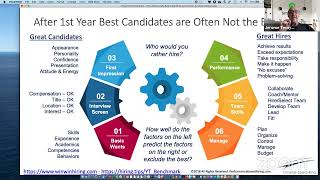
That's a great question, but I'm going to answer that in a minute. I think both of them are overrated. Now that's not totally true. Depends on the experience the person has. But so in general, I'd say absolutely, but it's much deeper than that. So let me leave. That's a very fair question. So let me kind of describe. No, let me kind of do two things. I want to just kind of give you the end to end system because I promise that then I'm going to describe how do you really understand top performers versus top candidates, which gets into the education experience skill set. I believe that hiring needs to be a system rather than a bunch of individual steps. And the key to that system is to embed post hire success at the anniversary date in the, in the requisition. So when I take in a, let me call a search assignment when I open a requisition or conduct the intake meeting with a hiring manager and the hiring manager gives me this job description that's got skills, experience, education, I look at that and I say to the hiring manager, you know, quite frankly, that's not a job description. That is a person description. A job doesn't have skills, experiences, competencies and education. A person has that. Let's put the person description in the parking lot for a minute. What does a person need to do to be successful? So after a year, this is win, win hiring. After a year, what is this person done that you would say great person, you've hired a great person, now we'll find it. We got to find a person who can do that. But what does that person need to do? And it's always five or six key performance objectives. Build a team of accountants to launch a report. Upgrade the business intelligence analytics system, integrating with Tableau and SQL and using this kind of DevOps people and working closely with our IT software development team. Okay, that's what they need to do. What would they do? First, well, they got to understand the problem. Second, put a plan together. Third, whatever it is, is a sequence of steps they do to get it. Sometimes it's in a call center. What are the best people do differently? Let's hire people who do that. They show up all the time. They learned very quickly, whatever it is. I define success in the intake meeting because I make the statement, if you want to hire, want to hire a. I don't know where I am anymore. If you want to hire a great person, you have to start with a great job. And a great job is not a lateral transfer, a boring list of skills, experience and competencies. That's not a job, that's a person. How's a person supposed to make a decision on that? If you want to hire someone in the bottom half for a job, maybe I still think it's silly, but if you want to hire someone in the top half, you've got to define what top half performance looks like. That's a great job. Now the second piece is sourcing. I got to go out there and find people. As I said, I find people who are performance qualified, meaning they can do the work they've been recognized for doing that work extremely well. Engineers get patents, white papers, whatever it is, they speak at conferences. Easy. I mean, tell you a LinkedIn recruiter gives you all the tools to find semi finalists. Why do you need too many? You just got to get on the phone with them. People who need too many because they can't convince the people that it's the right job. So you got to be persistent, call out touch people. That's high touch. Then you got to interview them in depth, dig into their background, into their accomplishments to see if they can actually do that work. If they can do that work, they have all the skills needed. But also the job also has to be a career move. So the three criteria to be a semifinalist is performance qualified, can do the work, recognize for formally doing that work extremely well. Clearly in the top half or top third or top quartile and would see the jobs or career move. So I got to do all of those things in the interview and you can't skip any of those steps. And then in the close, this is what I said earlier. In the close I hey, do you really want this job? Tell me why. Because if you don't want this job, you'll be a failure. If it's all about the compensation package, you will underperform. Then I got to clarify those expectations during the onboarding process. Then I got to deliver on the promise. That's called performance based hiring. That's called win, win hiring. That's how you raise the talent bar. You do all of those things. So two big things have a problem. Which goes to the question that JJ asked me earlier and the person said about experience. If you don't know the job, you're forced to do silly things. And that to me is a deal breaker. You cannot hire someone in the top half if you don't know the job because you want to track the person, you won't be able to assess the person properly. You might find a great person, but if you can't tell them what the job is, they'll be disappointed when they get there. So you got to start with a great job and everything else. That's the domino. Everything else falls into play. But here's the issue with respect to candidates, then I'll. I'm going to show this slide will open up to a lot of questions here. Generally speaking, when you don't know the job, you focus on skills, experience and academics. And I presented this chart to 30 or 40,000 hiring managers. How I start generally, and I always say this question, have you ever met someone with all the skills, experience and competencies who winds up not being a top performer? And they say half the time for more than half the time. And I say, have you ever met someone who's a top performer who doesn't have that background? They said all the time. Every person we promote and that person was referred to me. Other people out of college, they don't have all the skills yet, but they take on bigger assignments pretty quickly because they're smart and they learn faster. So. So none of this stuff predicts performance. But now that's what recruiters box check. People in the bottom half box checks that. That's what the job posting says. That's why if you don't have the perfect skill, you're not getting the game. So it got a lot of false positives and a lot of false negatives. Now the recruiter talks to somebody on the phone, okay, you okay with this compensation? I don't know what the job is. It doesn't matter if you're not okay with the compensation, you can't talk to me. Well, that is a stupid. I mean, if you can't tell me that's not an idiotic thing to do. I mean, people, you're trying to hire someone for a critical job that's going to affect their life and you make them agree to the comp before they even know what the job is. Give me a break here. And then recruiters say, oh, I got to do it because I'm efficient. No, that's not efficient. That's stupid. Doing something faster. That stupid is stupider. But I'm sorry, I know somebody said I'm. No nonsense approach, David. Definitely no nonsense. I've been kicked out a lot of meetings. I'll tell you that that's why I'm so old. I don't care anymore. I get kicked out of more meetings now. I can't wait to get kicked out of another meeting now. So you pass all the number one. We start with a flawed group of people who only have one. We further make that flawed group of people, screen them out on stuff that doesn't even make sense, and then we judge them on first impression. I mean, none of that stuff on the left has anything to do with that person's ability to do the work. Nothing to do with the person's ability to do the work, which is kind of amazing. And then people are trying to make and they say, oh, I got this greatest AI technology in the world. We do this stuff on the left faster. No, I'm sorry. I'm going. I got to take a break. Jj, any questions so far about that? Before I give you the answer, I just need to take a deep breath.
Yeah, we do have a lot of questions, a lot of them about engaging with hiring managers.
Just pick one. I can't have a lot. Just pick one.
Okay. Do you have a process for engaging with hiring managers to build job descriptions around this process?
Absolutely. So let me go back. And I think this. That's a good setup for the part on the right. My first search assignment, first one January 1978, and I already been in industry for 10 years. Prior to that, I've been an engineer on nuclear guidance systems, guidance systems for nuclear missiles. I'd been in automotive industry, had been in the high tech industry, consumer electronics. Was in the first company that made handheld calculators, which was a 4 and 8 and a 16K chip, if you can believe that. Then I got into finance and accounting and manufacturing. Then I got logistics and supply chain. So the first job I had when I became a recruiter and the only reason I became a recruiter, they just hated the group president. Said that earlier I thought I'd become a recruiter and I was really only going to use it to find another job. So I knew this president of one company, and it was a vendor that we had used automotive industry. And he said, lou, we're looking for a new plant manager. Didn't have a job description at that time. I just said, let's go out in the plant. Let's take a walk through the plant. And I very comfortable. I walked through many, many manufacturing plants, walked through the plant, found six or seven things that were wrong. And the guy said, we have to turn around the plant. I said, let's look at it. Let's prioritize it. The chrome line was bad, the finishing line was terrible. The logistics were terrible. Labor performance and the labor management was terrible. I mean it just, it was a screwed up plant. I said, well, find somebody who can turn the plant around. Had seven things a person needed to do. So that's why I just asked the hiring manager and, and this is the question I have in the job seeker class. If you feel that you are being interviewed inappropriately, ask the hiring manager, before we go into this, into your job too deeply, would you mind telling me a little bit about some of the challenges and performance objectives of the job? Because I'd like to tailor my answers based on work that I've done that you feel, that I feel is most related to what you need done. That will change the whole tenor of the interview, the whole tenor. You are now asking about stuff that predicts your performance. So now let me go to this slide here on the component on the left. I've asked 20 to 30, maybe 35,000 managers now since 1978, what does a great person look like? And it's always this stuff. They get the job done, they make it happen. They don't make excuses. They can solve problems real time that are on the job. They can work well with the team, they collaborate, they mentor, they build teams, they develop people, they coach people, they, they fit with the company culture and they get their stuff done. They can plan, they can organize and control. They manage to get their stuff done on time. It's an individual, he or she can get his work done on time. They plan it, they organize, they get it done at the managing group of people, they manage the team to get it done. Their project manager get managed over cross functions to get it done. They deliver the goods, they work well with people and they get their projects done on time, on budget. Everybody said that since 1978 they've been saying that that's what a great hire is. They've never said a great hire is someone that's got all the skills or agrees with compensation, makes a good first impression. And I make the statement if they can do this work, they're a great hire. So now he has hiring managers. Who'd you rather hire? Someone can deliver the results or someone's got all the skills. 99.9% say results. There's only one guy, maybe it's 99.99% now there's only one guy who said a great candidate, only one. That's a guy in New Jersey, president of A little company in New Jersey. That's why I don't go to New Jersey anymore. Sorry if I've offended anybody in New Jersey. I grew up on an island and my mother said don't marry anybody from New Jersey too. So. So when she first met my wife now of 50 years, she said, I hope she's not from New Jersey. I said, nope, she's not. She's from Whittier. That got her two thumbs up. So the key, and this is really the key to this whole thing, I ask hiring managers and I can ask you guys, how well do the factors on the left predict the factors on the right? And I. And they, most people say they don't at all. I mean just think about it. There's a lot of people who can do the work. 100% of people get promoted who have none of this. Maybe get a little nervous in the interview. Once you get to know them, they're fine. Salespeople sometimes are persistent, but not outgoing. Sometimes people will take a little less money if they see the jobs or career move. Sometimes. The most diverse candidates, in fact I say 100% of the most diverse candidates, non traditional candidates have a different mix of skills and experience. That's the key that somebody asked earlier about how do you switch industries? You got to demonstrate that your ability, I mean if you've got to build a project, a cross functional project to do something and it's in a different industry, you've got to present the fact that you've done comparable cross functional project management activities comparable on a complexity basis, decision making basis, scope and scale basis, types of people you're collaborating with. If you can prove that and get into the game, you have an opportunity to get a job and switch industries. You will not have a chance to switch industries. Using the criteria on the left will not happen. It will not happen. If you push the apply button, you have to take a different tactic. That's how you get in the top half. People in the top half don't look. People in the top will not push the apply button. I guarantee that. They know it doesn't work. So it doesn't work. Okay, I got to take another break. JJ meaning Answer a question.
Okay.
Yes. Kevin. Good. You're one of your college alumni. She went to Cal. Hi. I don't know if you know where that is.
So great. So hiring for the anniversary date makes sense. But a lot depends on the client's culture, onboarding, etc. And many times these things are not great, which affects the candidate's success. In the industry. So how can you overcome the those challenges if you have a less than stellar company that you're recruiting for or hiring for?
Well, now that doesn't. That sounds like an excuse, not a plan. You, you're looking for a plant manager for less than stellar company for top for some person. Let me tell you, the company I had was not a stellar company. My first plant manager was not a stellar company. But the fact the job was stellar because they're going to turn around a plant. I found somebody who was at a bigger company, hadn't had a chance to demonstrate his capability. Clearly remarkable manufacturing engineering type person. And he saw this as well. This is a career move for me. He turning around a plant adolescent is a pretty good move. But the issue is you have to define the job first. You have to find people who would see that job as a career move. You have to make the assessment properly. And the way I make the assessment is dig into their accomplishments to see if they're comparable on a scope, scale, complexity basis. You have to clarify. If you don't clarify the expectations in the intake meeting, they have to align pretty much during the onboarding process. And all we're really doing is, hey, you got to define the work performance management. I don't care how formal it is or informal. If you don't define the work up front, meaning at least on the start date, you have no chance of making it happen. I mean, that's management 101. Tell people what they're supposed to do. Now I'm just saying, hey, do it three, two months before you hire the person. It doesn't take any more work. You just tell them, hey, what is a person going to do? But don't use a list of skills, experience and competencies because that has no predictive value. So that's to me how I don't care. And most, just to give you a sense, most of my clients were not necessarily stellar companies. Big companies that had the big brand tend not to be my clients. They just, they might intellectually buy into what I say. But it's very difficult to get everybody in the organization to change direction. Now we got our competency models. We're using behavioral interviewing. We're using this. So my companies tend to be ones that have like 200 to 1,000 people in it. Where I'm dealing with the VPs and the President, where they see, oh, this is pretty logical, let's do it. So that's. So you gotta take a small, you gotta take a smaller subset of what you're doing and validate that this works. And then you do a little bigger than do it a little bit bigger like that. Let me keep on going here, which is this is I'm going to end it with this and then call to action. But so here's the essence of what someone said. How do you define the job? And it really boils down to this piece right here. Let me just kind of highlight this Typical job description is useless skills, experience and competencies wrapped around some boilerplate. That's BS which in the vernacular means hyperbole. And I tell people that's not a job description, that's a person description. So as a recruiter, that's what I say. And I teach hiring managers agree intellectually, it's obvious. I say what does a person need to do to be successful? And this is where I come up with the performance objectives. It's always a task, the action, some kind of result. Build a team, grow sales, launch a new product line. It's stuff. And I say walk me through how they can achieve the big goal. It's always five or six performance objectives. And the key is if they can do the work, they have all the skills, how do they do it? Somebody asked me how much experience I had a hiring manager do this and he said, okay, how much experience does a person need to have to accomplish those tasks? I don't know. Has to be able to accomplish those tasks. The best people probably need less. The worst people probably need more. I just, I don't care how much experience I have. They got to be able to do the work. And if you need to work done in three months, obviously they have to be able to know a lot about the job before they even start. So the work determines the skills. The skills doesn't determine the work. You know, all the skills underperform. The environment is important as well. The pace of the organization is critical. All of those. The hiring manager style. That's why I left Oregon Corporate America is I just didn't like my hiring manager. I didn't like my company culture. But nonetheless, there's a lot of factors. But having the skills is problematic. And to me, going from bottom to up is the fundamental reason. And I should actually probably make this chart tying to the total talent market. A job description is something that happens in the bottom half. And the best you're going to do if you be efficient managing the job description is hire the best of the bottom half. When I hire the best of the top half, you got to define the work. And it's high Touch. So the bottom half is skills based job descriptions, high technology, being efficient, hiring someone, performance which is in the top half. It's about high touch, understanding the job and that seven step process that embedding performance management into the pre hire process. The work determines the skills, the skills don't determine the work. And this took me 10 years to figure out this quote. But I would leave you with this quote. Took me literally, sadly it took 10 years for me to figure this out. So I must be getting old. Silly. Whatever, it doesn't matter. So obvious. It's what people do with what they have, not what they have that makes them successful. It's what people do with what they have, not what they have. So our interview process and we have scripted interviews, we have training courses, we teach people how to conduct an interview. We focus during the work history on what you have and then we say what'd you accomplish with it? And we're looking for people who've accomplished the most with the least amount of experience. I mean they obviously have to have enough to do the work. But it's the ratio is what people have accomplished that we're really measuring, not the skill set they have. And if you can prove, if you want to move industries, you got to prove, hey, here's what I've done in this industry. It's comparable to what you've done in that industry. Let's have a conversation. And that to me is you can do that by using the job postings as leads, not as a means to push the apply button. So I'm going to just show one more thing jj but I'll take a few questions now.
Great. So those are all fantastic, Lou, but how do you get a candidate to reveal all of those things on that great candidate list?
I don't know what you mean. Just ask the candidate. Candidate, tell me what you've accomplished that's most comparable. Oh, here's the way I do it. So that's a fair question. Let me. If you look up Lou Adler, LinkedIn, the most significant accomplishment question, even on ERE, it was written about 20 years ago. I don't know if it's still on ere because I haven't looked in 10 years. But it was the number one article written on LinkedIn and the number one article on ere, I think it's on Thrive Global, but I'm not positive about that. But the question is, hey, tell me about the best work you've ever done, best thing you've ever done. And I have this little magic card I Don't think you can get them anymore. You have to. Well, I don't even know if we sell them. It doesn't matter. I have this little card which summarizes the question. Hey, tell me about the best thing you've ever done. Tell me about the project. Give me a snapshot. Describe the challenges, describe the environment, what kind of skills you use, how do you apply them. Walk me through the detailed plan. Walk me through the biggest decision. Walk me through the biggest problem you've solved. And it's by looking at those person's major accomplishments. I compare them to the accomplishments related in the green and then I ask people tell me about a different accomplishment at a different period of time. So I start seeing the trend of those accomplishments over time. You start doing those things. You actually start understanding a person's performance. Now, if you're familiar with behavioral interviewing, I call it behavioral fact finding. I put all the behaviors under the umbrella of an accomplishment so I can compare it to the job. And I look at the trend of those behaviors and change over time to understand it. The typical behavioral interview is actually a shortcut that doesn't work. If you really read the underlying research from many, many years ago, you have to understand, you have to tie it to a real job. And you have to look at the behavioral growth over challenge in time. We actually do that. I don't call it a behavioral interview, but to me, people who do it recognize it instantly. But it's behavioral fact finding for each of the accomplishments. Hey, we need somebody to launch a new international reporting system. Tell me about something you've done related to that. Who was on the team? What was your role on the team? Where did you take the initiative? What was the problem you solved? How did you convince people on the team? So it's all the behavioral questions, but we wrap them under an accomplishment, then we ask it again for another accomplishment. So you really see growth, very rich meeting. And as part of that, I'm trying to understand competency and motivation and fit, but also if the job represents a career move. So great question. I'm going to skip this. I apologize for going bad. I just want to end it now. I don't like to go more than 40, 45 minutes. So again, our process. And it's a process, it's a series of steps. If you want to hire a great person, you have to start with a great job. And it's not a laundry list. It's a series of work. You have to find candidates on LinkedIn. I think somebody said, how do you find candidates. I just look for people. One, so I look for someone who's obviously as a recruiter, someone in the general area, geographic area, someone who would see the jobs or career move. Could be the title. Someone I think is ready to move, meaning they've been two, three years, are probably ready now. Not they're open for opportunities, which is too obvious. And then I look at one or two critical skills, just one or two that are critical. I probably look for someone who's got less experience than what's written on a job description because I know that puts them in the top half. I look for achiever terms, patent award, speaker, whatever it could be, honor society. So that's how I find my 15 or 20 people. And I'm relentless. I am relentless. If I got your name, I'm going to talk to you and I do it any way I can. I find connections, but I only deal with 8 or 10 or 15 people at most. I get 8 or 10 and I just, hey, let's have a conversation. I don't know if this job's great. Let's discuss it and generally can do that. I think I don't sell the job. I sell the conversation. Some people are perfect. They see it. That makes good sense. And I conduct the interview I described. I asked the candidate at the end, hey, is this a job you really want? I try to balance short and long term and we deliver on the promise. That's win. Win hiring course winwinhiring.com free we have another class, Introduction to Performance Based Hiring. And if you want to learn, I mean the courses are cheap. This is our learn on your own, real cheap kind of course. But if you're hiring people, take the two on the left on the right. If you're interviewing every job candidate, take the two on the left. You'll definitely do better just by that alone. We have a recruiter competency model. I'll give you the. Let me just kind of go through this. Here's how you can reach out to us. Info Performance Based Hiring. If you want any of this kind of stuff, and I know we have a few people on the Zoom meeting, we don't have your email if you're not on Zoom, if you're watching this on LinkedIn Live, if you're anything, if you're interested in any of our stuff, go to Info Performance based hiring or woundwoodhiring.com and sign in and we'll get you the information. We have a recruiter competency model. We take hiring managers and recruiters together. In a room and we demonstrate how do we conduct a performance based job description. Take the free classes. You can start a book club. Go to Amazon. Somebody just bought the book I think two weeks ago said Lou, I got, I read the book and I already got a job based on it. So they just thanked me. But the book is on Amazon. The essential guide for hiring and getting hired. Some companies start a book club. That's how they start. If you're a hiring manager recruiter, come to our June special program and you'll get it at info. At performance based hiring we have a real in depth in depth that is is for the advanced recruiter really wants to aces stuff a July program and we actually conduct a search. Our program is not a lecture, it's you're actually doing a search and we're monitoring your search progress. So my big, my ending item is fish with a big fish only talk to people who could be semi finalists and or no semifinalists to give you referrals. Given that, let's do some Q and A. Any questions here?
Yeah Lee, we got lots of questions so can you suggest a few points to write in a job description performance based job description so that you can target the ride ought candidates with those abilities that you were talking about?
Yeah, it's a good question. I asked the hiring manager as I do and we obviously in our training we give recruiters and hiring managers a checklist of what to do. What does a person need to do to be successful? What are the best people in this job do differently? Walk me through what the person would do in the first 30 days. What would the person do after 90 days that you know you're on track? How would the person build the team and get the resources? What would the planning look? So we really kind of understand the job. But before I end the conversation I said what's the deal breaker? What's the one single thing that the person must be able to do that you will not compromise on? I was with a company that had I think there's 100 customer success managers software product and I don't know that in the customer success field that these people actually knew what the job was. So I'm sitting with the hiring managers and it turned out in a customer success, it's a sales job, the software is already sold. Your customer success is ensuring the company is using that software properly. And as part of that they're trying to identify and this is where the tipping point came out is identify in the first 30 minute, 45 minute intake meeting identify those Clients that you think are going to be troubled who aren't going to be able to do it properly and also those companies that you think will get it and they can buy more product, three to six months once they get the initial software installed. That was the tipping point. And until I got that, I said what's the deal break? And they said, oh, it happens in the intake meeting. What did they do there? So I was really working hard to get it. I said, ah, this is a sales job. And then people said no it isn't. I said, well yeah, let's look at this. And all of a sudden they understood what this whole job was about. And I think they realized at that time that many of the people they hired for this customer success role was wrong. So to me it's always what's the deal breaker? And it could be for technical job. It's usually not their technical skills, it's not full stack developer, it could be DevOps or it could be collaborating with the product marketing team and, and customers to ensure that the product requirements document is accurate and predictable and we've made the appropriate trade offs. Well, that is not, I don't call it a soft skill, it's a critical non technical skill. But if you can't collaborate and understand product requirements and understand how users are going to be using this stuff, that technical person will fail. Now all of a sudden when a manager hears it, oh my gosh, I've been box checking that person's technical skills, not their ability to collaborate and develop product requirements documents. So that to me is, I'm sorry for taking such a long answer to that, but that to me is a critical question that you, and I think you as a job seeker have to ask that too. Hiring managers got to ask it to themselves. Recruiters got to ask. Hiring managers and job seekers say, what's the most critical tipping point? What's the tipping point for success or failure in this role that you absolutely must, you will not compromise on for the person you hire for this job? Now asking that question, you got to be pretty bold to ask the question if you're a job seeker and if you can answer it, you're going to be the finalist, you're going to be one of the two or three people getting an offer. So to me that's a great question. I think the answer was probably a little bit circuitous, but nonetheless that was, well, I'll live with it.
Another question, J.J. yeah, yeah, lots of questions still left. So how can recruiters narrow down their incoming with all the People out of work to find the right people. They can't have unlimited referrals. There's just not enough time. And everybody wants a star performer, but companies have the budget to pay a star performer. How can you narrow those things down to get to the right people?
Okay, so let's kind of start off. You want a star performer. So I asked the hiring manager, obviously you wanted someone in the top 25%, right? And they say, yeah, of course. They said, well, tell me, what does a person in the top 25% actually do? What do they actually do puts them in the top 25%. I mean, that's the same question of what does it takes to be successful? And it's usually three or four people. So, well, they got to have an MBA and they got to have this. I said, come on, give me a break. And then they said, no, I demand it. I said, okay, let me do this. I'll show you two or three people who have all the academics and experiences, and I'll show you two or three people who can be in the top 25% and you make your judgment. I'll focus on performance, you focus on skills, and we'll see which one is better. So now let's. So now I've got the hiring manager at least bought into the concept of its outcomes that we're measuring, not income inputs. Then I demonstrate now. So I'm going looking for a candidate. This is where I said, from a candidate standpoint, I tend to look for people who are performance qualified. So there are certain words or terms. You only need one or two. I mean, I know if someone's got Ruby or someone's got DevOps in a certain area or has done some kind of state of the art SQL work, they've got all the other stuff. I don't need to put everything down. I just need one or two things. Obviously I want a company that has done some of that work that's extremely effective doing that. This company is doing this kind of work pretty well. I'm looking for roughly the right title, doesn't even have to be. Sometimes I look for a slightly less title sometimes and I'm starting to look for candidates. I say, okay, the company, the manager said he wanted six to eight years, but I can go on LinkedIn Recruiter and say, now what? Somebody's doing this work has only got four to five years. If they're doing work that's six to eight level. And I got some of those four to five. And then I show the hiring manager what do you think of this person? What do you think of that person? They're passive candidate. They look pretty good. I remember showing someone who was just remarkable woman had she had all these honors in math and someone wanted the person. I said, well, here's this person looks great. She's not at all the background you want, but she's an all star. And you can just look at what she'd done. She'd done some math contest winner and some honor society winner. I said she's in Georgia right now. She used to live in California. I don't know if I can get her back at her. She'd be great. It turns out she had none of the background. I just showed the name of the hiring manager. A person who I never could possibly recruit. But I got the hiring manager to greet a performance and see a different kind of person. He clearly recognized this was an award. You're talking. This is a top 10% person. It was obvious that it was the person. So I focus on getting the hiring manager to convince that there's. By focusing on the job itself. And people can do that job and have been recognized for doing it. They're in the game. So that's how I kind of convince it now to get the candidate. I got to call the candidate up and get that candidate to agree that this job represents a career move. And I remember one. So this is a story and this is the last one I'm going to do today Jay because I'm going to tell it tomorrow at our training session too. I remember about it had to be eight years ago. I don't do a lot of recruiting anymore. But somebody asked me to find a controller in the entertainment industry. It was a company making cartoons. It was really kids cartoons and a lot of lot of Emmy awards. And I Southern California. I'd done a lot of work in entertainment as well as manufacturing, which was odd. But I had and I found I just went on LinkedIn Recruiter. It wasn't as robust as it was now, but I said she had to be at PricewaterhouseCooper had to have this kind of background. I also looked for MBA and then I saw one person who looked real good and it said your connect there. Other people also looked at. So a LinkedIn recruiter. You got this thing of. I found my like ideal person. She seemed to be a little bit too heavy. But it said other people also looked at these other candidates. So I just looked at. This is literally almost a half hour after I took the assignment and I found somebody Undergraduate degree in accounting at NYU New York, NY had worked at PricewaterhouseCooper. New York was getting her MBA at USC. She was working at one of the entertainment companies today as a director of accounting. And I said, boy, she's, she's director of accounting. She looks like she's 27 or 28 years old. I mean, she was just, didn't make sense. This was, I mean you didn't have to be a rocket scientist to figure this is a remarkable one. She was remarkable. She gave me her, her cell phone was on her LinkedIn profile, which was unusual at the time. So I just texted her and in the, in the background it said that she had this hobby where she cooked something. And I, whatever it was, it was kind of a very interesting background. I texted her and said, where can I find those items that you cook? And I have this pretty cool job for you. And it was really a very, I did have a posting that was very cool. It said this Oscar winning controller, something like that. She loved the thing. She called me back in about 10 minutes. So this is the negotiation part at the end of the half hour, 45 minute call, which was like the same afternoon I took the assignment. So this is real quick. I knew she was, she was a finalist. She was great. I said, the good news, bad news is I said, how much money are you making? And it turned out she was making more money than I could offer. So I said, the good news, bad news, you're going to get an offer and you're going to reject it because you're going to get a counteroffer. And I don't even want to pursue that until you recognize at best you're going to get a lateral transfer at best. But the offset would be a remarkable career move. You'd get out of the big company and you get a chance to make a difference. And I actually said, how often do you actually deal with people who make your movies and choose with a big entertainment company? It wasn't Disney, but a big entertainment. It could have been Sony, I don't remember. She said, never. I said, well, do you want to get out of the numbers, make a difference? This job would do it, but I know you're going to get a counteroffer and you're already at the high end of my number isn't going to happen. I said, call me in the morning and if you're interested, I'll go forward. She called me next morning, said, lou, I want to go forward even if it's a lateral transfer. I said, who'd you talk to? She said, nobody. I said, well, who's going to help you make this decision? She said, my parents. She's 27 or 28. And my best friend. I said, talk to him and call me. She calls me the next morning, said, lou, I was up all night. I want to go for this job. I realize I'm not satisfied in a big company. This is something I need. I'd like to go forward. I did talk to my parents. I talked to my best friend. We spent all night. She was number two on the list. She didn't get the job because she didn't have enough experience. The president of the company really needed a financial advisor. She just didn't have that protocol. But the point is, you've got to sell that opportunity. You got to pre close everybody. And I knew that this woman was remarkable. And I looked at her background a couple years ago and she is. She moved up very, very rapidly. She would have taken the job if she had it and she wanted to roll. It was the right career move for her. And sometimes money stands in the way. So you kind of have to look at that. Let me end it with. This stuff actually does work. If you want to be in the top half, you gotta understand that it's not the same as being in the bottom half. And put duct tape over your own apply button, figure out how to get the lead. But if you're looking for people in the top half, go high touch, offer people a great career move, and go step by step through the process. Being an expert at any one of those steps. An expert interviewer, an expert, expert sourcer, an expert person taking the job, an expert isn't going to do it. You have to be good enough at all of them. You don't have to be great at all of them. You just have to be good enough. But if you're good enough at all of them, you will hire great people every time. Thank you very much, everybody. Hopefully this was helpful. It.