Fireside Chat: Deliveroo & Accel Partners - NOAH17 London
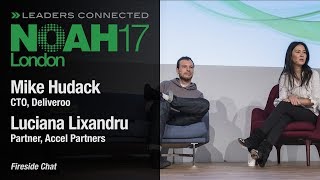
Deliveroo's CTO Mike discusses how reliable service drives growth and shares how the company scaled engineering from 100 to 300 people in 18 months through internal recruiting and empowering managers. He explains the shift to co-located pods of engineers, designers, and marketers, and warns that over-reliance on referrals can limit diversity.
Chapters
Thank you for having us here. We're thrilled and I'm very excited to be on stage with Mike, who's the CTO of Deliveroo, and talk to you a little bit about the CTO's role in supercharging growth, especially in consumer companies. So Mike has been with Deliveroo for a year and a half and he has a very unique background. Mike left high school at 15, started and sold a company at the age of 22, was then with Facebook for five years, roughly right in the last two and a half years there he was running their ads product team that was post ipo. And now we're absolutely thrilled to have him at Deliveroo since he joined a year and a half ago. And he increased the team in engineering and product from 100 to 300. So we'll talk about that and recruiting a little bit later. But tell us a little bit, Mike. What are the key areas where you and your team help with growth?
Well, a lot of what we do is just make sure that the service, I think that the best way to grow is to offer consistently good service to people. So we spend a lot of time on making sure that we have the right number of riders on the road, that we can predict when the food is ready and that we're dispatching orders and getting them to people on time as we spend a ton of time on that. Recently we've also started working a lot on marketing, both in terms of doing incrementality testing of all the marketing that we do online and offline so that we understand what works and how we can invest money most efficiently. And increasingly, we're just like automating all parts of CRM and performance marketing.
So it's quite interesting. It sounds like your marketing team is quite close, close to the engineering team, which is not always the case. And I believe it's a more recent evolution.
Yeah, it's something that we changed just in the last couple months.
And how is that going? Are you finding that helpful? Is it because it's much more tech driven and analytical or it goes both ways?
I think, you know, I think the marketing team always wants the engineering team to build things and the engineering team always wants to build things that are really scalable and wants a marketing team to, like, measure what they're doing more and, you know, think about incrementality and all these kind of things. And so I think if they're not sitting next to each other and they're not and they're not managed to similar goals, you kind of like end up talking past each other a lot. And so we started by just getting everybody to sit next to each other.
So physically.
Physically in the same marketing, engineering, product. Yeah. So like you'd have a pod of like six desks and you'd have like two engineers, a designer, and like some content writers, like doing CRM, for example.
Interesting.
So we did that for a couple months. We started moving much faster, started getting better results, and then we made some organizational changes afterwards to kind of like formalize parts of that relationship.
Okay, so it sounds like you've been very busy. The other area that I wanted to talk to you about, and I'll give you the background for this question, and I hope it's helpful to Everyone in the audience is hiring. Every time I meet a CEO or a cto, they tell me it's really hard to scale the engineering team. Probably our bar is too high. That's why we haven't increased the team. However, you have increased the team from 100 to 300 in under a year and a half. And I know for a fact it's not because the bar is low. The bar is very high. Do you have any tips? I know that's something quite timely.
Well, I think that one of the first things that I did when I joined was I went to find somebody to lead recruiting. So we have an internal recruiting team. We hired somebody really amazing who I knew from Facebook. He helped build the Facebook London office. He was at Google, he was at Twitter, doing engineering recruiting there. And he joined and we already had one in house recruiter working on engineering. This other person joined and, you know, their job changed from recruiting engineers to recruiting recruiters. And then we built up a recruiting team and then that recruiting team turned around and started targeting engineers. We were very careful and very strategic about who we went after. We generally went after senior candidates with experience at scale. But we also have made a real effort to find well known subject matter experts in certain areas who people want to work with. And so we'll grab somebody who has like a real following who, like, people would really want to work with, and then that person becomes an attractor for people in that field. And the other thing that we've done, which I think has been really important, is we've scaled engineering management quite a bit. We've given the engineering managers and engineering directors we've hired a lot of responsibility for growing their own teams.
Interesting. So there are a bunch of takeaways. First of all, you have an internal recruiting team for your engineering and product team.
Yep.
How big is that team now.
Well, that team now has changed to be the recruiting team for the entire company. So we've taken the engineering and product team and given them responsibility for overall recruiting. So I think it's about a dozen people now.
And at what point is it relevant for the companies here, you think, in terms of size of the team to think about having someone internally to recruit for the engineering part?
I think that's a really hard answer. I mean, I think, you know, at the time we had. We had basically one or two internal recruiters, and then we were relying a lot on external agencies. And the thing about external agencies is, like, they just. The quality of your outreach is incredibly variable if you're not working with one exception. So, like, you know, you'll have one engineer who fits your target profile who has probably been contacted, like, five times by people claiming to represent your company.
Yeah.
And some of those people are, like, not very good. And so they lose respect really quickly. I think for. I see what you're trying to do. So, you know, I would. If you're serious about scaling the team, I think it's a. It's an investment worth making. But again, you know, just like with engineers or designers or anybody else like that, you know, there's high variability in terms of the quality of recruiters. So you have to be really careful to get somebody who knows what they're talking about and people would want to talk to.
How do you feel about referrals within the engineering team? I know that a lot of people scale that way to a certain level, and then I guess it becomes hard. Is that how you did it earlier as well?
Yeah, we use referrals a lot. I think one of the dangers with referrals is, is they lead to a lack of diversity, obviously a lack of gender diversity and ethnic diversity, but also a lack of, like, intellectual diversity. And all three of those things are really important. So I think if you solely rely on referrals, you end up with a real monoculture, and that's really bad very early on. I think it's very useful, especially if you can get people who have been working together for a long time, they know each other. That's like a very efficient way to get started. Started. We bought a company called Maple a little while ago who, you know, their team has worked together. It's like their engineering team is like 10 people, and they probably work together, you know, a combined, like 60 years or something. And they just, like. They're just like.
They just go like they read each other's minds.
It's fantastic. It's amazing.
I can imagine that. And also on the topic of recruiting, but on the topic of recruiting an actual CTO, I know we have a lot of CEOs and entrepreneurs in the audience. It's a difficult and broad question, but are there any particular aspects of the job that CEOs should focus on when recruiting? I mean, obviously it's a full package, but are there a couple of things that you would say, hey, in a high growth startup without having these qualities or this thing on your cv, it's just going to be very difficult for the CTO to be successful?
I don't, I think it's. I think the CTO is like a very malleable role. So I think there are lots of different types of CTOs. And the way that responsibility is shared between a CTO and a VP of engineering and a VP of product and so on and so forth, you know, changes a lot from company to company. You know, my own personal style is I try to. Well, I don't really do anything anymore, so like I try to have credibility with, you know, all of like product design, engineering, et cetera. And I think that that breadth of experience is really important. I think it's very easy to get somebody who feels like their job is simply to deliver code that works. And you know, I think you really want somebody who understands that the definition of code that works is not just that it compiles and that it runs without errors, but that it actually helps move the business forward. And I think a lot of folks in engineering roles don't think about that aspect of what they're building. And I think think that that's a real, that's a mistake.
That's really helpful. How about management skills? Is it important to test for that when you're hiring a cto?
Definitely. Because like as you scale the organization, I think like most of the job becomes like organizational design. It becomes like, you know, what rituals you introduce to tell people what you care about, how you do reviews, how you talk to the organization. Like, you know, very quickly like raw ability to just like write code becomes completely irrelevant. Right.
I would love to chat more with Mike. Unfortunately I've been instructed not to go over time. So thank you so much for listening to us.
Thank you.
Thank you Mike, for joining.
More from Luciana

Getting Europe into the Fast Lane | Eileen O'Mara, Luciana Lixandru & Marc Lemaître
Luciana Lixandru: Who Are The Daring People Who Will Build The Next Legendary European Companies?

Unpacking the European VC playbook with Frederic Court and Luciana Lixandru | StrictlyVC London


Lessons From a Lifetime in Venture - (Sequoia) Doug Leone & (Sequoia) Luciana Lixandru | Slush 2022



Spotting Global Potential at Seed & Series A: The VC Perspective | SaaStock EMEA Online 2021