You Don’t Hate Your Work, You Hate Who You Become Doing It (Money Stories, Ep 5)
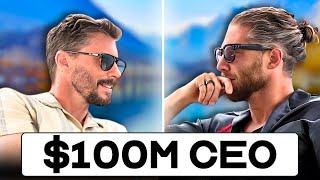
Michael Lett, founder of Vidyard and Garage Capital, talks about why people quit jobs they're good at. He built Vidyard during the 2008 crisis, went through Y Combinator, and now invests in hard tech like robotics and biotech. The conversation covers how AI is changing venture capital and what founders need to do differently now.
Chapters
We are racing toward a future where human work is no longer valuable. How do you see the future of money?
Happen— I don't believe we can truly live in abundance. AI is giving engineers the ability to test more models, more outcomes, more outputs, and so they can get to market far faster, and they can bring robotics and these complex technologies to market far faster. So I see this as the golden era of when the promise of technology making our lives better actually comes to fruition thanks to AI. What I see in the venture capital world is that companies are getting to $100 million in ARR with 20 to 30 employees, whereas before AI it took 1,000. If you are not building natively with and for AI in your software startup, you are going to get left behind.
The best investors identify and run toward asymmetric returns. Where did you notice the asymmetric opportunity? Welcome to Money Stories, the BVI edition. Here with my dear friend Michael Lett, who is the founder and CEO of Vidyard, which is an amazing company that helps salespeople connect with their customers through the power of video. Also founder and investor at Garage Capital, which is one of the top funds Benchmark in the world and certainly in Canada, award-winning seed investor. And that's not what I love about Michael Lip. I would say that while your accomplishments are impressive, you are one of the most thoughtful, kind, and considerate people that I know. And when I am working through something, you're one of the first people that I go to because you listen at a world-class level. So number one, thanks for being here. And two, thanks for being my friend.
Thanks for having me. Thanks for inviting me on this trip. It's been incredible.
It's pretty nice when you get to go take some intentional time to spend time with people that you love and that you want to get to know better and, and really carve out space to just be. Here's, here's where I would like to start. You know, I, I think the world has enough interview shows where we talk about how you were born in a cabin in 1976, but, but take me to a pivotal moment that really was an inflection point for you on the path of entrepreneurship.
So many. I think one of the most prescient in this moment probably be 2008. I was an intern at Cypress Semiconductor in Silicon Valley. I was a product manager on a very specific chipset. It's now an obsolete technology, but a day came when my manager said, hey Mike, stay home, work from home tomorrow. And I could just like, just like sense fear in their approach. I don't know what's going on. I lived on First Street in San Jose and I rode a longboard skateboard to the office every day. So that night I longboarded home. The next morning, logged in. And it was like this, this complex I lived in became a war zone. There were mattresses being dragged out of apartment buildings, dropped on the street, and it was a mass layoff from where I lived to the headquarters of Cypress Semiconductor. Something like 25,000 jobs were lost. This, of course, was the great financial crisis. And the reason I was told to stay home was we don't want the full-time people seeing that we've kept the interns in their role, in their job, on payroll. So next day I come back in, office is like a ghost town. And all of a sudden I was given the role and responsibility of people that were far more impressive. On a resume than I and had been in those roles for far longer, but it pushed me to go above and beyond, you know, my potential in that moment. And I learned a ton about people and behaviors and working with VP and C-level executives. And I mean, this is coming from a kid who, like TJ Rogers, the CEO of this company, he would get his hair cut at the office. He loved his hairdresser, so he emptied out an office, turned it into a hair salon, and I would try to book my haircuts when he did so I could go and spend time and talk to him. So I was already fairly ambitious. But what that taught me was I did not want to leave my career to the hands of anyone but myself. And so I remember going home that night thinking, you know, everybody thinks these jobs are safe. And this job is a crawlery for the founding story of Vidyard with Devin, something I've never really talked about before, but I will. And it was just an opportunity. But I looked at the broad stock market, said, look at these amazing companies that have huge brand, deep equity value, trading for nothing.
They're burning down.
Yeah. So put that in the skull locker for future scenario, right? These things all come in cycles. How do I prevent myself getting caught negatively in the next cycle?
But that's such a fascinating— how old were you?
I would've been in 2008, approximately 22. 22.
I just want to acknowledge, like, that is a fascinating thing at 22 to say, how do I store this away and prevent this from happening to me in the future? Right. Like most, most people, I imagine when they're in a chaotic situation like that, just go into fight, flight, or freeze and are just trying to tread water. And instead you are real-time using that as a learning opportunity and pattern recognition and saying, okay, how do I use this as a stepping stone to get better? Has that always been innate to you or is that something that you learned?
It's a great question. I grew up in a household that was ex— I was expected to be a good student. I was expected to be organized. I was expected to be on time. I was punished when I was not those things. I had an older brother that was extremely smart, extremely academic, and I was consistently compared to him. And so I really tried to carve out my own identity, which was to excel without appearing to apply much effort. Turns out that's an interesting skill.
That resonates. Yeah.
My dad and mom, you know, had very basic careers. My mom was basically, my mom was essentially digitizing health records manually. You know, she is now an AI in that role for sure. My dad was fixing Essentially, he was a, a line worker for a local utilities company, became an electrician when many people did. Many men took that job and there wasn't enough work. And so when my brother was born, he was taking a bus 4 hours each way, 2 o'clock in the morning to essentially wire the Bruce Peninsula nuclear power plant. And so when my brother and I were very young, we would misbehave, he would take us to factories, say, hey, like, if you don't do your homework, this is the type of job you might get. I remember going to Schneider's Meats factory and in the bathroom there were no walls around the toilets to prevent employees from doing drugs. And that was scary. I like pooping in peace and privacy. That was just scary for an 8-year-old.
It's a luxury that we don't consider until it's taken away.
Exactly. Yes. Thank you. And when he was, when he was doing work on the University of Waterloo Douglas Wright Engineering Building, he would take my brother and I there and said, you know what? This is a place where I could see you coming. His bosses were engineers and he wanted us to become engineers as well.
Wow.
There's a lot of thoughtfulness on my parents' behalf.
Yeah. And I think it's a, it's a hallmark for a lot of high achievers is that they have parents who are hard on them. That's a, that's a theme I hear a lot in these interviews and the work that I do. And the reality is it's a, it's a great trauma to have. It's like, you know, it helps you get there, but you know, there's also pain associated with that. So, so a lot of times kids will reject that teaching and kind of go the opposite way or use it as fuel. So it sounds like you were incredibly motivated by not wanting to poop in public, which is a great motivator. Then there's this 2008 financial crisis right at the beginning of your career. How does that lead to founding? Your founding story?
Yeah, great question. So, you know, combination of inputs all throughout my life, talked about how my parents behaved. We had rich, they had rich friends, right? And always awesome to spend time at their house in their life. And they were very generous with their time, their belongings. They'd borrow a cottage and I started to develop a penchant for wanting those aspects in my future. And doing the simple calculus of like, you know, can I get this on $100,000 a year salary? Probably not. So what do I got to do? So really great friend of mine from undergrad, Devin Galloway, real quick backstory. I meet him in an ice cream eating competition. As you found out last night, I love ice cream. We basically are paired up. Random 2 go to a room, make a big, beautiful ice cream sundae. Most beautiful sundae wins. And the catch is fastest one to eat it wins. So we got this monster, sprinkles, chocolate sauce, just way overboard. They give me a spoon and they say, your job is to feed the ice cream as fast as you can to Devin. But the catch is he's gotta put his arms behind his back. You slide your arms. Under his armpits, and then you use the spoon to feed him. And I'm thinking like, there's gotta be a way to hack this. And Devin, over shoulder's like, go as fast as you can, I keep up. So 3, 2, 1, I tossed the spoon, two hands into the bowl, boom, just force feed him the ice cream. And he took it, no questions asked. And so I'm like, this is, I love this man and we're gonna do amazing things together.
This is it.
Yeah. So through undergrad, you know, we day traded. We were just like fascinated with this idea of making money and figuring out how we can multiply our efforts and learn from each other and expand our time. And he helped me get a job in software product management at BlackBerry, which, you know, totally changed my trajectory. And so he was the one when I was like, I'm going to start a business. This is an engineer trained by accountants. Who's brilliant and I get along with. I step left, he steps right. Like we, we've got this great pairing. We're gonna do something amazing together. And so from that moment, we just hashed out ideas. And the beautiful thing about the Waterloo engineering program is every 4 months you do co-op, school, co-op, school, co-op, school. And so you see the way businesses work, you see the weaknesses that businesses have, you're trained to solve them academically. And if you have even an ounce of creativity, all you see by the time you're in your third, fourth year is opportunity. As long as academia hasn't beaten that out of you. And the attrition rate on these programs is incredibly high, like 50% out of our classroom. But Devin and I both made it and we knew we could do something incredible together. The idea for Vidyard started very lifestyle-y. Like the two of us making $300K a year in a business. That'd be great. That'd be awesome. You know, black condo, big screen TV, maybe a Volkswagen GTI. Life will be good. Of course, once you get into that, you learn, you see, and again, being opportunistic and being trained to be opportunistic is how we saw the opportunity to go bigger, farther, faster.
When did you know? When did you know this was a company built for scale?
When a roommate of mine in undergrad, name was Eric Mijakowski. So after the 2008 financial crisis, my brother and I are thinking, we're paying rent. Is there a way that we can use that rent to pay for a house? Canada evaded the crisis, but borrowing rates dropped dramatically. Overnight prime was 1.6%. We were able to get a mortgage at prime minus 1%, and I was able to get that mortgage on a promissory note from BlackBerry that they would hire me full-time upon graduation at a salary of $85,000 per year. My brother had already graduated, so we bought this house, subprime, zero down, loaded our friends into it, and didn't pay rent. And built equity in this house. That was the beginning of my brother's path as a mega real estate developer. He's building 2,000 housing units this year, just to give you perspective on that.
What I, what I just, I want to interrupt for just one second and double-click on, you know, the more people I talk to, leverage becomes such an important part of the story.
Yes.
And essentially what I'm hearing right now is that there's this inflection point where you applied leverage. You had, you had essentially free money and you took a calculated risk, but, but really an asymmetric risk opportunity, right? Like the risk of failure at this particular, you know, buying this house and not being able to pay rent was very low.
Yeah. The spread, we built a spreadsheet, right? Two very unemotional engineers, having to be brothers, not the easiest thing at all times. but the math, maths, like this, this makes a lot of sense. We can do this.
The best investors identify and run toward asymmetric returns. And I, and I, and then just witnessing you and knowing you, that's a skill that you continue. So back, back to Vidyard scaling. Where did, where did you notice the asymmetric opportunity?
Yeah. So Finished the strip of the house. We've got this house of entrepreneurs. Eric Mijikovsky, brilliant engineer, same program, year ahead. He's, he's, he's got this idea about building the smartwatch, right? This is before any smartwatch existed, right? We're in Waterloo. First smartwatch he builds is a BlackBerry smartwatch because BlackBerry is literally 200 meters from the house. Headquarters. He goes on, gets funded by this program in Silicon Valley I'd never even heard of called Y Combinator. And my, my biggest frustration with that whole thing is he basically broke his lease and we let him. So I'm no longer getting $500 a month from Eric. He goes on to build the Android smartwatch known as Pebble. At the time, highest grossing Kickstarter ever, over $20 million. Right? He proves that crowdfunding works, blows the doors off with this thing. Eventually he sells his company to Fitbit, goes on, builds Beeper, sells that to Matt Mullenweg at Automattic. Eric is a legend. He sends me an email and says, Mike, you gotta, you gotta come to YC. You gotta apply to YC. We're working on this Redwoods Media thing. We're making videos for companies. We're building software on the side. We get down there. We show them what we're building. The way we did it, this is a fun side fact. We sent them a video using Vidyard. We sat down in the, in the meeting. We said, did you watch our video? Paul Graham, Gary Tan, Sam Altman are like, yep. I'm like, no, you didn't. Here's the data. And they're like, I get it. You guys are building YouTube for business. That information is valuable to businesses, go-to-market teams. YouTube will never do it because it's too expensive to get that level of detailed analytics for videos that have like 3 or 4 views. You're in. And Paul Graham said, but you gotta shut down the content production services. That's a distraction. I said, that's funding the software development. He's like, no, you raise venture capital, shut that down. You focus on users, on customers, et cetera. And so that was the moment when I knew we had been inserted into this machine called Y Combinator. Very fortunate to have that opportunity. And all they cared about, because it's the venture-backed model, is immense scale. And if you're not going for 1,000x, you are not worth their time. They're venture capitalists.
Wow. What a, what a story. I, I, man, I wish I could be a fly on the wall in that meeting. This brings me to something that I think is really interesting. I think you're uniquely qualified to discuss, which is the past, present, and future state of venture capital. My thesis is that venture capital as we know it, the paradigm is collapsing on itself. That, you know, these moonshot zero-to-one companies that dominated the you know, the post-2008 to 2021 era are, you know, that model is no longer the default mode. Now with AI and new leverageable technologies, the venture capital landscape is going to change. How do you see that happening?
There's been these incredible technological inflection points. Over the past 20 to 30 years, right? Venture capital has always been rocket fuel to accelerate the deployment of your solution so that you have no limit on supply so that you can go and find as much demand as possible. And that's what makes the technology business so great. You can essentially have unlimited supply. So let's go back to OG days of software, on-premise, a server in the corner, right? The business model was on-premise, you pay a fee for this tower, and then we're going to come in and do maintenance on it. Then Amazon comes along and is like, wow, we've built this amazing server farm to, you know, help people buy books on the internet. Let's make that available to all these startup companies. SaaS. Boom. We're renting a server. We're going to use venture capital, rent that server. We are going to get software into everybody's hands faster than it's ever happened before. Massive inflection point, right? Venture capital booms, blurs into helping companies deploy software really, really, really quickly. And when you're no longer managing all these disparate servers around the world, you can move way faster. Mobile. Now we can get these solutions in everybody's pockets. This is massive for distribution, right? Again, we have unlimited supply. Let's go find some more distribution. The way I think about AI is as follows. There's a layer of applications that are now completely redundant because AI exists, right? And a lot of people might say, well, that means that software companies are no longer viable. What I see in the venture capital world, in the companies that we fund, is that companies are getting to $100 million in ARR with 20 to 30 employees, whereas before AI, it took 1,000, and it was hyperscaling, dumping money into the market, and these businesses are obviously profitable. So there is an accelerated curve, which is why if you are not building natively with and for AI in your software startup, you are going to get left behind. So those, those opportunities technically for venture capitalists are better than ever because these companies are getting way more yield out of the infinite supply of their software because demand is also exploding. People are becoming more used to using these technologies. But there's another thing that's happening, which is really, really, really cool. We are seeing businesses being able to deploy really hard technologies. I'm talking robotics, things that were previously very scary for venture capitalists to fund because they're very expensive. They're error-prone. Hardware deteriorates. You are supply constrained.
Hard tech's always been a tough space.
Hard tech's always been a tough space, but hard tech is now becoming an easy space. And you hear, you know, on the All In podcast, Friedberg was talking about You know, this is going to be the year of the autonomous AI-powered machine. I'm like, that's a robot. We've been investing in robots for 10 years. In fact, the best gains we've had as a fund have been in the technical space in robots. So this is why I think we're special at Garage Capital, if I may toot our horn just for a moment.
Beep beep, let's go.
We are 3 fundamental first principle engineers trained at the University of Waterloo. We wear our iron rings. We know how to technically diligence a company. Mike McCauley built a robotics business. Devin and I are still building Vidyard. We're deep in AI, so we can diligence a technical asset better than most funds whose managers come from finance backgrounds, et cetera. And what we're seeing in this inflection point in technology adoption is that AI is giving engineers the ability to test more models, more outcomes, more outputs. And so they can get to market far faster and they could bring robotics and these complex technologies to market far faster. And so we're looking at biotech, we're looking at the commercialization of space. We're looking at some really cool stuff on this planet as well that is fundamentally unlocked by venture capital. So I see this as the golden era of when the promise of technology making our lives better actually comes to fruition thanks to AI. And that's what gets me so fired up about Bora.
So many directions to go with this. There's so much there to unpack. I think the first question is, do you think this shortens business cycles in general? Right? Because, you know, when I hear that it's faster, like the flash to bang of deployment and demand generation is faster. That also means that incumbents can be unseated faster. And so you may be a novel solution today and somebody could, with a no-code AI platform, build a better software tomorrow and then have access to more rapid distribution. So, you know, the lifecycle of a company in general may be shortened. Is that fair?
Yeah. So we look at companies, those companies have very high-risk, low-deployment strategies. So if we, if we find a great founder who's building something and we're like, okay, we don't know where the LLM research and what OpenAI or Deepseek, where that is going to end and where the application is going to be, application layer is going to begin. We're betting on that founder to find it in that specific space, in that specific vertical. And so there is a lot of question marks around productivity software that we are either skeptical of or deeply thoughtful and want to back founders that we know are agile enough to not get disrupted by that next generation. You know, the, the kids in the garage. That's why we're called Garage Capital. Kids in the garage are always the disruptors, right? Since the beginning and origins of Silicon Valley. That's why we like the hardware bets. And that's why we really like founders that have very unique experiences in a certain field of interest that go and build solutions there. Because just like my earlier story, when we're in, in co-op, we're in a business, we're seeing and learning all of the inefficiencies of it. That's what we call founder-market fit. And the deeper that experience is, the better we are aligned to solving that problem. The more likely we are to invest in that organization and invest in those founders.
So right now, my mind is drawing a parallel between your 2008 experience, walking into your company and seeing 50,000 people laid off overnight, saying, how can I protect from the future? How are you thinking about that now? Let's, let's start from a founder lens and then let's answer the question as a, from an investment, from an investor lens. So as a founder, How do I play in this new paradigm?
Yeah, I mean, it's interesting, right? Because there is a lot of momentum behind the way things used to be done, and you've got executives that are trained for 20 years on playbooks that, as far as I'm concerned, are either obsolete or becoming obsolete, like, as we speak. And so this is like a really important distinction because startups have never been full of those executives. They've always been, you know, a couple buddies from an undergrad program getting together to build a solution, to build their company in their garage, in their garage, based on their view of the world. And they're going to take the shortest path to the outcome. Whereas this trained executive with this playbook that's you know, dusty, 20 years old. They don't even remember how that playbook got designed from first principles. So in this moment, right, we see enterprises floundering, floundering, floundering, floundering. So as a founder who sells software to the enterprise, we closed a deal a couple weeks ago, contract value, $750,000. That was funded through headcount budget, not from IT budget. So enterprises are trying to react. Because what they're worried about, and they should be, is these startups, these 10 to 20 people that are AI native, that are using agents instead of people to complete tasks, where these enterprises have these massive bands of people. And Klarna talks about this, unverified, I don't know if it's true, but when they have somebody leave a team, right, to get out of this, to disrupt themselves, to get out of this way of how things used to be done, they ask that team to go automate that person's role using AI, and if they're able to do it, they redistribute the savings to the team that solved that problem.
Wow.
And they don't backfill that individual. So, so they're basically saying you can make way more money if we have way less people. It's a bit of Lord of the Flies at this moment in the enterprise, but it's a powerful statement to what's happening in the market in general.
All right. Last question. And this is getting a little bit futurist, but I would love how you think about, you know, this show is called Money Stories. What is the future of money? Like if we are racing toward a future where abundance is the default state, right? Where we can automate most work with machines and technology where We can, you know, have abundant food production. I mean, we, we are racing toward a future where human work is no longer valuable. How do you see the future of money?
It's interesting. I, I think the big constraint is still energy, and I don't know that we fully comprehend that. Now, of course, we've seen models get deployed that are far more energy efficient than we thought AI needed to be. When you think of this future state of robotic intervention, Think of this future state not being gas and diesel powered, but being battery powered. We're limited by the technologies in batteries. We haven't cracked the code on solid state. We haven't cracked the code on nuclear fusion. Until those things happen, I don't believe we can truly live in abundance. And so that's why we look at investments in micronuclear reactors that are looking to have distributed energy supply so that difficult locations, let's say civilizations on other planets or in the middle of Saudi Arabia, have access to clean, sustainable energy so that they can start stepping ourselves towards that. But again, when you do the math, it doesn't QED as of yet. Now, 100 years, maybe 20 years, maybe. It's really about solving this energy problem in order to unlock that, that true state of abundance.
Michael, I could ask you a thousand more questions, but this has been fascinating, illuminating. I really appreciate you taking the time. I really appreciate the opportunity to get to spend time with you and, and just learn from you. And man, thanks for being on.
Feelings mutual, Michael Brown. Thank you.
Cheers, brother.
Cheers, buddy.










