Recruiting is About to Change Forever (and nobody even realises)

Mohammed Adris identifies five shifts reshaping recruitment: clients now have the same sourcing tools as recruiters, small specialist agencies are beating large generalists, AI amplifies strong recruiters while exposing weak ones, and content builds trust over time. The winners will be niche firms that move fast and use AI to enhance, not replace, relationships.
Chapters
Look, I need to be real with you. Recruiting is changing. Not in the things are evolving kind of way, just the entire game is being fundamentally restructured right now. And for most recruiters and agency owners have absolutely no idea it's happening. And the recruiters who see it now and adjust are going to pull so far ahead it won't even be close. And the ones who don't aren't necessarily going to disappear, not overnight, but the market is going to shrink and they'll spend the next few years wondering why. So if you're wondering why you should listen to me, then my name My name is Mohammed Adris. I've built my own recruitment business from scratch. I still run it today, and I support others who are looking to build their own recruitment business that doesn't ultimately depend on them. And in this video, I'm going to break down the 5 biggest shifts coming into recruitment, what they mean for you, and where the opportunity is. So the first shift, number 1, clients are getting access to the same tools that recruiters use, and that is the same job boards, the same LinkedIn Premium accounts, the same AI tools, the same messaging structure. And the recruiters who just literally find CVs and forward them that they find on job boards are being squeezed out. And once upon a time, that was a model of business development, which was that you cold call endlessly until somebody tells you, yes, I'm looking. You go and find the CV for a suitably qualified professional on a job board, send the CV over, and you get paid. And that is the first one that is dying because your clients, they also have their own internal recruitment teams. They also have access to LinkedIn Recruiter. They have job boards too. And the same AI tools that you use to contact candidates at scale, they're using them too. Ultimately meaning that if a hiring manager can get those same candidates with the same messages and get the same reply rate, then the recruiter who was doing that exact same job as a middleman and getting paid for it now doesn't have a value proposition left over. And this is not a future threat. You're already seeing clients try and do this themselves. And what kills the commodity recruiter is actually being replaceable. And what saves everyone else is being irreplaceable. The irreplaceable recruiter has depth of niche, knowledge, relationships, and insight that the client simply can't replicate. And the question every recruiter needs to ask is, if my client got good at using LinkedIn Recruiter or another AI tool or any other license tomorrow, would they still need me? And if the honest answer is no, then that's the problem that needs to be fixed. Which brings me into shift number 2, because this move that is taking place in recruitment has already played out in so many other industries. And you can see it being played out in marketing, in law, in estate agency, even in accounting. And that is this: it is that you have some major players, and these are the most reputable firms in those spaces. And once upon a time, they dominated the entire market until one day smaller smaller specialist companies that were nimble in the way that they could deliver their services, that understood their client needs and provided a more personalized one-to-one solution compared to what the larger firms could. They were prepared to do things that the larger firms just didn't have the policy to do or couldn't get approval from decision makers further up the chain quick enough to be able to replicate. And this is where the smaller micro specialists came up. So once upon a time you had a marketing company that took care of absolutely everything. Now you have PR specialists, Google Ads specialists, YouTube specialists, LinkedIn ad specialists. For every single area within marketing, you have a specialist agency that can take care of that one thing. And now what's even more common is the same thing is being played out in estate agency, in the real estate sector, where now all of a sudden you have these small independent estate agents that operate in just one geographic location. And recruitment is going through the exact same structural shift. The winners in the next era are micro niche operators. All because recruitment is following the exact same trend in the industries that I've just mentioned, except it's happening a little bit slower because it is an older industry. And micro niches ultimately mean a defined sector, a defined geography, a defined company type, a defined seniority band, and ultimately being the best in that box. And the reason why this wins is because clients trust specialists. So if you only work with fintech scaleups hiring senior engineers, then you know the things that a generalist will never know. You'll know the fine details of who's about to move, who's who's been misvalued, which companies have cultural problems. And that knowledge is impossible to replicate with the software and certainly can't be found on ChatGPT. Because if you do operate one of these micro agencies, then you're already seeing this in your own business. Inbound leads that come in from clients who've seen your reputation, they just fill out an inquiry form on your website without you even, even reaching out. That's what niche authority produces. And the micro niche specialist doesn't chase clients, clients come to them. And now here's something that a lot of people in this industry aren't even talking about, but I'm watching it happen in real time. And that is that the large recruitment companies and the ones that carry weight because they are on PSLs are starting to lose ground. Not because they're bad at recruitment, but because they're too rigid, too rigid to adapt to how fast things are changing. And smaller firms, they can update their processes and avoid new tools and pivot their entire delivery model literally within weeks. Whereas with large firms, that takes years and 7 layers of hiring managers and director-level board approval. And hiring companies, they're starting to notice this. So to break it down in more detail, large firms larger firms have really big infrastructure. They have compliance layers, they have approval chains, and every time something changes— new sourcing tools, new AI capability, new delivery models like offshoring or nearshoring— the larger firms, they just move slowly. Whereas smaller specialists, those firms can adapt to new tools, they can test new approaches, they can update their processes, and they can do it faster compared to the larger firms. And the clients and hiring managers who are forward-thinking, they are ultimately starting to prefer that flexibility because especially as the pace of change in hiring accelerates, then flexibility in delivery also matters. So you have to ask the question: do you offer contingency? Do you do retained? Do you offer RPO, temp, nearshore, offshore? Recruiters who are rigid about how they deliver their services are going to lose because clients who want something different are not going to come to you. For example, if you have clients who are based in London— let's just say you're recruiting accountants— and suddenly they want to offshore a department, if you're rigid and you say, hey, I don't do offshoring departments, I only do contingency recruitment, or I only do retained, and I only work on UK-only hires, then you lose that relationship. And you lose that relationship to who? Just somebody who said, yes, I'll do it for you. So ultimately, that means that the recruiter who keeps the relationship long-term is the one who follows the client's direction, not the one who insists on one particular product. Meaning a small firm, niche depth, flexible delivery. And that is the model that wins over the next few years. By the way, before I get onto the next few shifts, everything that we've covered so far, the commoditization, the threat, the rise of the micro niche specialist, and them move towards smaller firms. These aren't things that you can just fix overnight. They require a clear business model, a defined niche, and a system for acquiring clients that doesn't rely on you manually hunting every single day. And that's exactly what I've helped recruiters build. So if you're a recruiter who's thinking about starting your own agency, or you're running one and you're hitting that ceiling, then I work with a handful of people directly to build that exact model. I'll leave some information below and you can book in a call and we'll just figure out if it's a good fit. But for now, let's get back to it. Okay, so shift number 4, and this one is probably where the most noise and the most nonsense is being said right now. So everyone's talking about AI replacing recruiters. That's not the real story. The real story is that AI is an amplifier. It makes good recruiters significantly more effective, and it also makes bad recruiters look even worse, and it makes them do it even faster. So all of the gurus that are pushing AI will replace recruitment are missing the human element that still drives this industry. Industry. So let's go over it. You've got the hype, which is AI is going to replace recruiters. I'm going to say this, this is massively overblown and usually said by people not actively running a recruitment business, because if it was, then I don't think OpenAI and Anthropic would be actively recruiting for recruiters, because they are. However, there is something that AI can do, and it does it quite well. It amplifies what's already there. It gives strong recruiters tools to help increase their output by multiples. And the opposite is also which is if you give a weak recruiter AI tools, then all you've done is you've accelerated bad recruitment and you've done it at scale. And the human element that AI hasn't replaced yet, i.e., the sales calls, the ability to build trust with a hiring director on a phone call, the ability to read a situation or handle a counteroffer, navigate a difficult conversation between a client and a candidate. Recruitment is ultimately one of those industries where the sales process still requires a human. It's high touch. High-ticket, business-to-business relationship. And these are things where trust is built, and trust takes time. So one of the things that a lot of gurus are getting wrong is that they're teaching manual outreach as the antidote to AI. And frankly speaking, that's actually a bit of a lazy answer. The real answer is figure out which platforms and communication styles your clients respond to and meet them there. So if it's WhatsApp, if it's text, if it's email, Slack, LinkedIn, like, it varies. The AI tools that will matter most for recruiters focus on sourcing, enrichment, and sequencing, not the actual conversation. So The recruiters who are going to win are those who use AI to do more of the right things and do it faster, not those who try to AI their way out of learning how to actually sell. And the last shift, this one ties everything together, is that with more choice, more noise, and more recruiters claiming to be specialists, the time that it takes for a client to decide to work with you is going to get longer, meaning that the recruiters who win in this environment are the ones who are front of mind before the client is even ready. That's a distribution problem, not a sales problem. And the way that you know this is working in your favor is when you get clients coming to you just because they've been watching you from a distance. And those clients, they've built trust over time and they've reached out to you when they have the need. And that's irrespective of whether you reached out to them or not. And that's not luck, that's just the results of being visible in the right place consistently. So the old business development model where it's purely outbound calling, calling, calling, I'm not going to say that it doesn't work, but it's not the only game anymore. Clients have way more options more than ever, and the trust-building cycle before they even commit to new recruiters is starting to get way longer, and it's much longer than what it used to be already. So what is it that fills that time, that gap? Well, it's content, it's reputation, it's a presence, maybe a podcast, regular LinkedIn posts, a newsletter, maybe even a YouTube channel. These are all assets that build trust at scale passively, and while you're still running your day-to-day operations in your desk. And these are all some of the things that we're building right now, not because we want views, clicks, likes, comments, but because it keeps us front of mind with the exact people that want to work with us and the people who we want as clients. And yes, there is an added advantage for those recruiters who regularly make content and those who are in regular conversations with their clients and candidates, especially those who are in conversation with their clients and candidates before they even need that service. And that is a long game, but the compounding effect is real and most recruiters are not even playing it. So the window to be the first person in your niche who clients come to and you own that space, that window is closing, and that's just where this is going. So if you want to see exactly how I'd build around all of this from scratch right now, then click this video to watch me break down how I'd build a brand new recruitment business all the way up to $100K a month, step by step. So I'll see you there.
More from Mohammed








How to Build Client and Candidate Relationships That Make You Impossible to Replace

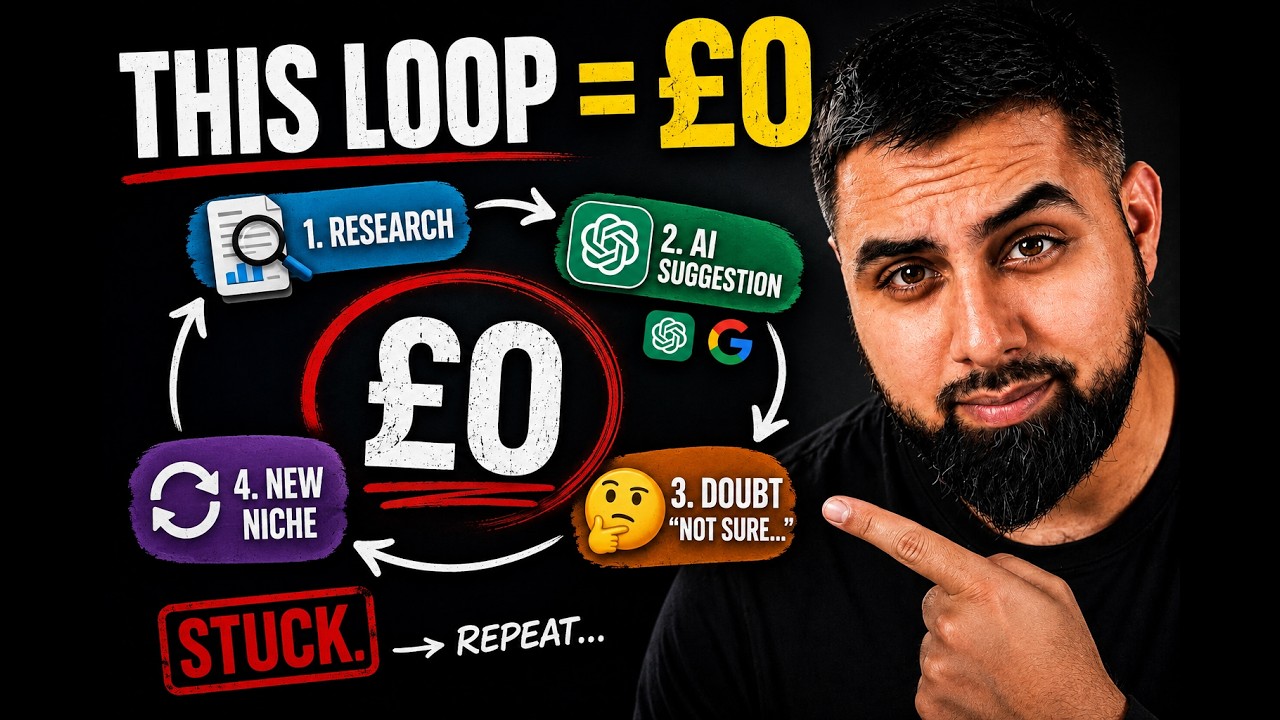
The Real Reason You're Afraid to Pick a Niche And What It's Actually Costing You