Episode 1- Founders of Airgen
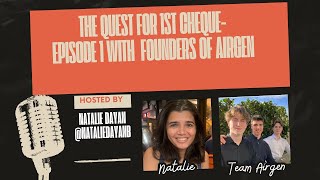
In this YouTube interview, host Natalie Dayan talks with the three young founders of AirGen—Maxim Schiffers (CEO), Guillaume Choup (CTO), and Cyril Thielemans (COO)—about their AI‑driven autonomous assistant, Urgent (also referred to as Urgen/Arjun). The founders explain how they identified a market pain: salespeople spend about 41% of their time on administrative tasks such as email, CRM, and calendar management. Urgent is built as a multi‑agent system that connects to professional tools (Microsoft Outlook, Calendar, OneDrive, HubSpot, web search, etc.) via API integrations, allowing users to issue natural‑language commands that the agent executes step‑by‑step. A live demo shows the agent drafting an email, proposing meeting times, and sending the message, all within seconds, while giving the user control to edit or reject actions. The team describes the product’s architecture (ChatGPT‑based core, additional models, web‑scraping, and database look‑ups), quick two‑minute setup, and plans to expand integrations to Google tools. They discuss the current stage—beta with pilot users, not yet a full MVP—but expect an MVP within a month and a B2B subscription model thereafter. Funding is at a pre‑seed round of €200 K (≈$200 K) with $100 K already raised; they aim for a $2 M seed round in March/April and target a $5 M valuation now, $15 M post‑seed. The founders articulate their vision of a Jarvis‑style personal assistant that becomes the single hub for all company tools, reducing tool‑switching and scaling beyond sales to other functions. Risks highlighted include high AI compute costs and the effort required to build hundreds of tool integrations. They emphasize their complementary skill set, youthful energy, and the advantage of being agile compared to large incumbents like ChatGPT or Siri. The interview ends with the founders offering a trial of Urgent and expressing excitement about moving to Silicon Valley.
Chapters
Well, thank you so much for joining me. I'm Natalie and these are the founders of AirGen. The first time I came across y'all was when I came across this post on LinkedIn saying that y'all won the San Francisco Vertical AI Agent Hackathon. And then I was immediately intrigued as to who are these 19, 20-year-old founders, what are they working on? So I immediately go on the website to check about what you guys are working on and I was absolutely mind blown. Given that I definitely feel that this is the future and this is definitely something which many people have tried to work on, but not, not many have really been able to do it to the scale that you all have been working on. And so, I mean, I won't give anything away, but I would love for you all to introduce yourselves and tell us more about who you are and what AirGen is all about.
Okay, sure, sure. Thank you.
All right, I think, uh, we can, uh, let introduce us.
I will introduce us. This is Maxim Schiffers. He's the CEO of Urgent. This is Guillaume Choup. He's the CTO of Urgent. And I'm Cyril Thielemans, the COO of Urgent. And yeah, we know each other. Like, we started a previous company together 3 years ago. It was an AI agency that integrated, developed tailor-made AI solutions for private companies, public companies, companies. We had a project that had 100K users on it. And then with that company, we saw a pain point in the market by working on our company. And we saw that, yeah, when we work as sales, we spend much time on the admin work.
So today salespeople spend 41% of the time doing admin work. Like sending emails, managing the CRM, managing the calendar, writing reports, preventing them from meeting new clients, enhancing the relationship with current clients, and actually making more revenue.
So that's why we've built Urgent. So Urgent is an autonomous AI agent to whom they can connect all their professional tools and to whom they can delegate this admin work. They can just interact with it like you interact with ChatGPT, and it is in a chat. You can explain the task in natural language and it will do the task step by step by connecting to your tools.
Yeah, so that is very fascinating. I definitely think that this is something which would end up at one point reducing the price or the amount of money spent by a lot of companies in terms of automating their tasks or also getting their tasks done. But I'm curious to know, what are each of your backgrounds and how, why this problem, you know, what was the inspiration behind working on this?
Uh, so yeah, uh, like I said, uh, I, I'm 19—
no, I'm 20 years old now, and, uh, since yesterday, yeah, we haven't that much—
I did that many, uh, experience in, uh, in the entrepreneurship. We started, like I said, 2 years ago, very previous, uh, company But yeah, I'm only now a student and entrepreneur. I'm doing a business management school, sorry, at Leuven in Belgium, and that's what I am.
All right, for myself, I dropped out from school 2 years ago, so I started a business school in Belgium. I started that because I always wanted to start entrepreneurship, but actually it wasn't very interesting. I wasn't learning anything, so I started a couple of small businesses like selling websites to small shops and eventually starting Arjun.
Yeah.
Hi, so me, for me personally, I am in third year engineering. So I've always liked technology. I've always been into the tech world, but I've always passed my exams with pretty ease. So I knew from the way it goes that I had a lot of free time. Yeah, so for me, this free time was spent on, uh, personal projects, and that's how I started, uh, this company 2 years ago with Maxim and Cyril.
Wait, so how did you all meet though? I'm, I'm very curious to know about that.
Yeah, um, I know Guillaume since, uh, the high school. Like, I know him for now 7 years or something. Uh, Maxim, we met him, uh, 4 years or 3 years ago in the BasicFit. It's a gym, like, to work out. And we met there and we were just talking like gym bros, like I said. And we talked about entrepreneurship, about business, about tech and everything else. And that's when also OpenAI launched ChatGPT. And we talked a lot of ChatGPT and opportunity that it gave to, uh, to companies and to us to help companies integrate that. And that's how we, we started, uh, our, our first company with some IDs, and we, we shared that together. That's how we, we met.
Yeah, you guys all have that shared connection for tech entrepreneurship and just like that passion and know each other for a long time. So, you know, I can see why you guys are working together and just like, you know, build this team. So how did it start off, so like when was the first time you guys started out and, you know, how did you all, like what was the transition from like the idea phase till right now and how is that journey like?
I'll let you introduce the idea.
So you're speaking about Arjun or the previous company?
Arjun.
All right. So now it's been 2 years, we are in the AI sphere. So we've worked with a lot of companies in Belgium, a lot of companies everywhere. And so we know the market very well. We know what people can use, what people cannot use, what people are, what is easy to use actually. And we saw that most of our clients were big companies. They have the money, the resources, and the team to actually integrate AI because actually the only way to integrate AI and actually have a real impact with it is to build a custom-made solution like we did with Meridiam. But there is no generic solution on the market that actually delivers a real impact on the company. We have tools like ChatGPT, like Claude, but it's very cool, it's very fun, but let's be honest, it doesn't change the way we work. So we want to go beyond that limit and actually have an assistant that's actually pretty affordable, that anyone can use, that is not too expensive, and that is easy to use. And so that's why today we are building Urgen, the first AI assistant that actually does things for you, that connects all your professional tools and actually replace most of your tasks.
Yeah. And also, like, we were in a coworking or office was in coworking where there were like a lot of salesmen and salespeople. And like talking with them, they were like, oh, we spent like half of our time just filling our CRM or sending emails, making an offer. And we saw that like they just want to focus on what truly matters is selling a product, being with the clients and sharing that kind of moments and not being behind a desk or computer to fill all that in the CRM. And that's how we started with Urjun. Also for us, we know that we spend a lot of time just contacting, contacting, contacting. I can't speak, sorry. Reaching out to our clients and etc. And that's how we came on that idea.
I found it pretty fascinating. I mean, I've having used ChatGPT and relied on it for most of the time. I find it pretty fascinating as to how you guys have that phase wherein it's not only integrated with so many other systems, but I mean, I'll let you all explain how it exactly works, but I find it very fascinating as to how it accesses all your CRM. For example, one of the examples on the website was write an email, write an offer to XYZ company. So it accesses your CRM. So because it is integrated with different tools, it writes an offer and then accordingly it just initializes the whole process of it without you having to do that. It just creates it and then sends it across. So literally automating the whole thing. So, you know, do you want to go ahead? I mean, if I went wrong in any ways, do you want to go ahead and explain how that works? And like, what's, you know, do you have any users or, you know, what's like, what's like the whole thing about it?
I think the best way to show you how it works is actually by showing you a demo.
Yeah.
So perfect.
You can ask a question if you have one. I'm making a prompt. Wait.
I watched the product and I feel it's so fascinating and I want to see how it works.
Yeah, yeah, yeah.
Take the English version.
For sure.
Up.
Wait. I'm making a prompt in English right now.
No problem.
I'm sharing now the screen up. Where can I share the screen?
Wait, do you need me to give you? Okay. Okay.
No, no, no.
Oh, okay. Oops.
No worries. Okay, I can see it.
Here we have the prompt. I'm just copy-pasted. I'll create just a new chat.
So before sending the email, we can show you that we have integrations with different tools. So in each chat, you can choose which tool you want to use. So right now we are focusing on the Microsoft suite because we have a partnership with Microsoft. So we integrate Outlook, OneDrive, Calendar, but we plan in the short-term future to integrate with every Google tool like Gmail, Calendar, and stuff like that.
Yeah. So like I said, I just copy-paste my prompt. Here we have send an email to maximshifers@amsergen.io. We will do it with Guillaume. Troop and GS. Meaning next week, based on my availability, you can read it. Here I just select first what kind of tool or which tool I want to use. Like I've here selected, I selected Microsoft Web Search, Calendar, and HubSpot. Then I just need to send it.
All right, as you can see, it's searching my, the Cyril Skandar, it's searching the web about Guillaume Choup. He added Guillaume Choup in the HubSpot CRM. And so right now we can scroll and we have an email. So it took like 10, 15 seconds to do everything. So it searched from the times when Cyril is available, proposed those times, and so we can send the email. So right now we have 3 options. We can either edit the email directly in the UI.
I just put my name because I will show it afterwards, but we have a signature. But yeah, like I just put my name and now I think the mail is good. I put yes.
So the idea is you always have the control on what Origin does. So here, sending an email can be sensible, so you can choose not to send it, and then it will ask you why you don't want to send it. You can give it feedback, and it will rewrite the email based on your feedback.
Now I will show you on my account that it just did. Oops. Oops.
This is very fascinating.
Yeah, I just go in my contacts. Oops.
So we can see the email was received.
Oh yeah, we see that he added urgent and medium. I can see in my emails that he just proposed the, the, the, the meal, like he sent the email. And it's in the European hour, but it received. And now that's how urgent works. But like we said, you can have a second mode is just ask normal question like make marketing plan.
So we integrated, we'd say, like ChatGPT feature because as we want to go beyond what ChatGPT can do, it was obvious that we needed to integrate ChatGPT. So when you take your subscription to Urgeon, you can delete your subscription to ChatGPT.
So here we have the marketing plan and that's how we use Urgeon.
So I'm curious to know, like, where does all this data come from? Like, how do you all end up chaining the platform to end up creating these marketing plans and what are the different tasks can it do?
So, uh, can you repeat the question?
Okay, yeah, my bad. Um, yeah, absolutely. So my first question was, uh, where do you all get the data from? And secondly, uh, another question was that, um, how— like, was it always this fast, or did it, you know, go from being slower to now being quicker to what it is right now.
So for everything that is, I would like to, everything that is linked to intelligence, just giving advice, making a marketing plan is just like the GPT models. So it's what they know inside the model, but outside of this, our models are also connected to the web so they can find any information on the web. Like other AI tools can do. And we also connect to some databases so they can scrap like phone numbers, emails, things like this about different businesses.
But I know, yeah, you can say how does Urchin access to all the data and how can you send that? It's like you see here, the authentication is I can authenticate with what kind of, what account I want. Here we have my Microsoft Outlook. I just authenticate. I want to authenticate with another account. I have here a lot of accounts. I just select ct@urgent.io and now it's connected with my account. And I do that in a few clicks, a few seconds, it's done. And that's how it accesses to my email account or just my HubSpot.
This is very important for us. We want to the user to be able to use Urgeon as fast as, as possible. So the setup on Urgeon takes like no more than 2 minutes. Just, we took like codes that are UI codes that are usual to people, so it's easy to understand how Urgeon works. It's a chat, you ask questions, you just connect your tools in 2 clicks, and so you connect, you can use directly Urgeon. Yeah, this is very, very important for us.
And what we are now doing is we are iterating Urgeon for or first-party users because we need to create a product that is there and fits well for our customer. And that's how we got some feedback from— it sounds a little bit too ChatGPT or too AI. Now you can just prompt your email, say how it needs to write it like here. I didn't do it because it's not my good account, but then you have also— you can add your signature, your logo. Full name, position, your company, something very basic. And then it will just create a good mail for you. And same for HubSpot. Sometimes you work at another— how can I say it?
Company?
No, no, no.
Other manner.
So actually the idea is that you can set up an agent in 2 minutes. But if you want to go deeper, you can personalize each agent at specific configurations. And actually have Urjun just made for you. Yeah.
And that's, that's what we created with Urjun.
That's why y'all call it a personal assistant.
Exactly.
So, um, quick question. So how many users do y'all have right now? And like, what's the, you know, what's like the plan for like the next 6 months? I know y'all launched your beta version like I think a month back, right?
Yeah.
So like, what's the, so how many users do y'all have? Like, are they like, what's the business model and how do y'all plan on, you know, what's like the timeline looking like in terms of releasing it out there?
So right now we still do not consider ourselves achieving an MVP that we can start selling, like start doing a real go-to-market.
Yes.
So what we do is we handpick a few pilot users and we work with them to basically understand how we can make the product better. Uh, we iterate with them. I think we are very close to having an MVP And once we will have an MVP, probably in a month, we will be able to do a go-to-market. And I think from there, the customer base can really grow fast because from what we see, from what we've talked to a lot of people, there is a big demand for what you are doing. So if it can work perfectly, if the reliability is enough for the market, I really think we can get a good user base very fast.
And we also made a lot of mistakes with our previous company, like a lot of, very lots of mistakes. And we've learned much about that. That's why also we went one-on-one with customers, like just customers to ask what do they need like daily, how can we improve urgent. And that's why we did it with 100 persons, I think. But really, And that was very important for us and also to focus on one point of sector niche. And yeah, that's what we did. We also had a lot of partnerships in Belgium with companies that are using Urgent as a freemium, but they give them reports and just feedback about how to use it or what is going well, what isn't. And that's the goal of Urgent. And like Guillaume said, in one month we want to sell it. And it's a monthly subscription in B2B, sorry. And that's what you're doing. And currently we are now doing our pre-seed. We do that, our pre-seed in Belgium. We're raising 200K, 200K. And then we want to come back in March, March, April to do our seed stage, to be, uh, to have a— to be more powerful against, uh, VCs.
I can say, I think we didn't say it, but actually we come from Belgium. We live in Belgium originally, and so we are here in the, in the valley for the month because we wanted to know what's about Silicon Valley, why is there so many success stories coming from here, actually be one of them. And we are also raising funds. So today we are raising $200K. We will be already found $100K. And then we plan in March to come back here to raise $2 million as a seed. And in March, I plan to live here and actually stay in Dubai.
Yeah, now we are also creating the company in Delaware because like Maxim said, we want to stay here, we want to create our company here. And we came from Europe, from Belgium, because they don't have the same mentality as we have, as they have in the Silicon Valley. And that's why we wanted to come learn about VCs, learn about founders. About their mistakes and also share our mistakes to just learn about it. And that's how also we wanted to go to a hackathon to see, okay, how is it here? Like, what is the competition? Yeah, the competitors. And we saw that we're still good, but yeah, we'll see.
I mean, I feel like that's perfect. And also you guys have raised $100K. That's like You know, definitely you guys are on the right track and moving to the US definitely is like, and the fact that you all are here is like perfect. So you guys are like, what is it that, so like what's the equity, you know, what's the valuation and like what is it that you're looking for when it comes to raising, you know, looking for a VC, like what sort of support are you looking for?
Well, right now for our pre-seed, we are aiming for evaluation at $5 million. And then for the seed stage, we will definitely look for more of a valuation about $15 million. So that's why we have a lot of things to do in the next 6 months to basically get that valuation up, get all the, how can I say, the markers green, get everything right. Um, I don't know, uh, what was the second part of your question anyway?
Uh, I said at what equity, uh, what's the equity y'all are giving out for your pre-seed round? And then aside from that, I, well, I don't really remember what I said, um, uh, but I remember what I said was that, uh, with I, I don't know what I said, right? But I mean, I'll, I'll, I, I have so many questions, but I'll ask you more after you say the equity. Uh, no, I said what, what is it they're looking for in a VC? My bad. What kind of support are you looking for from VC?
Uh, well, I think the, the number one is financial support. Like, we are in a big space, a lot of competitors, a lot of people are aiming for a market, and Speed has never been more important in the startup space right now. So we need financial resources to basically be able to hire, hire a lot of people in the team. I think we are very powerful right now with us three, but not powerful enough in the long term. And I think VCs here have a lot of experience. I think if you get the— if you get some successful investors who have the experience of taking startups to success, well, they can show us the path too. They can help us in this because they have already the experience. So like, for us, the, the, the objective is clear. We want to do a, uh, at least a $1 billion, uh, company. And we, we know here in Silicon Valley a lot of people know how to do that. So we hope we can get advice from these people who have already gone through this path.
Yeah, we know how to do it, but just we want to minimize the mistakes. We know that it's the best thing to do, like doing mistakes, because we learn much about that. But we are young, like we said, we don't know everything, and someone that can help us go through that and help us, uh, be, be better. I think it's the, it's the, the best thing to do. And also, like you said, show the path to go to, uh, be a $1 billion valuation company.
That's amazing. So you all are looking for someone who provides you the financial support but also as a partner in the journey, somebody can advise you and help you understand how to go about this journey. That's amazing. So, um, a few quick questions. What's like What would you say is the mode of your startup? And given in this day and age wherein ChatGPT, Apple, and all these big companies have the ability and the money to go ahead and do something which you all have done, what is it that you would say makes you all the perfect team to go ahead and work on this and say that this is something which you all have an absolute ability to tackle? Does that kind of make sense?
I understand.
Maybe you want to respond?
You can.
So I think one advantage we can have on the short term is by basically aiming at a vertical, which you have big companies, they have a big, big market to tackle. But if you can target the small markets, you can easily become the best at that market, become a leader, and then go from markets to markets. And then as a startup, we are much, how can I say, smaller, but agile is the right word. Like you have some big companies like Microsoft or Google, they are like big monsters, but they are very slow. And I think in this AI space, like we see a lot of revolutions come with startups. Like even Anthropic and OpenAI were once small startups who were fighting against Google. They have now clearly won this fight. So I think it's going to happen a lot in the AI space where small startups will actually eat the market.
And also why us, why this team and not another one is because like I said, We know each other very good. Not that we know just us very good, but we have a lot of ambition. We are complementary. Yes.
Complementary.
We have a lot of discipline. We know how to get to that valuation and how to create that kind of company like we are dreaming and the ambition that we have. And it's just go on that work, make mistakes, learn about it, and then just try it again. And that's how we know it. And we have also a lot of experience in that market.
So yeah, AI for enterprises is not new for us.
Well, I feel like the biggest advantage you all have is that you all are young, you all are hungry, you all are passionate. And above all, you all are all in for making sure that you all go and do everything you possibly can to be the best at this. And I see that hunger, I see that passion. I feel like that's like your biggest motive, even though it can be like ChatGPT has a lot of money to replicate, but then they don't have you all, if that kind of makes sense. So, um, a few quick questions. Uh, what would you say keeps you late at night, like What do you think would be, you know, one of the, not challenges, but what do you think, what are the risky moves for a VC to invest in your startup and what would you say is like the way you all would handle or tackle it?
So more of what bets we are making or what challenges could stop us, are you Are you talking about that?
So like, for example, like what would you say is like the risk behind investing in your startup and like how and what are the ways in which you feel like you could tackle that risk, making this a scalable startup?
Yeah, of course. Well, I think one of the big bets we are doing is that we are using extensively AI, like these big agentic systems are using tremendous amounts of AI. So right now, the cost of these systems are like way too high comparable to what you could have a user pay. And I think that's the case for a lot of startups and a lot of people are betting on the fact that the cost of AI will reduce by a factor of 10 in the next year or maybe a factor of 20. But I think a lot of models of startups today in the AI space could not survive in a year or two if the cost of AI doesn't go down. But like, we are pretty confident on the fact that AI will go down. But this is one of the challenges we could have. And then one other challenge for us is that people use a lot, a lot of different tools. And we have decided to basically connect our agents to all the tools by API, while some other startups do it by like, where basically an AI simulates mouse clicks, like cursor clicks on the web browser. And I think like what we are doing gives us better quality, but it's very time consuming. So the fact, if you want to tackle the whole market, you will have to do like hundreds and hundreds of integrations. and that will be pretty time-consuming.
Yeah, perfect. So, um, one, like, one last question before I open you all to say anything that I, that I must have missed about. So what's like the future for your, for your startup and any plans and goals to deal with, you know, privacy issues or server crashes or anything?
Yeah, explain the vision.
The vision today, we focus solely on salespeople in medium companies, but we plan to extend to other niches because Uragent can be used for actually a lot of different use cases than the use case we have for salespeople. Salespeople is a space we know very good. We have a lot of contacts in that space, and actually it's a space that is very relevant to what Uragent can do today. Once we have the funds, once we have the users in the background, we'll be able to extend to so many spaces. And the vision for Urgent is to have the hub of the whole company. Because today when you log into your computer, you have to open your email inbox, CRM, and you have like 10 different tools on the computer. It's like a mess for the mind. And so the idea is to have from Urgent just one place where you have everything, every information, every tool. So you do not have to switch between 10 different tools. And like an employee would do, you just give it tasks and it will do it for you seamlessly without having to switch between a lot of tools.
Yeah. Do you maybe know Iron Man? Did you already watch Iron Man?
I did. I love Iron Man. Marvel fan, big Marvel fan.
Jarvis. Do you know Jarvis? We want to create our Jarvis.
Exactly.
Okay. That's a big vision. Now I'm excited. Now you guys are talking.
No, yeah, that's our vision. That's our goal to create something because we know that in 5 years everyone will have an assistant like that. We already know Jarvis with iPhone, but Jarvis is very limited. It's very good. Siri, you mean?
What is it?
Siri.
What did I say?
Jarvis.
Oh, no. Yeah, Siri. Siri on iPhone. Siri on iPhone. But it's very limited and we want to go beyond that and create the assistant that everyone will use on their phone. Yeah.
Wait, what's wrong with Jarvis? You said Iron Man, right?
No, no, it's Siri from an iPhone, from Apple.
Because we want to create Jarvis and today what people can access is only Siri from Apple.
Oh, yeah.
It doesn't change anything. So we want to go from Siri on iPhone to Jarvis.
Yeah, sorry.
Okay, okay, okay. Now that makes sense. Well, this was a pleasure, but is there anything that you guys want to talk about that I did not ask? You know, this is just want to open it up for you all.
Well, maybe also more about the vision. Like somebody, I talked with somebody a couple of days ago and he put it, the things very clearly. It's like the biggest revolution with AI is that today you pass a lot of time going from website to website. You are a lot on the internet, you have a lot of apps, and the big revolution is that actually you won't need apps or websites or anything of that anymore when you will have your AI agents. You will just basically talk in natural language to your AI agents while they will go on websites, while they will use your apps. That's the big thing, I think. Everyone in 5 years, like Saiful said, will have his AI agents on his computer. It will be a trillion-dollar market. And I think for, for us, and we know we are very early, I hope not too early, but I know we, we can position us very good so that in 5 years we have like a big portion of that market.
Yeah, yeah. I wanted to add something. Wait, what did you say? You know, if I repeat it. No, forget it, forget it. I just forgot it.
Sorry. Maybe a little bit about the tech also. So in the background, we built a multi-agent system which is able to achieve very complex tasks.
That's amazing. I feel like I used I can't remember, there was this platform, was it Induce AI? I don't remember. There was this platform that I tried to use and it was a platform wherein you could just say that, for example, you know, write, look at the most liked comment underneath MrBeast's YouTube video. And it took a very long time from, you know, like executing that whole task. And I was like, you know, I could have just done that in minutes. You know, shout out to Induce AI, it's amazing. But I looked at it and I'm like, okay, I'm not sure. I used this like in June, so probably it could have gone better. I was like, I don't know what's happening, why they're taking so long, but I hear you. And that's like one of the most fascinating things. Like you can be doing things on the side and this thing will be working on its own. That's, that's, that's a big— you guys should rebrand yourself as saying that the personalized, you said Siri, right? Siri of the future.
Yes.
But one that does tasks for you. But yeah, that's— this, this was an absolute pleasure. Thank you for taking the time off for this. I really appreciate all three of you and Wow. Yeah. And I am so very excited for the future that you got, the amazing future you guys are, you know, already that's in store for y'all and for y'all to move to Silicon Valley and hopefully grab coffee with y'all in person.
Thank you.
Thank you.
It was a pleasure for us too.
Yeah. And we will also give you access to Urgeon if you want to use it for sure.