Episode 3- Founder of Nova Echo AI - Joey Seeman
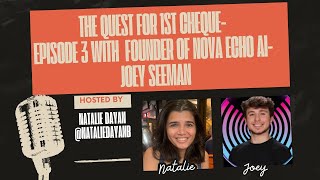
Joey Seeman, 16, built Nova Echo AI to make sales and customer-service calls with conversational voice AI that sounds human. The tech has ultra-low latency of 0.8-1.8 seconds and costs about $0.21 per minute for outbound calls. Nova Echo has 34 paying customers and raised $13k so far, now seeking $5 million.
Chapters
All right, thank you so much, Joey, for taking the time out for being on this podcast. I really appreciate you. Um, I remember going through one of your podcasts and I was so inspired and intrigued by everything you're working on, especially as a young entrepreneur who chose to focus on what exactly makes you happy and what you're passionate about, something which, you know, is very hard for somebody who's young and feels like they need to go about and do something which everyone else is doing. But anyways, that being said, why don't you go ahead and introduce yourself and what Nova Echo AI is all about, the startup that you're working on.
Yeah, thanks for the introduction, Natalie. So my name is Joey Seaman, and I've been working on Nova Echo for the past 15 months or so, and it's an AI startup. So it's an AI that sounds just like a human, and it makes sales calls and takes customer service calls over the phone. And does it flawlessly for a lot of different industries. We work with insurance and real estate and many others as well. And I am a young entrepreneur who decided to leave school to fully pursue this company and entrepreneurship in general.
Um, could you tell everyone how old you are again? Because I, I read about it and I was in shock by the maturity, confidence, and just like ability you have to believe in yourself and what your dreams are.
Well, thank you. Right now I'm 16.
See, it's like the best time to start right now is 16, especially when you are more, you know, you're more in tune with who you are versus the external noise that comes out. But anyways, now that you mentioned about Nova, I mean, Nova Echo, I'm really fascinated to know more about, you know, what's the inspiration behind it. I'm pretty fascinated by the whole, you know, the whole space in general because at one point I wanted to work on a mental health startup, uh, something like, um, Siri, one that talks to you like a friend but is trained by mental health therapist. And I presented the idea during my class and was pretty fascinated by how big the space is and how, you know, it can be so, um, it can just change, you know, people's lives in general. And especially right now, what are you doing? So what's like the inspiration behind it?
Yeah, I mean, there's a lot of inspirations behind it. First of all, I just love the technology. It's so cool. And since I found out that it was even possible, I just wanted to learn more about it and build it and help distribute it because it's going to change the entire world. Right now we're focused on more of a B2B approach. So sales and customer service is what we're mainly focused on. But I think that's where it starts because that's where the most money is going to be made. And where money flows, people flow. So that's where it's gonna start. And then as people start to understand how powerful the technology is, it's gonna start to get into many different industries like, uh, therapy, for example, which is gonna be a really helpful use case for a lot of people because therapists are ridiculously expensive. You end up paying $200 to talk to somebody and as soon as the hour's over, like, okay, bye. That doesn't feel very welcoming, right? So it probably doesn't help as much either and as expensive. Now with AI, You can have a personal assistant eventually when it does have a therapy use. You'll be able to have a personal assistant that you can just pick up the phone and talk to at any point. The personal therapist, excuse me, you can just talk to them at any point about anything. And they don't just have the knowledge that they've gained through their schooling. They have the knowledge of everybody's schooling across the entire world and every single philosopher to ever exist and every single therapist to ever post online. So it's a lot more powerful. It's going to be a better use of your time and money to talk to an AI eventually than it is a human for therapy.
Absolutely. I agree with the on-demand therapist, and I feel like that's so needed at this point because I— therapy, it's like you speak to someone for like an hour and doesn't really help because it's like, you know, just in that instant you feel good. But what about after, right? What about like when it's like 3 a.m. and you have those depressing thoughts and you don't feel like doing things, right? Who do you talk to? But anyways, I'm, I'm curious, you know, how do you go about from like the idea stage to being where you're at right now? Like what's the whole process? How did the whole process look like?
Yeah, I mean, it's definitely a very long process. It's not quick. It's not easy. But once you have an idea, if you have a good idea and you're a good leader and you build a good team around you that knows how to execute the idea, that's 80% of the work, you know? So I have an amazing team. And we have a pretty solid plan and a pretty solid idea of where we want to go and where we want the technology to be. So we know what features we want to add in our next version and the version after that. We know what we want the latency to look like, which is the time when we speak and the AI speaks back. That's very important in this industry. We want it, we know what we want the AI to sound like because I've tested every AI that exists. And yeah, I, you know, I could go and a lot of depth, but I could speak about that for days. It's really just about building a great team and having people in each aspect of the business that can help fulfill on the idea that you created.
I, I mean, I think I read about it like a few days back before I even reached out, and I was fascinated by how you guys are working towards, you know, transforming the whole space for companies and startups in general. Uh, but like, can you— is, is like the goal to replace like sales agents and replace it with AI/voice tech that you're using, or like, what's the, what's the, what's the goal?
So the goal is not to replace anybody right now. The goal is to augment teams. So instead of replacing salespeople, we want to take setters, make them closers. Instead of replacing first-level customer service reps, we want to take them, move them to more complex customer service roles that AI cannot fulfill on right now. So that's where like you have to go in and do custom changes with the software. Like, AI can't do that. AI can just answer basic questions. But that's 80% of customer service. So now 80% of customer service is done by AI, and the 80% of people that you had in that first level can be moved to second and third level, more complex customer service. And that way you can scale your customer service. You can either provide a better service to your current clients, or you can get more clients to provide the same service while spending pretty much no extra money. So that's on the, uh, that's, that's on the support side. On the, excuse me, on the sales side, we can take all the setters. Make them closers, have AI set all the appointments and do all like the basic, you know, follow-up. And then you can scale your setting because you'll have more closers on the back end. And it's, it's much easier to train a setter to be a closer than to train just some random person to be a closer because they already have that sales mentality. So now you're just training them up. You're not getting rid of anybody, but you're also not getting extra people. And we have AI take care of the basic stuff. So that's just augmenting the team. Then eventually, you know, and if I'm talking like 5, 10 years down the line, yes, AI will be able to do that kind of stuff, but there's still going to be some tasks in sales and customer service that people are going to want a human for in the medium term.
Makes sense. So what do you like? How does the whole process look like? Right? Like, how does, how does that exactly work?
So when we're setting up a sales agent, for example, we can program the agent so that it has all the information about the company. We choose its voice, we choose what it sounds like, we choose its inflections, we choose all kinds of stuff. And then we can just send it out and it can either just call through 30,000 leads in an hour, right? Or it can—
That's a lot.
Yeah, yeah, it's exciting. Or what you can do is you can have it call based on something. So let's say every time a Facebook comes in from an ad form, it automatically calls that person and says, hey, I saw you just filled out our ad form. Great to meet you. And it has variables. Great to meet you. Name of the person. I was wondering if you wanted to, you know, hop on a call with somebody from our team so you can learn more. Like simple as that. And that will increase conversion significantly.
I agree. I think that's like a perfect way. A, because that's something which no human can do, like 30,000 calls in an hour. That's an insane number. So that way it's, it's a great way to increase the profit for a company, and at the same time, it's, I think, sustainable slash, you know, what, what, like, what's like the pricing model look like? What's like the business model? I'm so curious to know.
Yeah, so we charge per minute of talk time. That's one thing. So every minute the AI is talking to somebody over the phone, we're charging about 21 cents per minute outbound, 26 inbound, depending on the plan. So we don't charge for dial time. And in a call center, 5.3 hours out of an 8-hour paid-up workday Nobody, or yeah, nobody's working. So 2.7 hours people are working, 5.3 hours they're off the phone. That's the average in a call center. It's ridiculous. So basically what our AI does with the pricing model is you're not paying for the 5.3 hours of nothing. You're only paying for the amount of time that the AI is actually on the phone talking to somebody. And even that, you're still paying less than even like a VA overseas.
I think you're so smart. Sorry, sorry. I mean, I just want to say, I think you're so smart for revolutionizing this industry.
Thank you. I appreciate it. Yeah, I mean, it's such an exciting industry. And as soon as I realized it was even possible that this, there could be an AI to do this, I was just all into it with everything. But so that's the first thing. Second thing is we charge a monthly subscription. So we have an agency program where people can resell our technology and we have the normal program where businesses can come and use it. We sell a subscription for both. And then if you want us to custom build things out for you or give you custom priority support, then we just do professional services for that. So like a white glove done for you kind of program.
Got it. Wow. I mean, I'm fascinated to hear, you know, every time you speak and tell me more about it, I'm fascinated, you know, how you've just managed to, you know, in a way transform this whole space. But I'm curious to know, how many customers do you have right now?
Yeah, we're, we're still a very small company. So we have about 230 on the platform. We have about 34 customers that are on like active subscriptions because, you know, we brought on a bunch early, early stages. Um, so all paying customers, but yeah, we're, we're small. We're looking to grow very quickly. And that's also why we're looking to raise capital now, which I'm sure we'll talk about later on.
Yeah, of course. Um, when did you start, like, like, when did you actually start acquiring customers? Like, because you actually— yeah, so it's, it's pretty good, I'm assuming. December, like, that's for December. It's been a year. Okay, but then still, it's like, you're pretty, you're pretty much in that whole process of knowing, you know, you've tested it out, you know what works, what doesn't work, and now, you know, it's onwards and upwards from there.
Yeah, yeah, we know. I mean, we've built hundreds and hundreds of agents and we've done so much prompt engineering. We've done so many automations. We know exactly what works for people and what does not.
That's, that's the main goal. I mean, once you know exactly what works or doesn't work, it only gets easier from there. So, you know, what's, what's like the whole process look like from like, you know, how do you acquire customers? How do you, how do you go about the whole process of it?
We acquire customers in different ways. I'd say the main one right now is organic content. So that's YouTube, that's Instagram, that's TikTok, that's Facebook, that's LinkedIn, that's Twitter. And just posting on these platforms, people see the content, they're like, what is this? This is insane. They click a link or they reach out to us. We tell them about it. They love it and they purchase it and they start using it in their business.
Who's, who do you say is like your target demographic?
Right now we're going pretty broad. Like we were thinking about going vertical, but we have the agency program. So we have agencies that are very vertical. So we have an agency that is just doing, you know, real estate, an agency that's just doing banks, an agency that's just doing car dealerships. And so we can go vertical through our agency program and we can have one agency that's focused directly on one market and that's what they do, but they're still under the Nova Echo umbrella. Well, Nova Echo as a company can go more horizontal and we can focus on different industries because there's so many different kinds of people that are coming in through our organic content. Main two would be insurance and real estate. That's, uh, that's agents, that's investors, that's wholesalers. On the insurance side, it's life insurance, health insurance, auto insurance. And we also have other industries that we've been talking to, like, um, debt relief collection companies. Banks, like I said, car dealerships, people that sell gold, a lot of different kinds of companies.
So, I mean, it's, yeah, it's great that you have a broad demographic because that way you can target more people because, you know, this is a tech that everybody wants to use and get their hands on.
We actually had one guy that was selling monkeys, literally.
No way.
Yeah.
That's, that's insane. Wait, which country was this? Wasn't based in—
No, it's in America. Um, maybe he wasn't selling in America. He was based in America, but he was selling monkeys. I don't know. But hey, you know, if you need AI to sell monkeys, you need AI to sell monkeys. Who am I to tell you not to, right?
Of course, make the most of what you get.
Mhm.
So what do you— what would you say is like the mode of your startup? What differentiates you from other startups out there? Because there's so many startups that use AI, but then, you know, what is it that you would say differentiates your startup from other startups out there?
Yeah, so I mean, we're already pretty niche just because of the nature of our business. So we have either startups, software startups, AI startups, voice AI startups, conversational voice AI startups. That's what we are. So we're very specific in what we do. There are other conversational voice AI startups. So if we're talking moat in that specific niche, then there's a couple of things. So one, on our tech, on the tech side, we have some features that no other company has right now, at least not that I've seen. One, and this is in our current version, we're, we're building our 2.0 version right now, which is going to have a ton of new features that we haven't seen anywhere. So that's very exciting. And I'll talk about that in a second. But currently we have a double call feature. So it calls people twice in a row to get past Do Not Disturb. That's big with, with real estate insurance specifically. That's very big when you're doing outbound. And then we also have very low latency. So a lot of our competitors have like 2 to 5 second latency. We've got down to 0.8 to 1.8 seconds, and it's going to decrease significantly more in 2.0. And we also have very realistic voices because of the tonality. So there's a lot of inflection in the voice. It goes up, it goes down. And actually, when we release 2.0, I can't talk about all the features, but there is one that we are going to be releasing a feature where people can adjust the tone themselves manually. So in the script, they can choose which words should be higher tone, lower tone, where there should be pauses, and they can do that in a very consistent format. So as I talk, I go up, I go down, and that makes me sound human. Robots just talk like this. They sound monotone, right? Nobody likes that. So when you can control that, it's powerful. Right now in voice AI, most companies, the AI will use inflections in the wrong place. So it'll say like, hey, how you doing? It sounds weird instead of, hey, how you doing? Right? The doing is where you should go up. That's just how humans speak. That's how English works. So being able to control that is very important to making it sound realistic. We've thought a lot about that one alone, and there's like 10, 20, 30 that we, that I have written out personally. I haven't even shared all of them with my team yet because it's too much right now, but it's very exciting. So our 2.0 and 3.0 version are going to have bigger technology modes. As for the distribution, I have not seen a ton of companies do organic social media content like on YouTube and really be the leaders in teaching people how to integrate and use conversational voice AI employees. That's what we're doing. So when people look up conversational voice AI on YouTube, Nova Echo comes up because we're teaching people how to actually integrate it before they even buy our product. So that's also, I think, a big moat in distribution.
Is the, like, I'm curious to know too, you know, how does the integration process look like? And do you think it's seamless? And two, like, how do you go about training the data to make it, you know, it's like, how do you go about sounding it more real, more human?
Yeah, so I'll kind of combine those. So the integration process, at least on our done-for-you, so the white glove service, excuse me, the client signs up. Have them fill out a form with all their information about their business and a possible script, example script, example, um, knowledge base, which is questions and answers if we need it, right? Then we'll go into the employee, the AI employee, and we'll start programming it. So it's prompt engineering. We're gonna teach the AI what it's supposed to be doing, what its name is, what its job is, what company it works for, why it's doing what it's doing, what it's supposed to be saying. We're gonna give it a script. We're gonna give it Q&As. That's how we train it. It's prompt engineering right now. We're going to be adding more complex ways of training models in the future, but right now prompt engineering does a very good job and it's very simple. And then we adjust settings, we choose a voice, we choose a phone number, we finish the agent, and then we connect it via webhooks to the client's CRM and we set everything up. So when a lead comes in, automatically calls, or if they want to call 10,000 leads, we set it up so all they have to do is click 10,000 leads, click start call, and it calls everybody. So that takes some extra programming as well.
But yeah, well, I mean, I feel like you've studied this space inside out. So like, like how, like how did, how did you go about from like, you know, how do you go about studying this whole space and like why do you think you're like the best one to work on this? I mean, I see it, but, you know, I would like to hear that from your own words.
Yeah, of course. So, well, I started in this space super early compared to how long this space has been around. Like, I was one of the first people to commercialize conversational voice AI, one of the very first. And I did it to a very large extent for the time because it was a year and a half ago, which is pretty recent. But for this industry, it's actually not recent at all. It's a long time. And I've just been in it longer than almost everybody else. So that's one thing. And I've also, I'm also obsessed with it. So even if somebody's been in it for 2 and a half years, which like barely existed then, like just starting to, you know, exist. I have spent pretty much every single hour of every single day for the last year and a half obsessing over it. So I've kind of just understood every part of the space. Second, obviously I keep a very close eye on all of our competition. And I know a lot of the other founders as well because I've just gotten to know them personally as we all progressed. A lot of the great people in the industry. And why do I think I'm the best to work on it? Well, I think that my team is the best to work on it. That includes me. I think I'm the best leader for my team. And I think my team is full of very smart minds. And we have some of the, I think some of the greatest technologists in the industry, at least in conversational voice AI, maybe not in voice AI, because they hire all the Google guys and the X, you know, whatever, whatever, but we're not competing there. We don't want to build the best voice AI models. We don't want to be a research lab. We want to be the best at bringing conversational voice AI to consumers, to business owners. Excuse me. So that's what we're the best at. We have the best technologists when it comes to the experience of a customer. We have the best fulfillment team when it comes to building AI agents because our fulfillment team has been doing it for extremely long when considering how long this industry has been around. And we have some of the best salespeople as well because we've taken thousands of calls and who else has taken thousands of calls for conversational voice AI? Almost nobody.
You've done your research pretty much enough and have, you know, kept your eyes on enough to know what exactly is happening, which I think is like the most key factor when it comes to, you know, like making sure that you're working on something which you're staying ahead of the competition and at the same time you're educating, you know, yourself enough to know what risks might arise in this, you know, with your startup, and just stay ahead of the competition. I also like how you've built your team around to make sure that they are the best in the game, even though they might not come from Google or Amazon, but they're young. And having a lean team and somebody like you who's a great leader makes a huge difference. So yeah, thank you for sharing that. Do you— I mean, I'm curious to know, do you guys have like a patent on the technology, or are you like working towards it?
Yeah. And, uh, also just to say one more thing on there, we do have a younger team when talking about AI, but our, our team ranges from my age to in, you know, 50s. So we, we have a lot of older people on our team and we, I did, I brought older people on our team so that I would have that older wisdom while still also keeping the team with that young energy. Right. So we want both. And that's important. But I actually think that that combo is extremely important and most businesses don't have it. A lot of businesses is all young, they don't have that wisdom and a lot of businesses are all old and they don't have that energy and the drive to move as fast as we do. And as for patents, no, we don't have any patents right now. Yes, some of it is patentable. To be honest with you, like if we tried to patent conversational voice AI, it's not going to— it won't do anything because it just won't do anything. There's going to be plenty of companies that create conversational voice AI. A certain model or a certain feature we can absolutely patent. So that's what we're going to be looking to do that as we move into 2.0 and 3.0 in our platform. But a more broad patent over the industry in a whole, no, that wouldn't work.
But that's a great— I mean, that being said, that's a great approach. I mean, like when you spoke about building a team, I think that's a great approach to have people who are younger and older, you know, be together and learn from Because both of them have something which one of them don't have. So I think that's like a great approach when it came to building your team, which is, I think, super important when you want to get far ahead in the game and want to be in it for the long run.
And also with that, I actually think, and I never even really thought about this before, but I think that ideally the young people should be the one making the final decision and the old, older people not old, but older people should be the ones advising. Because if you have an older person that's making the decision, they're never going to listen to the younger person. Let's just be honest, right? So the younger person doesn't have a way. It is just a team of older people. But if you have the younger persons making the decision, they will listen to the people that have more experience than them, and they'll take that into account, but they'll still make the final input. So I think that would— that's a better scenario in almost every company. I mean, well, There's some exceptions, but yes, I think it's a better solution.
That works for your company, right?
Yes, it works very well for us.
Okay, so probably it could work for someone else as well, given that they tried it out, which I suppose is not really easy. But, you know, if you build a great team, I feel like, and if you know exactly what you want and where you're headed, I think it should be. Yeah, I don't know.
Yeah. And young is like 30 years old too. So I don't necessarily mean my age, like having a 30-year-old make a decision while a 60-year-old is advising him versus the other way around, you're going to have more input that actually goes into that decision because everybody's going to listen to each other that way.
I was going to say to you, you should mentor young people, but then I realized I think you already do that, right?
Yeah. Yeah. So I also run a club called the Triple W Club, and we, we basically throw events and we help younger entrepreneurs ages 16 to 30 grow their business and network and learn. So that's also very exciting.
That's crazy. You're also giving back. That being said, I had a few quick questions before we jump on to fundraising. I was wondering, how do you deal with privacy concerns?
Yeah, so we don't sell any of our clients' data. And right now we use— we don't yet have our own LLM. I don't know if we will. I'm still thinking about it because it may not be the best move. I know some other companies have done it. I don't think it's made such a big difference for them, and I've researched that as well. But anyways, we don't have to worry about privacy concerns on that end so much because we work with trusted companies already. So really, we have partnerships. We have some agreements with cybersecurity companies that are going to help us continue to make sure that all of our clients are safe. And we don't sell any of their data.
All right. Okay. So moving on to fundraising, because you also mentioned about the new features that are coming up. So I think, you know, that's like something we just covered. But like my next question was, how much have you guys raised in the past and what are you looking to raise at what equity?
So we're completely bootstrapped right now. We, we did raise a small friends and family. We're actually, well, still in the middle of it. We haven't taken any money out. Yet though. So small friends and family raised about $13,000 so far. Just, I think we got like 9 checks, you know, right now we're looking for institutional capital. So much bigger checks, we're looking to raise just under $5 million. And that can be done through crowdfunding. But ideally, institutional capital would be a lot quicker that way. So yeah.
So how much are you looking? You said how much are you looking to raise? But like at what equity? And you know, what is it that you're looking for in a VC?
Yes, well, we discuss terms directly with each investor. But what we're looking for in a VC is somebody who is willing to or comfortable giving money and trusting in the people they invest in, because that's what they're doing. If they invest in us, they're trusting in us to make decisions. So there's a lot of VCs that will, you know, trust in somebody to make decisions, but then they want to make the decisions. And that doesn't work because these VCs do not have as much time as I do in this industry. They have not been here since the beginning. They do not understand the company as well as I do or as well as anybody on my team does. So they should not be making decisions for it. They can have the input, right? That wisdom, that older wisdom, because they've seen so many companies fail and succeed. But at the end of the day, they need to understand that the decision is being made by our team. So that's very important to me. And I also would love to have a VC that does input because we do want help. We do want that wisdom. We just need to be the final say.
Got it. So like, what do you plan on— how do you plan on using the funds?
Well, we have a use of funds. It breaks down exactly how we're going to use the funds, but generally for development, for support and customer service and fulfillment and administrative costs, and then third for marketing and getting ourselves out there. So that's throwing our own events, sponsoring other events, ads, organic content, a team to help create organic content quicker, easier, and better, and, and stuff like that.
I think that's a great marketing strategy. One last question, uh, what's the inspiration behind the name, um, of your startup, Noah Echo AI?
Okay, so the name, uh, or the inspiration I tell everybody is that Nova is like a bright new star and Echo is the spreading of sound. So it's like a bright new way to spread sound. Right. Really? I mean, that sounds great. And it is. That is what it is. But really what happened was I used to be obsessed with this video game called Echo and the domain cost—
Oh, I know of it.
Really?
Yeah.
Yeah. And the domain cost $4 million. Actually, it was, it was like a VR game. It was probably— there's a couple, I guess there's a couple called that. But anyway, the domain cost $4 million and Nova. I've always loved astrology. I love the idea of something being new and bright like a star. So in that aspect, I did like the name and then I just combined the two.
I mean, at one point I was thinking of naming my startup Nova, and so I was like, okay, well, this is taken now. But after me, I start up something else. But yeah, any— before, before we hop off the call, is there anything that you wish to ask to— anything that you want to share with our audience, with the VCs, or with anybody who's listening?
Not right now. I mean, there's going to be a lot of cool projects that we're working on in the future. Actually, one thing, we are going to be partnering with another brand soon, and we're going to be teaching people how to start a conversational voice AI agency and grow it to be making a lot of money every month. So that's going to be really exciting and we're going to be launching that soon. But yeah, there's more information on NovaEcho.ai. We're on all the social medias and thanks for having me.
Of course, thank you for doing this and really appreciate you for taking the time off for this and I wish you the best of luck and I'm sure you're going to kill it out there.
Thank you, we will.