Episode 5- Founders of Rezora
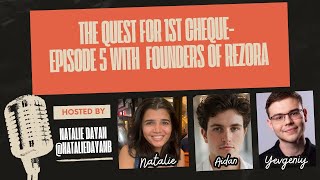
In this YouTube interview, host Natalie Dayan talks with Rezora co‑founders Aiden and Yevgeny about their AI‑driven platform that automates cold‑calling and follow‑up for real‑estate leads. The founders share their personal backgrounds—Aiden’s sales and fintech experience and Yevgeny’s computer‑science and real‑estate work—and how they met via Y Combinator’s co‑founder matching service. Rezora is presented as a verticalized AI solution that fine‑tunes a large language model (LLM) with synthetic conversation data to sound more human and sales‑savvy than generic GPT wrappers. The product workflow includes subscription sign‑up, industry and lead‑type selection, AI‑agent choice, personal profile input, script‑like instruction tweaking, scheduling, lead upload, and automated calling; positive lead sentiment triggers calendar notifications for the human agent. Technical innovation centers on a custom synthetic data generator that creates high‑quality mock calls, which are filtered (score ≥ 8) and used for fine‑tuning. The team highlights early traction: a six‑week pilot in October with ~50 users generated $38,000 gross revenue. They discuss the competitive moat—industry‑specific fine‑tuned LLM versus generic CRM, outreach, or wrapper tools—and upcoming features such as SMS and email integration. Target customers are experienced residential agents (10‑20 years) reached initially via Facebook ads and founder networks, with plans for product‑led growth, channel partnerships, and referrals. Rezora is seeking a $1 M pre‑seed round at a $10 M valuation, emphasizing the value of investor relationships beyond capital. Finally, the founders envision a future where hyper‑specific, proactive AI voice agents dominate niche industries, with fully autonomous agents emerging in the next two years.
Chapters
First of all, thank you all so much for taking the time out for this. I'm Natalie, this is Aiden, and this is Yevgeny, founder of Drizora. I came across y'all's LinkedIn, I think probably sometime last week, and then I was pretty intrigued with what you guys are working on because it's pretty niche. I'm not going to go ahead and say this because I feel like y'all can do a better job at explaining what this does. But anyways, without further ado, could you tell us more about who y'all are and, you know, what's your background and what inspired you all to work on Resora?
So I've been working in sales for the last 2 years, I guess 4 years really. I have started some small companies in the past, but Resora is my first full-time startup commitment. Grew up in Boston originally, I was working in politics, I tried real estate, and then I got into fintech sales, and now I'm back in real estate with a combination of, what Resora does along the AI guidance lines. So that's a little bit about what I've done, but I'm happy to jump into anything else.
Githianai, do you want to go ahead and introduce yourself as well?
Yes. So my background involves, I went to college for computer science and I did real estate for a little bit of over 2 years. And during my real estate towards the end, I decided to start Resora because I did see a big gap where real estate agents and just any sales professionals in general had to cold call and follow up with leads. And I just thought to myself that there's definitely a better way to do this and automate it. So that's where the vision of Resora was born.
Now that we spoke about Resora, I'm curious to know what is exactly Resora and what's, you know, what does it do? You know, if you all want to give like a one-line pitch on that.
Yeah, absolutely. It's an AI platform with multiple AI agents that cold calls and follows up with real estate leads.
Okay, and what was the inspiration behind the name Resora?
So RE is real estate, and Zora in a lot of Slavic languages is almost like new beginning, new dawn. So that's where the name came from.
I love that. Um, I was, you know, I was pretty— I mean, I was curious, you know, how do you guys meet? And, you know, how do When did you all start working on Resora and get to where you're at right now?
Story. So Yevgeny has been working on this for about a year. I met him back in February on Y Combinator's co-founder matching platform, not the actual Y Combinator incubator itself, although hopefully that'll happen to us in the future. But we've been working together since February after just meeting online, having a few conversations and realizing that we're a really compatible fit and both real estate agents in the past.
Okay, wow, I love that. So Y Combinator matching app actually does work.
Rarely, I think.
Surprisingly.
Okay, let's say— Wait, sorry, I got you off. What were you saying again?
I was just saying it's great in premise. I recommend it for people who are looking to cook up something.
Okay, I love that. So y'all's So you said Evgeny worked on this for about a year and you guys met in February, so.
[Speaker:ALBERT] So yeah, I was gonna say the idea was born almost a year ago. So the idea was born in around July, but we really started implementing it, I wanna say in September, October. We got positive feedback, but we just had so many people joining on and I had to build out each AI agent independently that I had to stop and make a centralized platform where people can just log in. People that are not technical at all can get an AI agent set up in 5 minutes rather than paying. They, we would charge a good hefty startup fee plus monthly fee plus credits, and I wanted people to be able to afford it too. So that's where, why we've been working so long on this so we can integrate all the parts and also to appeal to people that don't have any prompting knowledge.
Okay, so I, I mean, you know, I love that you guys are working on this and, you know, it sounds like a pretty, you know, big enough of a problem to solve. But I'm curious to know, how does this exactly work and what exact problem are you looking to solve with this?
So the exact problem in sales across all industries that involve sales, so even car sales, real estate, but we are focusing on real estate right now, is to actually cold call and reach out to leads. So a a person that, for example, my specialty was expired listing leads. So houses that couldn't sell before, and I would go in every single day and call these people. And the thing is, it's very draining. You forget to follow up. And instead of hiring someone overseas, paying $2,000 a month and training them, you have an AI doing it for you. And what makes it stand out is the actual AI itself. It's not a GPT wrapper where we just give a prompt and say, oh, please close this lead. We actually fine-tune our LLM model so it has more salesmanship, sounds more human, and has a higher chance of converting said lead.
Can you give me like, you know, a step-by-step flow of, you know, how does it, you know, how does it exactly work?
Absolutely. So I can give you a step-by-step of the user journey essentially. So once they pay for the subscription, they sign up, they select first what kind and what industry they are. So we're in the real estate industry, but we also, we cater to real estate agents, brokerage owners, wholesalers, investors and mortgage loan officers. After that, they choose what AI agent they want. Why? Because different people in these industries will target different leads. Some agents will target pre-foreclosure leads, buyer leads, whatnot. Let's say we're going with buyer leads. They picked a buyer AI agent. They fill in information about themselves, so they can fill in, oh, my name is Randy, I've been in real estate for 10 years, stuff like this, so the AI can use it in conversation if people ask. And then they can also modify the script a little bit. But after that's done, they set the calling hours. So I wanted to call from Monday to Friday at 9 to 5 PM. Okay, cool. Sets it up. Once that is done, they upload their leads, their buyer contacts, they launch the campaign, and it just runs. Once the AI agent gets a positive sentiment from any of these leads that it calls, and let's say someone says, yes, I actually am interested in buying a house, let's go, I want to meet with this real estate agent, the person, our user, gets a notification, their Google Calendar, oh, you have an appointment for 3 o'clock on Tuesday. And that's pretty much it.
So I mean, I'm curious to know, I mean, correct me if I'm wrong, so the, the AI handles the first call, or is it the, the person who works at us? AI handles the first call. Okay.
AI handles all the calls.
Okay. And the script for this is given by the user? Is that right?
No, no. So we have— it's not even a script, it's a set of instructions that we already gave the AI plus our fine-tuned AI model, the LLM model. But the user can go in and tweak some certain parts of these, uh, instructions essentially. So it's a step-by-step flow. For example, ask, uh, we'll prompt AI, ask the lead to— ask the lead if they ever thought about selling. So the user can go in and put something else instead of like, as the lead, how are they doing? Very simple things they can go ahead and tweak.
The data for the customers or the people the AI is calling, does that come in? So where does that data come from?
So our users in any sales industry, but specifically real estate, people have their own leads, they have their own lead source. So people will do Facebook ads, expired listing leads, pre-foreclosure leads, all these type of leads. So they choose what type of leads they want from their own source, and then they upload to our system. They pick which AI agent best suits their lead type, and then it goes ahead and cold calls.
Okay. Wow. That sounds very interesting, especially since the first call is handled by AI. So I can only see how big of an impact it is creating for a specific company because they don't have to focus on cold calling all these people over and over again. Which is, I know I worked in sales and I know how big of a pain that is because—
Exactly.
It's insane. It's too much for people to handle.
Even for me when I was doing it, after 2 years I felt like, oh my God, I'm going insane.
I'm curious to know, how do you, like, where do you get the data for, you know, for building the whole script for this? And also, how do you all make it sound as natural as a human being? Could people actually tell if it's a human talking to them or if it's an AI talking to them?
Really happy you asked that question. So for the data, for the way we prompted, best to say is it's not like we went ahead and found the best data because prompting is a little different. What we did is we did months of backtesting on specific prompts. We found which ones work best. Boom, it's done. The more important thing is we actually create a synthetic data generator for fine-tuning the LLM. So it's very hard and very expensive, especially for a startup like us, to go ahead and get cold calling transcripts of professional agents, right? That costs tens of thousands of dollars. And I was also looking into it. I could buy synthetic data, but that's also $10,000, and I don't want to pay $10,000. So I coded out a synthetic data generator. It took me a couple months to do, but it's basically a prompt approving agent and it generates these synthetic data conversations. We have another AI that checks which one is the best. So on a scale of 1 to 10, anything above an 8 gets passed on to fine tuning. We take that data, boom, we train the LLM on it so it sounds more human, more natural, and has more chance of closing the lead. So most of these other companies, I'm not trying to talk bad from what, but what But from what I've seen is when they call an API like ChatGPT and the lead says, no, I'm not interested, ChatGPT will say, okay, no problem. Thank you for your time. Our AI has more salesmanship. We'll say, oh, but let me ask you this. What is stopping you? Like little things like this that overall makes a very big impact on lead conversion.
It's definitely very fascinating, just like the whole process of, so I mean, I, I mean, you know, I'm curious to know, like, you know, I know you'll have You know, you're all short on time, so I'm not going to keep this super long. But like one last question on just the product in general. How long does it take for you to work on, like, you know, work on this? And also, you know, why real estate? Because there are a lot of companies that are working on something similar, but you all are pretty focused on real estate, which I found is very fascinating and I think is the mode of the startup. And is what makes it all the more scalable, scalable. But you tell me, since this is something you have been working on for quite a bit of time.
So when I just thought of the idea of, oh, let me automate this for my business, let me, because I don't want to cold call and I don't want to train someone, let me automate this. I was looking for AI solutions, but the problem was you're absolutely right. There's a lot of companies doing the same thing, but none of them are hyper-specific to a certain industry. All of them. From what I've seen, I could be wrong. They just are ChatGPT wrapper. They don't fine-tune their LLMs, they don't train their LLMs, they don't care about training their LLMs, so they don't care about the quality that the customers get at all. So that's where we came up with the idea for real estate. I was a real estate agent, of course, but on top of that, I wanted to make the AI essentially smarter. It's the difference between me reading off a script versus me studying and getting coached for 10 years. If that makes any sense. Oh, but why real estate? Because it's the first stepping stone where we can actually fine-tune the model, make it hyper-specific, extremely smart, and give it better conversions versus make it vertical industry, every single industry, and then it's not going to have the best conversion rates.
Okay. I love that. Especially given that you come from a real estate background, it complete— both of y'all, honestly, it makes complete sense. Okay. So I'm not going to ask you more questions on that because I think pretty much that answers the questions I had. Um, I'm curious to know what's like the pricing model of this and how many users do y'all have right now?
I would say the most surprising thing is honestly how enthusiastic people are about using it, because you'd think in the abstract, you know, there are all these concerns about artificial intelligence. Is it going to take my job? Is it going to diminish the quality of the relationships that I built with my customers? Things like that. But almost every real estate agent that we brought this to is like, oh, this is fantastic. This is exactly what we need. It's such a time saver. It's so cost efficient. So, you know, getting that positive feedback, especially when we're so early in the startup process, has been not only really surprising, but also really rewarding. In terms of users, we don't have anyone on the platform right now. We were live back in October for a while, and there were about 50 people that were using the platform over the course of around 6 weeks. Right now, we're just looking to bring on a small select group of alpha testers to give us some product feedback since we've reworked the model. Since our October launch, but then we're looking to go live hopefully in about a month from now. And then we'll just be bringing people on as quickly as possible and as many people as possible.
It was just in 6 weeks we were able to generate $38,000 in gross income from 6 weeks from those 50 users.
Okay, that's really great. That's a big thing in itself. And especially, Aiden, that you mentioned that all the users that you had mentioned how how much of a problem this was and how it's solving their problem, which I think is big because having that sort of user feedback and just awareness that, you know, there's something that's just helping people and it's because it is ultimately built for the people. I think that's a, you know, that's a sellable point. And, you know, I'm sure that once you all launch back again next month, it definitely will, you know, be big of a deal once more people use in because the more the people use in, the more the, you know, the natural word of mouth process goes by. And, you know, the more you all will be able to scale your platform. But anyways, I was wondering what's like, you know, what would you say is like the moat of your startup? Or like, what is something that you feel differentiates your startup from the ones that are out there?
Like Yevgeny said, there are kind of 3 buckets in terms of the way that our competition is structured, but no one's doing quite what we're doing. So there are companies that handle existing lead coordination, essentially a CRM, but they don't do outreach themselves. There are companies that offer outreach tools similar to phone calls, but not phone calls themselves. So texting, ad management, emails, things like that. And then there are companies, generalized wrappers that offer a sales phone call. But like you've said, they're not trained enough or sales-specific enough to really be able to close the deal. Like if someone objects on the phone, the agent is going to go, okay, that's nice. Have a nice day. And they're going to hang up and give up. But Resora, since it's specifically trained on real estate information, it can answer those complex questions and it knows how to actually close the deal.
Kind of reminds you of Landaire, except it's a little bit more customized. More customized, exactly, because y'all are focused on real estate. Also another question, how would you, you know, what's like, are there any product features that, you know, the users, your target customers should, you know, look out for in the next few months?
So we are going to be adding text message and as well as email integration. So an AI that will go ahead and send market updates, text messages confirming the deployment and whatnot. The only reason we have not implemented that yet is because we don't want to use the regular chatbot that a lot of companies— they'll just use a very basic chatbot that plugs into ChatGPT API and will just ask very generic, very basic questions. Once we are fully done with this launch and then continue fine-tuning our model, we'll go ahead and integrate it with text messaging and email services. It can be perfect.
Amazing. Um, y'all mentioned that y'all had 50 users before and plan on getting in more users. I'm wondering who exactly would you say are your target customers and how do you, how did you reach out and how do you plan on reaching out to them in the future?
Our ideal customer is someone who's an experienced residential real estate agent, ideally 10 to 20 years just so that they really understand the market, they understand how to sell, and they're looking for that additional edge that Resora can give them. It's a lot harder if you're coming into real estate and you're just starting out to use Resora because you're not going to have the lead lists and the quality and the market insight that Resora kind of augments. Um, in terms of bringing users on, originally we were just advertising on Facebook and that's where we got that first 50. Right now we're just kind of using our founder networks, having a lot of conversations, going to a lot of networking events, and just getting raw feedback as we talk with people in person. But down the line, we're looking at building out a really aggressive product-led growth platform, channel partnerships, referral programs, and then just general cold outbound sales.
Are you all looking to raise any time in the near future? And if yes, how much? And, you know, like what equity valuation?
We're looking to raise around $1 million at a $10 million valuation for pre-seed. And we're just kind of kicking that off now. So we're having some early conversations with investors, gauging their feedback on Brazzora and kind of what they would want to see from us, what we can do to get properly aligned. But yeah, we definitely are.
Okay, great. So what would you say, you know, you're looking for an investor, you know, what value would you see them adding beyond capital?
I'd say the most important thing outside of the investment itself is the relationship that we get to have with them and the relationship that they build with us. So making sure that they're not only just an investor, but actually a partner, we can go to them for feedback, we can go to them for recommendations. You know, should we do this over that? You know, every single day there's 10,000 questions that come up as we work on this. And it's, it's kind of, it's not impossible to know what it is that you're supposed to be doing. I think we have a really good direction that we're heading in. But to get that feedback, especially from someone who already is interested enough in the team that we've created here and the product to give us that additional feedback is really essential.
I mean, if you know, since, since you're like raising, looking to raise, what would you say is the risk involved in investing in a startup like yours and how do you plan on mitigating that? I know that's like a heavy loaded question. Yeah.
Um, I, I mean, the risk in investing in Resora is not necessarily greater or less than any other startup that you're investing in for a pre-seed company. I mean, You know, if anything, I would say it's a little bit less because we've already been on the market, we've had customers, and we've generated a decent amount of revenue, which is incredibly exciting. You know, startups fail, things don't work out, but I'm, I wouldn't have kind of, you know, I wouldn't have quit my job and dedicated myself to the startup and Yevgeny wouldn't have done the same. We didn't believe in the product and the future that we're building here. So I'd like to imagine that the risk is as low as we as low as we have possibly made it.
Okay, I love how you sold saying that you guys are all in to the startup and wouldn't have bet on, bet on the startup and just call in had you not believed in it. And I feel like most VCs, um, bet on founders versus betting on the startup because anybody can build this, but why are, you know, why, why are not better at working on this versus anybody else. And that was my question, and you all answered that, so I'm glad you all did. If I was a VC, honestly, I would invest in this. So you all pretty much convinced me, except I don't have the money. But in the near future, whenever I do, I'm sure this will be a startup I would invest in. Two quick questions. One of them is, what would you say is the future of AI voice tech in How does this or INT, you know, integrate into it?
I think we're onto something very early. Right now we have the big giants, Google, Anthropic, OpenAI. They're all competing to be the best either in general information or they're competing to be best at coding, right? But in the next coming years, next year or two, there has to be some hyper-specific niche AIs that come out for people in specific industries. And so that's why we're also going down the path we are is because just from a logical standpoint, we can't just have a general AI for the— so the public can just talk to it normally and just coding just for the programmers out there. We're going to have to see AI emerge where it targets specific industries and it excels these specific industries. So that's where I think AI is headed, where we're going to be seeing more hyper-specific LLM models and they're going to assist in a lot of these niche industries that it can't do right now. And we are also— well, I'm really excited to see it's probably in 2 years' time, we're also going to see fully autonomous AI agents where you give it one command and it'll go do the task until it's completely done. You can technically do it right now, but sometimes it gets stuck in loops and it can crash, whatever you want to call it. But in 2 years, I think that's going to be perfected as well.
You say more proactive AI versus reactive AI will be the future?
Correct.
Okay, I mean, sort of, but I know hyper-specific LLM models is something which everybody's been speaking about, and that is something which the world is heading towards. So I can definitely see how you all integrate into it. One last question: is there anything else that, you know, is there anything that you all wish I asked? Or if not, you know, feel free to, you know, say whatever you all feel I should have asked you all.
I'd say no, this is a pretty good summary of kind of how everything is going. Like, you've got the past and the present and the future.
Okay, I'm glad.
You got it. Thank you so much for your time.