Old School Agency NEWSLETTERS that BUILD TRUST with Nate Kennedy | Ep #642
Transcript of a Smart Agency Masterclass episode featuring Jason Swank interviewing Nate Kennedy about using newsletters as an owned audience and revenue channel for agencies. Covers newsletter content strategies (curated vs creator), recommended frequency (daily for curated; 1–3/week for creator or agency use), AI-assisted summarization, sponsorships/affiliate monetization, and list-building tactics like one-step funnels and polls.
Chapters
The newsletter business to me was my way of finding another revenue stream inside my company that didn't require max amount of my time and allowed me to also, you know, as an agency owner, it's also going to allow you to better communicate with your clients because the next person's right behind you trying to pick them up for you for cheating.
What's up, agency owners? Jason Swank here with another episode of the Smart Agency Masterclass, a podcast for the agency owner that wants to scale and grow faster and really kind of get the freedom and really kind of get out out of that agency burden and create a true asset that you have freedom, wealth and predictability. And on today's episode, we're going to talk about newsletters. Now don't kind of hang up yet. And, and I know kind of a lot of people have bad taste in their mouth from newsletters, but this is going to be a story that you're going to want to, to listen to. So let's go ahead and jump into it. Hey, date, welcome to the show.
Hey, what's going on? Happy to be here.
Yeah, man, excited to have you on. So tell us who you are and what do you do?
Oh, well, Nate Kennedy. I am a dad by day, emailer by night. No. So the history of myself real quick is I'm in the. I used to have a marketing agency. Been in the Internet marketing space since 2006. All the, I guess the accolades have spent over $100 million for my clients, mostly my clients at the time, and then also for myself. I got tired of the agency business, so I reinvented what I was doing because it was taking up too much of my time and I was spending less time with my family. So I wanted to reinvent myself and moved over to media company and building out newsletters for ourselves and built my life first and then my business to support it.
So nice. I like that. You know, it's a lot of us are accidental and kind of gotta get drawn into the business and then if you don't start designing it the right way, it can really kind of create a good wall or a prison around you. Let's kind of jump into it and talk about kind of newsletters. You know, I was telling you. And then I kind of shut myself up before I hit record, I was like, you know, we're just kind of redoing our newsletter. Like I always felt like. And here's the impression a lot of people feel about newsletters is if you see a bunch of images and all this stuff, it's too busy, it's just spam and just delete it. Rather than getting a regular email with like personalized text being like, hey, are you a redwood digital agency and you want to grow or whatever it is. Help me with the belief of going, making sure I'm going in the right direction with our newsletter because we are putting some graphics and, and kind of recapping the week and that kind of stuff. So set us on the right path.
Got it. So for me, when I look at a newsletter, I look at what content are we delivering. So for me a newsletter is helping somebody within a specific niche or industry and providing value to them. So a lot of what we do is you can do one of two ways. One, it can be your thoughts, your insights, your content that's helping them get better. So or it could be curated content for that industry. So for example, in our financial newsletter that we own, we curate financial news for the consumers. So it's consumer products on the financial side. Right. It's not business B2B or anything like that. Or we're just teaching consumers how to actually become financially smarter. And so we're curating a lot of content across the web in different segments to help them get a five minute read every day. That's going to level up their knowledge and become smarter. Right. And so that is different. We're not writing all that content, we're curating it and we use AI a lot inside of some of that as well to help that content. But then I also have a newsletter that I, that I have for entrepreneurs and founders. Really just my insights and my thoughts. So what I'm thinking it's more personalized where I am writing that stuff and I am sending it out. Right. So there are, and part of that, what you just said is on your newsletter and there's not a ton of images in that stuff. We do have some, but it's not, it's not like a E. Comm style product newsletter. Right. It's going to have a bunch of imagery and everything else. We don't have that. It's true valuable content that your person that you're emailing can gain value from. Right. And it helps position you more as that trusted advisor, that expert, the person that they want to listen to and gain information from. Right. So you're taking something, doing all the heavy lifting and making their life easier daily. Right. So it's gotta be valuable content, not just pretty graphics.
For sure, if you have a target audience, a specific audience and you know their challenges or what they Want. You can either curate at all, you can write from your personal thoughts, or you can do a hybrid of both and kind of put it all together. What's the amount of time between newsletters that you send out that you found the most successful?
So our most successful, most profit will go out daily.
Daily.
So we. Yes, and now those are curated.
Okay.
So I call. You're either the curator or you're the creator. Right. And so the curated newsletters go out daily, at least six days a week. And our ones that were creators, they go out less. I send, I send my, where I'm a creator, I send one on a Tuesday and then I post a lot of content online. So I, I take all those links and I put them in a digital roundup every week. And so I'm sending that content to try and get to our newsletter so they can kind of also start seeing us, seeing me in other platforms. Right. And ideally now when they get a newsletter for me on Tuesday, they see my new video on Wednesday, but kind of, you know, build more, more rapport and trust. Right. So, you know, for me it depends on what your goal is at the end of the day. Like so our newsletters that are brand based, that aren't like expert based. So we have a bunch of conservative newsletters we send seven days a. But we have advertisers in them seven days a week.
If you had to go back to when you were running your agency, what kind of newsletter would you create? How often would you send it out?
Yeah, if I go back to owning my agency, I would use a newsletter in our way that I would have. I do the two model. I do two a week, two to three a week max. Because you don't want to overkill because you're, you're, you're mailing to your clients. And so really. And I also would leverage the model where you said kind of a combination, right? So a hybrid. I'd have some content I created in it and then I would also have some around the world, kind of around. Around the world of marketing section. Right. And things that are happening and updates that are going down in regards to Facebook's changing this, you know, they're now meta, right? It's now X. Like I would give those updates of what's happening in the space that's going to have a positive impact on them. So they, they know what's going on. So they understand also on the back end, like, hey, we're back here working. We're not only doing the work for you, but we're in the trenches researching this stuff, making sure we're staying ahead of the game and we want to make sure that when we're together, you're staying on the same page as us and understand these changes are happening too. Right. So I would go more along those lines twice a week. But it's, you know, in one that's kind of here, you know, marketing and review marketing for the week if depending on what it is niche you're in. Right. Obviously agents can be a bunch of different niches but you want to make sure that it speaks to them. And then two, I would also, if you're creating a lot of content of your own as an agency, I would do a digital roundup that kind of puts that information in front of them as well.
Which do you find gets more of a click through or engagement? Is it ones that are kind of a sum up from the week or kind of the emails that are more to the point?
So for us we get similar opens across the board. But the way we structure Digital Roundup, we're getting more clicks because you're dealing with bullets, hyperlinked bullets of like the content that you put out. Whereas if you're doing a hybrid model where you have your own content, it's going to be more of a traditional email that's got maybe it's got a larger summary that drives out, maybe it's got a full email breaking down a specific insight and then underneath it you're going to have maybe your bullets of different hyper, hyperlinks to different articles and stuff that's going on. So you're going to get more clicks in the roundup because that's what it's designed to do. But at the end of the day you're going to build more trust rapport of like here's what we're at, here's where we're at, here's what we're doing and here's how we're impacting things for you right now by telling them what's going on.
And are you seeing like with the roundup, what is better to do? Is it kind of break things up into sections or like you were saying, like link, link, link, link, like headline, link, link, like which is better.
So we prefer to break all of our stuff up in sections. So it would be potentially, you know, we could break it up into different. For me I have it in snippets of social content. Then I've got a podcast I wrote out. Then I've got, you know, like, you know, so like when this goes live. Send me a link. It'll go out right inside of there. And then if it's. And then we also do kind of, you know, what will embed something else from potentially Twitter, if we post it there. Right. So valuable content. Yeah. And on our newsletter side, we're going to do. On the very beginning, we're going to do the kind of insight, which is going to be a little bit longer, a little bit more of a summary, a good quality piece. But then I'm going to break up snippets into buckets below. And that might be. It could be website development, it could be online advertising, which could be your Facebook, your Twitter, your native ads, your Bing, all that. Or you could potentially even have tools as a section. But I would break it up and group it into sections. But when I group it into sections, I want that group to be big enough to be able to have enough content to be in it. Right. I don't want to have a tool section. And then once a week I just have one tool. Unless that's the structure. I'm saying, hey, tool of the week. Right?
Yeah. We started doing our newsletter about. This would be the fourth one coming up next week, I think. And we basically have it broken up of kind of. Here's the latest podcast, like the Agency Insights. Here's a story for you. You might. And that's really a success story just to motivate people. Then we have a tool section where we give them a certain tool. So it could be like, hey, you having issues finding your niche? Or you having issues finding your foot in the door? You know, here's a tool that you can use to do that, or here's how to get the budget, whatever it is, Right. And then sometimes we'll put in other videos that we've done throughout. You know, like if we created a video on building bigger retainers, we'll have a link there so they can kind of scroll through that. What would you change on that? Because I find, like, a lot of agencies that would be a. For me, like, I would think that would be a good structure for them as well.
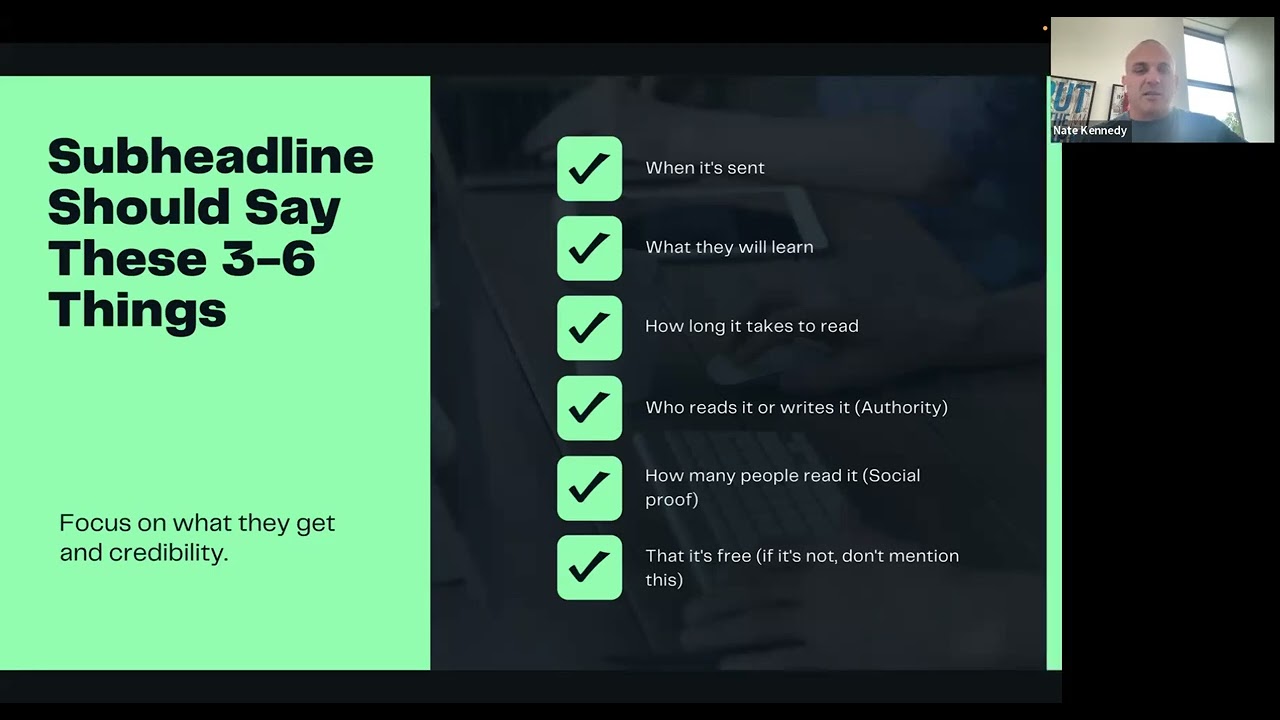
I think you've nailed it. You know, the only thing I would change is kind of your sections, and I test to see what section drives more clicks and engagement. One thing I would look at as well is the subject lines you're using. So one thing that we started doing in one of our. In our newsletters was when we got a lot of content in there, we'll actually use the subject line for the piece at the bottom right of the newsletter because. Or it'll be in a sub headline, right, the preview, one of those. Because we want them to kind of either see the subject or see the preview. And then anything above the fold is going to get the most amount of clicks.
Correct.
But if you want to get them to engage in the email further, then you can leverage that subject line with the piece. It's the bottom right.
What are you using AI for?
Content creation. So we've got a process we, we use it for. So for example, one, one simple way that we use it is we'll take an article and say, hey, I need a 50 word summary of this article with this type of tone. Right. And whatever it is, and then we'll plug that in, it spits out a couple of different 50 word, like summaries of that article. And then we use that to go into the newsletter for the curated side.
Yeah, I love using AI that way, where it's like, hey, give me some idea. Like, I'll load it up. I'll load up one of the chats with all of our information and all the stories and like, just train the shit out of it, honestly. And then I'll say, hey, what's, what's a good blog post that people would find interesting right now? They come up with, I'll be like, cool, tell me, expand. And then I'll put my own stuff on it. And it's amazing what it does. Like, and I'll even say like, write it in a comedic tone or write it like Snoop Dogg wrote it or, or whatever. And it does it. It's just, it's kind of crazy. It's, it's actually kind of fun. You know, one of the things that I was just doing this week, since this is our kind of our fourth coming out, I wanted to train my team to do it because I don't want to do it anymore, right? Like, if I keep doing it, the newsletter will not get done. So what I always tell people is like when they're doing something and find something that works, make sure you record it and then you can hand it over to someone else that can, you know, keep up with it. I have another question for you on the newsletter. So where do you think is the best place to put a call to action and should a newsletter have a call to action?
So yes, we call them sponsorships, right? No, but, yeah, absolutely. So one, a simple way for an agency owner that a lot of these agency owners. I don't know. No, they weren't doing it when I was running my agency for nine years. But I do know that it can be done and some have started to do it. But if you have this newsletter, there's a thing like when we're recommending tools and we're recommending resources to our clients, you can get paid an affiliate commission on that. Right. And so one thing I tell a lot of people when I, when I'm working on newsletters is you want to actually find stuff that has a monthly continuity that is a valuable tool, resource, or thing that you can, that you feel confident recommending. And then I would also. And then I would build that out as a sponsorship inside the newsletter. So I'd have the first either section of bullets, then the sponsorship or the first content piece, then the sponsorship. Right. And so for me, I want to put that in there because one, it's going to help build reoccurring revenue inside your business without having to do anything. So the best ones are one, it has to be something that you actually believe in though, right? Don't just start recommending stuff that you don't. You don't believe in, because that's just going to kill the relationship you have with the people that are actually reading your newsletter. But for me, it's the continuity side. What I like about it is it comes in every month. Right. And now as an agency owner, it becomes another revenue stream for you. Leveraging his newsletter and then putting in these affiliate offers becomes another revenue stream just by providing value. And you're not hard selling it, you're just putting it in saying, by the way, brought to you with this tool. Right?
Yeah. And. And I think when the newsletter gets big enough too, you can sell sponsorships.
Absolutely.
I don't like what we do with our podcast. Right. We sell sponsorships, but like you were saying, every one of them I've had to try or test or really kind of vet the out of it. Because if I'm telling people to go to it and then they suck, well, they're going to think I suck.
Yeah, that's the way it works. You are who you hang with. Right. So with sponsorships, a lot of the reason I said just find the affiliate and do that, because in the beginning you probably don't. A lot of people are going to have a large enough segment or large enough list or subscriber base to where an advertiser is going to want to pay for that sponsorship. Right? So if you. And we actually do affiliate deals on reoccurring stuff and then we do sponsorships. So like I actually, if it's a tool we use, I don't want the sponsorship revenue, I want the reoccurring revenue. If it's a tool, right. A software ongoing so you can mix and match it too. But once your subscriber base is big enough, you will 100% have advertisers coming out. If you own the audience, you will, you'll be able to sell that space. And that's kind of where I came up. Started deciding to build the newsletters. Is one of my clients at the time in the agency side. You know, he, we, he paid us well. We were paid very, very well for the work that we did with him. But every other month, good month, it's like, oh, you're on the chopping block. A great month. You're the best thing ever. That helped them, you know, along the way. So you kind of go through this ebbs and flows, right? And we started buying email traffic from this other guy in the space. And he would go cut a ten thousand dollar check without thinking about it. And I'm like, I'd send the, we'd send the copy over to the guy sending the email. We sent him a tracking link. He would load it up and send it. I'm like, wait a minute, that guy just spent 30 minutes and made 10 grand. I'm like, I've been building funnels, running paid ads. I'm like, you know, and all this stuff, I was like, I got it all wrong. Yeah. So I realized if you think about it, we always have to go to Facebook or Google and Bing and all these networks to buy traffic. Why do we do that? Because they own the audience. That's why we always go there as an agency to buy traffic. So I look at with those two moments and having that big realization of, hey, if I just own the audience, I don't need that. I just want a small piece of that pie. Right. I want a small piece of it. I don't need the big piece. I don't need to be as big as Facebook or Google or any of them. Right. I don't, frankly, I don't want that. But I know if I own a small piece of the pie, advertisers will come and pay money.
How are you building your asset, which is the list?
Yeah. So great question. So coming from the Internet marketing space, I've done lead magnets, I've done low ticket, high ticket, all that stuff. Funnels, you know, Ascension models, all that stuff over the years. So when the newsletter side, what I love about it is I have to do that anymore. So it's two things that I do it two ways. Number one is I will run an ad that just says, hey, subscribe to my newsletter. Right. Because if your newsletter is very targeted to a specific individual or niche or industry, you'll get subscribers through that. But now, but along the way, the way that we drive majority of our subscribers is we use one step funnels. And so the one step funnel for us is a very simplistic way. We know that we're building a subscriber base off of, we know who we're trying to acquire. We know they're usually passionate about that space or an expert trying to learn something. Right. And so we will use a one step funnel which can be a poll like having them vote on something we know they're passionate about. It could be a question of like, hey, would you do prime example, we did a lot of stuff in a conservative space, who should be the Republican candidate? And you put three, four people on there and let them vote. Right. And now if they, if you put a Democratic candidate in there on a conservative traffic list and they picked a Democratic candidate, you want to make sure they don't make it into your subscriber base. Right. So, and vice versa, if you're running on the other side of the dial on that traffic. But another thing could be simply is like, do you think so like one poll that we ran a lot of, do you think Trump should run for a second term? And I'm using conservative because that's what we did a lot of on before we expanded in other niches. And that's a yes or no. Right. And so people are fine projects. Find stuff. If you're going after the pet industry, if you only could have one, what would you take? Dog or cat, you know?
Yep.
So pet people are fanatics. Right. They're super passionate. So like you're going to get people voting on that and then we're also going to tally those votes to give people the results.
I like that, I like that. I've, I've always been the model of building it through a lead magnet and that's a lot more challenging. I do like the quizzes though. Like, which one are you? I think now I'm like, does your agency own you or do you own the agency? Yeah, everybody be like, yeah, the agency owns me, dummy.
Yeah, sure. You know, I did one in the, that I tested. It didn't go well for me when I did run it. But the, is it the offer or is it the offer or the traffic. What's more important? The offer. The traffic. And interesting enough, man. The marketing people weren't that as passionate as I thought they would be about.
What'd they say? What most people say it was about 50, 50. But really, what were you thinking it would be?
I was like, I didn't. To me, I didn't care because I didn't care who was going to win. I just wanted my lead cost to be down. I wanted people passionate about the topic and my lead cost to be low. My lead cost was either way, no matter what they picked, I was attracting the right person.
Yeah, of course. Awesome. Well, this has been amazing. Is there anything I didn't ask you that you think would benefit the listeners listening in about creating their newsletter and getting their agency more stuff that they own?
You know, I think for as an agency owner, the biggest thing is, as I mentioned earlier, the newsletter is a way inside your business to gain some of your time back. So as you start as an agency owner, I found myself trapped in my agency. I found myself stressed out because my clients were constantly calling me all hours of the day. And I had built this company that I was so focused on building. I, you know, wasn't able to do the things I wanted to do. Right. My time was constantly on the phone dealing with stuff. So when the newsletter business to me was my way of finding another revenue stream inside my company that didn't require max amount of my time and allowed me to also, you know, as an agency owner, it's also going to allow you to better communicate with your clients because the next person's right behind you trying to pick them up for you for cheaper. Right. So a newsletter is going to help you stay front of mind and they're going to be reminded why they hired you, not wondering why they hired you. So that's a big piece. And so the newsletter give you that ability to do that. Don't stress it, just send it. You know, like, don't stress about it. Send it, get it done. Put some content in there does. You don't have to write this beautiful thing. Just update them, give them tips, give them knowledge and make them easier to communicate. You know, as you train them, they become better clients, Right?
Yeah. And whenever you create anything, the first version is always going to suck. And you just got to keep getting better and better. Like, I know every week we're always constantly on different things that we're doing. We're like, how can we make this 5% better, 10% better, 1% better, whatever it is. And just kind of step it up. That's what I've been trying for the past nine years. Just like, how do I get the interview style a little bit better, a little bit better? And, you know, it just, you gotta keep cranking at it and then eventually you'll, you'll get it there and then you'll be like, all right, well, how do I keep going up? Like, it's constantly chasing higher until you get into the space and then you don't have to go any further.
Exactly.
So awesome. What's the website people? Go and check you out.
Nate's Kennedy.com or all my social handles are. Are Nate Kennedy M.D. so marketing Dr. Nate Kennedy M.D.
Well, I have to do a call to action now to my newsletter because we talked about newsletter. So I'm going to literally right after this. But it will be timed live. If you go to jason swank.com newsletter, you can sign up for the newsletter. It's a weekly newsletter where we'll send you all the greatest strategies and insights and stories that can help your agency and give you a little inspiration and let you know you're not alone. So make sure you go to jasonswank.com newsletter. Sign up for that and chat with you soon.
More from Nate


Anxiety doesn’t have to control your life. @realcraigballantyne breaks down how he faced it head-on
Chasing someone else's version of discipline cost him everything. Success on the outside means nothi
Scaling your business doesn’t have to be a slow grind. There’s a smarter way to grow faster without

Starting a business from scratch isn’t easy, but rebuilding it all over again was the best decision