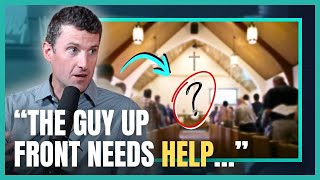
A recorded conversation (YouTube) where host Nick Stumbo asks pastors about challenges in fostering a vulnerable, grace-based church culture versus a performance-based appearance. Ken emphasizes combating religious posturing by modeling transparency—publicly admitting he and his wife are in counseling—to normalize help-seeking and reduce hypocrisy. Ronnie affirms that seeking help is healthy, notes community trauma (the Charlie Kirk shooting in Sandy, Utah) has driven people to seek support, and describes ministering alongside recommending professional care. The exchange stresses that everyone has struggles (including sexuality and past abuse) and that normalizing vulnerability can change church culture.
Questions this video answers
Sandy, Utah
17 years
The Charlie Kirk shooting
So I think for all of us, if we're being honest, there's a part of us that wants to just, you know, look good, look nice, you know, turn to your neighbor and say, good morning, I'm fine, you're fine, everyone's fine. And kind of to be in that church culture where we don't go to those honest, deep places. And so because of that, what challenges have you faced as a pastor in moving people towards a real, you know, vulnerable, real grace based kind of way of doing church versus just a performance based, we're all fine kind of way of doing things.
Challenges. Boy, I, I again, not to paint it with too broad of a brush, but I would say the challenge is just strictly pushing against that kind of religious culture that's inside of all of us, you know, that you, you hit the nail on the head there, Nick. We all do want to present this, you know, I've got it figured out. And especially if we, if we are influencers and leaders within a spiritual organization or a ministry, you know, sometimes we reflexively will feel and I can't, I can't let my bustedness show. I can't pretend to lead people where I haven't been, you know, and that can get out of hand. That can get pretty unbalanced, where next thing you know, man, hypocrisy is just knocking on the door of your performance there. And, and so my pushback, and I've kind of already alluded to that, has been to just always be as transparent as I possibly can. You know, I stood in front of our congregation recently and my wife and I have been married for 17 years and we adore each other and we're one of those couples that are, you know, we got our problems just like anybody, but divorce is nowhere near, you know, our mindset. We feel secure in our marriage and we've worked on that a lot. And this is the thing I admitted to by my people, we are currently going to counseling. There are certain things about our communication that we just keep going around the same mountain, you know, and, and so we just got this place of man, these, these little things that blow up into big things over the course of a few days and it keeps happening. You know, I'm, I'm not finding my way out of this, and I'm going to need some help. And I think that that's been my weapon against that religious posturing is to just be really quick, to be as vulnerable and transparent as I can be as the father of this house. And, and I' way Not that we're perfect in this, but it really has created a culture of vulnerability that. That everybody's like, hey, if that guy up front can admit that he's going to counseling. Like, every time I've said that we've gone to counseling, I've gone to personal counseling in years past, and I've had people come to me and be like, you know, hey, I had one guy two years ago, when I mentioned that, he's like, well, Pastor Ken, you just forgive my language because you just screwed me over, man. And I'm like, oh, sorry. What do you mean? He goes, my wife elbowed me in. The sign goes, a pastor, can't you go to counseling? You're going to counseling.
You know, suddenly counselors all over your area were getting phone calls.
Yeah. Yeah, that's it.
Yeah. What you're saying is like, it's okay to go get help. You know, it's that quote we talk about a lot. Healthy people seek help. And seeking help is never a sign of our weakness. It's a sign of our wisdom when we go get help. And thank you for leading that way. And I think, just another thing, it's okay not to be okay. Yeah, I'm not okay. And I want to go get some help for this. And I know you're in Sandy, Utah. I know last month there was the Charlie Kirk shooting and the trauma of that that has hit your community where people are not okay because of this traumatic experience. And so trauma happens in our lives for a lot of us at different ages, and when it's not resolved or processed, it's stuffed. That's when it creates a lot of problems, we find. And so, yeah, I know that you've been helping your congregation and those in your community just process and grieve and. And get help to work through some of these life's painful situations. So thank you for modeling that firsthand.
Yeah, absolutely. I'm not apologetic, but I just realized I'm wearing my Charlie Kirk T shirt. I was. I wasn't thinking that about this interview when I went through the song this morning. But yeah, we've had some really good things come out of that tragedy. Speaking to your point there, Ronnie, that there's a girl that came the Sunday after that happened, and she hadn't been in church her entire life growing up in this area, you know, predominantly lds, Mormon. And she goes, when I was a little kid, I had some of this going on, but I saw the footage of that happen, and I. I knew I needed some help. You know, she was basically describing some ptsd. You know, she was. She's suffering with. And I baptized her last Sunday, you know, and her whole thing getting in the door was just like, I need some help processing these. This imagery, you know? So we're pushing her towards some more professional help that can help her and also being able to minister to her soul with the gospel in the meantime, too.
Yeah, one. And what I hear you saying, Ken, and you share stories like that up front from your own life. You're saying, we've all got our stuff, and no matter who you are, you've got stuff that you need to deal with. And sometimes we feel like our version of the stuff is a little better than others. So we're like, well, I'm okay, but if we're honest, like, we've all got something. And I think one of the things we're trying to emphasize in the work we do is to say, like, whether your stuff is related to sexuality, to things done to you, to things done by you, it's not a separate category of stuff that we have to avoid, ignore, or act like it doesn't exist. Like, this is part of the human experience. Right. We're made as sexual beings in the image of God by a good, loving God. So all of us, in some way, are disordered in our sexuality because we're in a fallen world. And if we can create that environment as you do, when you share stories of, like, hey, I'm a real person, I go for counseling, I've got my stuff, I have to deal with stuff to say, and we're all in that boat, I think then people start to feel that, okay, this is real. It's not just a few of us that need help.
Like, we.
This is all of us. And that can be a real game changer.