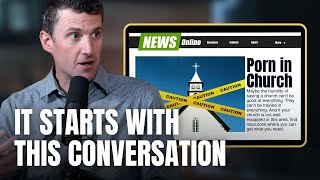
A short interview-style YouTube conversation (host Nick Stumbo with a guest) advising church attendees how to constructively raise concerns with pastors and leaders. Key recommendations: set an appointment (don’t grab the pastor), approach with a posture of help and encouragement rather than blame, give specific examples of impact, and — if a church is unwilling or unequipped to address an issue — seek resources elsewhere or temporarily attend a church better suited to those needs.
So this is an interesting angle on that question, because many people may not be a pastor or leader, but they attend a church where they've perhaps heard some of these stories. Maybe the very things you've said not to do, they know are happening, or that's the kind of advice their pastors are giving. What role could they play in approaching a pastor or leader with grace and truth? To talk about this? I mean, do we just pray and hope our pastor figures it out, or what. What approaches might there be to address some of these things? If we know it's happening in our church.
I would say set a time to go have a conversation with that person. Let them know the information that you have. I've just become aware of this is happening a lot in our churches. What would it be like if our church started to talk about these things? So come in in a positive way and in a way of saying, I would like to see this more in our church. What do you think about it? So you're. You're coming in, you know, again, wanting to assist and encourage, not, you know, blaming and shaming the pastor for not talking about these things. That would not be helpful. It won't get anyone very far. But to. To offer yourself, as you know, I'm not an expert on this, but I do have some information, and I'm hearing that this is happening in lots of churches. How might we start to respond to this? So if that's something that God would put on your heart is perhaps something you know, and you know how to talk to someone about that, perhaps you're a person that can start to make a change in your church culture, even just by bringing it up.
One thing you said at the beginning there, that's more important than many people realize, is you said, set a time, make an appointment.
Yeah.
Far too often.
Don't just grab them.
Yeah. People are trying to grab a pastor before a church service or after a meeting or they're on their way out the door. And often that's just a very difficult time for anyone, really. But I think pastors in particular, they're like, this is a lot to process. And I'm in the middle of, you know, trying to get ready for the service, or I'm on my way home to my family. And now I'm trying to think about that. And it's just often not going to have a positive outcome unless there's some space to have a healthy conversation. And what I would relate as a pastor in terms like people maybe approaching me about my sermon or my Leadership style. There were definitely people that came across as, well, here's what you're doing wrong. Here's what you did poorly. Here's what you said. That was bad. In typical fashion. My internal reaction is, all right, well, thanks a lot. Really appreciate it.
No one responds well to that.
But I had other people that really had a skill to say, nick, I want to help you impact more people. And I see your skill and I see the talent. And I'm wondering if you realize that when you said this, this is the impact it had on some people. And just that approach, I was far more open, like, oh, you know, they want to help me. They want to see me do better. They want us to succeed and help you. And I want to help people. And if I did something that was unhelpful or hurtful, I wanted to know that from someone that cared enough to really walk through that with me. My response was night and day different. And that sense of they really cared enough to say something was felt. And so when I would take that to this question of if you see that happening in your church, if you come across just pointing out everything your church is doing wrong and why don't we do this? And we need that ministry, and you don't get a positive reaction from your pastor, don't be surprised. That's a hard thing for any pastor to hear on any topic. But if you really are coming into that place saying, I want to help us minister to more people, there's broken marriages and we can really make a difference. And here's something I've heard that I'm wondering if there might be a different approach that'd be more helpful, that. That can just be a better conversation in so many ways.
Yeah. Yeah. So good. So good to be able to do it that way. And that's how we're supposed to be with one another, respectful and loving and open. But some couples do find their church, for whatever reason, decides, this is not our thing, we're not going to talk about it. We're not going to do it. And even though I don't want to encourage people to leave their church, but for a period of time, perhaps you do go to a place that has more of that kind of environment for you. That would be helpful. And then when you're ready, maybe you can bring it back to the original church. But. But to ask people to stay in the church setting where there is this. This kind of like, we don't talk about this here, that's going to be really hard for that couple to really receive things in our church.
Yeah.
So just be aware of that.
Maybe the humility of saying a church can't be good at everything. They can't be trained in everything. And if your church is not well equipped in this area, find resources where you can get what you need, even if you still care deeply for that church and see all the other qualities they have.