
The Future of Search: AI and Personal Branding. Jason Barnard from Kalicube interviews Nir Zavaro
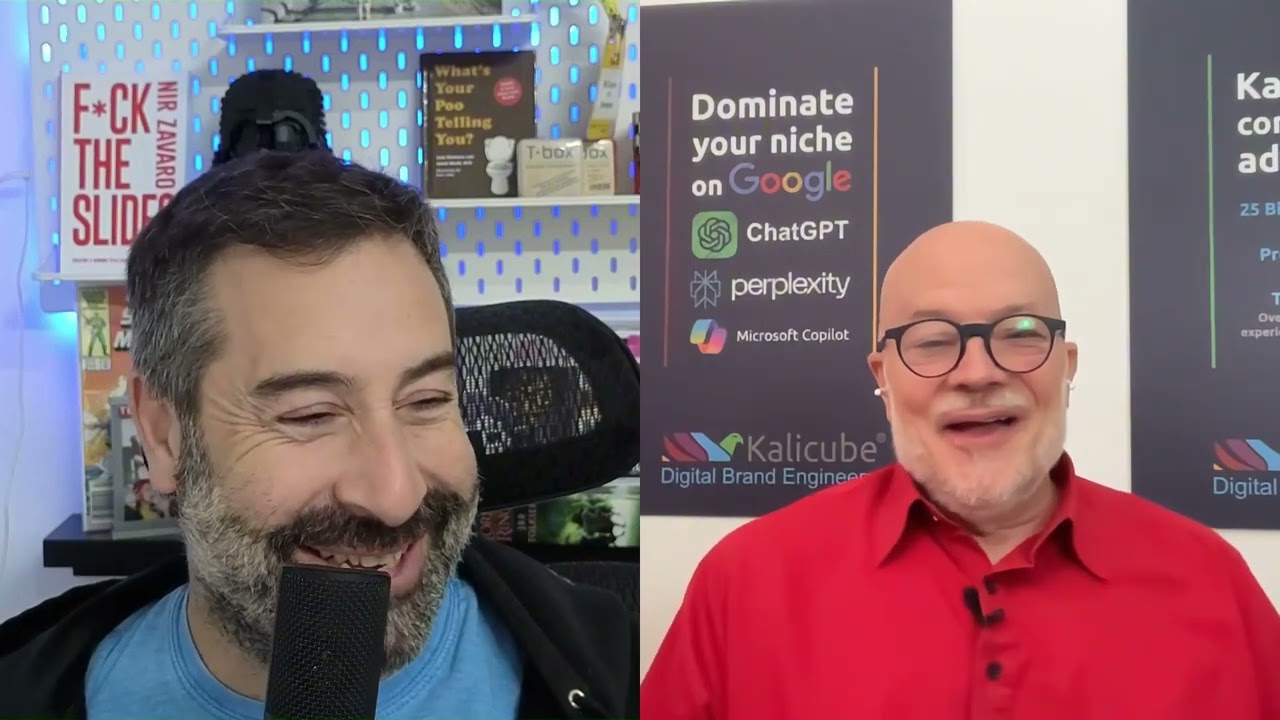
In this interview, Jason Barnard (founder of Kalicube) and Nir Zavaro discuss how AI is reshaping search and personal branding. Jason positions himself as a "world's expert in precision brand engineering," explaining how Kalicube uses billions of data points to shape how AI systems (Google, ChatGPT, Perplexity, etc.) perceive a brand. They contrast legacy SEO tactics—keyword stuffing, link building—with the new reality where AI demands verifiable history and organized signals; you cannot "fake it till you make it" with AI. The conversation delves into the problem of fragmented digital footprints, showing how years of varied roles and content create noisy signals that confuse machines. They propose reframing past experiences (e.g., voice‑over work) to align with current positioning, and they introduce a practical "Claim‑Frame‑Prove" methodology for establishing authority. Practical steps include crafting a concise two‑sentence entity description, placing it on the about‑page (the "entity home"), updating existing content before creating new, and consolidating data points across the web. They also discuss the strategic advantage of leveraging a founder’s personal brand to lift a corporate brand, the urgency of claiming a niche quickly in the AI era, and the concept of the AI acting as an advocate or recommender once it trusts the narrative. Throughout, they share concrete examples from their work with Nir, illustrating how organized storytelling and data‑driven signals can dominate a niche without massive new content creation.
Chapters
And one of the things about the past that I wanted to kind of point out is you can reframe things quite extensively, and I'll give you an example. Hello.
Hello everyone. Once in a while, I love doing these episodes on my journey to build something bigger. You meet a lot of interesting people. A couple of months ago, I had a great pleasure of getting an email from Jason through a good friend of mine, Dave Burnett, which we've also recorded a few episodes with about my website and SEO stuff. And Jason does something amazing when we're talking about the AI search world or industry. My name is Nir Zavaro, and I thought this might be such a good conversation. that we would like to share with you guys. So here goes. Jason, how's it going?
It's going very well. Thank you very much, Nir. I'm having a lovely day in the South of France.
South of France. And you're based there, right?
Yeah. I'm from, from the UK originally, but I've been living in France since the late 20th century.
I thought this is what I would like to do. Short introduction about who you are and a little bit about the topics we would like to cover, which for me is a little bit about how you got to where you are in terms of the data points and the information you guys have collected, why what you guys are doing is in the forefront of search engine optimization for the AI world era. And if we can then talk a little bit about the stuff that you and I did, which are now starting to bear fruits for my business. If that's okay with you, I'll start with the— Please give us a short intro.
Yeah, thank you. Absolutely lovely. That's a great set of topics to talk about. I'm, what I would say about myself is I'm the world's expert in precision brand engineering. So I take a brand and I can mold the AI and Google and ChatGPT. I can mold their perspective of that brand to anything I want. So for the clients that we serve at Kalicue, we help them to be present in Google, ChatGPT, Perplexity, Copilot, Meta AI, Amazon Siri in a way that makes sense to their business, a way that makes sense to their career so that they dominate their niche and they're seen to be and presented as the authority they deserve. That's the specialist topic that we deal with at Kalicube. And if we look around here, we have 25 billion data points, 70 million brands, a million entrepreneurs in our system. So we can figure it out down to the URL, which web pages make all the difference. And I love that, the certainty.
If we're able to like turn it into that one sentence, you're able to take Personal brands, if I remember correctly, is understanding as quickly as possible what is their niche. And that is also very important to understand and make sure that they can own that niche if people search for them on search engine optimization.
Yeah, that's very, very, very, very well put and much shorter than my incredibly long That's, that's, that's, you're amazing at what you do.
I'm pretty good at what I do. This is why this is a great conversation. I think what I understand is if we look at SEO of the old days, you could rank on anything. If you had some money, you put the word, you put a few blog posts, and you can probably pay to be number one. Then you can probably build a very good engine behind with a lot of articles and links, and you can probably rank for a lot of different things. I remember there was a guy who wanted to be number 1 on Amazon and there was a paragraph about cats. So he did a marketing book, but the category he went for and became Amazon number 1 bestseller was training cats or something like that. Now they stopped it. There's only 3, you can only choose 3 categories when you launch a book. Um, but at the time you can improvise, you can try, you can find a lot of ways to find clients and stuff. Is that correct to say that in today's search engines, this is changing?
It's changing. I think that's exactly it. It hasn't yet fully changed. The traditional strategies, tactics that you just mentioned can still work. Links and word counting can still work sometimes, but A friend of mine at a company called Autharitas has just written an article, Can You Fake It Till You Make It in AI? And the answer is actually no, you can't. So in terms of building credibility, which was what you're talking about, leading your market, dominating your niche, which is what we do at Kalicube, it's not possible if you don't have a history. If you haven't walked the walk, you won't be able to cheat the system. The AI is too smart.
I think that's also interesting because it means that if we look at my business, there are a lot of speakers, there are a lot of authors, there are a lot of people who talk about storytelling. And if I've walked the walk, if I've done it for 20 years, I have a good chance of ranking. And if I have the book and the authority, all these will help. But if someone just comes in and decides they want to own the category, it's not like the old days. You cannot necessarily achieve that.
Yeah, that's it exactly. And one of the things I would say is, yes, you've been doing this for 20 years and in your mind you're saying, well, I've got all of this proof, but that's in your mind and it might be out online, but it isn't organized. And if it isn't organized, the machines are going to miss 95% of it. So the trick is simply to organize the information and place it in the right places. So the machines feed off it. So if you have 20 years of experience, you need to demonstrate that to the machines in an organized manner, then you will win the niche.
When we started to work together, your team sent me a report of what the internet says about me. Yeah. Yeah. And there were things, as I said, 20 years, the amount of times we changed how we describe ourselves. the way we evolve, right? For many years, I owned a marketing agency. Now I go by author, speaker. There's so many different things. I found places where I'm still consulting small businesses in the food and beverage industry, which was true 15 or 16 years ago. So it's so interesting to all of a sudden see this. In a funny way, it's kind of like the roadmap of everything you did. over the years in different industries and how you evolved and how you grew. And even when we looked at things that are similar, so let's take the past decade, which most of the things are similar, there were small tweaks that your team has brought in that made a huge difference.
Well, I think exactly that is we have a history, all of us, and it's gonna be 20 years for you, 20 years for me, 5 years for somebody else, 30 years for somebody else. And as you say, our story changes over time. The way we present ourselves over time changes, and we don't naturally go back and clean all this stuff up. And so what you end up with is a very messy signal or a messy set of signals, and the AI will pick up on all of it and it doesn't know which one is important and which one isn't. And so one of the things we did with you is go through it all, And say, which are in the past, which are important, which can we emphasize? And then we can start to pivot your narrative so that we emphasize the right things and that we use everything in your past to serve your present and therefore convince the machines of one particular narrative that is supported by credible resources over the last 20 years we organize.
I think what I'm hearing, which is interesting, there are 2 paths. You haven't done anything, get to work.
Yeah.
If you have done, the problem is, were you consistent? Because sometimes you make small tweaks. I went on, we found, I don't know, 20, 25 different podcasts I did in the last 2 or 3 years. Some of them are big. It was sort of consistent. Now, if we do not bring everything under one roof, There's a problem if we do not create that clear message and consistency. So I think it's interesting because if, guys, if you have done a lot, it is a great chance to go back, review everything. For me, by the way, I don't know if I told you this, but a huge thank you. After we discussed, you and I discussed certain things, I put author first, speaker, entrepreneur, and then everything else. For many years, it was an entrepreneur because I had bars and I had a business and everything. And I had 2 books, but now I'm working on number 4 and 5, and number 3 became an Amazon bestseller. So I decided this is how I'm going to own it because if it says author on search, I need to stay more consistent about my writing. I need to write more. I want to publish once a year. I want to publish every 2 years. So It's interesting that it also helped me improve my focus. So, so thank you for, for that. We had long conversations.
Well, I can thank you back because your history over the last 20 years is so varied that the AI came to us with a huge document that was really confusing, and we ended up doing 2 hours of discussion. Rather than the 1 hour we usually do. And that brought home to me how important it is for us at Kalicube to already synthesize the story when the AI is very confused. And we've now improved that process. So we kick off every project with a client with an interview with me where we go through what we did with you, which is, here's what the AI understands. What's important, what isn't important, and how can we frame everything that is important to serve your current purpose? And those interviews are much shorter now, and we get to the point much more quickly to figure out what are we trying to say? What are we trying to emphasize? Where are we gonna take you? What narrative are we gonna build into the minds of these machines? And that's really powerful.
It's interesting. It feels like, in a sense, we are stepping into a whole new territory, but basically going to the basics. If you've done the work, you have a chance. If you haven't, you have a problem. Secondly, if you're ready to go back and consolidate all the things you've said and become even more concise, which is interesting. And for me, If we look at my 20-year CV that was scattered all over the web, it is now saying, hey, no, no, what I've done for the last 15 or 18 years has gotten me here and this is who I am now.
Yeah.
So the AI is technically asking if I can help with that.
Yeah. If you can create a really solid story that's very consistent. And you can lead the machine from A to B to C to D to E to F in a very logical manner, it will believe you and it will promote you. And I now talk about the machine becoming a recommender for you and also an advocate. We talk about getting clients to be advocates, but the machine can be an advocate. Google and AI can be an advocate if it understands that you're leading your market.
And I've been playing around with Comet, the search engine.
Yeah, me too.
And the first thing I did was download, use a VPN. And the first thing I asked was, I'm looking for business storytellers that I can talk to. And you and I, we went with this. I'm using that, let's say, description. So, Nir Zavaro, the business storyteller. And I said, I'm looking for business storytellers, and it gave me several options. And the second query I did was, can you help me find a few others or people who do something a bit different or people who might be unique? And it's crazy to see. that it said, oh, you know what? You should also check out this guy, Nir Zavaro. He is the business storyteller and he also wrote a book. And then it started to write it in a way that almost was trying to convince himself, the AI, that what the choice he gave was even better than the previous ones. Mind you, the people before me are, with all due respect, they've done quite a lot of things and everybody knows their brands and names.
But I think kind of that's a really key point. Number one is what you managed to do talking to me and my team is give a unique angle. And if you can give a unique angle, you stand out for human beings, but also for the AI. And the AI is seeing the same thing over and over and over again, badly organized. And as soon as you have a unique angle, as soon as you have everything organized, you stand out. And you were mentioning that other people within your industry have done, let's say, a lot more than you. The fact that you are organizing, the fact that you're expressing this in a way that's very clear to the machines, and the fact that you have a unique angle puts you at the same level as people who should be a good huge step above you. And that is super interesting because other people aren't organizing, but you are. That immediately gives you an advantage with less firepower.
How important do you think it is to repurpose the text that already exists, which is part of what we did, but also to create a whole new content, whether it's on our websites, connections, external links? These are 2 Different worlds that we need to address.
Well, people always want to create, or people often want to create more. They want to go out and create new content and they think, well, what I'll do is create lots of new content and that's going to change the narrative. But in fact, changing existing content is going to be more powerful for changing the existing narrative. So number one is look at what you already have. And update what you can, and then start thinking about creating new content. The other thing you need to look at is where does the machine find the foundational story? And the answer to that question is always the same, on your website. And if you don't have a website, build one now because you don't want it taking the foundational story from LinkedIn because LinkedIn is rented space. Build your website, tell your story, push onto that website the content that tells your story the way you want it to be told, that puts you in a situation where the machines understand your level of credibility, you understand your authority, understand all the things that make you a leader in your niche, link out to the proof. And once you've done that, you can start building out. But until you've done that, you are wasting an immense amount of authority and credibility that's already there. Most people don't need to build more right now. They need to consolidate what they already have. Once you've done that, you understand where the holes are, where the missing pieces are, and you build the right pieces on top. Sorry, go ahead.
No, no, no. I love it. I think you are mentioning authority quite often.
Yes.
And I need people to understand And correct me if I'm wrong, define your niche. Which niche are you gonna own? How large or small is up to you. The competition will get fierce, right? The bigger the niche is. So if your niche is marketing, good luck. And I think the next thing is to clearly articulate who you are in the next 3 years.
Hmm.
Understand then what you were before. and where, improve or help the AI understand that you also knew who you were before, even though you were searching and changing stuff.
Yeah.
So there's a baseline of, oh, you know what, 5 years ago when he did this, he already knew who he was because it creates a— everything is better articulated and it is concise. Once we have all of these, we can discuss how the concise, clear message will look moving forward and where.
Yeah.
So it's basically understanding all the data points that already exist, making sure that they are the same, then they are connected, and then you can go into adding more data points.
And you, you say the word data points, and if you think about your digital footprint as just a set of data points that need to join together in a logical manner and that need to be consistent, you are already thinking the right way. And one of the things about the past that I wanted to kind of point out is you can reframe things quite extensively. And I'll give you an example, which is coming actually onto what we'll be talking about later. My previous career, I was the voiceover artist for a cartoon blue dog, and that cartoon blue dog was quite famous. The cartoon blue dog is in MusicBrainz. It's in Wikidata. It had a Wikipedia page. It's in IMDb. It's in Rotten Tomatoes. All of these sites, the huge sites that have immense influence on the algorithms. And I had been saying, oh, I had this fun job where I was a cartoon blue dog. But then I realized, obviously that isn't great for business. But I could reframe that and say, I was the CEO and founder of an edtech company called Up to 10. I signed deals with Disney, with Samsung, with ITV Studios for a cartoon which had a blue dog in it, and I happened to do the voice for it. It's the same situation, different framing, but all of a sudden now all of the AI says Jason Barnard is this amazing entrepreneur. Because he had this wonderful Up to 10 edtech company. Before that, he had a music company called WTPL Music. Now he's running Kalicube. And the story is the same, but the framing is different. And I focused in on the CEO founder of WTPL Music, founder and CEO of Up to 10, founder and CEO of Kalicube, placing me as an entrepreneur first and foremost. I'm still the voiceover artist for a blue dog, But it isn't what I'm pushing. And that's reframing. And that's what we can do. And if you think about your career, how can I reframe something from the past that doesn't seem to help my current career? You can probably reframe it and get it to support you.
But the reframing needs to move quicker because a lot of people are gonna try and, and claim a niche.
Yes.
So the race is on.
Yeah, the race is on and the window is pretty small. Everything's moving very quickly. We all know it. We're all looking out there and seeing the AI changing the landscape pretty much every day. Whoever gets in first is going to nail down their place and they're going to be almost impossible to move.
Do you, so first of all, thank you because I'm moving fast. I think it also It sparked something interesting because it also made me reconsider the type of content I want to spit out to the world, the cadence I want to do it in, the topics I want to talk about, why. And I'm actually doing more video— videos than I did before and actually really enjoying it. And there's something interesting that's happening. More than that, I think, correct me if I'm wrong, there's this thing now where a personal brand needs this at the moment. If they're good enough, big enough, if they've been around for long enough, they have a chance to conquer the niche. And through that, the company brand might move up. Am I correct?
Yeah, I've talked to quite a few people about this, especially in startup companies, is it's very difficult to build a corporate brand. And very relatively easier to build a personal brand. And we've had multiple clients where the CEO founder comes in, builds up their personal brand, and the corporate brand naturally hooks onto that. So the corporate brand is pulled along on the coattails of the CEO founder brand. So CaliCube, for example, is exactly what we're doing. My personal brand is very dominant, but Kalicube's brand is catching me up. And Kalicube's brand in the AI's mind is very much attached to mine. So what's now happening is I'm up here, Kalicube's here, and we can feel Kalicube catching up. And at some point in the next 2 or 3 years, Kalicube will overtake me and the Kalicube brand will become more important. And for me, that's a really smart strategy.
What else can we teach them? I think we had a very short, meaningful conversation. I think a lot of people have to go do their homework. Yeah.
Well, I, what I'd like to talk about is claim, frame, and prove, because it's something that when you hear it, you think, oh yeah, okay, that makes total sense. And it's really simple idea and approach. Claim, frame, prove. You make a claim. For example, I'm one of the world's leading experts in generative engine optimization, search engine optimization, AI-assisted engine optimization. That's my claim. Now, how do I frame everything that I've already done to serve that particular set of statements? I started in 1998, the year Google was Incorporated. That's a really good piece of framing that puts me right at the beginning of the world of SEO. I built a website to 1 billion page views in 2007 in one single year, website for kids. That places me as an expert and authority of building websites, especially as one-fifth of that traffic came from Google Search and Microsoft Search. Yeah. Then in 2015, I built Kalicube.Pro. Kalicube.Pro designed to manage brand in search with the brand SERP, the search engine results page for somebody's name or a corporate name, then knowledge panels, and now AI. So ChatGPT, Perplexity. So it's all about, Kalicube.Pro is all about managing brand in search and AI. So I can make those statements and I'm framing Kalicube and Kalicube Pro to serve that expert message. Then I say, and we have, 2 years ago we had 3 billion data points. Now we've got 25 billion data points. I'm framing the data in the context of saying those data points mean that we know what we're doing. We know where to aim. We know how to influence the algorithms. We're not guessing. We're not using generic ideas and standard processes. We're saying we know exactly what we need to do. We know exactly which pages are going to affect your brand in the minds of the AI. Then I say, I coined the term as answer engine optimization in 2018. I did a webinar series on Semrush that proves that I did that. I did an article for, sorry, a white paper for Trustpilot. That's a big brand. I'm associating the big brand with me for the creation of answer engine optimization 7 years ago. Now people are using answer engine optimization as a term. I'm therefore a pioneer and my work was a precursor to what's going on now. And as you can see, I'm simply taking things that I've done over the years and framing them in the context of being the world's leading expert in generative engine optimization, answer engine optimization, and brand in search and AI. And then proving it by pointing to all of the third-party corroboration, Semrush, Trustpilot, Disney, ITV Studios. And that is how you're going to build your domination, your thought leadership, your absolute leadership within your niche. Claim, frame, and prove. And you'd be surprised at how many different things you've done that you can frame to your advantage today that didn't appear to be like that in the past. Well, I'll give you another example. The Davy Awards. Davy Awards are an award. I won an award called the Davy Award in 2008 for a website and for songwriting. The Davy Award is For the website wasn't specifically about edtech, but I can say that it's edtech because the website was an educational website and the category was education. So then you just say, I won a Gold Davy Award in 2008 for edtech innovation. It's true.
Yeah.
And I'm simply framing that particular award in a way that makes a lot of sense today because of that innovative edtech plays into the innovation that I've put into place with Kalicube, Kalicube Pro, Kalinexus. And Kalinexus is our technology.
I really like it. You know, when I wrote the book, Fuck the Slides, and the book I'm writing now about branding, the concept was that everything we're doing is wrong. This is why, so I'll prove it and let me show you how to fix it. Hmm. And I remember I finished the last draft of the book. I went for a run. I'm running by the boardwalk. There's a sunset and I'm listening to, um, an interview with this guy who's written like 11 books. And he says, I learned early on a concept. Tell them everything they're doing is wrong. Tell them why and show them how to fix it. I'm like, what? That was my concept. I was like, so it's amazing that sometimes things are already there, yet we keep doing things and thinking we're reinventing the wheel. And the last thing I want to talk about when it comes to this, I have a very interesting About Me page, and we had some issues with the About Me was extracting a lot of stuff throughout my history. All of them are true, cool stories, interesting things I've done, and referring to them online, which who would have thought that? I thought it was a cool page for people who are reading it because oftentimes you go on a call and people say, by the way, we loved your About page.
Oh, right. Yeah.
So it was for them. It was not for an AI. It was not for an SEO purpose and stuff. How important is the short example The, let's say, the blurb I usually teach during my workshops of how do you explain who you are and define, but in a very specific, let's say, translation for AIO, how important where it's located on the website, homepage, about, and so on.
Well, one of the biggest pieces of work we do right at the beginning with our clients is write what we call the entity description, the whole description about who you are, what you do, who you serve, why you're credible, which is fundamentally what we're trying to communicate to the machines. Who am I? Who do I serve? Why am I the best? And the executive summary of that is 2 sentences and that needs to absolutely nail that down very quickly. So in 2 sentences, who am I? Who do I serve? Why am I the most credible solution for your users speaking to the AI. And that is the single most important thing you're gonna write because versions of that are gonna be across the entire web. As you said earlier on, you leave behind you a lot of fragmented information that you haven't updated. This is the opportunity to go back and update absolutely everything. But does that go on the top of the homepage? It should go at the top of the about page. So all of the AI is looking for what we call the entity home. Google called it the point of reconciliation. It's the webpage that describes who you are, what you do, and who you serve and why you're a credible solution. That should be the about page and not the homepage because the homepage serves too many other purposes, including— being incredibly impressive for your users, for your audience, whereas the about page can be more factual. So that great story that you have, you can put it on your homepage. The about page, I would suggest more factual with the important stuff at the top. So the machines will start at the top. They will take whatever's at the top to be the most important and work their way down. And if you want to tell a very varied story, I mean, you, like I, like most people, have got multiple facets. I'm a musician as well as being an entrepreneur. I'm a voiceover artist. I've done a lot of things in my life, but I can present those things on different pages on the website. I can summarize them very quickly on that about page and then link through to the deeper explanation if I feel that's an important piece of information for the AI. So I will link through to the Up to 10 page, And that company, I can talk about Up to 10, my company, in the context of me today.
So do you think, uh, asking ChatGPT, for example, to extract every place he can find our brand and the description would help us start collecting a little bit about who we were? Is that a, a, a good, okay if people, or they should, or they need you to start searching?
No, I mean, uh, it's something you can DIY. I would suggest that as an entrepreneur, you probably have better things to do with your time and more profitable things to do with your time.
I agree. And I loved working with you and I'm not getting any referral or commission. I think seeing what you guys extracted, I was like, oh shit, I could have done this years ago.
I think, I think that's key is You can DIY, you can go to the caddycube.com website and find DIY information on there. I'm not hiding this information, but the key is, will you do it as well as we can do it? And Dini gave you information that you didn't even know was out there. Will you be able to organize it in the way that we can do it? Will you know, once again, these 25 billion data points, will you know for certain that you're doing the right work in the right places when you prioritize that work? Are you wasting time on URLs, on pages that won't make any difference at all? And it's a huge waste of your resources, your time, your headspace. And at the end of the day, I think you are, we are all making money with our businesses, selling services or products to people that they cannot reasonably do themselves, or they can't do as well as you would do. And in this circumstance, that comes down to exactly the same thing. Outsource because the outsourced company like ourselves are going to do it better unless you've got loads and loads of time, headspace, and resources to spend on this, to learn how to do it and to do it.
Amazing, guys. I think this was a very important session just to start figuring out who you are, what you were, and who you want to be as a personal brand. How's that connected to your business? I find it, to be honest, I find it inspirational because it got me to rethink and reimagine what I do and other stuff. More than that, it got me back into like constant writing, which I love, and saying if I'm an author, it needs to look a certain way. I think most of us think that if we do another video on TikTok, that will solve it. But apparently there are other ways, and most of them we've already tried. It's just about going back, fixing. And I think it has a lot to do also with this commitment of who we are, what is the niche we actually want to conquer, right? And being a bit more intentional about where our businesses are going in '26, '27. Jason, I want to see—
I agree with that.
Thank you. Thank you for your time.
Thank you. Now, that was delightful. I love talking about this stuff. And the idea that you can dominate your niche without actually doing anything more is super attractive. I already have the authority. I already have the credibility. I've already done all the things I need to do to be recognized as the world leader in whatever niche I choose or I'm in. Being in a position where you can say, well, I can get Kalicube to just go out there and make that happen for me, not do anything extra. I find that— what's attractive would be the word.
Love it. I'm in. I'm already a client, so I'm easy. So thank you for that. And guys, if you need anything, I'll put in the links, Jason's information, feel free to reach out. And then as always, if you need anything, ping me. I'm happy to help. Take care. See you next time. Thank you.
Thank you. Bye-bye.
More from Nir

How to gain more clients with AI? The customer journey is your opportunity: updated AIDA model +R









