Building an Effective Organisational Structure for Your Salon
Amy Guy shows salon owners how to stop doing everything themselves by building a clear org chart with defined roles and SOPs. Delegate one task this week—accounts, cleaning, or admin—and only hire when the role frees up time for you to drive revenue.
Chapters
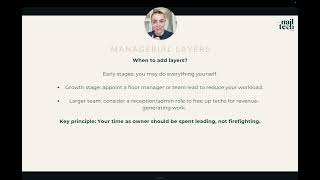
So next we're going to look at your business's organizational structure. Now, that sounds like a really posh, complicated word. It actually isn't. It's basically just making sure that there is a structure when you are bringing new people into your business so that you are not the bottleneck and so that it doesn't always feel like even though you have this team of people around you, you're still doing everything alone. So we're going to talk about basically when and what to delegate at each point of your business. Now, as a quick introduction, one of the biggest challenges that we face as salon owners is wearing all the hats. How many times do you hear people say, you know, you're a nail tech, but you're also, you know, a receptionist, you are a stock handler, you are a cleaner, you are an administrator. Like, the list is literally endless to the things and the responsibilities that you have as a business owner in the nail industry. But the key to to that is to start delegating is to start welcoming in help. Now, in order to do this, you need to have a profitable business model because obviously you need to be able to pay your staff. And that's why we've covered that in the first part of these lessons, because you need to be making right decisions at this point. You can't just hire a load of people when you don't have the cash flow to be able to pay them or when you don't have a clear plan for how you're going to get a return or on the investment of each of these people. Okay? So every time you bring somebody into your business, it should be to make you more money or to clear up some of your time so you can make yourself more money. Okay? And building an org structure that works for you and your business is the key to running a successful business that is also growing and that is starting to, you know, have a compound effect. Now, the truth is, without having a clear org structure, you are always going to feel overwhelmed. So there might be people around you, you might have other nail techs in your space, but if they don't have clear roles and responsibilities and know exactly who they report to, then your team will never really know where they stand. So this is going to help you if you are at the start of your journey of building a team, or if you've already built one, but you feel like you're still stuck in the weeds. And it's like, yes, I have a team, but they're not doing what I want them to do when I want them to do it, the first step is to actually have a visual org structure and that looks a little something like this. Now this org structure is very advanced, okay? So I'm not saying right now that you're going to have all of these people in your business and it might not even be a goal of yours. You know, the biggest business isn't always the best. And a lot of the time the more people that you bring in, the more stress accountability that brings. Because human beings are complex, okay? And actually managing human beings is a whole skill in itself. So you might know that you don't want to have multiple human beings in your business. With the complexity of being, you know, a manager with lots of people, people underneath you, that is so fine. However, I'm showing you this example of a salon org structure just so you can start to get your head around the layers involved in your hiring process. And a lot of the time what will happen is you'll have you as the owner and the CEO at the top and then everybody else who comes into your business will all be in a straight line and they will all feed into you. So I imagine right now if you've got a team, all of these dotted lines, a lot of them will be feeding into you. Which makes it really stressful because it means that even though you've got all these people helping, yet you've got that anxiety that if you were to go on holiday or if you were to step away for a while, you either couldn't or it's going to cause turmoil because everybody needs to wait for answers from you or wait for guidance from you, or feed things up to you before they do things. Okay? So a healthy org structure would look something like this. That would mean that you as the business owner and the CEO actually only have two people who directly feed into you for support, for feedback, for, you know, growth and coaching and all of those things. So you as the CEO would sit here and you would have a layer of experts underneath you. So people who are in a managerial position and when you hire people who are in a managerial position, they should already have the skills to be managing other people. So that takes a lot of the weight off you. So let's look at the left side of the business space and this is you really mapping out exactly what your in person salon and could look like. So underneath you, you could have a salon manager who has a clear role within the business of looking after team members, looking after the business operations, looking after the systems, and kind of keeping your company and your business really Tight. They will be responsible for looking at numbers, looking at budgets, making sure that everything in the salon is happening as it should be. And then they would have people underneath them who would directly feed into them for support and feedback and in the moment and help. So people like the receptionist, people like the cleaner and any sort of senior nail tech. So a senior nail tech could be the nail tech that you've got employees in your business who has been there for a long time, for example, who is, you know, really great at everything that you do, and for example, like really complex nail art or really luxury manicures or whatever it is that you do. They live and breathe the vision, the values, the business. And they're in a seat that other nail techs could look up to them and learn from and things like that. And then underneath that senior nail tech, you could have any other nail technicians that you have in your business. What that means then is everybody is sitting in a seat of responsibility. Over on the right here, you'll have potentially a social media manager or something like that. But again, they're at a managerial level, so they should be able to manage themselves and they just come to you for the coaching, for the feedback and for the support. But they're then able to run with the roles that they have and create really great work that they're proud of, that you're proud of as well. So let's just look back at this side here. You've got your salon manager. Underneath your salon manager, you'd have your receptionist, your cleaner, anybody else who's maybe in the salon space, and your senior nail tech. And then you'd have two nail techs here that would feed into that senior nail tech. Now, can you see how this really takes the stress off you as the CEO? So if one of your nail techs is having an issue, then not going to ring you straight away, they're going to speak to the senior nail tech who's in position. If that senior nail tech doesn't know what to do, they're then going to go to the salon manager and ask for their support. If the salon manager doesn't know what to do, then they're going to come to you. But can you see how there are many doors for them to get through before they get to you? And what that means as a CEO is that your time and your energy is protected. They're not coming to you with little problems like, you know, we've run out of top coat or, you know, this seller wants to use a gift voucher. What do we do with those. I've never done that before. This customer. Sorry. Or you know, little things like that day to day stuff where if you're asked that question, it might take you five minutes to resolve it. However, what that does by actually taking you out of the business energetically, yeah, it might take five minutes to resolve, but it might take you out the business for half, half an hour energetically because you were stuck into a task at that time that this has just pulled you away from. Your team's job is to protect your energy as the business owner because your job is to lead. The vision is to make the key decisions that are going to affect the profitability, the growth and all of that of this salon. So in order to do that, you need to be in the right frame of mind. You need to be in the right energetic space. You need space, space in order to do those things. And you can't have space if you're constantly in the salon. Every single person is feeding into you. So this is an example of what your org check could look like. However, you can't just run straight to creating this. This would happen over a long period of time. But if you are going to start hiring, you know, and if right now you've got lots of nail techs working for you and you feel like you're the bottleneck, then that's when you can start to think about, okay, how can I maybe put a salon manager in place? Or how can I bring a receptionist or a cleaner in? Or is there one of these nail techs that really stands out that actually could be responsible for all of the training, for all of the support that these nail techs need and stuff like that. So it just gives you a little bit of food for thought about what is possible and it doesn't always need to be your responsibility to do things. Now the key when you are creating and building out an org structure, even if there is only, let's say for example, example, right now there's just you as the owner and one nail technician, right? And that one nail technician is feeding into you, that is absolutely fine. But what you need to be clear on is what is your roles and what are their roles. Okay, Clarity equals efficiency. And a lot of the time if you've got people in your business right now who aren't doing what you want them to do or doing things how you want them to be done, it's probably because they lack clarity. They don't know what good looks like, they don't know what their expectations are. So when you have an org structure, whether there's one person on it or 10. It means that you have to define exactly what each role is responsible for. So it gets rid of any gray areas and gray areas is what leads to problems. So for example, your receptionist, their role would clearly be bookings, client communication, cash handling, right? So if there is problem with someone's nails lifting, for example, we know that that's not the receptionist responsibility to deal with that. Maybe that's when the senior nail technician would come forward, or maybe that's when the salon manager would step in. But the receptionist knows what they are good at, what their zone of genius is and who to go to for any other things that are outside of their area. Then you might have, for example, a senior nail tech. Now they're clear defined role would be training any new nail technicians or any juniors, maintaining the standards of the salon. You know, stepping in. If somebody you know is in the middle of a consultation and isn't sure whether to use hard gel or acrylic or soft gel, maybe then the senior nail tech could step in and say, oh, I would do this in this situation. So it's about maintaining the salon standards in the role that they are good at, that they are an expert in and that they are being employed for. And then you would have the salon owner, which is you. Now do not get your own rule, roles and responsibilities twisted. Because if you get unclear on what your responsibilities are, not only is that damaging for you as the person doing it all and your nervous system, but it's also damaging for the people on your team who see that time and time again. If there's a problem, you just step in to fix it. Because if you keep doing that and if you keep stepping over everybody else in the business and trying to fight these fires yourself, that gives everybody else permission to take a step back and allow you to do it. And that's not what you want to empower and train your team to do. You want to empower and train your team to step up when there's a problem, to be bold, to make decisions in the moment, to ask for forgiveness and not permission. Okay? But in order to do that, you need to empower your team and you need to stay within your role as the business owner. Your role as a business owner is to lay down the vision, lead the vision, make decisions that guide the vision every single day. To take ownership of finances, to know exactly what is going on financially in the businesses, to make decisions and prioritise things based on finances and based on profits. And also to look at the big picture strategy, to look at what it is that you're trying to create, to make, like, create responsibilities and roles within the business or to make choices based on what the bigger picture actually is. The benefit of having these clear roles is that your staff will feel confident. Your staff will feel empowered. They know what good looks like, they know what success looks like in their role. And tasks will not get missed because everybody has something assigned to them. Now, how to know when to add layers like this into your business. So if you feel like you just have one layer right now and everyone is feeding into you, how to know when you need to add layers. So, first of all, at the early stages, it might be that you are doing everything yourself. It might be that everyone is feeding into you, and that's okay. You're in that stage of, you know, new business, you're in that stage of fight or flight almost, and you're just doing everything so that it gets done. But you will get to a stage where that will no longer be sustainable, where you have reached your maximum capacity and you're ready for things to change. So that's when you might head into the growth stage, which. Which is where you might want to appoint a floor manager or a team lead to reduce your workload. So it might be another nail tech, it might be a receptionist, it might be a salon manager, it might be a floor manager or something like that, but you want to introduce a layer between you and the work that's being done to shield you from all of this stress and responsibility that is being put on you right now. You want to appoint someone who already has the skills and experience in this role, because the worst thing you can do is say, for example, you've got a nail technician in your salon who's like, really amazing at being a nail tech. That might make you think, I know, I'm gonna make them the salon manager all of a sudden. If they don't have the skills and experience that it takes to be a salon manager, they're going to be out of the their depth. And also you've taken them away from what they're good at. So that could not only lead to the salon standards slipping, because now they're not on the floor doing nails and getting the results that they get, but also they're in a role where they're out of the depth, they don't have the right skills, and they start to either resent it or make poor decisions or do something that leads you away from the vision and not towards it. So I am all forgiven opportunities to the people in your space already. But you need to make sure that with those opportunities comes resources as well. And if they don't have the skills, you can't expect them to do the role in a way that you expect them to do it. You have to give them support, training, resources to be, to give, to make them be successful. You have to give them an opportunity to be successful in the role. Don't just throw them into it and expect. And then when you want to think about growing a larger team, that's when you can consider a receptionist or maybe somebody like a VA or an ea, an admin role to free up your nail techs so that they can be doing more revenue generating work. Okay, remember, every time you hire someone into the business, let's say for example, it's going to cost you a thousand pound per month or 2000 pound per month. All you need to be understanding is where you're going to be able to see that return into the business. So if it's going to flip free your time up, does that allow you to then, you know, launch an academy arm to the business which is going to bring you in more profits because you've now got the time to do that. Does it mean that your nail techs are going to free be freed up so they're no longer having to get up and answer the phone, which means they can create an efficient service, which means that they can be more profitable at what they do and it fits in more customers. Everything should lead to you generating more revenue or getting more of your tech time back so that you can create revenue in that time. The principle here is that your time as a salon owner should be spent leading, not firefighting. If you feel like you are firefighting every single day, you want to think about who could I get in to fight those fires for me so that I can then be in the seat of the leader instead and really be driving this business forward. Clarity equals accountability and structure reduces stress. So when roles aren't clear, people will step on each other's toes or worse, tasks will get ignored. If somebody doesn't know it's their job, how are they going to go and do it? So you need to make sure that when you are hiring, you are giving people a clear role profile of exactly what is expected of them, exactly what success looks like and a list of all their tasks and responsibilities, almost like a tick list. You also want to introduce systems within your business. So these are called systems, well sops which we'll go into in future lessons, I'll go into that in a lot more detail. Basically, systems and processes in your businesses. So you can't expect somebody to be employed by you and all of a sudden know how to take appointment booking exactly the way you want it to be done. Okay, but if you write that down as a system, so when you are taking an appropriate appointment, you, you know, it might be a DM appointment. So you will then reply to the DM and send them the book and link or you will reply to the DM and you will take their phone number and their email address and the required time that they want to book in. Like what is the process that you want this person to follow and how can we write that down so it no longer lives in your head? With a clear org structure, the performance conversations will also become easier. Easier. So what I mean by performance conversations is, you know, a one to one with the team member, a one to one understanding how they're performing, what's going well, what isn't going so well. Because if they have a clear understanding of this is your role, these are the expectations. If they aren't being met when you have a performance review or a one to one, you can then say to that person, you know, we set this as your role. I clearly explained to you the expectations. Let's put pull up your role profile that you were given when you came into this job. Why aren't they being done? And give them the opportunity to talk to you rather than not being able to communicate that things aren't being done how you want them because you never laid out clearly in the first place. The result is less conflict, more productivity, and a team that will run smoothly even when you are not there. And isn't that the goal? To create something that doesn't rely solely on you? And it's absolutely possible. So an org structure might sound like something that's really formal, but actually it just means more freedom for you. It just means structure. It means that you can step away from the salon without worrying that it's going to fall apart. Start small, define the roles clearly and delegate one task this week and build from there. So I want you to think about what in one thing I'm doing right now that has taken too much of my time. It might be your accounts. Okay, how much is an accountant? Can we delegate some things to an accountant? It might be cleaning the salon at the end of the day. Okay, how much is it to have a cleaner twice a week? It might be the admin. How much is it to have a personal assistant or an executive assistant? A couple of hours a week or a couple of hours a day? The more structured you are, the smoother and the more profitable your salon will become. So start small and then work your way up as and when you get more confident.