The Fair Exchange mini masterclass
Amy Guy explains why nail technicians should price based on the full value they offer: customer experience, skill, and quality. Undercharging attracts the wrong clients, breeds resentment, and kills your business. Fair pricing means the scales balance for both you and your customer.
Chapters
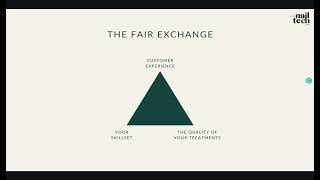
So it's time now to learn about a concept that at the nail tech Org we have called the Fair Exchange. And this is super important when it comes to understanding your appropriate pricing as a nail technician. Specifically, if you are an existing nail tech who knows that you need to restructure your current pricing, but there's a few things going on in your mind right now. This will also help you if you haven't yet set your prices, if you're a new nail tech, just something to be aware of as you step into running your business effectively and really understanding what you are actually a part of when you are at an appointment with a client and they're paying you for that appointment. So before we understand the concept of the Fair Exchange, I just want us to wrap our heads around this first. Now, as a nail technician, you are not just offering your customers one thing. You're not just giving them an appointment, you're not just giving them a set of nails, you're actually providing them with a whole set of things, which I have umbrellas in these three categories. So the first thing that you are providing is a customer experience. And that customer experience does not just begin when they sit down in your seat. It begins in that very first touch point with the customer. So when they very first find you via your marketing channels, via social media, via words of mouth, via walking past the salon, whatever way that customer comes across you, that when their experience with you begins, their experience doesn't end. Also when they step up out of your seat, their experience carries on right through up until when they walk out the door. Do we send follow up emails? Do we ask them to book in for the next appointment? Do we check in on how they're getting on? Do we offer incentives to come and return or to, you know, referrals to friends and things like that? So the whole customer experience is not just the length of time that they're in your salon space, it's the moment that they find you to the moment that they leave you and we continue that communication. So that's the first thing that you're offering, is your customer experience as a whole. And you can start to have a little think about, okay, well from a customer experience perspective, what is it that I'm offering? You know, am I happy with that entire customer experience or have I actually just put all my focus on the time that the customer is in my seat without really focusing on the parts outside of that? And how can I really tighten this to create a great customer experience? Or you might be sat there thinking No, I think my customer experience is spot on. I've been in this industry for a while now. I've really refined my experience. So I'm confident with the way in which the entire journey plays out with the customer. So that's the first thing is customer experience. The next thing that you are offering is your skill set. And this will be dependent on the level of training that you've had, the quality of training that you've had, potentially your experience, so how much practice time you've had, how long you've been in the industry for, and all of those things. Now that's not necessarily to say that if you've been in the industry for longer, then your skills are higher. It also comes down to the level of time, energy, attention you have spent on your skills. You know, somebody could have been in the industry for one year, but they spend every single day and time outside of doing clients upskilling, you know, investing in new training, watching videos, practicing on friends and family. And somebody may have been in the industry for 10 years, but they may be, you know, they may have only completed the very initial nail course and never done any further training since they don't actually submerge in additional training or watching videos or upskilling themselves outside of sitting at that now desk with clients. Okay? So don't just think that your skill set is simultaneous to the length of time you've been in the industry, not always the case. So your skill set depends on your level of training and your level of knowledge and your experience level in what you are offering as well. And the last thing that you are offering to your clients is the quality of your treatments. Now again, this could potentially come down to your experience level within the industry, but it also is massively implemented, impacted by the products that you're choosing to use, the tools that you are investing in, the little additional touches that you are adding into these treatments, the USP that you are given your client experiences. So these three things are what make up what you offer the customer. So it's not just an appointment, it's a customer experience overall, it's your skill set and it's the quality of the treatments that you are providing to your customers. So with that in mind, let's now talk about the fair exchange and what that actually is. Now, the fair exchange means that every time you are paid in business, technically you are part of an exchange that doesn't matter who you are or what industry you are a part of. So you could be watching this as somebody who has a jewelry business Maybe you're a jeweler, or you could be a butcher, you know, and you, you earn a butcher's, or you could have a cake shop. Whatever way you are offering this to your customers, you are then forming part of an exchange. You are providing your client with a specific service and in turn they are providing you with money. Okay? So you give them the service, you give them this, and in return for that, they give you money. Now, in order for this exchange to be balanced, okay, so what I mean by balance is to be fair, to be something you can sustain, to be something that is worth taking place, then it absolutely must be mutually beneficial for the client and for the nail tech. And we'll go into more what that means in a minute. But at a glance, if you think right now you are existing nail technician, you are currently part of an exchange, I want you to look at your business and answer this question honestly right now. Are you currently a part of a fair exchange or does it feel more like an unfair exchange right now? Now, a fair exchange kind of looks like this. So on one side, what you are offering the client, what you are giving to the client is a beautiful set of nails that is going to last three to four weeks. Plus you're giving this client confidence and a feeling. You're giving them me time and self care times themselves that they might not have outside of this one treatment. You've given them someone to talk to. What if you are the only person that your client gets to talk to all day or potentially even all week, you are giving someone a luxury treat, a chance to truly express themselves through intricate nail designs or nail art or whatever that might be, or wacky colors or subtle colors, a chance for them to really express who they are and almost see their nails as a form of art, prescriptive treatment. So if you're someone who will do a photo consultation with your customer when they first step in, and you might say, okay, your nails are telling me that, you know, you have these hobbies, you have this kind of lifestyle. So I would really suggest utilizing this treatment or this product as part of your treatment. So you're given a prescriptive treatment. Are you given a luxury service? You're also given hours of your time and the list goes on. Okay? So again, you're not just giving somebody an appointment. Think back to that, that diagram, that triangle from before, you're giving a client all of these things as a part of that triangle. And in return, the one thing you are getting from your customer is a payment. Now, if you imagine you put all of those things in a set of scales. Okay, so you put the payment on one side and you put the service, the experience, the skill set and all of that on another. Are your scales balanced or do your scales look like this? Does it feel like you are given so much in service and inexperience, but the payment that you are getting just doesn't match up to that energetically? It doesn't feel good? When your client is walking out the door and you're left with this money in your hand, does it feel like it's enough for what you are providing? Maybe it does. And if it does, and that's great, that suggests that you are on the right path. That suggests that your price and structure is currently representative of the exchange that you are offering. But if it doesn't, that's where we face a small problem. And that's why it's amazing that you are sat in this module right now, because that is where it's a real chance for you to correctly calculate exactly what your business prices should be. Now it's time to start looking at at your business like a business when it comes to pricing. I want you to ask yourself these questions. What experience or service are you currently providing to your client and how long does that service or experience take you? And the second question is, are you honestly hands on heart receiving enough in exchange for that? If you know at this stage that your exchange is off balanced and your service is too cheap, then potentially your ideal customers will also probably be feeling this too. Even if they don't say it or portray it. Charging too cheap can be so damaging to your business long term. We've already covered that in some of the previous masterclasses. But when it comes to the Fair Exchange, here is why it could be damaging to not charge the correct amount for your treatments. As we've already discussed, cheaper things have less value. Clients are less likely to value their cheap nails, not follow aftercare, not follow your policies, and have less respect for the work that you do. Also, those looking for quality can easily be put off by low prices and question why they are so cheap. You could be losing a whole clientele who are willing to pay more and are likely your ideal clients. All because you choose to keep your treatments as cheap as possible. And lastly, and for me, I feel like this is the most important factor of the Fair exchange. If your exchange is unfair, you can easily start to resent your beauty business. If you're not in it enough, you're working too many hours, you're seeing little rewards. And all that does is energetically make you feel like your business is failing, your business is not successful. You're putting all this time and energy in and you just don't seem to see, you know, a fair amount of rewards off the back of that. You just don't seem to have enough money. When you look in your bank at the end of the month, it feels like you're grafting and grafting and grafting and you've got nothing to show for it. That's when you start to resent your business and that's when you start to see not enough profit. That's when your business is not growing. That's when you are not enjoying the life that you have built for yourself. Now, I hope that this fair exchange concept has really started to help you to understand exactly what you are offering for your customers and also why it's so important for this to be balanced. We're going to discuss this more in the next videos, but just a little bit of food for thought for now and something for you to start considering your existent reality when it comes to the service that you're providing.