Understanding your data
Amy Guy walks nail technicians through five monthly metrics that matter: bookings, reach, engagement, email list size, and income. She says what you measure, you manage, and recommends checking your archives to see which content actually converts.
Chapters
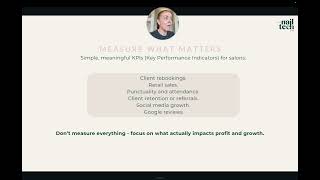
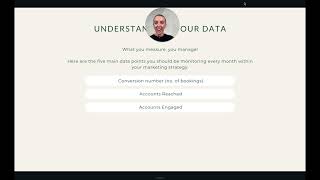
Okay. As nail technicians, we were never ever taught to be really great at numbers, to be really great at dissecting data, to be really great at the boring stuff. Okay? So I am here to make your day a whole lot better. And I am here to teach you exactly how to understand the data that is in your business when it comes to marketing, and how you can understand exactly what you should be focusing on, exactly what you should be taking from the numbers, and exactly how to use them to help you move forward. Okay, so I'm going to take away any in the torell relevant and I'm just going to focus now on the top five data analytics for you to start measuring from today. So let's dive straight into this. And first of all, I just want you to understand that what you measure, you manage. And that is why I feel like it's so important for me to be teaching you this today, teaching you to understand your data. Because if you measure something, then you are managing it. You're going to be able to see a movement within those numbers. But if you aren't managing these numbers, if you aren't measuring these numbers, how are you able to improve them? So if you don't know what they are, how do we grow them? And I mean this from the most granular detail of your business right up into the big stuff. Because I know there'll be people watching this right now who aren't even tracking their income on a month by month basis. Now if you are that person, go back to module one. Lesson two, pull up the weekly business tracker and start using that from today. That is how you are going to track your income every single week. And it gives you other data to track as well. So easy. Once you start using it, it will take you less than two minutes a week to fill that tracker in. It will give you all the data that you need to have a complete overview of your business, how much money you're making every month, how many new clients you've had and things like that. It doesn't give you anything you don't need to know. It's not War and Peace, it's literally a couple of columns that give you the important stuff. Okay. If you are someone that has been tracking that for a while, then you will know and understand how game changing it was for you to start to understand exactly what your numbers are. If you've recently started tracking your income or started tracking how many new clients you've got through your door and things like that, you will know it feels like someone's Pulled a blanket from over your eyes and given you this new insight into your business. And that's because it's an awareness. So what you measure, you manage. And that's why I want you to understand the same thing happens in your marketing. And I don't want you to just be throwing stuff at the wall and seeing what sticks. I want you to throw it at the wall. But then I want you to look at the data and tell me what has stuck based on actual facts, not based on how many likes a post got, not based on how many people responded to your email and things like that. That's just irrelevant when it's not being drilled down as key data. So in order to make it easy for you, I've drilled it down to five main data points that I think you should be monitoring every single month within your marketing strategy. Strategy. Now, there are more numbers that you can monitor. So if you want to monitor more, go ahead and do it. I would not stop yet. In fact, I would encourage you to look at what numbers are available to you in your business and always be monitoring them. They will tell you a story. They will tell you what to do next. They will almost speak the strategy to you. But here are the ones that I think are important for you to use. So, as we've already gone through in the previous lesson, your conversion number. This is the number of bookings that you are getting every week, every month, or even every day, if you want to be that specific. If you're someone whose goal right now is something like to grow a client base, and let's say you're starting at the very beginning, then every week you should be tracking how many new clients came into your business. Off the back of that, you should be looking like, okay, so over this past month, on this week, I gained the most amount of new clients. So what did I do on this week with my marketing that was different? Did I do a specific post? Can I go back on my archive stories? Can I go back on my archive post? Can I look on Facebook? What did I post this week? Because whatever it was, it really helped me to gain new clients. Can I do that again? Can I tweak it and add it into this month's strategy? So it's about understanding exactly where you have converted your customer. You won't know this unless you start writing down how many new customers you're getting. This is a column inside the weekly business tracker. So it's made easy for you, but you just want to understand what is your conversion number based on? All of your efforts, how many bookings are we actually getting? That will then tell you what you need to change, what you need to add, what you need to do differently inside your marketing based on whether it's conversion issue, whether it's a reach issue or whatever else accounts reached. So you also want to track how many people are seeing your stuff essentially. So if it's an email, how many people were sent the email? How many people out of those people opened it? If it is a social media post, what are the insights on that post? How many people was this pushed out to? Remember, if you using social media to market your business, you're essentially playing a game because there's an algorithm in place. Instagram, Facebook will show your posts to people depending on whether or not they deem people want to see it, whether or not they deem it's going to be a highly interacted with post. So, so play the game. How many accounts did you reach with the content that you put out this week or this month? What was the highest reach piece of content? What did Instagram really push for you? Or you know, what email was the highest opened email this month? How can I do more of that? What's actually right in the email? Accounts engaged. Okay, so not just how many people open my email, but how many people actually replied. How many people not only seen my post but shared it, commented on it, saved it, liked it? How many people not only seen my story but actually replied to it? How many people responded to my sticker tap? How many people commented underneath my Facebook group post, like how many people are actually engaging with the content we're putting out? So maybe we reached a lot of people, but no one commented, no one really engage with us about. Okay, so maybe we need to encourage more of a conversation in our pieces of content. How could I do that content again, but how can I encourage someone to, you know, DM me with something specific off the back of it or comment underneath or ask a question and things like that. So accounts engaged. The next number you want to also track is your email list number. Now, I've said this before in this business program, but if I could have done one, one thing differently in my journey as an ltch, as an educator, as an academy owner, it would be growing an email list. Now, I'll talk about this later on in this module, but an email list is an asset, okay? And it's something you should be actively growing as you grow your business. Because having customer data is worth something to you. It's worth something to your Business. It's a way of communication. Remember, emails don't have algorithms. Emails belong to you. So once you've taken someone's email, that is your opportunity to be able to give them information as and when you need to and for it to land in their inbox. Then it's just a case of whether or not the open air based on, you know, interest and preview headers and things like that on your emails. But we can go into all of that later. So your email list, you want to actively be monitoring that every month to know how many new emails you're getting in your business. And lastly, your total income. If you are not monitoring your income right now, how do you expect to grow it? You can't grow something. You can't manage something if you're not measuring it. So your total income, at a bare minimum, should be something that you are tracking every single month. Okay, every single week, even. So, to accumulate all of this in a nutshell, these are the things you want to start tracking. When it comes to your social media and your data analytics or when it comes to your posts, you want to be looking at your conversion number, your accounts reached and your accounts engaged. When it comes to everything else, your overall marketing, you want to be looking at your email list and your total income. Like I said, there are so many other metrics that we should and could be calculating at this stage. But if you're not tracking anything so far, I want you to start with these five and see how you get on. I'll teach you more about marketing as we move through these modules, but there is no point in me giving you strategy. And if you're not going to start monitoring what works and what doesn't when you implement it. Okay? So get comfortable with these data points and these numbers pop. Anything you need on the newsfeed, and I look forward to seeing how you get on.