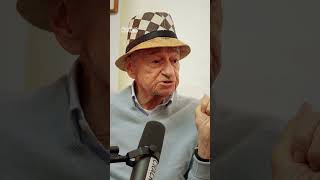
A podcast-style YouTube interview between Oso Trava and artist Pedro Friedberg exploring surrealism, the absurd, and Friedberg's eccentric visual universe. The speakers discuss religion/atheism, the role of absurdity in art, Friedberg's surreal chairs and sculptural objects, a critical view of minimalism, and a question about psychedelic influences on his work. The transcript includes brief biographical context (born in Florence, 1936) and characterizes Friedberg as an architect of the absurd.
Chapters
For people who have beliefs or religions, destiny is very important, isn't it? I'm almost completely atheist. When I look at nature around me, I would like to believe in God a little. I don't understand the concept of God. I don't like it very much. We ridiculed everything. Everything seemed very funny and very curious to us, very absurd. And the absurd is one of the bases of surrealism, imagining things that one has never seen. This is a gift given to very few people, isn't it? Most people eat very square and very sad lives limited to the conventional. The chair by hand. They brought me one like a tree root that had a shape, kind of like what it is, right? It's a joke. As a sculpture, it's quite ugly. As a chair, it's more or less comfortable. And he saw that thing and said, that's a surreal chair. I'll take two. You say you've sold more than 5,000 chairs?
Oh, no, I didn't count them. With the counterfeits, I probably did. A contemporary of Matthias Jarrett's, Remedios Barro, Leonora Carrington, Diego Rivera and Edward James, Pedro is an eccentric genius, an architect of the absurd and one of the most irreverent artists that Mexico has produced. He was born in Florence in 1936, but he was born in a Mexico inhabited by surrealist scientists and exiles, where everything seemed possible and absurd at the same time. He has created a visual universe that combines sacred geometry, impossible architecture, esoteric symbols, refined irony, and an almost manic obsession with symmetry.
Although it sounds corny, more had to be made of painting. They were trying to reduce it. Reduce it, reduce it until minimalist art was created. I find it horrible. Well, it's not art. It's nothing thing. These touches of psychedelia that seem to inject a reality of fractals into your paintings, are they influenced by any psychedelic substances like those used in the 60s?