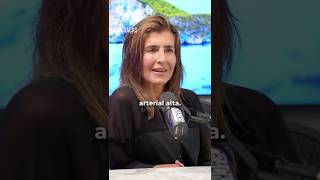
This is a spoken interview (Cracks Podcast) where Dra. María Patricia reflects on common beliefs about salt and high blood pressure. She recounts an anecdote about being advised that lack of mineral-rich salts — not sodium chloride alone — may underlie hypertension, describes how this challenged her prior assumptions as a chemist, and says the encounter was a turning point that led her to study the interaction between environmental minerals and health.
Questions this video answers
Duma Labs
1,000 milligrams of sodium
Chapters
Do you know anyone who has high blood pressure? Sure. Okay, what's the first thing we take away? Well, salt. Salt. Sure. I was wearing my medicine hat. Well, I have a supplement brand called Duma Labs, and we took out some electrolytes that were even labeled as having 1,000 milligrams of sodium, right? And the first question they ask us is, what if I'm hypertensive? We're terrified of salt. So, look, I go in like this, right? Learning, thinking that this is quackery. I still didn't know what I was going to do next to go back to it again. But, hey, I was going to fix something. And this guy says, what's the main problem for someone with high blood pressure? And he says, lack of salt. Look, at that moment, I said, no, no, no, no. I threw away the money. I. I threw away my career, everything. And I don't know why he kept talking. I don't remember what he said because it was all an internal dialogue. What is salt? Do you know what salt is? Well, if you're talking about sodium chloride, that's one part. But if you're talking about a salt like Himalayan pink salt, It's, I think, 200, 200 elements, the minerals of the Earth. When in the modern world we talk about salt, we. We're talking about sodium chloride, just like you said. But this gentleman wasn't talking about sodium chloride. This gentleman is talking about the minerals of the earth, the component of the earth as it is represented in our lives and in our health. This heals. This sickens. How did we get from all the minerals of the earth to 2. Industrialization. Of course this harms us. This does not exist in isolation on Earth. At that moment, imagine I was an organic chemist. And it started to dawn on me that I don't even remember what the rest of the class was like. But it was all this internal dialogue. I said, wow, I hadn't seen that. How come? I, as a chemist, hadn't even questioned what salt was. Instead, I had completely accepted the idea that salt is bad for people with high blood pressure. That was a moment that changed my way of allowing myself to observe and to let information in and to question and wonder how to continue seeing this interaction between our environment, our habitat, which is planet Earth, and our health. It was the breaking point. And that's when I turned around, I broke down, and I began to learn.