Build and Activate Workshop Series - Activation
Peter Fogelsanger leads a workshop on activating B2B SaaS partner ecosystems, covering onboarding, co-selling, professional services integration, and measuring pipeline impact to drive predictable revenue.
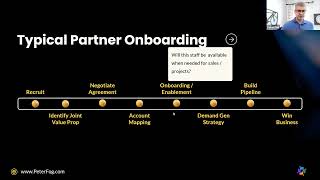
Hi, welcome back to the Build and Activate workshop series. Today is the third and final session where we will talk about the activation phase of building your ecosystem to drive results. If you missed the previous two sessions, just quickly about me Peter Fogelshanger Last 10 years I've built partner programs and enablement programs for several B2B SaaS vendors. Prior to that I spent about eight years in direct sales for enterprise software and then early in my career I spent about 12 years working for some regional boutique agencies. A lot of what I learned about partnerships and partner enablement was by accident. I was hired by VP of Sales at sitecore who was building what I would now call the first ecosystem led go to marketplay and the expectation during that time was that we drove 50% of our pipeline and revenue performance from a partner ecosystem that we were personally responsible for recruiting and onboarding and in the early days it was 100% commission program. So if we didn't figure out how to do this well, we starved to death. Personally, I'm married, two adult daughters and son in laws and as you can tell from my avatar, I'm a little bit of an introvert, geek and DIY guy and just a refresh on why we're here. You and your teams are busy. You can't imagine doing more without headcount that you're probably not going to get. And at the same time you've got a bunch of partners that have signed partner agreements and they're not performing the way you want them to yet. But your leadership is asking you to drive pipeline from their point of view. They've made an investment in you and the program and ecosystem itself and they need to see Pipeline, they need to see ARR, and most importantly, they need to see predictability for the future. So in the previous sessions we talked about some of the typical friction points in the process that you may be currently using and had a lot of participants validate that their process looked similar to this. Specifically, it's premature to do JVP early in the process, it's premature to negotiate a detailed partner agreement when the partnership's unproven, and it's premature to do broader account mapping and account planning when the partnership just isn't understood or proven. So today's session we're going to start to talk about what's the best way to do onboarding where you actually know who the staff is and what's the best way to start thinking about driving demand that isn't simply academic skills and good intent. So part three is activating enabling for that first project, if you recall, the second session was really instead of doing broad scoped onboarding and enablement, we really want the early stages of partner program to be focused on identifying the first deal and then co selling that first deal. And if you do that, then your activation becomes focused on enabling that team through the lens of who they are, the scope and type of project that it will be around and then we can focus on winning that business and scaling it out. Before we dive into the these three parts, these three activities, I want to take a step back for a second and share with you two key areas of my career and strategy that has been really instrumental and making this go better and go faster. And I would encourage you to talk to your leadership about how you can implement some similar things. The first is to make sure that your training and enablement isn't a separate thing from your program strategy. Instead, turn it into a gamified program where you can, you can leverage the circs and badges into the tiering scheme. Then it becomes a carrot for them to stay engaged, to move up and reap the benefits of higher tiers. And if you're a SaaS vendor, your product really lends itself to this. Already you're continuously improving the product and rolling out new features. So why not have your enablement program reflect that? That's good from a quality of delivery point of view, but it's also really good from an engagement point of view. If you're doing that with self service and inexpensive tools like prms and lmss, then you've got both the content and a inexpensive process that this can start to become a really great tool for you to keep partners engaged. They get the first deal done, they deliver it and then they go away and they forget about you. No, if you've got this gamified process in place, then it's a regular cadence of keeping them interested, engaged and having your product be top of mind. Similarly, if you have anything like professional services in your organization, please think about talking to your leadership about leveraging that for your partner first deal. And if you're able to do this, it becomes an additional insurance policy for that customer. If they have a little bit of a nervousness about it being first project that that partner's done with your product. This, this is the insurance policy. This is a safety net. It also commercially can become a huge carrot to incentivize them to bring that first deal to the table. You can acknowledge, yes, we're asking you to take a leap of faith to Identify that first deal from somebody who trusts you. In exchange for that, we're going to invest in you with some form of professional services. During that first project you can decide what makes the most sense commercially. If you can do this at no cost to the partner, that's great. Could be part of cost of sale or it could be passed through as part of your license, or it can just be low cost cost recovery. But if you're able to do this in a way that's milestone reviews, architectural reviews and other types of professional services, that can be huge. And if you do this right, then that team that may be perceived as competing with partners now is not perceived that way at all because it's now a strategic first deal enablement resource that they can take advantage of. So with, with that in mind then what are the, what are the things that you that I would suggest you think about for that project team? Of course the partner is going to be thinking about identifying resources this professional services, who do they staff and how do they take care of this. If it's ISV to isv, obviously they're identifying who's the CSM that's that's going to own this and they should be ensuring that the team that's assigned to this project, if not already has gone through whatever self service that you provide to them. From your point of view, you want to think about transitioning the pitch materials into project assets. I think this is often overlooked. I think sales tosses it over the fence to customer success and if there's a partner involved there's probably even more rich knowledge there that you can set the project up for success and rapid sprints. So think about how you can maybe even take their statement of work if they have that asset. Also think about any challenges that are project specific that you might have identified during the co sale phase that could be, that might warrant deeper support from you to proactively avoid those challenge areas. Maybe you can bring an SE or SA to do some one off enablement or, or some architectural discussion to make sure you're proactively cutting off any of those challenges before they become problems for the project. And I also think partner teams are not proactive enough in ensuring cross functional alignment as you're transitioning from co sell to the delivery phase. I think it's our responsibility to make sure that sales and partner and customer success know the history of this project and know that there's a partner involved and oh yeah, partner identified this project. So we need to treat the customer almost as we need to Treat the partner almost as if they're the customer and not do kickoffs and QBRs strictly with the customer. We need to, we need to have the partner in the loop and maybe even defer to the partner when appropriate for specific communication. And of course you've won the business, it's kicked off and now we need to deliver. What are the things the partner team should be thinking about? The partner, obviously we want to encourage them to have their project team communicating with you and collaborating with you. Same as what I said a moment ago. We don't want their project leadership completely ignoring the customer success team. And we want to make sure that they are aware that as they're putting resources on the team that they are aware of enablement, whether it's the optional or advanced enablement that might be important at a key phase of the project or simply enablement for new team members that are added that missed the early phase. Then from your point of view, if you don't have professional services available, maybe think about the SE or NSA shadowing the project during the initial sprints, milestones, reviews that allows for additional on the job training. This can be a really good way of avoiding problem areas, but also a good way of deepening the partnership and getting to know each other one another as organizations. I really think this, this next one can be truly valuable which is to do a delivered project review. You could do this at the very end of the project or you could do it along the way. Having someone in customer success or professional services reviewing what the product, what the partner is delivering, and then awarding an official delivery certification can be an uber tool in your credentialing and in your cheering, but it's also your camel's nose under the tent. This is your official excuse for really diving into what's this partner do? How do they do it, what do they know? How is this customer using your product? And that can be intel that is very useful for references and case studies and those other kinds of things which a good segue from a partnership point of view. This is, this is when you really want to start documenting the joint value prop, because now you have the evidence starting to come to life through this project. I'd also suggest that you drive an informal initial case study that you might publish internally. Even at the, at the kickoff you could think about doing this because that's when you've got the, the high fiving that we close this deal, you've got some positivity. So let's, let's start to share that internally to keep the momentum up that will help you with this partner to scale them up with the rest of your teams, but also is a really good way of injecting a partner centric culture into your sales org by saying hey we, they brought this deal to the table. Hey we want it. Hey, here's what they're going to be doing with our product for this customer. Really important step. And then of course we're all thinking about this phase which is how the heck do we build pipeline. So if you've, if you bought into this idea of identifying the first deal and enabling the first the project team first, then you can think about the pipeline building phase a little bit differently or a little bit more strategically. The partner, you can ask them to think about what's the next project even though they identified the first. If you've gotten to this point positively and successfully, they're likely going to identify it's likely that they could identify additional low hanging fruit from their portfolio that you want to make sure that you focus on and that might be a good excuse for them to enable additional bench resources that keeps the the buzz and the momentum up inside their shop. And these two things are important. This is the time to start having a conversation about scaling out the trust between the account team that won this deal and other teams and also to think about aligning partner executives with your executives. Then from your point of view, this is a good time to start thinking about how can we reciprocate. Is there a way we can give and get here in this relationship? That is the best way to get a partner really lit up if you bring them a net new at this stage. Of course you also want to be thinking about scaling out the account team to your other account teams. Also suggest this is a, this is a really good milestone to recommunicate and set expectations on your program, your process. What is that give and get rhythm? What is, what is the criteria for tiering was the criteria for co marketing and this is, this is a. This last bullet warrants its own workshop series. So I'll just highlight here for a moment. My partner in crime at the last two early stage companies I've worked at is a CMO that aligned with me around partner co marketing through our ABM strategy. And this was a real epiphany for both of us that instead of doing these separate partner marketing things that were expensive and cumbersome and often met with mixed results, it's very incrementally easy to bring a partner into an existing ABM process. So if you like this idea, think about you've got tools you've invested in, you've got processes, you've got content and expenditure that you're already going to do anyway. So this can be an earned benefit of partnering with you with obviously with the appropriate dials and, and levels of scale. But you can invite a partner into a small part of your abm. Maybe they can own a certain number of accounts for your ABM program that is earmarked for them that they've designated as interesting to them. Or maybe they can own a specific territory if you've got a small partner ecosystem or certain period of time or a certain campaign that they can buy into. And this leverages what you're already doing to the benefit of the partner. But then you can also leverage what the partner knows. If they identify two or three accounts that you didn't have in your target because they think they're really good from what they know about the marketplace, that's making your ABM strategy better as well. So lots of things unpacked there, but this could be really exciting way for you to attack co marketing. So to, to, to wrap up this partner activation topic, we've talked about how to be more agile and efficient in recruiting and how we do agreements, how do we how we do initial onboarding and then focusing all of our time and attention on getting that first deal over the line. If you're doing this really well, then hopefully this project, team enablement and winning in pipeline building isn't Captain Obvious. It's just a lot more natural follow on to these other steps and if you've successfully done that, then it's time to think about transitioning your process and transitioning that relationship to a growth phase. And, and in my experience, in my opinion this warrants a process as well. Very simple example here where I would suggest at this point in time there is a some sort of kickoff or planning phase for the long tail of your relationship. So you've come out of the initial onboarding and activation, you've got the first win. Now you want to sit down with your stakeholders and set the goals for the next quarter, half year, year, whatever is the right period of time. Let's, let's discuss them and agree to how we're going to measure them. And then instead of the normal, let's set up a pipeline cadence. Now your cadence can be should be more meaningful. Specifically you can have a GTM demand gen cadence that instead of just focused on what deals do you have, for me it can be a little bit more Proactive. Now the partnership has proven. Let's look at account targeting. Let's, let's have a monthly discussion around intersections in crossbeam. And this can be a lot more positive. Instead of just a pipeline reporting session, you can also have some kind of session throughout this period of time. Maybe, maybe this is monthly, maybe it's every six weeks. But have a regular checkpoint around continuous education. This gives you an excuse to be positive and consultative. Where is your team doing with the project? How is your team doing with continuing their expansion of their knowledge? Hey, we've got this new badge. Hey, we've got this new certification. Hey, only two people on your project team are certified. This would be a good time to think about, you know, formally credentialing the rest of your team because we're going to look at that at the end of the year for tiering. And then throughout that process, throughout those two types of cadences, you're going to identify deals to co sell. And this is a time to circle back on demand to co sell activation part of your process for those specific deals and not try to weave those into this process, but branch them out as a parallel track when you have those new deals identified. And then of course, if you follow any of the subject matter experts on partnership leaders, you know that you, that we as a discipline are not measuring things as well as we should. So this is a really key part of this process that you, you set some goals, even if it's just number of deals or number of meetings or something, set, set that at the beginning of this period of time and then review them. And you've got to have some understanding of how frequently are you going to review them. It shouldn't be a surprise when you get to the end of a year that a partner hasn't met the criteria to be promoted or to get the next lead or to do co selling, co marketing with you, or even worse, that they've not met the criteria to stay in their tier and you're going to demote them. There needs to be some kind of process, I call it a qbr. Maybe you do it semiannually, but it needs to be with some kind of frequency that you review the plan, you review the activity during that period of time and then you maybe reset expectations or reset your goals. And if you're doing this right, it should become a very natural way and a very efficient way of you spending your time on high value things and not wasting your time on low value things. So quick poll how many of you have have found how many of you have a process that does to partners feel like we're just meeting to to exchange pipeline niceties and fill out some kind of trip report or pipeline sheet. Yeah, I see a lot of you and that and that's a struggle. We're measured incentive to drive pipeline and deals and so we want to go talk to the partner about that. But some of these techniques and tactics that I've shared with you hopefully can give you a way of doing that in a much more positive, proactive and consultative way. I would love to hear from you on the Slack Channel if you guys have other ideas or other tactics that that you can weave into this that we can all improve. So as a next step, if you haven't already, please sign up for Catalyst. I was registered number two. I'm so excited about Catalyst in May, the one in Chicago last fall. This. This fall was amazing. I'm even hoping to present some of this content in more detail at Catalyst and, and really look forward to meeting many of you there in person. So that's it. Thank you and I appreciate your time.
More from Peter

Kiflo Q&A Live: Why Aren’t My ‘Paper #Partners’ Performing & How to Fix It? #partnership #gtm
Kiflo Q&A Live: Why Isn’t My #partnership Program Generating Results & How to Fix It? #partner