Partnership Mastermind: Service Partner GTM Bootcamp [week 1]
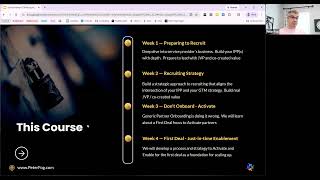
Peter Fog opens a four-week partner program bootcamp with a framework for recruiting service providers. He introduces the Ideal Partner Profile, a template covering business model, resources, and go-to-market strategy, plus the GROW framework for scoring partners. The IPP must be iterated quarterly, not treated as static.
Chapters
Hey, Eric.
Hey. Evening.
How are you doing?
Good. It's been a great day, actually.
Good. Good air on paternity, right?
Yeah. So there. Is there a backdrop, background background noise on my side, or is it fine?
I'm. I hear somebody talking occasionally, but not. Not enough to be disruptive.
All right. It's my daughter watching Peppa Pig.
I just had a bunch of dogs barking in my background, so.
Yeah, I didn't hear anything, so.
Yeah.
Awesome.
Yeah, no, it's. It's seven in the evening here in Norway, so. So, so. Well, yeah, it, it, it works. But. But I need to be around with the family here, so. Yeah, sure.
Absolutely. And you had your fourth. Okay.
And you had your first granddaughter or grandson.
Yes, granddaughter. Yep.
Congratulations.
Thank you.
Different experience. I haven't had it yet. So you have a while.
You have a while.
Yeah, yeah. At least. At least 10, 12 years, like minimum. So I'm good for a while.
Yes.
My oldest is sick, so. Yeah.
Okay. Yeah. Hopefully it'll be at least 12.
Yeah. Give it 20 years or so and I'll be fine. Where are you at? Are you someone in the U.S. yes.
I'm on the east coast in Maryland.
Okay, nice. I haven't been, but.
Do you know where Philadelphia is? Yeah.
Yeah.
Okay.
So I haven't been, but. But I know where it is.
We're about an hour south of there. Hi, Dana.
Hi. How are you doing?
Well. How are you?
Good, thank you.
Hello. Hello.
How's everyone doing?
Outstanding.
Good.
Yeah. The day is coming to an end and it's been a good day, so can't complain.
Oh, Eric, where are you located?
In Norway, actually. So it's. It's 7 o' clock here now in the evening.
Oh, wow.
Yeah. Yeah. It's soon. Put the kids to bedtime, but we'll manage an hour. So I was excited about this. So of course not gonna miss it.
Making sure I could still see you guys if I share my. Share my slide, so. Good. That'll work. You East Coast, Dana?
I am, Yep. I'm in Rhode island, so I'm in the Northeast. Yep.
You still have a lot of snow on the ground too.
We have a ton of snow. A ton. My kids love it that, you know, they're excited about it. We're not, but yeah, I'm in.
I'm in. I was just telling Eric I'm in Maryland. And yeah, we actually have ice. It's still from two weeks ago. It is strong enough that I can walk the dogs on the yard and stay up on top of It.
Oh, yeah.
Wow.
Yeah, we got about a foot or so, maybe more, two weeks ago, and then we got. We got it again this weekend, so it's just layered on top. So, yeah, we've got quite a bit of snow.
We've missed the second one. We were supposed to get some, and then we just got a little flurries. Nothing accumulated.
Yeah, we were. We were told 1 to 3 inches this weekend, and we woke up to about a foot, so we were surprised. Yeah.
Wow.
Hi, Drake.
Hey, Peter. Hey, y'. All.
Good to see everyone.
Hi.
Good to see you.
We'll give it another minute or two and we'll get started. Stragglers or not. There's a lot. Lot to cover, and it will be recorded. I hope. I hope everyone is okay. We're being recorded right now. It's automatic with the boot camps that they get recorded, but I live in Maryland, so I'm obligated to make sure everybody's okay with that.
Yep, absolutely.
Awesome. So today. Oh, yeah, sorry.
Go. No, I was just going to ask Drake how Texas is. I'm really curious about Texas. We heard. We hear good things about Texas in Norway, actually, so.
Oh, okay. That's good to know that you're located out there, unfortunately. Well, fortunately. Unfortunately, I just left the DFW metroplex in November, so I'm up in Minnesota now. So I heard you guys talking about snow a little bit, and so I'm. I'm familiar now all of a sudden.
Yeah, Minnesota. Then I start thinking about some kind of crime. Serious. There's some good shows that's filmed in Minnesota, and it's super cold and creepy.
Sorry, Fargo. I think comes up for a lot of.
Exactly.
That's North Dakota, though, isn't it?
It is.
You're correct. You're correct. It is.
I think. I think Drake decided to see if he could move from one extreme temperature to another extreme climate and succeeded.
Yeah, so far, so good. I got some snow boots and some mittens, so we're all good.
Hi, Jordan.
Hi, everyone. Sorry for the delay.
No worries. Hi, Paradi. So before we get started, just want to let everyone know that all the boot camps are recorded. So hopefully everyone is all right with that. It's to your benefit because we will provide the recording each week. If you missed something or if you have a scheduling conflict and you miss the whole week. It's only four weeks, so hopefully you can make all of them. It is intended to be fairly interactive. Today will be a little bit more me talking at you than future weeks. Just because I Want to kind of set some tone and we have a lot of just sort of the administrative stuff to cover today. So everybody good with recording? Beautiful. Okay, so we'll get rolling here. So I've spoken to a few of you in the past, but I thought I would start with who the heck am I? And where does my point of view around service provider partnerships come from? And hopefully some of my lessons learned will be helpful to you. I started full time in partnerships about 10 years ago. I built a number of partner programs and partner enablement programs from the ground up. You can see several B2B SaaS companies that I work for and I had a really unique experience where most of my employment recently was with early stage startups, venture backed startups, but the Thunderhead company was a a bootstrap startup that was being oemed by Salesforce. So in that four and a half years I got to see both the complexity of trying to do things in a really small company with no resources along with what did the, you know, the gorilla Salesforce do particularly around partner programs and enablement. That was really interesting. Prior to full time working in partnerships, I was a direct seller, spent about eight years in enterprise software, sitecore and SDL in particular. And then earlier in my career I worked on the on the other side of this equation in sales and marketing roles for boutique agencies and sis. And I usually share that. Most of what I learned about how to work with service provider partners and in particular was when I was at sitecore. I was there for six years and I think that they were the first partner led or ecosystem led go to market strategy in the market at the time nobody even talked about that when I got hired there. It was really unusual. And the first two years I was there, not only was it a partner led strategy, but for any of us who were field sellers, SES, regional sales directors, it was 100% commission. So if you didn't figure out how to be successful with partners, you didn't feed your family. It was really that extreme. One of the few companies I've ever heard of that had 100% commission in tech and it scared the crap out of me when I took the job. But and a lot like many of you, I suspect the onboarding was a week of here's the demo, here's your laptop, here's our product differentiators, here's your partner agreement, go figure it out. There was nothing more than that. So you really did have to figure it out. And I ended up staying there for six years and was wildly successful because it was a good product. We figured out the partner led strategy and it works really, really well. I'm going to ask many of you to do something similar when you introduce yourself just a little bit about your role and personal about you personally. I've been married for 30 years, have two adult daughters. The I think the relevant thing to know about me in terms of my experiences and how I've applied them to this discipline is that I'm naturally an introvert. I'm a geek right out of college. I was a programmer. I'm not a natural public speaker. I'm certainly not a salesperson. Even though I had 20 some years quota carrying success, it was all learned. And if you're wondering why I'm sporting pink, I'm Also as of 6pm last evening my grandfather this was me this morning visiting her. This is Mia visiting her in the hospital this morning and it's our first and obviously I'm a little excited about it.
Yeah.
So thank you. Thank you so much. So quickly talk about this course. Then I'll give you what I think are the challenges that we're going to try to help you address through the course. And then we'll also look at what all of you responded in a survey. I think it was really interesting. And then I'll let you all introduce yourselves. But today is going to be the content part of today is going to be helping you prepare to recruit regardless of where you are with your program. My belief is if you're an ISV and you have service provider partners, recruiting should be an always on function whether you need to recruit one or whether you need to recruit your whole program. This is something that I think as a discipline partner pros are not taught well how to do it. And even if you don't need to recruit, the things we're going to talk about today will be good context for how you can improve the partners you already have. I hope next week we will dive into then when you start executing on that, what is your strategy? What's, what's the approach that I have found works the best and lessons learned from places I've wasted a lot of time until I've learned how to not waste time. And that leads to a little bit of unveiling. My philosophy is not to onboard and to activate and we'll talk a lot about some tools and approaches that I have found really, really successful in activating partners in week three and then in week four we'll talk about how you handle the first deal, how you handle Enablement. And all across all four weeks, I'll sprinkle in an overall process recommendation and I'll compare that to how I have found almost every partner team that is not five to 10 years mature. And every other partner team I've employed or worked for or consulted with tends to have a very common process. Now that is part of the problem. And we'll look at how I would suggest you can adapt your own process. So this is going to be stating the obvious. You're all stretched already. If you're an individual partner person or if you're part of a team, it doesn't really matter. I believe that this is one of the hardest jobs in tech because there are so many demands and so little time to do what you have to do. And at the same time you probably, I think someone mentioned they inherited partners that aren't performing. Some of you are, Eric. Yep. Some of you may be recruiting partners and you're not sure how to get them to perform. So this is a problem. And the other end of the pressure is that your leadership is always expecting more. So you're already busy, you're already got this process in place. It's maybe not doing what you need to do, but meanwhile you're being asked to do more ARR. More ARR. More whatever. So this is, I mean if you, if you were interviewing for this job that I just described, you'd be like, why would I want to do that? But it can be the most rewarding job in tech, I believe, when you figure out how to manage these things. So what you told me is very similar to what I just shared. And I didn't look at this before doing these slides. So I just dropped this in this morning because some of you hadn't responded until late yesterday. But I think in general everybody said your number one KPI is revenue generation, including arrangements, which usually means partner sourced ARR. Specifically, you also said a huge KPI is pipeline generation. Those are really opposite ends of the same KPI. Top of funnel, bottom of funnel and everything that that means. And then obviously the way you get those two KPIs, almost all of you are thinking about how do you acquire partners and get them to perform. And this was Gemini's summary of what you said. These are not my words, so this is an AI version of your words, but it's very familiar to me. I talk to partner leaders through the partner leadership community. I average Drake and I had a one on one last week. I average five calls like that a month where somebody's asking for some help. And I have that kind of conversation and it's almost always this same set of how do I do what I'm being asked to do? I'm going to pause and I'm going to ask you to first introduce yourself with a quick bio and then any comments you personally have about these KPIs. And Dana, I see you're already off mute, so why don't you go first?
Okay. Dana Mulvaney. I'm a partner channel manager at Generics. We're a global SaaS company and based out of. Headquartered out of France. But I've been brought on as a partner channel manager in North America and I'm based out of Montreal. My. My office. Anyway, I live in the Northeast. Mainly we sell supply, like for our portfolio. For North America, it's supply chain solutions. So warehouse management, transportation management, that sort of thing. I've been in technology for many years, over 20 years, in a variety of roles. So I've worked, you know, I've implemented ERPs, I've sold WMS, I've sold services and cloud around WMS. And this is. I've worked with a lot of partners and I kind of, you know, in my mind, I know what makes a good partnership and what makes it easy to pull partners into deals. But I've never been in charge of a partner organization and I kind of came on board here, you know, to kind of really jumpstart our referral partner program. We have a handful of sis and resellers. That's not my focus. My focus is like affiliates and referrals and we really don't have a formal program. So I'm kind of building it from the ground up and, you know, just looking to, you know, get good quality relationships. Like, I, you know, I've kind of identified who my profiles are, but now engaging them. And then at the same time, I'm kind of simultaneously having to build all of the onboarding stuff without having, you know, without having really done this at a, at a different. I mean, I know what was in place at other organizations, but I'm kind of having to do it from the ground up. And of course, you know, I'm being measured on, you know, SQLs that are being brought to the table by partners. And right now it's a very informal process. So I'm trying to formalize it because there are things getting passed internally that I don't even know about. So I'm trying to, trying to get my arms around all of that. So excited to be here and learn and kind of, you know, get others perspective and insights into how this all should work.
Awesome. So I'm going to go in the order that I see you on screen. So, Drake, you're up next. Hey, y'.
All, Drake Buffington here. I work with a SAS company called ChiroHD. We provide an EHR solution specifically to chiropractors. It's been an interesting journey. My dad's a chiropractor, my cousins are chiropractors. So I just kind of grew up in this niche and it lended me the necessary experience to get into the door. At ChiroHD. I've worked specifically on the CX side, supporting our enterprise clients, our larger clients, for about a year and a half. And then over the last three months, I've been in the manager of strategic partnerships role. Little bit of context around CairoHD as an organization. When I started with Kyrig a year and a half ago, we had 30. I was number 32, 33 employee, and we just surpassed 92 this week. We took on PE funding at the beginning of actually about halfway point of last year. So as you guys can imagine, everything is accelerated. I really resonated with what you said, Peter, where it's like everybody is pushing on us from different directions to produce. And that's kind of where we are. It's been a fun journey. With that said, we're in our infantile stages. Basically. They hired me on into this role and said, okay, let's get some sourced revenue going. We want this to be a real revenue engine for our company. And I'm like, okay, I am learning this day by day. So I'm really excited to be a part of this group. To glean so much from, from you, Peter, and the group at large. But yeah, that's a little bit about me. Excited to be here with y'.
All.
Awesome. Jordan.
Yes. So first of all, thanks for, for having me. So my name is Jordan. As you may have heard at my accent, I'm from France. I' for Francis company, specialize on the E commerce and retail sector. I've. I'm a partner manager since two years now and I'm moving to a new company at the beginning of April. This company, it's called Aden. It's a company, it's a fintech, it's a Dutch fintech who is, who is able to. To provide some financial services. And I will be focus on the, at least at the beginning of my journey on the French market. So just to. To give you an idea today, it's, I'm working on a. In a company with less than 200 employees. We are three on the partnership departments and Adyen is around, I think 4, 000 employees and the department, the partnership department is around, I think maybe around 50, 50 people in the. In six different continents. So it will be really different from where I'm from. But yeah, happy to be here and to trying to understand maybe what will be the. Maybe the this kind of quick win that will be able to apply from the beginning of my journey.
Outstanding. And I'm sure you have some future Dutch colleagues who are very happy about how their team is performing in speed skating right now. The Dutchies are. They always kill that event. It's really interesting. I work for a couple of Dutch companies, so Amit.
Thanks and nice to meet everybody. So I'm with a SaaS company called Avid Exchange. We're primarily in the AP automation space, specifically invoice automation, payments automation and facilitating digital payments. So within. Sorry guys, I think. All right, my screen just cut out.
Sorry.
There we go. So within that space I've been hired as a partnership director, specifically sourcing for ISVs. Within this space, my background is relatively new. I've only been in the partnership space about five years. I've been in my vertical and my specific industry for about 20 years. So have gotten really good background in terms of the UX side and the CX side of the world. But working into the partnership strategy side, really starting to understand, you know, how to build momentum on source revenue, how to generate pipelines, specifically with regard to new partner acquisition. So I think that's where my focus will be. Kind of wanting to learn a little bit more from this team, get a little bit more in terms of context, what other people are doing within this space and then trying to put my two cents in to see where I can help and boost a little bit more knowledge base.
Awesome.
Personally, I am based in Ohio, so relatively cold here. Hopefully everybody else is in warm weather, but it's not that great here sometimes. But for the most of the year it's not bad. But right now very cold.
Exactly. Eric, you're up.
Yes. First of all, super interesting to hear about your backgrounds. I think we're quite a diverse group here, so should be a lot of good learnings from across continents. I'll try to tell a bit about me then kind of my professional background and then the company I work in and then kind of the challenge that I'm sitting with right now. So first I'm 34, located in Norway, Bergen. More specifically so I'm not too far away from Jordan down in France and I have three kids. I just four days ago got got my third kid, a boy and I had two daughters before and well I've worked in kind of like commercially for or have a commercial background and I've worked for around 11 years now and the first eight, nine years I started my own company. It was a home cleaning company where we tried to be uber of home cleaning in our Nordic region. And we quickly realized that it's really hard to get people's trust when you try and send cleaners into other people's home. And you doing that with just sitting in between and trying to facilitate the customers and cleaners was really hard. So instead we kind of ended up hiring 1500 cleaners and scaled to three countries and it, it's. Well it's a success. The company is still doing well but it was a lot of traveling and that's why I kind of left in the end to be more with the family. And I then were a sales director at yeah tech company that was like really a turnaround company and I realized it can't be turned around so I left and then a few months later it went bankrupt and then now I'm in a company called Arithma. It's a fintech company. We do B2B SAS and we, what we do is that we connect banks and ERPs. That's basically what we do. And our main channel partners are ERP resellers. So we, we focus on those and we now we operate in five countries in, in Europe. We also got external like private equity funding a few months back and we might maybe we see each other Jordan down in France, not too long in the future but, but I can, I can mention briefly also that when I started there was no people in charge of the partner program. It was just a sales manager doing it with their one or two fingers basically. And the program was quite sleeping and the partners were not really active. There was 20 partners, 10 of them. I quickly kind of got rid of and focused on the remaining 10 and built pipeline on those, acquired a few new partners but it was like a learn a lot of learning and failings I would say. And we a few months back we also acquired another company who had 30 partners and I see kind of similar signs there but the difference is that the product market fit of the company required is like 10 times better than what we have. So it's like really much smoother, it's easier to sell. You see that the partners you Talk to they want to sell our product. Compared to it's been like really uphill battle with the current partners. So that's kind of the set of setup I'm in and I recognize myself in the setup that you explained. There's always. Or, or I would say there was when we didn't have a good product market fit. There was always like I, I had more capacity to do more but there was hard to get people to sell our product. But now it's a bit the opposite. Now it's like the internal processes that are. We need to speed up internally to kind of roll out the product faster because now we have so many partners that want to sell our products. So it's, it's an interesting challenge. I would say that is interesting.
Okay, last but not least, Pariti.
Yes. Hello everyone. Very nice meeting you all. I think something that Eric just spoke about, it's going to be very interesting to really learn of each other and of course from Peter. Like, you know, my name is Parity. I lead the partnerships house of business for Overledge. Overledge is a company which is focused on data cataloging and data governance. We are a product technology company essentially based out of the, the I think Georgia Atlanta and we have various different offices in India as well. I'm based out of India and I, I was brought in to really take care of partnerships. So it was a lot of working from ground up, really getting the buy in the external and the internal ones to start off with. And something that I really took care of from the get go was the ISP and the technology partnerships because it was really important to align yourselves with the bigger engines. Being a technology company. So a lot of the snowflakes and the databricks of the world was a key part of the technology landscape that I was looking into post which I think every. Everybody wants roi. So we really quickly jumped to how we can, you know, get, get some revenue from the partners. So that really switched things up and I got into the entire deferral partner motion and that really took me to taking care of various different stages in the partner emotion which is from identifying, recruiting, then really moving towards the onboarding, education enablement and really activating business. The reason I'm here is because I really want to like I've seen Peter and his work in a couple of other sessions and I really admire everything that he puts out. So really looking forward to learning more and more, more from an executionary lens. And the idea would be like my challenge particularly was around how do you really activate that part. Like it's very different and subject to the size of the organization and also like keeping that entire pipeline moving day in, day out. Like at the end of doesn't have to be just a track around what are the activities, the leading indicators, but a lot more about lagging indicators that we run out, follow through. But I'm really excited to learn from each of you and interact with you and connect as well. So yeah, glad to be here.
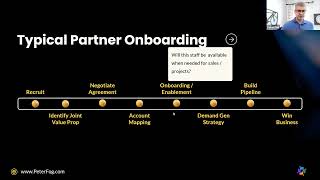
Awesome. Well thanks everybody that, that was very helpful to give me a little bit more context and hopefully you all start to get to know each other and we can make this really interactive. I'm probably going to talk fairly fast for the next half hour because I do have a lot of content that I want to get as the foundation for the rest of the boot camp and going to be challenging to get it done in 30 minutes. But as I mentioned, today is going to be around thinking about what's the best way to prepare yourself to do recruiting partners. We'll look at IPs, then we'll look at some processes and thoughts around a joint value prop co created value which may, you may not have heard of that concept before, but we'll, we'll start to dive into these details in more detail. I mentioned this earlier, we're not going to unpack this in detail, but I just want to kind of highlight what your current process probably looks something like this. You recruit a partner or you go through a process of attempting to recruit a partner and very early on you're probably being asked to document or build a joint value prop. I found in a lot of programs that's one of the very first tasks at the beginning of a recruitment and onboarding process. Maybe either right before, right after that is negotiating your agreement. Depending on how big and mature you are. That could be a lot of blood on Word documents or it could be some minor T's and C's, but earlier stage your program is, the more this is probably a huge time suck. You probably go into some account mapping. I've seen a lot of account managers that get through this part and they have a partner who's really excited and I call it Happy Feet. You got the partner manager on the other side and you got your partner manager on your side which is probably you. And we're going to do a partnership and we're going to do some account mapping and we're going to get really excited and you have a bunch of spreadsheets or maybe even crossbeam to tell you some logos that Might be worth going at after. But again, this tends to be a huge time suck. Then you do some onboarding and then you want to do some demand gen and then you want to do some pipeline from that demand gen. And then hopefully if you've done all that right, you win some business. Just kind of wave your hand or nod or thumbs down if this is radically different than your current process. Similar, kind of familiar. Okay, so for today's purpose, we're not even there yet. We're over here. We're going to talk about if we're going to recruit. What are the, what are the things that we need to think about internally and prepare ourselves from a strategy and documentation point of view before we start recruiting? And the very phase zero thing that I would say sometimes is overlooked because we just get tasked with activity and we get focused on activity and we forget to take a step back and ask the question, why are we recruiting partners? What's the plan? What do we need partners for? And if you're building an ecosystem, what's the purpose of the ecosystem? What's the purpose of each individual partner in that ecosystem going to be? Almost all of you said something to the effect of deal flow. So I know that's top of mind for everybody. But there's other reasons. You might be recruiting or you might want to pivot and be more specific around your recruiting. It might be to expand into a specific market. Dana, for example, you're tasked with doing some recruiting in North America versus where the company is already thriving. That's, that's an important North Star to think about. You might also be thinking more about account growth or penetration. So the purpose of your partners, maybe one of you might be coming at this from a product led growth company that has a lot of freemium customers. And now the leadership is saying, okay, now we need to figure out how to turn these low end or tactical customers into more enterprise customers. So we need partners to help us with that. Or maybe it's to move up or down market. Maybe it's, you've got a departmental solution, you're trying to make it a more enterprise solution, or a SMB solution and you want to move to enterprise. Or maybe you don't have any of those problems. Maybe you've got a really good product that's somewhat complicated and you need service providers to help the customers implement the product or deliver services. Maybe you have some service capability already in house and you're just maxed out and that capacity can't keep up with the product ARR growth or maybe, you know, many of you are in very specific product domains, so maybe you need some additional customer or domain specific knowledge to help win deals. Maybe you've got a really solid erp, but you need some third party expertise around ERP processes to help win those deals or maybe even identify new deals. I'm not saying any of these are right or wrong. I'm saying you probably have more than one of these. That is the reason you're recruiting partners. Oh, sorry. And of course, complementary product integration is probably for many of us. My assertion is you, if you haven't really agreed to what your priorities are with your leadership, this is the place to start. Don't just say we want ARR. Okay, how do you want us to get ARR? What are the priorities of this potential list? And maybe others you're thinking about, what's the top one, two or three. And then that needs to be how you define first of all your ideal partner profile. Why are you building partners? And then once you understand the why, then you can describe, well, what kind of partner would be ideal to do that. This probably seems like really fundamental 101 stuff, but it's often skipped. Where I see partner managers out there dialing a bunch of partners and then they realize that looks like a good partner from certain criteria. But it really doesn't help us with this, with this real need over here. Why is that? So that there's some challenges with who. Who has an IPP already that's documented in print. Not just in your head, on in print. Drake. Does anybody else. Yeah.
Did it for the questionnaire for this one.
Okay. Okay, good. It's. You're not alone. I've been in plenty of partner jobs where I didn't have one. And somebody say, what's your ideal partner profile? I don't know. I'm just trying to get somebody interested in returning my phone call. That's my ideal. So. Yeah, we already did that. So this is really common. I mentioned the number of partner managers I talked to in the last 18 months. You know, four to five deep one on ones every month. So many, many partners. And universally many of them say, we don't know, we don't know what our IPP is. Even if they've written it down, they don't know if that really is ideal because it's been an internal project. We think we know, we've documented, but we really don't know. Or they have it, but they really haven't used it. They went through that mental exercise to answer somebody's Question. But then it becomes a document on the shelf and they don't really use it in any kind of regular operational execution fashion. And a big missed opportunity is we have one but we've never looked at our top performers to see what they have in common. And this would be Eric, I think you mentioned you kicked 10 out and you have 10 underperforming. If you haven't done this yet, that would be a really good thing to do. What did the 10 that you kicked out have in common versus the 10 that are performing? Are there any things that are any trends there about the company or about the relationship or so do that you might discover some interesting things. And then even if you've done all of that, a common fear is we have a pipeline of partners, but there's really not too many that are a fit for the ideal partner profile. So what do we do? And then often there's a lack of alignment. So there's two parts of ipp. And I'll get into this in a minute in more detail. But sometimes there's an IPP that aligns with the product and service delivery. So you know Drake, I'll pick on you for a second. Coming from customer success, this is a potential risk for you developing an ipp. You know your product, you know what the customers need. So you could probably build a killer IPP from that point of view. What kind of services do our customers need around our product to be successful? But overlooking that big. Part of the reason you're going to build this program or these profiles is to drive go to market. So it, it would be very easy to hyperfocus on what you know, what you're comfortable with and then kind of overlook or under invest in the go to market side. I often see it just the opposite. A lot of organizations I've worked for, I have reported to the head of sales or the Croat. Excuse me one second. A dog. Scratching, scratching, scratching. Going to drive me crazy until I let him in here. So if you, if you report to sales, especially if you report to a very old school sales exec, it's probably likely that your IPP will be very GTM focused. It will be. We need them to have a lot of sellers and be in these geographies and overlook. If they bring you a deal, what are they going to do? Can they deliver? So that's a problem. So I'm going to just really quickly unpack the components of an IPP because you already have one. This will be rehashed or maybe some things you haven't thought about. Those of you who don't have one, hopefully as a takeaway from today, will give you some structure for thinking about how you build your your ipp. But there's three or four distinct parts of a partner that you want to examine and understand. What's their business model specifically, if we're talking about service partners in particular. So if you're an ISV and you are building your ideal service partner, what kind of services do they do? And if you've not been working with service providers before, this is really easy to overlook. The partner managers who've worked for me in the early days, they kind of have this assumption that every service provider does the same kind of work. They're just bigger or smaller. And that is as far from the truth as as could be. You've got management consulting. All they want to do is the really big brain advisory kind of stuff. Really high rate, very valuable. But they don't do some of these other things. You've got some that are specifically system integrators. Global system integrators are, you know, really popular with CROs. They go recruit a bunch of global system integrators. Okay, what do they do? Really well, they do technical implementation. Then there's others that do outsource services where they have a lot of bodies and they will outsource a lot of bodies at lower rates and maybe they don't do those other things. And then of course there's agencies and digital service providers. All four of them will have very distinct ways that they will be interested or not interested in working with you and the value they bring to the table. So understanding first of all, which of these four, five, six different kinds of business models are ideal, you need to think about that first. Do we want system integrators or do we want agencies? Do we want outsourced capacity or do we need big brains? What do you need? And then when you're recruiting, you can compare what do these guys do compared to what I think we need? Then the next is firmographics. From an ideal point of view, it's important that you begin to think about. Pick on you again. Eric, of the 10 that are performing, what do they look like from a firm point of view? Were they a different kind of company than the 10 you kicked out? Did you kick out really tiny ones and you have midsize ones? Or did you kick out ones that are only in one city and you kept those that have a bigger geographic reach? Or did you kick out some that are old school and don't lean into any kind of innovation and you kept the ones that are more innovative. Again, there's not a right or wrong answer here. But these are distinct profile attributes that you want to know in terms of your ideal. But also if you recruit somebody that's not ideal, where do they fit and how do you, how are you going to work with them? And then there's the engagement model. So despite what kind of company they are, from a business model point of view and a firm graphic point of view, they may also deliver services with customers in very different ways. They may prefer to do statements of work that start with strategy and have a lot of strategy around them. Some of them will say, well, we're project based, we want to do project based. And they wouldn't care about doing anything that is ongoing maintenance or integration oriented. They want to do the cool projects at standing something up new. Or they may be staff augmentation. They might not say that, but you start peeling young. And that may be primarily what they do. They sell bodies for hours cheaper than somebody else can sell bodies for hours. Or they might be the agency of record or they might be a transformation kind of engagement model. So when you're building your ideal profile, you want to have a strategy around what do you think you need for the kind of engagements that you want your customers to be able to hire. And then again, when you're recruiting, you need to be able to ask some questions around what's their typical way they interact with customers, what's their typical statement of work and project size. And so I'll say this probably a couple of times during this boot camp. One of the things you'll find about service providers is many of them will not answer these questions honestly the first time you ask them. They, they will generalize or sell themselves as a, as a firm more than they really are capable of. That's their job. I understand that our jobs are then to peel that onion like, well, what are you really good at? It's one of the reasons I don't like strictly using application forms through PRMs. Those are helpful. But what they say when they fill in those forms is probably going to be about 75% Hoo Ha and 25% True. So you need to have this stuff in your hip pocket to be able to sniff out what is. They'll all say, we do anything for anybody for money and we do it really well anywhere in the world. We can do any kind of technology for any kind of project. Okay, all five of your people can go anywhere in the world and implement any kind of technology. And then last but not least, what's their ideal customer profile and their go to market strategy? Again, a lot of partner managers, even if they do these things well, then kind of skip over asking about the partners business side of things and they'll focus on their own. They're like, oh, I gotta, I gotta, I gotta build pipeline. So how are you gonna help me build pipeline instead of turning that other way around? Like how are you trying to build your business? What, who are your ideal customers? What industries do you focus in? And then let's figure out how I can help you which will ultimately help me. So I know it's a fire hose. I normally would want to pause here and ask you a lot of questions, but I'm not going to do that because we're going to run out of time. Next phase, you have one of those ipps. You spent some time thinking about it either before today or after today and you're like, I don't know how to answer some of these questions. You put it on paper, maybe you ratify it with your leadership and now what do you do with it? I mentioned having an IPP that sits on the shelf is a problem. So my, I guess I should back up on a second. I'm going to be talking a lot about processes and these guides and frameworks and whatnot. My success has always been to have these as my guidance but not be heavy handed, not overly administrative. So when I suggest you have an IPP and then for each and every target partner you do some things. This is quick and dirty, back of the envelope, bulletized, kind of like these slides. There's a lot of things in my head behind these slides that I didn't write out. Every sentence. Same for you, have a one page IPP and then every time you're thinking about recruiting a partner, build a partner specific version of that for each of those four attributes. What do you know? What can you find out about them? They're going to tell you some things, you can discover some things and then you're going to iterate on that. And this is a really important one. This is not a one time thing. This should be part of your normal cadence. If you're going to work with service providers, what do you know when you're recruiting them, what do you learn after you recruit them? And then maybe part of your quarterly QBR with partners iterate on it because they will add capacity, they will add new offices, they will add new projects with your company. So you want to make sure whatever cheat sheet you have for your partner specific profile, you have a process to keep that up to date. So I don't know if you can see the fine print at the bottom. A friend of mine, Rick Flores, is a partner manager. You've probably seen him on partner leaderships if you're in the community. He took a lot of these concepts and put it into a framework that I think is really helpful called grow, which is an acronym Go to Market. So for each partner, what's their go to market, what are their resources, what's their outreach and what's their willingness. So it's taking that ideal kind of thumbprint and then looking at each partner and evaluating against grow to give you a sense for where, where are the red flags or where are the risk areas. So I'm, I'm going to unpack GROW here really quickly and there's a lead behind it you can look at this week to dive into more detail if you'd like to. So again, for each partner you're going to recruit, I would start this before you make that first outreach is just do a really quick assessment for yourself. What's their ICP and how aligned do they look, look like from the outside with your ipp? What problem and solution synergy do they have? So this one again, I've, I've had partner managers work for me who didn't have much of a tech background. Maybe they came from a BDR or something like that. So this one is one of the most important skills I think partner managers working with service partners in particular can build over time, and that is understanding the product in more detail and then trying to understand what kind of services they provide. And as a trusted advisor, how do those two things work together? The better you get at this, the better you get at adding value to your job. Conversely, there's a lot of partner managers out there who have dashboards and scorecards and weekly huddles that do the pipeline sync kind of stuff. But they've not taken the time to dive into these value added topics. So the meetings with their partners become very academic and they get rescheduled or canceled. The best thing you can do, especially if you're somebody like me who is an introvert, is be a trusted advisor, bring value to the conversation and that can be understanding what's the problem you're trying to solve with your product and what synergy does. Their solution, their services and then the next piece is understanding their sales motion. This is really important when ISV to ISV partnerships, Amit I think you said you have a lot of ISVs that you're responsible for. So in some respects ISV to ISV partners are easier because you're kind of apples and apples. You're both selling products to customers that, that fit in particular swim lanes. Where ISV to ISV partnerships can be hard is if the sales motion is disconnected. It's hard to build a partnership with somebody who's buying decision is completely disconnected from your buying decision. Then they don't, they don't care. I mean maybe they call you say oh yeah, two months ago we sold this to, so they might be interested in you, but we're gone. You know, they sold their product and they're moved on to the next one. With service providers, this can be the most valuable part of the relationship is there is a natural alignment of their sales motion to yours. If they're doing value added services to your product, that buying decision is almost always either one decision or a very tightly sequenced decision. They're going to buy your product and then they're going to pick an implementation partner or they're going to hire an advisor to pick your product. So understanding what's their sales motion and then assessing that to your sales motion is really valuable. And then again, our job is to be able to add value to that, articulate it and talk to the partner about, hey, you guys do these discovery sessions or you do these free assessments. If we plug in there, we can help you be really credible with our product. Looking like you. Whatever. You get the idea. I've got nine minutes left. Resources is a really, really hard one and a really important one to understand and know how to manage. This is true of existing partnerships as much as it is new partnerships. You have to verify they have all the disciplines you need to be whatever kind of partner you are putting them in. Specifically in gold. The most important one is their billable staff. You need to get a sense for what's their processes and what is their capacity. Almost all of them are trying to run at 100% utilization. That's how they make money. So you're not going to find a partner who says, oh, we got 50 people on the bench ready to go with their product. If they do, then that's a red flag, they've got a problem. But more importantly, what is their history? What's their normal cadence? If you bringing them a project tomorrow that requires 15 people to service, what do they do? And if they kind of scratch their head and say, well, so understanding this is really important. Do they have people who are skilled at opportunity identification. Sounds like a really obvious one. There's a lot of really good service providers out there who are founder led and don't have any professional sales and go to market people. So you need to sniff that out and kind of figure out am I dealing with the CEO all the time and is he going to have the bandwidth and the skills and the capacity to identify opportunities and help facilitate them? Again, not a right or wrong answer, but it's just something you need to know. Like if you're expecting to bring in five deals a quarter and there's one guy and he's also running the company, be realistic. That's probably not going to happen. What's their outreach? This is the one that is really gray. When you're recruiting, you have your ideal. You're not going to have that many to fit your ideal from an outreach point of view. But can they fit somewhere in your program from an outreach? What's that purpose we talked about a minute ago and how well do they align to that purpose? I'll pick on you again. Dana, if your job is to ramp up pipeline through partners in North America, does that mean you have to recruit partners that are only covering all of North America? No, that's kind of ridiculous. But if you have one who's really good in Boston and they only do Boston, okay, that now you know their specific partner profile isn't a match to all of your ipp. But if they're a rock star and everywhere else then you, they become your go to in in Boston or they have got stellar customer relationships in five of your target markets in your ABM program. You're like, wow, let's go recruit these guys. That's going to be our fastest path into these accounts. And then of course if you need leads, you need to know what's their lead flow potential. Again, this sounds like this is motherhood and apple pie. But there are types of partners out there that have very low volume. Digital agencies are an example. There are some digital agencies that only do one or two net new logo acquisition a year. They might have five or six hundred people serving, servicing the same existing customers for the last 10 years with digital services. So recruiting them is not going to be a net new logo deal flow for you. So that doesn't mean they're a bad partner, but it might mean that you have to set an expectation that okay, they've got these 15 house accounts. So I need to figure out how do we, how do we tap into those and then the last is willingness. And willingness is again one that often gets overlooked. Not because partner managers don't think about this, but they don't unpack willingness with the right caveats. I'll give you some specific examples. I failed wildly in the early days with recruiting partners who got up to the willingness and had a founder or a practice lead, really committed to investing in a partnership, including onboarding and training people. And we did that. We got happy feet and we got six or eight people onboarded in the product and then nothing happened. Because the rest of what we're going to talk about for the next couple of weeks I didn't think about. I just thought, hey, we build it and they will come. If we build knowledge and capacity on their side, then deals are going to happen. So you need to think about and understand what's their willingness, what's their approach to long term collaboration and onboarding, what's their vision? Let's see, we got four minutes. I'm going to skip this for a second. I want to hit the takeaways really quickly and move it. If we have time, we'll do some more discussion. First thing that I've kind of implied, but I haven't stated explicitly until now, there's no such thing as an ideal partner. So your IPP is really a collection of all the attributes that you seek. If there was a such thing. If you could pick the most ideal partner who covered every aspect of your go to market strategy, they would look like this. But there's not going to be a single partner who does that. There's going to be something about every partner you try to recruit that's not going to fit that. Translate that to when you are profiling specific partners, they're going to match part of it. So if you have an idea of what, what's the high priority parts of your ipp, what are the high priority parts of your go to market strategy, then you can almost score your partner specific profiles against them. And I want to just rehash that when I do this. This is not a, a novel. This is not. Sometimes it's not even more than three or four or five bullets about each specific partner. Once you go through the IPP and you have that in your head and you train yourself that I'm going to think about this every time I'm talking to a prospective partner, then you've got the things, you've got the questions, you're going to ask them and you're going to have like the five or six bullets, like they're really good at this. But this is a gap. They're really good at this and this is a gap. So those bullets, those exceptions, exceptionally good or exceptionally bad are the things that you want to document for each partners when you're recruiting them. And then the last one may also be somewhat obvious that like there's no perfect ipp. There probably isn't really a single ideal partner profile for your business. You may today or in the future realize that you need two or three or four partner types and you need to describe them separately. Again, that sounds really patently obvious, but I like to state it because if you don't set out ahead of time realizing that might be your outcome, you might be trying to smush a bunch of different partner attributes into one profile that don't make sense to be together. So if you start thinking about these things when you're going through this process, you may realize you might need the boutique agency profile because you're going to explicitly try to recruit the Bostonian kick ass ERP implementer. And then you might have another profile that is your super regional that covers like 15 offices. And those are two very different profiles. Both are, both could be really great partners. So one minute left. I will share on the Slack channel. Has anybody not joined the Slack channel yet? Okay, so I'll share the links to all this stuff on the Slack channel so you don't have to write them down. Your action items for this week, think about review your IPP and the GROW framework. The more time you put into that, the more value you're going to get out of the coming weeks. I know you have day jobs, so I'm realistic how much time you're going to be able to put into that. But consider building a new IPP or iterating on the one you have, if you already have one, as a way to kind of apply what we talked about today for next week in addition to kind of just doing that as a, as a reinforcement to today for next week, review your ideal customer profile. And if you can come ready to articulate to two or three attributes of your ideal customer, that would be helpful. And then similarly, what's your go to market strategy? Is it net new logo? Is it growth? Is it geographic expansion? Is it a move up market? What are those major go to market strategies? And then everybody shared a little bit about this already and in the survey. But we'll probably take a little bit of time next week because I won't be talking quite as much. We want to talk about your challenges or things you tried that Failed. We've all tried things from recruiting partners that fail somewhere along the way. And then last, everybody who I coach I give, excuse me, insider access to my AI based coach. I call it Digital Peter just to stick with my silly independent consultant branding. But it is a LLM based coach. It's on my website where you can ask it whatever question you want and if you're an insider it will know your email address and it will keep context so you can keep coming back and it will keep building knowledge about questions you've asked before and how it's answered. And like any LLM it will start getting better and better and better. So it's a source that I am offering you at no charge for the next year that between sessions or after this is all over, it'll be a place you can go. There's almost a million and a half of my words and ideas that are trained in this LLM. So I'm not an expert at everything, but it does have a lot of stuff that I've learned over the years that you can tap into. So we're officially out of time, but I'm happy to stay on and chat, ask questions, comments, feedback. Anybody.
I mean I can jump in. For me it was very interesting for a first session I didn't knew that it can be relevant to define different ipp. I think it's, it totally makes sense but I didn't get it before.
Those.
Things we all conclude because we're all self taught and somebody says you need an ideal partner profile and we all just sort of assume that means there is one ideal partner profile. And so you've done this for a bunch of years. You're like well that's a very different partner than that is but they're both killing it. So maybe I need two or three ideal partner profiles. Especially when you start thinking about the different kinds of work that partners can do that could fit really well in your program. You might want the advisory kind of partners who aren't going to do any technical work with your product, but could be really good at identifying deals and helping position your product. And then you might have another completely different type of partner that's doing service delivery on your product. So you may find you need more than two, you might need three or four. And then there's markets that are different too. If you have different market responsibilities, you know Europe behaves very differently than North America. So you may have a European partner profile that looks different than a North American partner profile because the way brands interact with third party service providers is very different in those two markets. Other Thoughts Comments Is a good place to start for everybody. Not too elementary hopefully.
Yes thank you.
Awesome.
Great. Well I will look forward to seeing everybody next week. I'll post on Slack a link to the recording, a link to a couple of these leave behind worksheets, a link to the AI coach and anything else I haven't thought of. Thanks everybody.
Thank you.
Thanks a lot. Thank you guys.
Bye guys.
More from Peter
Kiflo Q&A Live: Why Aren’t My ‘Paper #Partners’ Performing & How to Fix It? #partnership #gtm
Kiflo Q&A Live: Why Isn’t My #partnership Program Generating Results & How to Fix It? #partner