Build and Activate Workshop Series - Onboarding
Peter Fogelsanger walks through partner onboarding strategies for B2B SaaS. He covers how to recruit partners efficiently, get them activated fast, and turn them into pipeline and revenue drivers.
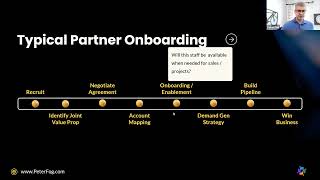
Hi. Welcome back to the Build and Activate workshop series. Today is Part two which is Onboarding how you can onboard partners to efficiently build your ecosystems. If you missed the first session, Just a quick reminder About Me My name is Peter Vogelsanger. Last 10 years I built partner programs and enablement programs for several B2B SaaS vendors. Prior to that I spent eight years as a Regional Sales Director for enterprise software companies and then earlier in my career I spent about 12 years on the other side of the partner ecosystem with regional boutique agencies. A lot of what I've learned about partnerships has been by accident. I was hired by VP of Sales at sitecore to be a direct seller in a time when he was building what would today be considered the first ecosystem led go to market strategy. And as an individual contributor we were expected to drive 50% of our revenue from partners that we personally recruited and onboarded and managed. And to make it even more complicated, the early days of that tenure was 100% commission based. So if we didn't figure out how to do partners efficiently and effectively, our families didn't eat. Personally, I've been married for about 37 years with two adult daughters and son in laws. As you can tell, I'm a little bit of an introvert and geek and my side passion is diy. Just a reminder of the problem statement why I think we're all here as partner managers or managers of partner managers, you're already busy or stretched thin and you're being asked to do more without expecting to get a lot more headcount. And at the same time you've got partners you've already recruited, they've probably signed agreements and many of them are not performing the way that we need them to. But leadership is also asking us to drive more pipeline and revenue. And from their point of view, they've invested in you and the team and the program and they're expecting results. And not only are we expecting results, they're expecting predictability for future results. So how do we tackle that problem? I've asserted that part of the challenge that creates that problem is the process that we all kind of naturally have been taught or learned on our own to do partner recruiting and onboarding. And there are friction points along the way. The first friction point is often we're trying to identify a joint value prop. Maybe not here, but somewhere early in the partnership. And it's just premature, it's unproven. We don't know know enough about each other. We also almost always all of us are trying to negotiate a Partnership agreement. This is often the first milestone and it can turn a positive partnership into an adversarial relationship unexpectedly because we're negotiating terms that we don't really understand each other well enough to do that. The value of the partnership is unproven. The value of your product or service to the other party is unproven. So doing it early before there's any results, it's just a colossal waste of time. Similarly, we're often doing account mapping. We get really happy feet when we have a partnership that is engaged and we've maybe negotiated that agreement and now we want to do target account mapping way too early. I also suggest that this is a waste of time because it's too broad. Joint value prop isn't proven, we don't know each other and so why go deep into account? Target account planning, onboarding and enablement is often done by partner teams in a vacuum, prematurely, proactively, but without a specific project in mind. And the question is, is the staff that's getting onboard and enabled going to be available when they're needed? Are they available for an onboarding currently? Because they're maybe the B team that that partner has them available. If it's ISV to isv, is it, Is it the right team that's going to sell the first engagement? So suggest doing broad onboarding enablement at stage is premature and then demand gen and pipeline building. I always say that this is a career limiting move if you're doing it at this stage for this kind of partnership because what are you selling at this stage? It's just academic skills and good intent. So try to do any kind of demand gen and consume your time and resources from the marketing team. Both marketing teams before the partnership is proven is just not a good idea. Instead I would suggest a more effective and efficient or agile approach that looks something like this could be more effective. Recruit do some sort of NDA, maybe even make it later. It's just a confidentiality agreement or terms of use signing into your partner portal. Then do onboarding just for the sales team that's going to help identify the first deal and folk that partnership on the first deal. Co selling that first deal and moving beyond. So today is going to be about activating before we fully enable really that first deal stage. So let's dive into the details for sales and onboarding. Instead of trying to proactively onboard and enable staff who may not be the right folks, you really want the partner to identify who's the sales sponsor. Ideally this is somebody who's responsible for revenue on their side. This might be an ae, this might be a practice lead, it might be a founding executive. If it's a small shop, you also want to onboard a technical sponsor. I always insist that you have at least one of each of these roles that are separate people. You need somebody who is speaks sales, who understands the partnership from a sales point of view and you need someone who understands the tech from a tech point of view. If you have one or the other, it's going to derail things. You want both of those, at least one. If you're a more mature company with a more mature program, I would suggest you probably want more like 2 and 2 to make sure that you don't have a single point of failure. But the emphasis here is a level of sales onboarding and enablement that's just deep enough that they can know an opportunity when they see one. The tech guy is not going to be onboarded in enough detail to deliver. The sales guy is not going to be onboarded enough to handle all kinds of pricing objections. But it's just the initial value of your product that you want them to be able to identify. And then from your point of view, you need to begin to understand the partner's profile. I think partner professionals spend an inadequate amount of time on this. You are trying to recruit them, you're trying to work with them as a partner, treat them like the partner. What do they do, what are they good at, where do they work and understand that and will help you know how to work with them better with your sales team. Begin to join, develop a joint value prop. But don't spend a lot of time here. It should be bullet level details just to help frame up conversations. But it's not something that's going to actually have any detail that you can execute around and then communicate and set expectations for the program. And this will be an ongoing part of your process. But everyone has expectations when they come to the table at this point, they're probably expecting leads from you, you're probably expecting leads from them. They're probably expecting a certain amount of MDF or co marketing. So you need to be clear in what is expected. And if you follow this process, the expectation is you want them to identify the first deal. Why do you want that to happen? If you think about a new partnership, if it's an ISV to service provider partnership, there's something that I call the risk triangle. There's three parties here. There's you, if you're the isv, there's the service provider as a partner, and then there's the end customer. And if, if they're asking you to give the. If they're asking you as the ISV to give them as the partner, the first deal, how do you do that? The customer hasn't used your software before, the partner hasn't used your software before, and the partner hasn't worked with that customer before. So all three legs of this triangle is risky. And every time I've seen partner professionals try to do this, it fails miserably. And even worse when you try this and you get someone on your sales team excited about this and they're willing to introduce their deal with a prospect to the partner, and it fails because the customer says, well, where have you done this before? Who's your references? I don't know you as a partner. I don't know this product. It the deal goes south for the salesperson, and that almost always means that this relationship with this partner goes south not only with that salesperson, but it now becomes an urban myth inside your sales team that this is a bad partner because they couldn't close this deal. So stop right there. Don't approach it this way. The way to communicate this to the partner is you have a ecosystem of prospects and customers who know you and already trust you and look to you as their advisor, their trusted advisor. So this is not a risky line. That relationship is well established. It's well understood. And for you as the partner, to introduce me as a new product ISV to that customer is a very natural conversation. They're not going to ask, where have you done this before? They're simply going to ask, oh, how are we going to attack this? This looks like this product does solve that business problem we talked about last week. So when they've, when they're willing to do this and you turn it into a positive conversation, they'll be willing to identify that first deal. Now it becomes something that they get, and they'll realize that that's the path for them to be successful. And they can focus on, then identify, identifying that and preparing to pitch this customer. They know the customer. They probably know the use case. Now all they need to learn to get a deal over the line is how to pitch your product in that context. From your point of view, that gives you the ability to focus on sales resources who own that account. It's much smaller than trying to enable your entire team on that new partner. And you can work with that account team to prepare for that joint pitch as well. And then of course, that transitions to the co selling phase where you want the partner to get comfortable with supporting the pitch. They're not going to lead it, it's the first one, but they need to be comfortable with supporting it. How to add color commentary to your pitch and build trust between their account team and your account team. And the key to this during the sales process is they're starting to gain firsthand knowledge of to the sales motion that you have so they can begin to understand the value prop in a lot more clarity. Because it's a real world way of learning that from your point of view. You want to learn how the partner pitches and what's their value prop. Again, you and your sales team are going to have firsthand practical exposure to that that help you build trust and knowledge between the two sales teams. And this will be just in time enablement for the partner on objection handling and pricing. Every partner professional that I've ever hired or worked with hates when partners say well, can you send me your objection handling? Can you send me a price deck in a vacuum? We all hate that because we don't know how they're going to use it. We don't know how they're going to interpret or misinterpret it. Instead, if we're doing it this way, we're giving them that information and we're training them on that information informally through this first co sell so we know they have the right context for interpreting those things. And in this sales motion, your sales team is in the lead. You're leading most of the pitch with the partner in a supporting role, but in an active co selling role. So when you buy into this process and we're doing partner activation from this point of view, we're only looking to onboard adequate number of resources at the partner who can do sales support. And then we're focusing them and your team on identifying that first deal, hopefully from somebody that they know and trust and will not object to that being the first deal that they've ever done with your product. And then we work on co selling that deal together. All of the effort and investment on both teams part is on winning a deal that has a much higher probability of success. Because they trust you, you're aligning. The unknowns are simply how the two teams work together through the context of that first prospect and first deal which is a lot less risky than the way we traditionally do things. What are your thoughts and questions? Well, thank you for your time today. If you buy into this process and you and you want to learn more, part three is on the 11th. And this is be the activation phase. Once you've got that deal identified and you've co sold it, how do we then activate that partnership to turn that into a growing partner program that drives demand?
More from Peter

Kiflo Q&A Live: Why Aren’t My ‘Paper #Partners’ Performing & How to Fix It? #partnership #gtm

Kiflo Q&A Live: Why Isn’t My #partnership Program Generating Results & How to Fix It? #partner