Build and Activate Workshop Series - Recruiting
This is a YouTube video titled "Build and Activate Workshop Series - Recruiting" containing a detailed workshop presentation by Peter Fogelsanger recorded in December 2024. In this session, Peter shares his extensive experience in building partner enablement programs for B2B SaaS companies, focusing on effective partner recruitment strategies, common pitfalls in partnership processes, and practical advice on simplifying agreements and onboarding to drive ecosystem activation and revenue growth.
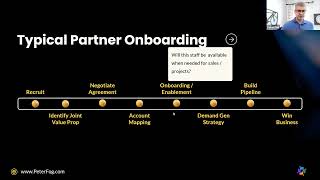
Hi everybody. Thanks for taking time out of your day to join the Build and Activate workshop series. We will be looking at some ways you can efficiently build your ecosystem that will actually drive results. Hopefully you'll be able to avoid some of the mistakes I've made and learn from some things that have worked really well for me for my career. Just a really quick context for who I am. My name is Peter Vogelsanger. I've built partner enablement programs for several B2B SaaS companies over the last 10 years. Before that I was a regional sales director for Several enterprise software ISVs and earlier in my career I spent about 12 years in sales and marketing roles for regional boutique agencies. So I've been on both sides of the ISV and service provider partnerships. And I really want to highlight that I was really fortunate earlier in my career in 2010 to be hired by VP of Sales at Sitecore named Jason Crea. And he was a very, really a visionary who created what I think is one of the first ecosystem led GTM strategies before that was even a thing. And so I learned a lot about building partnerships and partnership relations that drove results really because I had to. I was a direct salesperson who was responsible for driving revenue through partnerships. And in those days the role was 100% commission based. So if I didn't figure it out, my family starved to death. So lots of things I've learned about partnerships from that experience. So that's some of my most recent professional background. But who I really am, I'm a husband of 37 years, I got two adult daughters and son in laws and this avatar probably represents me a little bit better because I'm an introvert, a geek, a DIY guy, started my career as a software engineer many years ago. So let's just level set for a moment and review why we're all here. What's the problem we're trying to improve or tackle. And the first is that you guys are busy. If you're a partner manager, you're already busy. If you're managing partner teams, your team is busy, you've got, you know, need to add more partners, recruit them, onboard them, enable them. And you're thinking well how are we going to do that? And at the same time your leadership and maybe even you as a, as a partner, lead partner exec, recognize that you've got a lot of partners already and signed agreements and they're just not performing yet. So what's happening there? And meanwhile you've got leadership saying we invested in you, we invested in this ecosystem, we've invested in this partner program. You gotta produce some results. Where's our top line revenue? We need ARR, ideally this quarter and we need this program to be predictable. Quarter over quarter, maybe overly simplistic version. I've seen quite a bit of you have something similar. So I would assert that part of our challenge as partner managers starts here. I think in many cases this is the wrong sequence or we're focused on the wrong things along this timeline. So I'm hoping to highlight some of the challenges that I believe this represents and then we'll talk about some areas that I've changed this in my own career that's been really, really successful. If you're an isv, how many times service providers have come to you after you've gone through this account mapping stage with their catcher's mitt out saying where's my leads? Or maybe took you months to get the first opportunity in a pipeline and the people who went through onboarding are long gone. Lots of, lots of challenges here. If your team is doing even the most basic reporting and auditing of your ecosystem, I think you'll probably agree that a very small percentage of the partners in your ecosystem are actually performing some problems here. I think it starts with some programs, some processes. Try to identify this joint value prop too early. If you're doing it anywhere in this early stage, maybe not necessarily here at the second stage, might be third or fourth, but anywhere before you get over here, it's just premature. You don't know enough about each other to do that at this point. And if you have, if you're an ISV and you have a service provider or another isv, say hey, we can't really do anything with you until you develop a JVP1 pager, Big Red flag. There is no JVP yet. You have some ideas, but you don't have one yet. So don't spend a ton of time on it at that early stage of the relationship. Similarly, why would you negotiate any kind of formal agreement at this stage? The partnership is completely unproven. It's a waste of time. You're negotiating terms, you're negotiating maybe referral fees or something like that. It's all academic. It's a complete waste of time. And you all know that a certain percentage of those are not going to make it out the back end of this process and perform. So it's a costly, costly process that you just shouldn't be doing at this stage. Account mapping again, I've seen a lot of partner managers get to this point, get really excited. They recruited a partner, they signed an agreement, they're in the program, they get happy feet. Let's do some account mapping. Let's get on crossbeam and let's do. Let's go. Dang. No, Much like the jvp, it's just too early, you know, to do account mapping in any kind of formal way at this point of your partnership. It's too broad, it's too boiling the ocean. You just don't know enough about each other and it's not proven enough. So again, I'm not suggesting account mapping is bad, but to do any kind of extensive account mapping at this stage of an unproven partnership doesn't make sense. What about onboarding and enablement? Everybody's like, yeah, we've got to onboard partners. Yeah, of course you do. How you do it is often out of sequence. Don't onboard the delivery staff at this stage because most likely the people who are engaged with you at this stage of the relationship will not be the people that are available over here. After you go through a demand gen sales cycle and closing process from here to here is most likely a fairly extensive period of time. So doing it, doing an extensive onboarding and enablement at this stage is out of sequence. This time is probably wasting everyone's time. And then demand gen, again, I've seen partner managers get to this stage and they say, well, we've got an agreement, we've got, we've got some people trained now we need to do some demand gen. Let's, let's get our marketing folks, folks talking about how we can do a joint campaign. Whoa. If you're doing that at this stage of your partnership, I would say it's a career limiting move because it's not proven. What the heck are you selling at this point? It's just academic skills and good intent. You don't have any proof, any evidence that this partnership is valuable. And if you try to do some demand gen, you're going to fall flat on your face. You're going to waste a lot of time. Your marketing team is going to get really annoyed if you keep bringing partners to the table who have no experience and evidence and case studies and you want to do some kind of demand gen. So again, put in the cart before the horse. So I would assert something like this has worked really, really well for me over the last 10 years. Some variation of this and we'll unpack parts of this in more detail as we go. The high points are getting rid of a Formal partnership agreement early in the process. Don't do complete onboarding and account mapping. Focus on identifying the first deal and from that point forward everything starts to happen much more naturally. Today we're really going to focus on the recruiting and disqualifying parts, which are these first two parts of this notional process. So from a recruiting point of view, we all do, we're all doing this already. Some of you probably are doing it really well. Just like to talk about some things that you might do to improve the outcomes and make you more efficient in how you spend your time recruiting. The first is probably what you're already doing fairly well, which is what's the value prop of what you have to sell to the partner's end customer. So if you're an ISV and you're working with a solution provider, you're educating them on what's the value prop of your software to the customer they might implement it for. And this is important absolutely is table stakes for partner managers to do this and to do it well. If you're a partner manager and you think of yourself as only a relationship person, you probably are not doing this important part of your job justice. Yes, partnerships come with relationships, but good relationships are based upon some kind of substance and the substance is what is it you're selling. You don't have to be the best salesperson, but you do need to be able to articulate why do they care. The next thing is that joint value problem. And I very deliberately put potential here in italics because at this stage of a discussion there's just potential. You're speculating of what your joint product and service or product and product might mean to the market. Don't spend a ton of time here, maybe even is a somewhat generic JVP that your organization puts together for partners of that type need to know a little bit and just articulate to them. This is something that will be a work in progress that you'll spend a lot more time on later on in the process. An area that I think is often way too overlooked is alignment. What do I mean by alignment? There's a couple of different kinds of alignment between two organizations when you're partnering. The first is what's the fit between what you're offering and what they're offering. And on the surface, sometimes the alignment might look good. For example, you might have a product that requires JavaScript skills and you might find an agency who has a lot of JavaScript skills promoted on their services page to a first glance partner manager kind of doing this Assessment, I'm going to say, oh, that's a great fit. They do JavaScript, we require JavaScript, let's go partner with them. The challenge is you need to peel that onion because sometimes they over inflate what they actually are good at. But more often not. It's how they engage those services or those skills. That's where it's nuanced. For example, what if they are an offshore outsourcing SI and they promote that skill? They may actually only be providing that service or that skill to customers when they ask for it. They provide low cost services. If you need some JavaScript stuff, we'll give it to you inexpensively. That's a big red flag for you if you're an isp. Why? Because they don't do anything proactive, they don't actively promote, they don't say, hey, we've got JavaScript skills, we can help you transform your whatever that means that most likely they're never going to build you pipeline. They may be a great low cost maintenance partner for you, but if your partner program is about driving revenue and closing deals and identifying new opportunities, they're going to be a big goose egg. The next thing to think about is alignment around your sales cycles. This is particularly important with ISV to ISV partnerships. When does a prospect buy your stuff versus when do they buy their stuff? Again, this tends to be overlooked on the surface. Our product works with our product. We have got an integration customer, we have joint customers and that all sounds great. And then you try to go to market and you realize they're never going to recommend us to their customers because by the time their product is evaluated, the customer's already made a decision. In our swim lane, this becomes a big problem if you've got top level executives, especially those that aren't in the in the go to gtm. Org who don't understand this. I have seen it a million times where someone who's not in GTM says hey, I saw this company. They do. You know, they're a prospective partner and they're in 100% of our target accounts and their product works with us. Go recruit them and that'll be a great deal flow for us. And maybe you take it at face value and you go do it. And then suddenly you realize, you know, 12 months later like oh, that's never going to work. Peel the onion here, do some alignment discovery and you know, really at the end of the day you want to take these things to qualify out and fail fast. If some of these things look like problems for the partnership, you need, you need to get them out in the open with your sponsor or who you're pursuing. And if they don't engage with you around your value prop to the customer, don't force it. It might be a timing issue. It might just be that these other things are never going to make them a good partner. And finally, and probably most importantly, is your value prop to the partner. And many of you probably say, well, yeah, we do that all the time. We talk about our partner program and our referral fees and our tiers. Okay, that's important, but it's not strategic. And let me let you in on a dirty little secret about the partnership world. There's this myth that partners care about that stuff, that they really are interested in your referral fee. My experience is most could care less. Some don't even want it. So if you're focusing your value prop on that strictly on that commercial part of your partnership program, you're missing the mark. What executives of your partners care about is your value prop to them as an organization. How are they going to make money with services or how are they going to sell more product by partnering with you? It has to be about them. Here's an example of some value prop content I've used in sales enablement with different teams over the years. And just bear with me, these examples might not represent the organization that you work for. I'll use it as an example to help you maybe think about some ideas. Building a practice or building a competency or building a partnership with. You might have some direct revenue streams for the partner. And you absolutely want to make sure you articulate this. This is top of mind. If it's an ISV to service provider, this first area is top of mind. Implementing your product is a revenue stream. If they're not doing that already, that's a new service that they can provide to their customers or identify new prospects through that. And that's absolutely important. But you also need to think about and talk to other partners that are already working with your product. Talk to the rest of your organization and develop what are the ancillary things that your product might print at a table. From this example, if you are any kind of marketing content management martech stack, there's implementing your stack, but then there's the other services that often fit around a project like that that's not directly related to your product but is going to uncover revenue for them. They can take on a new website or a new channel because your product helps unlock that or maybe there's integrations again that aren't directly related to your product but are empowered by your product. Maybe, maybe there's backend to backend or maybe there's extensions of the ui. So there's a lot of things you can do here that's beyond articulating the direct services to your product or service that they will derive. So spend some time on this. Equally important is the non revenue stream value prop. For example, maybe you can help their organization become sticky in the account. If they're a digital transformation provider, maybe one of the challenges they have is that when they're done, they've done whatever that initial project is, the customer perceives them as being done and they go away. So maybe your product helps them become sticky by expanding into additional brands or lines of business. Or maybe they can expand their services to do maintenance or retainer based services to continuously improve, you know, the product or project. Maybe they can transform the organization in new areas they never thought about. So these are just some ideas but I would, I would argue that there is most likely some things that you are not doing to build up this value prop that should be top of mind way. You're selling the value of partnering with you to the other party. And some things to keep in mind, this is, the tone of this slide is really to direct sellers but it's things for you guys to keep in mind for your internal communication because you have to sell internally your partnerships and your efforts as well. First is the agencies aren't exclusive. Often sellers and sales execs think, well, we got them signed up but why are they still working with. They're going to do that. I mean they got, they got to make a money. They, they have to, they have to have a sustainable business. So they're going to work with other products. That's just the reality. Some of them will go so far as to say we have to be Switzerland. In some cases they'll do that publicly. They'll tell customers are agnostic. Sometimes that's for real. Sometimes it's just, you know, overt. And they will align with you guys covertly. But you need to acknowledge that and recognize that. And the way you manage that internally is really important. I've worked with senior sales execs in the past who said they're only a good partner if they are willing to recommend us, which is just nonsense. Obviously that's nirvana. If you have a partner who's willing to recommend you as the solution to the customer's problem, yeah, that's great. But if they're not willing or able to do that doesn't mean that it's not a good partnership. They could still be taking you to 52 new opportunities a year that you've never been to before. So just because they say they're Switzerland, just because they may not ever be willing to recommend you doesn't mean they're not going to be an awesome partner. And regardless of which of those first two facets of their DNA that they are, you still have to earn the go to position. Even if they're, they are exclusive. Even if they are willing to recommend. You got to earn that. And that doesn't happen overnight. Some organizations, and this is, this is a difficult one for, for salespeople working with partners as well. Some organization, especially the really big agencies, big digital agencies, want to own the client relationship, maybe even have to own if they're agency of record, they may be contractually responsible for owning that relationship. And they'll just say, well, all we need is pricing. This is tricky. It's not easy, I admit. You're going to run into this and it's a challenge. You just have to navigate that and coach them and treat them like the prospect. And the way you present pricing has to be in that same way where you do, you know, barn, bread basket, unpack it, learn more about the project. And if you want a formal quote, then that has to be vetted with what the real requirements are. Other two little minor things here. Regional agencies will say they they can do anything for anyone, anywhere. Probably can't, but they will say they can. And large sis will do anything for anyone if the project is big enough. So those kind of nuances are going to need to be factored into how you kind of put them in a box or how you manage them, how you communicate them. And the reality is partners are used to making as their service provider, they're used to making a lot of money on somebody else. So when you're recruiting them, keep that in mind. They are, they are not going to flip the script quickly just because you have a better mousetrap. Okay, the last part of today's session is around that partner agreement I shared earlier. This is a big pet peeve of mine. I learned the hard way, multiple times in multiple roles, that hustling to execute partner agreements is fake success and is not going to necessarily drive activation, drive the outcomes that you're looking for, and can also be a colossal waste of time. This is intellectually offensive to me, to be honest with you. You're recruiting other companies to Join your partner program and then we're willing to let them dictate terms and conditions and elements of our partner agreement. And that just. It feels intellectually dishonest to me and you get mired down in this. And I would suggest if you take a step back and say, do we need a partnership agreement at this stage? And I think when you think about it from that point of view, it's premature, it's unproven. You've got them interested and we have trained ourselves and our discipline to have that be the next milestone. We're going to get a partnership agreement. Let's not do that. What we want is some kind of protection so that we can talk about to each other candidly. That might be a mutual NDA. I've had a lot of success in my career not even, not even doing it as an NDA. If you have a partner portal prm, that can be your next step. We'll invite you to our partner portal. And signing up and joining the partner portal may constitute, maybe enough for you to constitute them being in your partner program. Maybe you need a little bit more. This is something you talk to your leadership and your legal counsel about if the organization feels you need a little bit more than just joining the partner portal. I've had success just doing a confidentiality agreement, which is a click to sign. Again, it's not a negotiated NDA with DocuSign and red lines and all that nonsense. It is a. Here's our terms of use, to use SAS terminology, here's our terms of use for coming into the partner program in our portal and please accept it. That can be really, really, really simple for you to maintain, really easy for you to communicate, and it's easy for them. You say we're really easy to work with. We don't require a partner agreement at this stage. We can worry about that later when we both agree that this is a partnership that's going to drive some results and we can, we can negotiate some kind of more formal structure, but for now, we just want to be easy to work with. We've got this confidentiality agreement on our portal, or we'll just do a mutual NDA. My advice is do anything and everything you can to get legal out of this step. If you can make it a mutual NDA, I.e. click to agree or digital signature or confidentiality agreement that the partner manager on the other end of the conversation can agree to, that's the best. And the reality is, having talked to my legal counsel over the last couple of roles, partnership Agreements are really pretty loose to begin with. So going through the negotiation doesn't give you a whole lot more protection than a confidentiality agreement or mutual NDA anyway. Organizations are going to behave well or they're not going to behave well with one another. So make it easy, do something to open up the collaboration and accelerate the conversation. The delay of the red lines and the legal and the lawyers getting involved in this early stage is a blocker. You want to unlock that. And if you have to do something, if you have to do some kind of partner agreement, do just a base agreement. Make it like an MSA that doesn't have any addendums or exhibits. Pull the fees, pull the mdf, pull anything out of that base agreement. If you have to do it early and even if you're doing it later, get those out of your base agreement. Those are the things that partners want to negotiate when they don't have a right to negotiate them. Those should be part of your program. Those should be things that they can earn into. And those should be things that you can just layer in in some way as an addendum to something else. Again, if you can, if you can make that really simple. I had a lot of success where those, those addendums were in the hands of a partner manager to add to a partnerships account once they reached a certain milestone and they had an agreement. And it was a, it was a, hey, I just added the referral agreement, click to sign. You make it that simple, then all of that partner legal nonsense gets radically streamlined. And I said this a minute ago, you want to use this part of your process as a tool in your recruiting and onboarding, not as a gate that you got to get through. So use your prm. My advice, if you can get, if you can get your PRM configured in a way where your partner managers have the ability to invite anybody in and have the, the authority to invite anybody in when they've got them recruited, then all of the investment you make in content or enablement or other things with your PRM and LMS becomes a valuable tool for them to use. And you don't have this legal blocker preventing that from being accelerated. So to wrap up and we'll have some discussion here, typical onboarding looks something like this. The first stage is recruiting jvp. Negotiate an agreement. I advocate for simpler recruiting focused on your value prop of partnering and some kind of really streamlined confidentiality or NDA or something like really appreciate everyone joining today. Thanks again, have a great day.
More from Peter
Kiflo Q&A Live: Why Aren’t My ‘Paper #Partners’ Performing & How to Fix It? #partnership #gtm
Kiflo Q&A Live: Why Isn’t My #partnership Program Generating Results & How to Fix It? #partner