Kiflo Q&A Live: Why Isn’t My #partnership Program Generating Results & How to Fix It? #partner
Ignacio and Tom from Kiflo host a live Q&A with expert Peter Fogelsanger on why partnership programs fail and how to fix them. They cover securing your first deal, optimizing partner onboarding, and structuring agreements that actually work for B2B SaaS.
Amazing. Well, welcome, welcome, everyone. Thanks again for joining one of our rapid fire sessions today. We're super excited because we have a really, really knowledgeable and interesting guest. I'll explain how it works, everything, but I'll introduce him in just a few minutes. We give a couple of. We already have 14 people live, which is kind of like a record for us. And we'll give a couple of minutes so that people can join because it's probably they will come and they will join. But in the meantime, for the ones that you are here and it's your first time, the format of the session, it's a rapid fire Q and A session. So we encourage you to actually ask questions during the session. Don't wait until the end. We'll have our guests actually answering those questions during, during the subtopics and during the session. So please do ask questions. So if you don't know me, my name is Ignacio. I'm part of the keyflow team and I have Tom, also from the keyflow team. I'll be your host today and Tom will be moderating the questions and making sure that we are on time with everything. Okay, so for starters, maybe because we have people in the chat there, so maybe you can tell us where you are from or where you're connecting. I see Alicia, I see everyone there. So if you can tell us where you're from, that would be amazing. And then I'll introduce you to our guest today. Let's start with Tom. Tom, where are your base today? Because I know that you're traveling. Where are you today?
I'm in Germany right now.
Nice, Nice.
Yeah.
So we got Warren from Marin country. Jim, Cindy's from Kelowna. Oh, British Columbia. Beautiful. Barcelona, Spain. Beautiful. And Alicia from England. I met from Cairo, Bangalore. Beautiful. Kevin from Leon. All over the. All over the world. All over the world. I love this. I honestly love this.
Thailand. Wow.
Thailand. We never had someone from Thailand and I believe that's the first one.
Nice.
Beautiful, beautiful country. James from Burlington, Ontario, Canada. Beautiful. Canada. Nice, Nice. Cool. We'll give it just one more minute. We are almost at 20, so one more minute and then we'll kick it off. Okay, so a little bit more patient and we are almost there. Jennifer from Colombia. Nice. Jennifer.
Renee from Germany. Yeah, well, Germany is a big country.
So Tiffany from South Africa. Beautiful. Okay, so we are going to kick it off regardless. We'll share that. You'll receive the recording afterwards. So you'll have everything. All the material that have that will be shown today will be shared Also so today we have Peter Fogelsanger. Peter is a partnership and enablement expert for more than 30 years of working in B2B SaaS and enterprise companies, helping other companies. So Peter, it's a real pleasure to having you. Thanks for your time and thanks for joining the session today.
Thank you. Really appreciate it.
Amazing. People are super excited for the topic. So I'll introduce the topic today. So why isn't my partnership program generating reach results and most importantly how to fix it? Okay, so Peter, if you want to kind of like give us an overview of who you are, what you've been doing and then we can deep dive into the, into the topic.
Yeah, I guess the main thing about my background that I think would be relevant to this conversation is I spent a large portion of my career in direct sales. And so most of my portfolio point of view about driving partner programs successfully comes from that foundation of how do we drive pipeline, how do we close business and how do we sell? And I was really fortunate that the last sales director role that I had was with a company called sitecore. Some of you may have heard of them. This was in the very early days of sitecore that I would suggest is one of the very first ecosystem led go to market strategies before that was a thing. And what was relevant about that is our, our entire direct sales team for the first several years was on a 100% commission plan and we were expected to drive 50% of our pipeline from partners. What that means in context of today, if I didn't figure out how to do that, well, my family starved to death. That sarcastic. But it was really that dire, you had to figure out how to do it. And there was very little infrastructure. It was learn as you go. I've got lots of scars and lots of war stories from that. But it really did build a foundation of building partnerships in a way that drove pipeline and closed business. And everyone on this call already knows this. So I'm not going to rehash this too much. But from your point of view, you and your team are probably already very stretched, being asked to do more with less. You probably already have partners in your ecosystem that are not performing and trying to answer that question, why? And then finally, really that investment that your organizations have made in you and ecosystem that you've built are being scrutinized and leadership is saying, we've made an investment in your team, we've made an investment in this program. You have to produce revenue, you have to produce pipeline. So I think everyone probably would agree maybe we Want to do a quick survey, everyone? Sound familiar to everybody?
Yeah, probably it does, Peter, because everyone has the same issue, but maybe we can show the graph and then pop up the poll as well. So do you have that? Yeah, this one. Right, Perfect. So everyone say yes in the chat, by the way.
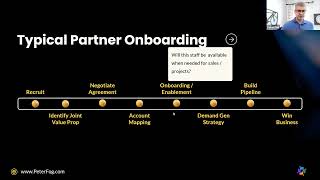
Beautiful. Thank you. So your, your process may not look exactly like this, but what I have seen in my career is that there tends to be a fairly similar approach to building partnerships, obviously starting with recruiting. But then very first couple of steps are to tell them about your product or service and then immediately jump into negotiating a partner agreement. And then everybody gets excited about the partnership and you do some account mapping and then do some onboarding. And so this tends to be, you may, you may do them slightly in different order, but immediately going to an agreement, trying to drive demand, build pipeline, and then hopefully on the back end win business. And you're not seeing, you may not be seeing this milestone. So I think we're going to do a survey. Yeah.
Let's hear the audience. So does this diagram that Peter showed you looks like typical year boarding? We are having 100% yes. Let's give it a little bit of time, but probably it's going to be a yes winner. We're having 100% yes, 100% consistent with.
Everybody I talked to in my career who worked for me. And even in my case, it's the way I did things for the first several years of my partnership career. And let's just quickly talk about where this is a problem. Where are the friction points that may not be obvious unless you've taken a step back and thought about why the process itself is creating blockers to driving business. The first is if you're doing any kind of joint value prop early in the partnership, it's probably premature because the partnership isn't proven. I saw this a lot when I was working for emerging tech, trying to work with larger hyperscalers or larger sis. They would always say, well, we need to develop a joint value problem. Whoa, premature. Same would go for negotiating an agreement. We all have been tasked with signing partners and we probably all look at that as this great milestone. I would argue that if you're trying to negotiate a formal partner agreement at anywhere in the early stage, specifically before winning any business, it's a waste of time, especially if you're allowing both parties to bring lawyers in and do redlining. It's a waste of very expensive resources and you don't have context. Neither party knows what the partnership is going to look like. When it's proven. So you don't know how to evaluate the things that you're going to give and take in the terms of the agreement. So to try to negotiate them at this stage, really premature. And I would imagine a lot of the folks on this call probably invest a lot of their administrative time negotiating, facilitating and pushing red lines back and forth, and nobody likes doing it. So I would suggest don't do it at this stage. Same as same is true of account mapping at this stage. To jump right in to do this broad account mapping, again, everyone gets excited and partner managers on both sides of the partnership want to do account mapping and you need to do enough to know that there's a fit. But to do really deep, broad account mapping at this stage, again, it's just. It's not proven and it's a little premature. Continuing on if you've got a really solid enablement and onboarding process. The problem here is if you're onboarding a delivery team, if you're an isv, onboarding a solution provider team, this is probably also premature. Saw this happen, did this myself many times. To the angst of the founders of the solution provider, six months would go by and they'd say, peter, we trained six or seven of our consultants on your product and it was expensive. We took them off the clock and it made them unbillable and they're not working on the project because it was premature. You did the wrong people, maybe, who were not going to be available when you needed them and you didn't know where you would need them. So let's not go too deep into onboarding and enablement at this stage. So if you're thinking about this and thinking about, how do I attack this, this is. This is probably the place that we can have the most conversation in this session, because this is really. You take nothing else away. From my scars and experience, this is the thing that I would suggest is the most valuable. Pardon me. And that is to go into every partnership conversation with the milestone of identifying the first deal. I think every partner manager on this call would agree the first deal is always the hardest. So let's get that elephant out onto the table right away and let's build our whole conversation, our whole approach around that first deal. And the reason this is really important is if you're an ISV and you're building partnerships with solution providers, this is important, but it's also important between two ISVs, because I call this the risk triangle of the first deal. So if this is a prospect, not A customer. And let's assume this is you. You're an isv, you're building a new partnership. And the partner saying, hey, where's our first deal? And if you lean forward and say, okay, I'll bring you a deal, there's risk here because that might be a new prospect. So the prospect has never worked with your product before. There's risk to the customer because they've never worked with that partner before because you're introducing a new partner. And there's risk between you and the partner because they've never done a project before. So there's this massive triangle of risk. And every time I've tried to do this with a new partner and a new prospect that's never worked with my product before, it almost always fails because at some point the prospect says, show me a reference for your product, show me a reference for your partner that you're recommending with your product. And it really quickly falls down. And in the worst case scenario, this poisons the partnership right from the beginning. Because somebody on one side of this relationship, the sales exec from my team or the leadership from the partner, gets really frustrated because it invested all this time pursuing this deal and the customer didn't convert for anybody.
Sorry to interrupt, Peter, but we have a question from another Peter who's asking, what is isv?
Independent software vendor. So a software provider.
Okay, good one. Good one, Peter.
Also, if you have more questions, feel free to ask in the chat.
This is super important and I think that this is critical what Peter is explaining right now. If you have questions, please do ask them right now, because this is the root cause probably of underperforming partners.
So my advice, if you are starting to think about this as a challenge in your business, my advice would be to ask them right in the beginning, not maybe the first meeting, because you, you want to court them around your product or service or program, but immediately after getting them to lean in to think about partnering. Instead of saying, let's sign a partner agreement, start talking to them about identifying the first joint deal from their portfolio. Excuse me. And partner managers who have never done this before might feel really uncomfortable in the beginning taking this approach, asking the partner to identify a new deal for you right out of the gate. But I would suggest if you do this well, this can make a lot of sense to the partner. Again, I'll say software provider to solution provider as the example. If I'm asking a large SI to partner with me, and then I say to them the path of highest success to the first Deal is if you identify somebody from your portfolio and you give them reasons why those customers already trust them, they're already familiar with that service provider introducing new technology to them. So this risk line almost completely goes away because they already know that service provider. This risk line will also be dramatically reduced for your product because they trust that partner already. So the only risk that's still somewhat significant is this risk of them never having worked with your product in the past. I would argue that for the prospect or the customer, that is even reduced because they're used to this si. They know their technical skills. They don't feel it's risky for that partner to do something new because they do that all the time for them. They. They have new requirements that they implement. So all three of these risk lines get dramatically reduced if the partner is bringing somebody who already knows them from their portfolio to the table. And then when they start leaning in on that and you coin it with the way to reduce the cost of onboarding and the risk of onboarding not being successful, they almost always get it. And then we can say, all right, instead of doing, you know, negotiating agreements and doing target account work early, we can, we can focus everything on that first pitch and everything else will be through that lens. We'll focus on onboarding you to do the pitch as the product provider will align our sales team to align with the sales team on that project to begin to get those champions on both sides of the partnership through that first deal instead of it being academic. Hey, sales team, I want to train you on this new partner. It's hey, account exec. I want to bring you this deal with this partner to do the first pitch together again. If you have tried this before, I think you'll agree that it starts to make everything happen a lot more naturally. Instead of the broad academic things that we have done historically, now we're really, really focused on something and driving that towards success.
I love that approach. Peter. We do have questions, Tommy.
Yeah. So Warren is asking first, are you suggesting onboarding a new client prior to inking an agree or identifying the client and negotiating the reseller agreement in parallel?
That is an excellent question. I've done it a couple of different ways in my career. I would normally position it with the new partner that we will negotiate an agreement after we have the first win. And if you're a referral fee kind of partner, we're not going to pay you on the first one because we're going to invest our quote, unquote dollars in onboarding you for that. First deal. So we, you may, you may still give them referral fee, but I would lead with that first. I would say we're not going to pay a referral fee on the first referral because we're going to invest in each other to get the win. And then once we have that success, we can, we can then talk about a business plan. So let's flip over here. So I would start with an NDA instead of a partner agreement. And then when we win that first project that you're so focused on, then you can start, both parties can have a much more intelligent conversation around the business plan. So then it can be a real business planning exercise, not an academic target account exercise. So you can negotiate an agreement then where they have a lot greater idea of how much work are they going to do with your product? How many other customers do they have that they can bring the product to? How many of our prospects or customers on the software side can they go pursue? So from a legal point of view, I would, I would make your very first milestone as lightweight as your executive team and your legal counsel will allow you to do. And that might sound controversial, but every in house counsel that I've had this conversation with will almost always, almost always tells me that a person partner agreement from a legal point of view really is mostly an NDA anyway. And when you go into court, there isn't that much in a partner agreement that historically is that much more binding. Now obviously it depends on your jurisdiction, but most partnership agreements are arbitration anyway and not court. So pushing that off until you have the first deal really doesn't make too many lawyers that I work with that uncomfortable. And you can always decide that instead of doing it over here once you want it, you could, you could decide to do it once it's identified and you're in the pursuit like you've already got agreement and you're already pursuing it and it's in the pipeline to protect one another. You, you could do it then, but it's still not doing it at the beginning of the process, it's doing it much further. And those of you who have struggled with getting that first deal across the line with new partners, you know that this really simple timeline here, from recruiting to getting that first deal in your pipeline can be a massively long period of time in some cases. They're waiting for you, you're waiting for them, you're trying to see what happens. I've seen this be earlier in my career. I saw it take 18 months, 24 months from the time I got, I got Happy Feet and got a partner agreement signed and we're doing some enablement and onboarding and the first deal just never happened until 18, 24 months later.
So we have some more questions here. I think I'm going to read Peter's question because it's kind of like a sub question to this one first. So does it mean that every agreement signs with different partners, going to be different? How do you manage all of those agreements then?
Peter, that is phenomenal question. I would avoid that at all cost if you can. My most success in this area was not even doing in an NDA, doing a, what I call a confidentiality agreement. In my career, I've used a PRM as my big tool to get partners engaged, even in the recruiting stage. So the very first thing I ask them to do when they start leaning in, instead of signing a partner agreement, I get them to do a single click confidentiality agreement. Maybe it's your NDA or whatever, but doing that as simply as possible. So every partner that hits that milestone is doing basically the same agreement. And then when we go to the point where we want to do a formal agreement now, you've got a more positive relationship with that prospect, prospective partner. You, you've gone through this first pitch identification and you're starting to pursue that deal together. It's a lot easier at that stage of a relationship to tell them, we don't negotiate custom partner agreements. Here's our, here's our standard partner agreement, sign it and then maybe you have some addendums that you can attach to that that have some variability. For example, one of my teams that I built, we did that all through our partner portal, through our prm. And every agreement was exactly the same. It was a single click to sign. And then we would have some addendums for what the referral fee is. And all the partner managers on my team had the authority to negotiate within a certain set of bands what kind of referral fee that we were giving to the partner. And we had guidelines on what did that look like. But back to your question, Peter. There was no custom agreement except with some variability in the referral fee. And then long term, you might even lock that down that, that might be completely dependent on your tiering strategy where here's our agreement, you've got to earn into it. There is no variability except for based upon performance. If you're an early partner program, an early ecosystem, you probably are two or three years away from having that level of sophistication in your program.
Yeah, People are loving this and I think that it's a great approach. So lots of golden nuggets here. So, Tom, maybe we can cover. Because there are a few questions that.
There are three more questions. Yeah, people are. Yeah. Because we don't have a lot of time actually. So Nelson is asking in the market segment. I'm in. Accountant. I find it difficult for partners to be open to share customer information before signing any deal. Any tips how to contour this?
Yes, that's. That's always the give and take between new partners when, when they really, really resist. Then this first step is a mutual NDA instead of a confidentiality agreement. Honestly, from a legal point of view, in my experience, they say almost the exact same thing. But if it's a mutual NDA, what's implied there is it goes to their lawyer to check it out and sign off on it. But in almost every case I've had success in as a software provider, I don't want to invest in you as a partner in without us having some alignment over what the go to market is going to be. And that starts with the first deal. You don't have to disclose anything to me except for the name of an account and maybe what the project's going to look like. You don't have to give me contact information in the early stage. But let's just agree we're going to go after Coca Cola and we're going to go after the, you know, loyalty application for Coke fans or something like that. 99% of the time in my career that has worked pretty well to get past that resistance. Every once in a while, you'll still find somebody who's super resistant, more receptive. Well, obviously the, the partners who are hungry to drive growth through your partnership are going to be more receptive. They want to partner with you. And I, I guess I kind of glossed over this in the intro. I always approach every recruiting in a very positive. I want you to partner with me. I want to make it easy to partner with me. And this approach that I'm going to suggest is going to make it easier and more cost effective for you to partner with me. Even though I may be suggesting some steps that are different than you are accustomed to. I've designed this activation process to reduce the waste of time on your part and reduce the chance that we're going to invest in a partnership that doesn't perform. Alicia. Almost every time, if you tackle it that way, instead of just saying, well, here's our process, take our process. You don't Want to be legalistic about it. You want to be very consultative. It is a partnership. It's a relationship. So turn this whole thing into a very positive aspect of why partnering with you is easy and why partner with you is going to be focused on driving results. When. When I've been on teams where we made this pivot, the guys on my team who went from the kind of that traditional way to this immediately saw a less adversarial conversation from prospective partners. It became much more, oh, we can make this really easy. We can make this. Or I'll come back in six months because I don't have a prospect in mind. So everyone agrees. All right, let's not waste any time talking to each other for six months. Let's. Let's reconvene, you know, beginning next fiscal year.
That's. That's great. And I think that it covered pretty much everything that you were asking. I don't know if we have any other questions, Tom, or we can move, because we do have other stuff to cover.
Yeah, we do, but we also have two more questions, so maybe, Peter, if you can, like, you know, answer them, like, shortly. So Marco is asking. I love the approach. How do you push back with partners that want an agreement in place before starting to talk business?
I would. I would continue to try to push towards the positive of doing it, you know, with just a confidentiality agreement instead of a full partnership agreement. And if they really, really push back and you don't think there's any way to avoid it, I would look for a way in your program to have a penalty. And I don't mean a penalty with a, you know, hammer on their head. But you say, okay, if we have to use our lawyer's time before the first deal, we'll carve that out of the first referral fee. So they have to admit that it's costing you money to negotiate an agreement, and somebody's gonna pay for it. So they'll pay for it out of a referral fee or MDF or whatever you have.
Perfect. And then the last one is from Tahira. He's asking to do the partner activation. Communication plays key role, but as we know, everyone is busy in their work. How to overcome the communication gap between ISV and partner.
Yeah, and I've seen some other questions related to how do you get them to use a prm? In general, my experience, partner managers tend to lead with the PRM as the place to register deals. And, yes, that's really important, and that's one of the reasons we want to have a prm, but partners hate it if that's the only reason that you're putting it in front of them. So I would always look to implement your PRM with more incentives. Give them gamify your enablement, gamify their engagement, give them points for logging in and looking at whatever content you have there and factor that into your tiering strategy. They have to earn a certain number of points, they have to look at a certain number of videos, they have to do a certain number of courses and create incentives for them to stay engaged. And then use your PRM as the way that you're sending information out. I always talk to my marketing teams. I don't want to send generic outbound to partners from marketing. I want to send up through my prm and I always brand it my partner portal. I always have some kind of brand around that destination. It's partner connect or partner my software company name portal. Then all my outbound information about the product and new case studies all comes with that branding. So you're beating them over the head in a positive way with here's your destination to work with us and make them want to go there.
That's perfect, Peter. By the way, you can all do that with keyflow as well. But we are on time. I just wanted to make sure that if you can stay, Peter, have a lot of other things to cover and maybe we can extend it for a couple of minutes. What do you think, Peter, in terms of time, Are you okay? Okay, so by the way, the recording will be shared and also all the material will be shared as well. So if you need to drop like Kevin, that's fine, but if you can stay, that would be amazing. Okay, so can we jump to the next topic, Peter? Because we need to cover the other subtopics. So I don't know if you want to tackle the level of effort. Yeah, the level of effort of partner activation, which was the other topic.
Can you pop that back up there, Ignacio? How do we.
Yeah, it's. The level of effort is the second subtopic.
Yes. So. And you're muted, Tom.
Sorry, I don't see the presentation here on the left. That's what I was trying to say.
So the level of effort is really impacted by changing that process. Taking this friction points out and level of effort is one of the reasons that I adapted to this process in the first place, because I saw myself and my teams investing so much time in those friction points that are in, you know, the typical process. Let me put it back up Here. So each of these friction points has a level of effort for you, your team and the partner. So anything that you can do to not do them early in the process or push them off when you have a more contextual relationship with a partner is going to, in many cases, dramatically reduce the level of effort to getting to an activated partner. And I think if you, if you think about your partner program, there's somebody in there that is your North Star that, that you're really excited about, they're really active, they're really performing. And if you kind of peel back and think about what, what has happened to make them so engaged, there's probably an individual early on who got excited about your product or service and about how they're using it, and they begin to become the internal champion. So this is really about building that alignment with somebody on a project and on a sales team for that prospect. And so when you do that, all of these other levels of effort get shrunken or pushed off when you have somebody on, on the other side of the partnership who will advocate for you and validate all of the, the effort.
Nice. Well said. That's great.
The last one. Yeah, we have the last topic.
Right. Yeah. The outcome. Right. Which is so.
Yeah.
How to set the right outcomes from day one. Exactly.
Yeah. And this is, this is really good wrap up where we started. The whole thing is the outcome. You want to set that expectation right from the beginning of recruiting. The outcome, initial outcome should not be we're gonna sign a partner agreement. The initial outcome should be we're gonna identify the first deal and get a joint win. Everything else is academic. So that, that is the outcome you want. And then from there you're going to do the rest of what you would do normally. You're going to do full enablement and full onboarding and account planning and all those other things, but you're going to do it from a foundation of mutual success. And every time that I've had a partnership that approached it that way, it performed much better. You'll have anomalies that won't, that won't work. They can't identify that first deal or won't identify the first deal, but when they do and everybody's aligned to that, it goes a lot better.
That's a great wrap up. I think that, that conclusion, it's great, Peter, because at the end of the day it's what all of us are looking for. And I think that that's a great, great conclusion everyone. Thanks for joining. Warren. Thanks. You need to go but also, quick reminder, one lucky winner that attended the webinar will be winning an extensive session from Peter alongside your team. So we'll be announcing that probably at the beginning of next week. But keep an eye, we'll share that with you. And also we'll share the recording and probably the deck that Peter used today. So, again, thank you all for joining and for the questions. They were great. I think that it was the session that had the most questions. So it was super, super helpful. And Peter, again, thank you for taking the time and for the super knowledge as well and sharing this with the audience.
Thanks, everyone.
Perfect.
Thank you so much.
And see you next one. Keep an eye on the next one that it's coming in June. So thank you so much and see you next one. Bye.
Bye.
More from Peter

Kiflo Q&A Live: Why Aren’t My ‘Paper #Partners’ Performing & How to Fix It? #partnership #gtm