Streamlining Partner Agreements
This is a YouTube video titled "Streamlining Partner Agreements" containing a multi-speaker conversation recorded in September 2025. The discussion features Peter Fogelsanger and other participants such as Mike, Kasey, and Casey, focusing on best practices for simplifying and managing partner agreements in business partnerships. The conversation covers topics like minimizing legal negotiations, using PRM systems, and structuring agreements to accelerate partnership activation and reduce administrative overhead.
Hey Peter, why don't you go ahead? Yeah, let's get started.
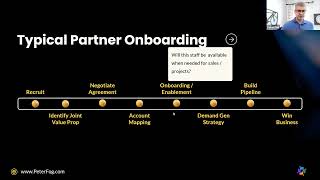
Okay. Fabulous. I threw together just a couple of slides to form up the conversation and just share my thoughts. I'm certainly not an expert on this, but I have made some changes to the way I do agreements that the last two programs I worked to build it was really successful, so I thought would just at least start there. So emphasis is on how to streamline agreements, not eliminate them. And the way I think about talking about partnership agreements is making sure you do the right agreement at the right time. And just give you some context of where my opinion and experience comes from. In the last 10 years I've been building partner programs and partner enablement programs really from the ground up. 2 Series A uniform and content stack. I was the founding partner global partner leader at ContentStack. Got them from an A to series C. Where a lot of what I'm doing today around agreements really formed at ContentStack. Prior to that I was in direct sales roles. And a lot of what I learned about partnerships, ironically was the six years I spent at sitecore as a direct seller. For context, during that period of time, sitecore was a partner led growth play. Before that was a thing. And to be successful as a seller we had to recruit onboard and manage our own little ecosystem in our territory. And the first two years of the six I was there was 100% commission. So you really had to figure out how to make that work fast or you starve to death. So, you know, skip all that. So I like to start with the way most partner programs historically have thought about agreements and where I think we get it wrong. The way we kind of intuitively have built partner programs and it's something like this. Your processes might look a little different from this, but it's probably somewhat similar. You recruit a partner, you do some early stuff, some kind of joint value prop or something like that in the, in the kind of courting recruiting phase. And then very early, most of us, myself included, do the agreement. And part of that has been because leadership has asked us to get partners recruited. And that's the KPI that oftentimes we're being measured against for short term success, like how many partners are going to get signed. During my time at sitecore I won multiple awards month after month, quarter after quarter for signing partner agreements. Thought that was good. Had a lot of partners signed agreements that were paper partnerships only. And the reason for that is when we're doing agreements at that phase, we're focused on the wrong thing the partnership at that stage is unproven. It's really a waste of time because if you've done this yourself, that word negotiate is a big pain in the backside because the way we're often doing it is sharing them or agreement electronically, letting the partner redline it. Why we let them redline our agreement for our program, I don't know. But that's what we have done historically. We let everybody redline it. It comes back with blood all over the place and we got to get our in house counsel, or even worse, our outhouse council, outside counsel to review it and goes back and forth. Just sound familiar? You do this in your program? Yeah, hate it. It's such a colossal waste of time. And one of the reasons we do that, we have to do that is we're negotiating things that neither party really is in agreement around at that point because the partnership is unproven. We don't know the value. They don't know how to evaluate whatever the terms of the commercial side of the agreement is. So I did a whole series of workshops last fall for PL around activation. So this is kind of an excerpt from that. But I think this is an important way to think about agreements if we want to activate partners. Where do agreements fit into that idea of getting a partner on board and streamlining all this? So I usually advocate for kick the can on partner agreement as long as you can. And the first thing to start with is some kind of I have in the slide NDA. My, my advice to partner managers is do the absolute minimum legal step here that your in house counsel or your outside counsel will let will approve. I've been really fortunate that I've had two very commercially savvy legal counsels the last two programs I built. And both of them were pretty transparent about the fact that partner agreements really aren't that enforceable in a court of law anyway. So why do we spend a whole bunch of time on it? And both of them supported me not even really doing an NDA, to be honest with you. When when a partner asked for it, I sent them to our PRM and said there's a confidentiality agreement on there. That's the, the rules of the road for how we're going to work together and click to accept if your leadership and legal will approve that. That is so much more efficient. When we did this at ContentStack, we went from just this massive amount of time across my team negotiating red lines to it just not being something we even talked about anymore. And I was frankly shocked at how receptive the partner community was to that. I thought we would get pushback. They do red lines because we've trained them to, to get red lines from us and to expect to go back and forth. When we started saying we don't require a referral agreement or partner agreement to be in our program, you can be in our program by coming to the portal and agreeing to the confidentiality. So you're quote unquote in the program. That's it. Almost every single partner we recruited from that point on, we didn't talk about it. It was just like, okay, go. There's exceptions. The really big GSI's are going to say, oh, we can't do anything without at least a mutual NDA. Okay. So we then handled that as an exception. But even that is a lot less to negotiate than try to get a referral agreement through publicisapien or Accenture when you have no revenue. They won't, they want, they won't even send it to their legal department. So click to agree, simple as possible. And, and again, a lot of times I've had success just having the fact that they've signed into the portal and all of the terms of use on the portal be adequate or like they didn't even explicitly click on anything. They just, they, they've come in, they've, they've signed into our portal, they've created the account to start some kind of sales onboarding check. We've got that first step in place. So I think I said most of this, yeah, you, you want whatever this step is to be enough to make the other party comfortable with having a collaborative conversation. I usually tell my counterparts in the conversation that doesn't matter what we put in writing. Humans are going to behave a certain way and we want you to work with us. We want to be easy to work with and we're going to do that as part of our program. That's who we are. Regardless of whether we sign a 92 page agreement or you click the signer confidentiality. So we start having that kind of, we're going to be a good partner, set that out, you know, as the way you're going to work with your partners. It starts making them a lot more comfortable and then they internally promote that. Like, yeah, you know, we have, we have this confidentiality agreement. That's all we need. Again, there's going to be exceptions, but that's, that's, I've had a lot of success for that in the last five, six years. Don't waste any time trying to Negotiate the full partner agreement. Usually at this step, I present what the program might look like and what some of the benefits might look like. But we don't negotiate anything. Make sense to everybody.
This is, this is very helpful, Peter, because I mean I've been trying to push for this because what you're saying is the reality. Right. So you get into lengthy discussions to the traditional partnership, not the bgsis. Right. So it's good that you mentioned this because it gives me more evidence that I can bring to my leadership and to my ego team to show that it's possible and has worked in other places. So it's good to know.
Yeah. And when you get pushback internally. One of the things that I've said to leaders when they start to push back is what are you worried about them disclosing? Our entire product documentation is open on the web. Like you can go into our site and see the entire product documentation. You can go into ChatGPT and get complete insight into how product APIs or whatever. So what are we protecting?
Well, interesting enough like my, my company today has no open at all documents.
In the Internet a little bit.
But it is.
I've been pushing to. To the same thing. The other thing I'm also trying to do and would like to in keeping the simplicity, not, not negotiating any fees or referrals or anything like. And, and even if we go into that direction, I. As we move on making that part of a program. Program guide, not as part of a legal discussion. So that's. That helped me in my past, but I don't know if you had the same experience.
Yeah, that's exactly where I was going to go next. 100% on board with that. So this is, this is not a whole process webinar. But just to kind of help you see where I fit this. I always advocate for you get, you get whatever that first step is done and you focus all your efforts on getting the first deal done. And that's the way I talk to prospective partners. Like we're going to focus all of our time and attention as potential partners on the first deal. We're not going to worry about the program. We're not going to worry about partner agreements. We're going to focus on proving the partnership or disproving the partnership by getting the first deal in place. And if and again, when we started talking about partnerships that way at Content Stack, it really quickly weeds out the ankle biters. The, the small shop that comes in and thinks they're going to be getting leads handed out to Them all the time because they signed a partner agreement. They go away really quickly because you start talking about, hey, this has to be a give to get partnership and you know, the first milestone is we got to identify the first deal and ideally the partner brings something from their portfolio to you, regardless of how you decide to do that. This is where I usually like to do the agreement and I'd like to do it as the base agreement. So this, the second part of my lessons learned is when you get to the stage of signing a formal agreement, take everything that's commercial out of it. And Christine, I think you were just implying this is the way you like to think about it too. That base agreement should just be almost like an MSA with no, you know, statements of work or orders or whatever legal structure you're familiar with, but just the legalese here. Click to agree. Again, if you can get your partners into the mindset that it's my program, here's my agreement, you're joining my program and no, you're not going to redline and change all the terms. You know, I'm not going to warrant your stuff differently than I'm going to warrant somebody else's stuff or, you know, indemnify your stuff different than I do other. This is our agreement. This is what our, our company's built around and the insurances you have and all the other stuff that goes into the basic agreement. Here it is.
Great one. Yeah.
Started doing that wildly successful transformation in the cadence of getting agreements done too. And then. Excuse me. Yeah, I kind of elaborated on that. I like to think of it as just slightly more than an A mutual NDA. It says partnerships. But the main thing in a base partnership agreement, if you look at your own agreement right now, if you take the commercial stuff out of it, it's really a disclosure agreement with a few other provisions, but it's, it's not that much. And then use whatever tool you have for them to accept it. If you can get away from sending things around as attachments and email, I highly, highly recommend it. The last two programs I built legal agreements, were part of the prm. They, they saw them in there, they agreed to them in there, and they were stored in there. And that was with, with exceptions, of course, for the ones that had to be custom. And I talked about all that. And then the commercial provisions, if, if they need to be in legal, which a lot of times you do want something legal in there, do it as an addendum. So at, again, a content stack, we had three to Five proven legally approved addendums to our master agreement that a partner manager had the authority to assign to a partner and that was based upon performance they could negotiate. All right, you've done, you're certified, you've done your first deal. I'm going to add to our agreement the addendum to get you 10% referral fee or whatever that it is. One page addendum, no legal involved, simply a partner manager adding it to, you know, their file or however you think about it. And again, it was clicked to accept. And the reason that we had a couple of different variants is we, we had an entitlement where a partner manager had certain bands that they couldn't kind of, they were pre approved to negotiate. So they had the ability to say these guys, I'm going to give 20% instead of 10%. But they were standard agreements, standard bands that they had pre approved. And in a more mature program that should tie into tiers, in my opinion, whatever those commercial things that they earn should be tied to those tiers. And if it's tied to your tiers and it's tied to your playbook for the program, then they don't even need to be in legal. It's just once you're in the program. Here's what bronze, silver and gold get. I think even put a screenshot in here. Yeah. So this is, this is what we put up on the portal. For my last, there's a lot of detail here, but for my last program this is a page that they can see right from the homepage of the PRM portal. And this is a combination of benefits and criteria. So confidentiality agreement is kind of the first thing they have to do sales enablement, they have to do product enablement. And then you know, what do they get for each one of these levels? And it just, when you kind of rethink about how you're doing agreements and tiering and the commercial side of things with this framework, it reduces all that noise. In the last two years I was running the team and for context, contest act team was about 12 people in the partner team that I built when I left. So there was a lot of transactions there and the amount of legal noise was gone. We were just focused on commercial, focused on onboarding and pipeline and sales and there was just so little time spent on this stuff. It was, it was really amazing to me. I, I knew we were reducing the amount of crap that I had to deal with, but how, how that affected the actual velocity really was a pleasant surprise, to be honest. So I'll, I'll shut up. And we have 10 minutes to chat. Discussion. Disagree.
Yeah, I'd love for everyone to share what it is that brought them to this call. If we could just like go around and everyone say what they're struggling with and what they're trying to learn so that we can kind of problem solve together and gather more information about future webinars that we can lead to help with your day to day.
Yeah, I can start if that's okay. So I, I head up partnerships at a small software company here in Boston. Casey's actually on, on my team. But we are very much a partnership driven organization. So about 80% of our ARR is sourced, you know, through our, our partner ecosystem today. So we're, we're, you know, currently, you know, at this, yeah, I guess inflection point where we're establishing, you know, tighter relationships. So outsourcing implementations, you know, potential resell, you know, with, with all of that comes the complexity of more complex partnership agreements and requirements. You know, it's not just a referral agreement, which you're right, Peter. They're, you know, I don't think they're ever enforced in the court of law. So just hearing some of your philosophy and we're, we're also evaluating PRM systems as we speak, hoping to sign an agreement with one fairly soon. So a lot of the automation that you spoke to in utilizing the PRM to streamline a lot of this is, you know, super, super beneficial and Kasey, I think it's what you and I have been kind of talking about for months now.
So.
Yeah, reassurance.
And just on that topic, there are not a lot of PRMs that have the agreement functionality advertised as a native thing that they do. At. At Content Stack, we had Channeltivity, which is a very old PRM that I don't think anybody picks anymore. They had, they had agreements and agreement templates and it was, that feature was really good. Yeah. Since then, every PRM I've looked at, they either don't have it or it's pretty lightweight. But you can still accomplish the same kind of thing if they have any type of form and gating. My last program we did all bound and doesn't have an agreement module, but we use their custom form and web pages to simulate that same functionality. Yeah. Yeah.
The one we're leaning towards, luckily does have it.
Okay, good.
So excellent, Fingers crossed.
Other, other concerns or challenges on your mind that we should chat about while you have the floor? Oh, me?
No, I figured I took up enough. Enough time. But, Casey, I'll turn it over to you, put you on the spot since you're on my team.
Oh, my gosh. Yeah. Well, everything you said is also why I'm here. And I think it, you know, we. We built out this implementation addendum to our original referral partnership, which I think is. We haven't gotten it signed yet, but I think it works pretty well.
It's working great.
Yeah, it's working great, but it took a while because we. We had to go to outside counsel. And anyway, all that to say we. I think the next iteration is reseller, like Derek mentioned. So, you know, curious on thoughts about constructing that agreement. Like what kind of things to consider compared to maybe your average agreement that would be helpful.
That brings another whole set of challenges. Yeah. So, yeah, they're doing your. Your commercials on their paper, and there's obviously legal liability there. So that. That's a, That's a lot more serious situation than just a referral. But I still like to keep them simple and maybe even depending on what kind of cadence you have within customer, maybe there's a way to do reseller that you're still the paper holder, so kind of looks like a referral fee. Yeah.
What are your. What's your experience? So that, that would like our cfo, you know, my conversations with him, like that would be the ideal scenario.
Right.
Because it's easier also from an accounting perspective.
Oh, yeah.
But when you're talking about some of the big si, like, you know, an RSM or, you know, some of these bigger players, like, you know, have you run into issues doing it on your paper versus their paper.
Not almost the opposite. Most of the places I have been, those big gsi, they want to be able to do it on their paper, but they don't really want to be a reseller. So they want you to have it as a. An addendum or a subcontractor agreement on there, and it's really for the convenience of the end customer that they're doing the single. They don't really want to be a reseller, and in some cases they can't from a compliance point of view. Right. If you look at any that has any accounting background, they'll like, we can't resell your stuff. Yeah. Yeah. So I, I like to make it a co sell agreement as a place to start. And then it's easier to communicate with your internal team because it's from an internal point of view. It still looks like the same kind of referral. You still have a salesperson attached. You still have a salesperson potentially responsible for pricing and negotiation and you just pass the paper through the prime.
Would partner handle the renewals in those scenarios? In, in that scenario?
That's a good question. I've seen it both ways in the same program. I've seen it both ways and it really kind of. I think it depends on the nature of the GSI's master agreement. If they have a multi year MSA with, you know, Fortune 50, then you want, you want them to. Because getting your paper through that process can sometimes, you know, take a year. Yep. And then you have to figure out, all right, well what's commercially reasonable if they're just, you know, pushing paper through.
Okay, that's helpful.
Yeah, it's tricky stuff there, but keep it as simple as you can.
Yeah, but that's all, all good. I mean I have a lot of ideas. I could spend like a. Now we're talking. Right. So Mike, my, the premiums we have, like my current challenge is that I'm new to the company. I've inherited kind of a lot of a lot of contracts and whatever and I, I'm really like redesigning everything and I, I will, I want to go on the simplicity thing like getting to the first milestone. I don't have a prm, I don't have budget for a prm. So it's horrible. And there is a tradition there expectation that we have to have redline anything. So I, I. All that you're saying here will help me a lot to push. That's not just me. Right. Is like industry experience tells us that's easy to go there. Right. And I don't like there's no resell on the horizon yet which is good. But there is a lot of almost like licensing. So they, they talk resell. But it's not that somebody's reselling the, our product is us selling somebody else's product which is like the other way around but similar issues. Right. So some people say oem, some people say licensing, but nobody has done this very clean at this point. So I don't know. But it, for the really, the really.
Big SaaS vendors have tackled this a long time ago. You, you don't redline a license agreement with Salesforce.
Exactly.
That's how it was at Oracle. It was take it or leave it.
Yeah, yeah, yeah.
And we'll move on to the next.
And even if a customer buys a partner's product through the Salesforce msa, it's, it's simply an assignment of the end user agreement, end user license from the third party through Salesforce to end customer. I went through that interesting process at Thunderhead Salesforce, OEMs or product and it was really interesting to see how efficient they are. Like they, they negotiated with us like you got to have public end user license agreements on your website and we refer to that in links in our MSAs and it's take or leave it. Here it is. It gets assigned to you by, you know, signing through our msa and very few legal, real legal discussions.
Interesting. Yeah.
I think the people who expect a red line are, you know, old gray haired guys like me who came up through perpetual licenses where you do one or two, you know, big massive deals, you know, a quarter and you know, the end customer was expecting to license and customize, you know, license for on premise perpetual license software. And we're still behaving that way even though it's, you know, most of us have some kind of SaaS or more nimble.
Right. Yeah. And that's another thing I'm facing like our contracts here are at least like 4 or 5 years old. So some of the language was kind of a language from when it was not SaaS or it was not really clean like on getting things through. Yeah.
But there's a really, really nice library on partnership leaders of agreement.
So if you haven't looked, that's where we got ours.
Yeah.
I mean I was in the same boat. I had to build everything from scratch. The agreements were outdated. Yeah. So partnership leaders, great, great resource.
And there is also like even like common paper or some others outside there that is almost like you can outsource the council on a focus with best practices. So it's even like a step ahead. Right. Yeah. I'm trying to push as simple as possible. I think simplicity is the name of the game. Right. And getting to that first milestone. I like what Ken said, like the framing of the partnership almost approved before you spend much time. So yeah, that was, that's good.
Well, it looks like we're out of time.
Yeah. Thank you guys so much.
I appreciate everybody actively participating.
Awesome. Thank you, Peter.
Thank you all so much.
Thanks.
Bye.
More from Peter
Kiflo Q&A Live: Why Aren’t My ‘Paper #Partners’ Performing & How to Fix It? #partnership #gtm
Kiflo Q&A Live: Why Isn’t My #partnership Program Generating Results & How to Fix It? #partner