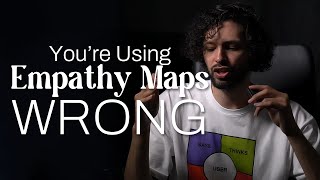
Empathy maps aren't a final deliverable. They're a note-taking tool for individual interviews that capture what users think, do, and feel. Aggregate them through affinity mapping to find patterns and actionable insights that actually inform design.
Chapters
Okay, I have an unpopular opinion, or at least something I've never really heard discussed. It's research-related, but right now you guys can see that I'm wearing my, my Empathy Map t-shirt, and you know, that's really the topic that I think is worth discussing is, you know, is an empathy map— now people consider that as like a research deliverable, right, coming up with an empathy map, but to me An empathy map is really like a notation device. It's, it's how you would take note on an interview, right? If you're, if you're watching, if you're watching a user interact with something, you're looking at what they think, what they do, observing how, what they do. You're looking to see their goals. And obviously these come in the lines of questioning, but putting them into these empathy map categories I think helps categorize your notes so that you can, you know, understand your user better and get some of the outcome. Now from that, from that empathy map, I then think you follow it up with an affinity map to kind of group the patterns and themes that you see multiple users do. So you're taking an empathy map for user interview 1, 2, 3, 4, 5, and 6. Then you're taking all the data from those empathy maps and grouping them in similar patterns and then similar themes so that you can see which of your users have similarities and areas that are worth exploring. That should influence your next steps, right? If you saw out of 6 of your users that you interviewed, all 6 of them couldn't find the button to continue on the prototype, then you know there's a problem, right? Because you see all 6 users. So when it says does, and the task was to move on to the next step and they couldn't find the next step, button, obviously that's a problem that all 6 users had, so it's worth exploring and improving your design. When they said, you know, that they think that this feature is super helpful or they think this feature is not, you can hear in the dialogue whether they— what they're thinking, what they're doing, what they're trying to do, you know, certain things like that. And I really think that empathy map is more of a note-taking, note-taking tool that then syncs up with your affinity map. Instead of just being a deliverable, you know, I'm delivering an empathy map. I feel like a lot of times that's just getting caught up in the work and not exploring what's, what's actually useful. And that is the suggested next steps or the analysis, which is like the affinity map from your, your actual work.