Designing Your Life and Career
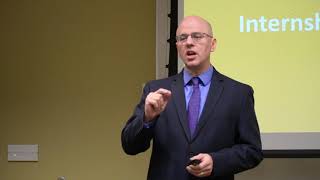
Rob Bagley, director of career services at LDS Business College, teaches students to design their careers through two practices: talk with people and try stuff like internships and classes. Most good jobs come through personal connections, not applications. The college now requires internships, which let you test fit and gain real job experience.
Chapters
Hi, my name is Rob Bagley, PhD, PhD. I'm the Director of Career and Internship Services, and I'm really excited to talk with you this week. So you know that the school's mission is to develop capable and trusted disciples of Jesus Christ. Now, for you to accomplish what God has in store for your life, you're going to need to have a good career. You're going to need to be able to provide for yourself and your family. So it's a very important decision, and if it was— if you're like me, when I was trying to make that decision, when I was first new in college, I was super stressed out about it. I spent a lot of time praying about it. I remember one night I was reading the Book of Mormon, and I was really stressed out trying to decide if I should do this major or that major. And I came across a scripture in Alma 36:3 where Alma is talking to his son and he says, "Oh my son Helaman, if you will put your trust in God, he will support you in your trials." in your troubles, in your tribulations, and you shall be lifted up at the last day. And it gave me a lot of peace. I want you to know that God is interested in your success, and he's going to help you. But he does expect you to do a lot of the work. Just like with Joseph Smith translating the plates, or Nephi trying to build a ship, there's a lot of work that he's expecting you to do. And then when you do your part, he'll open up the doors, introduce you to the right people, give you the opportunities so that you can have the type of life that you want and he wants for you. So I want to give you a few strategies this week that if you'll apply, I promise you it will be a significant help to you as you try to figure out how to have a great career and a great life. Now one of those strategies is called designing your life or design thinking. This comes out of Stanford University. And one of the assignments this week is to watch a YouTube video about this strategy called designing your life. Now if I was going to summarize what I learned about studying Designing Your Life, I would summarize it into two concepts. The first one is to talk with people, and we're going to give you some exercises to do and some help with how do you talk with the right people to help you figure out if you're heading in the right direction for your career. But that's one of them, is to talk with people. The other thing, the other concept, is to try stuff. The best way to figure out if you're on on the right track is to try stuff. Try something. And that can be taking a class, it can be doing an internship. There's a lot of different ways to explore the future. In fact, that's kind of what designing your life is about. It's trying to explore in your mind through conversations, through trying stuff, if the career you think you want to do is a good match for your personality, for the things you're good at, for the things you enjoy doing. So talk with people and try stuff. The next thing I want to talk with you about about is internships. And one of the great things at LDS Business College is starting fall of 2019, any student that is getting a degree at LDS Business College is eligible to do an internship. In fact, it's part of your graduation requirement. Now, an internship is one of the best ways to build professional networks. It's one of the best ways to try stuff, to, to say, you know what, I think I want to do this for a career. Let me work in that field for a while and see if I really do want to do that for a career. I'll give you an example. So my brother Richard, he studied accounting at BYU. He did 4 years of college. He took his first job as an auditor and he found out that he hated it. Now the sad thing is that's kind of a little bit late to figure that out, right? Wouldn't it have been great if after his second or third year he did an internship in accounting and found out if he really liked that or not? And then if he didn't, he could still switch to something else. So an internship is a great way to validate your career choice and see if it's really right for you. Let's say that you are studying digital and social media marketing. You could finish your certificate in your first year, your first 2 or 3 semesters, and then do an internship in social media marketing. At that point, you would either find out that you really like it, or maybe that it's not the right fit for you. And if it's not, you can switch and finish out your education in something else. Else. Even, even if you switch, the information that you got from that certificate is still going to benefit you whatever else you do in your career. So you don't really lose anything by trying things. You get more experience and you get to find out if you're heading in the right direction. Okay, when I was in college, I had to do an internship as part of my bachelor's degree, and that gave me valuable experience to see if I was heading in the right direction. I felt like I was, so I went on to graduate school. When I was done with my PhD in marriage and family family therapy, I had to do a year-long unpaid internship. So it kind of felt like a sacrifice, but I found out that in my internship I learned more about my— about therapy and how to do that than I had learned in school. The stuff I learned in school was helpful, but the on-the-job experience, I learned so much more than what I learned just in the classroom. So when you actually try stuff, not only do you get to test to see if you picked the right career, but it's also the learning is much better by actually doing things. So an internship can be fantastic for that. The other thing that an internship's great for is it increases your chances of getting a good job. One recent study found that even at the associate degree level, those that had done a relevant internship had far more job offers than those that didn't. The other thing that they found is those that did internships related to their career had far better well-being and thriving in their life. So it benefits you tremendously to do an internship. The other thing that an internship does is while you're working at a company, hopefully you will introduce yourself to people, you'll get to know people at the company, you'll start to build your professional network. Then when it comes time for a job, you have people that know about your skills that could be references for you, that know other people that might be hiring, so it's fantastically helpful as far as building your professional network. And that leads me to my next topic that I want to talk about, and that's mentoring and networking. Networking. Of all the good jobs that I've had during my career, most of them I found because I knew somebody who was aware of the job opportunity. So the more that you can network with people, the easier it is to get that good job, to find out about the opportunity. People are watching you all the time, whether that's at school, at work, at church. The job I have now is because my home teacher had been watching me for about 3 years in my ward. And he became aware of this opportunity. President Cush was asking him for recommendations, and he said, you know what, I think I know somebody who'd be good for that position. I didn't know he was paying attention to me and my capabilities. So people are always watching. You always want to be doing your best, and you want to be expanding your networks, because you never know when that friend or that schoolmate is going to be the person who helps you get the interview or the job that you want later in life. Networking is extremely important. Now one of the assignments we're gonna ask you to do during this week's section is to create a profile on a new software platform that the school has called BC Connect. The software is PeopleGrove, but our version of it is called BC Connect. All of the church schools are using the same platform: BYU, BYU-Idaho, BYU-Hawaii, and LDS Business College. So if you join this platform, you have the opportunity to network with alumni all over the world in all different professions. So what I would encourage you to do is to get on the platform, find people that are studying the same career that you think you want to do, and start to have conversations with them. Find out what they like about their job, what they don't like about their job, what's hard about it, what's the best part about it, what are the salary ranges, how many hours do they have to work. Find, kind of live out that life you think you want to live by imagining it through having conversations with people who are already living living that life. It's a great way to try stuff by talking with people. And as you— essentially what you're looking for is mentors. You want to talk with people who are already doing what you think you want to do and find out the advice. How did they— what did they study? If they required graduate school, how did they get into graduate school? What advice do they have for you to prepare yourself so that you'll be ready to do the same type of career that they're already doing? Tremendously valuable. Don't think that just just going to class is enough. It's important, but it's not enough. You need to be networking, you need to be expanding your networks, you need to be trying things through jobs and internships and talking with people. And if you do that and you also pray hard and ask for the Lord's inspiration, you will be guided in the right direction to go. Doors will open for you that you never imagined could open because of the Lord's blessing if you do your part. And I'm so excited for the fantastic careers and lives that you're going to have. I hope you take full advantage of the assignments this week, and when it's all done, give us some feedback on what was most helpful, because we really want to help you and the rest of the students here at LDS Business College to have a great life and a great career. There's a quote that I wanted to read you from President Gordon B. Hinckley. He said, the Lord would want you to be successful. You are his sons and his daughters. He has the same kind of love and ambition for you that your earthly parents have. They want you to do well, and you can do it. It.