This is a YouTube video titled "Disrupt Backstage: Roelof Botha" from October 2010 featuring an interview with Roelof Botha of Sequoia Capital. The content is a conversational interview where Roelof Botha discusses his role as a startup judge at TechCrunch Disrupt, his investment philosophy, the importance of business partnerships with founders, and examples of successful investments like YouTube and AdMob. The interview covers topics such as evaluating entrepreneurs, the nature of investor-founder relationships, and what Sequoia looks for in startups.
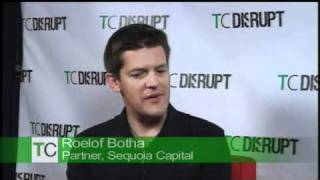
Ruloff Botha of Sequoia Capital has been a familiar face at TechCrunch Disrupt this year. He is a startup battlefield judge. He will be one of the judges for the final round, and he was also part of the much-talked-about Super Angel VC panel. Thanks for joining us. Thank you. So to start it off, I actually wanted to give you kind of the final word on that panel. You know, there was a lot discussed. Some of it kind of got muddied in the controversies of the last few weeks, But when you talk about the dynamics of the Super Angel and the VC, what is the final word that you want to say?
The key thing from my point of view is that it's not a versus debate for the candidate. Fundamentally for me, the choice that a founder should make is about a business partner. The right person to help them recruit, choose business partners, raise follow-on financings, answer strategic questions, just the general help that an outsider can provide as a business partner to the founder. And so for me it's not a versus question. And to be honest, the debate, I'm delighted to see what has happened since the debate took place on Monday because a lot of people have been writing about the fact that it's about that choice of business partner rather than a moniker that happens to describe your firm or your partnership. And certainly from Sequoia's point of view, we always think of ourselves as being the business partner for a founder independent of the stage. You know, when we had the fortune of meeting the founders of YouTube, the three of them, they were in a garage in Menlo Park, or Omar Hamoui, the founder of AdMob, working out of his bedroom as the sole founder of his company, AdMob. They chose us as their initial business partner, and they took up residence at Sequoia's office. We were their first business at race, because they felt that we were the best place partner to help them build very large and enduring companies. And that's what we strive for.
So I guess what you're saying is that the generalizations that people have talked about, especially in the last month and a half or so, Don't quite fully get the picture. In other words, for example, the founders of YouTube and such, you know, what they need can't just be this generalized solution that people talk about.
Exactly.
At the time they needed Sequoia. And that's why you guys partnered with them.
Earlier today, sorry to interrupt, actually one of the interesting dynamics that happened with YouTube, since you mentioned the example, was that there were other groups who met the company and offered to invest. And there were a couple of groups who said, let us invest and we'll help you get to an exit in six or nine months and we'll flip the company for 20 or 30 million dollars. And at the time, even though the site didn't have a very large user base yet, the three founders felt that there was something really interesting about this business and that it had very large opportunity. And they chose to work with Sequoia because they felt that we were better placed to help them build that very large enduring business. given our experience as operators, given the experience of the partnership around the table, and helping them navigate a tricky landscape, figure out how to make money on the business, recruit people, etc.
Is that something that you look for in entrepreneurs, the idea of someone who wants to make something great? Because when you're such a large firm like Sequoia Capital, you need a really large exit, right? So do you screen entrepreneurs carefully that they're not just trying to build their companies to flip them.
Great question. So yes, this is the short answer. We are attracted to entrepreneurs with incredible drive and ambition. People who want to change the world, who want to take on established industries and fundamentally change them. Now obviously we have many exits that never realize wonderful outcomes like what we've had. Many of them never work out, many of them have modest exits, but that's not the they're starting out goal and objective. And so we're really, really attracted to people who have those sort of much larger ambitions. Now, the one thing that's important about that, and you said it correctly, it's about the exit. It's the outcome that matters. And I think a lot of people have been confusing that with the input. And I've heard a lot of people say, you don't want to go to Sequoia unless you need to raise a very large amount of money. Well, that's not true because again, it's the outcome that matters and with very small amounts of money, you can achieve wonderful things. So, you know, our first investment in Yahoo was $900,000. Okay. Our first investment in AdMob just a few years ago was $2 million. Yeah. And, you know, we regularly make investments that are a couple hundred thousand dollars. Again, it's about what you start with and the outcome, not how big a check you need to write at the outset.
Yeah. And you mentioned Sequoia tries to act as a support network for these corporations that you invest in. Earlier today we heard from Vinod Khosla, who said that the investor should act almost as a co-founder. They should work closely. They should really help drive the company. What do you think about that? Is that kind of the relationship you see?
I think that I agree with Renode that it's a very important trust relationship that a founder has with a business partner who will provide capital but provides many other services. But that needs to be a trusted relationship in the way that I think co-founders have a very strong trust relationship. And to me, that's wonderful when we have repeat customers. Sort of any company that that you're an investor in, one of the key metrics is what are the repeat usage rates? Because if you're doing a good job for your customers, they'll come back. And Kevin Hartz from Eventbrite is an example of an entrepreneur where I helped him with his previous company, Zoom, and when he came to raise money again, he again wanted to work with me and Sequoia because of the service we delivered to him at the outset. At the same time, I think it's also important for the investor to not try to front run an entrepreneur. I think Sequoia has this tagline with entrepreneurs behind the entrepreneurs. Having been part of the team that built PayPal, it was very clear that there was a difference between the people who spent 80 or 90 hours a week inside the building dealing with tons and tons of little issues to make the company successful. And board members provided tremendous help, but it was different from the sort of help that you got from your fellow executives building the company. And to me, that's an important distinction that you're an advisor, but you're not sort of shoulder to shoulder with the entrepreneur standing on stage.
Yeah, the relationship is a bit more complicated but still supportive. And my final question or the topic I wanted to talk about was, you know, as you've been a judge and disrupt and in real life as you're vetting entrepreneurs, what are you looking on stage and what are you looking for when you talk to people who want you to invest in their company? How do you know when you have the leader or the kind of company the right idea? What's your metrics for success? So how do you evaluate companies and their founders?
For the initial investment.
For the initial investment, yes.
Passion, drive, an ability to articulate the problem that they're trying to solve. Candidly, most of our great investments have come from founders who had a personal problem that they were trying to solve. I don't know if you know the story of Cisco, but the two founders of Cisco were on different parts of Stanford University's campus, on different sub-networks, and they couldn't talk to each other via email. so they built a switch to network the two different networks and that was the origin of Cisco. It was that solving of a very personal problem that then turned out to be a problem for many other people where the founder can articulate the problem and come up with a compelling solution that ends up addressing the same problem and needs of many other customers. It's one of the key insights we look for.
Of all the entrepreneurs you met, of the first meeting, who was the most impressive and how were they able to articulate their message or their drive or their passion? What were some of the words, and if you could name a name, that would be great.
I think just a recent example, Omar Hamoui from AdMob. Omar had started two previous companies before he started AdMob, and one of those companies was a mobile publishing company. And so he was a little mobile publisher, and he really struggled to make money with these mobile websites. And that really frustrated him and it led him to want to build AdMob to enable other publishers like himself to generate revenue and to solve the needs of advertisers that were trying to reach those sort of customers. And it was so clear that he understood the nuances of the problem of that particular customer because he himself was that customer and it was very compelling.
And... Was there one thing that he said that stuck out to you?
That was two, three years ago. I don't remember the specific words.
But it's that feeling that you got after his presentation.
Yeah, I mean with most of those investments, I mean, kind of the, you know, we met Omar on a Monday, the investment was done by Friday. It took five days. Wow. It was just so clear he had such an ability to communicate what his company was doing and the problems it was solving, the market was addressing, that it was very clear that that was a company you wanted to be an investor in. Wonderful.
Well, thank you so much. Really appreciate it. So once again, my guest today has been Will of Both. I hope I got that right. Good yeah. He's with Sequoia Partners.