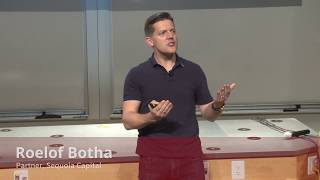
View From The Top with Roelof Botha, Managing Partner of Sequoia Capital

Roelof Botha, managing partner of Sequoia Capital, talks about his path from South Africa through PayPal to venture capital, his views on leadership and immigrant contributions, and why certain career decisions shaped his trajectory.
Roll off, we are so excited to have you here today.
Thank you.
You could say your Silicon Valley story began here at Stanford GSB. How does it feel to be back where it all began?
Kind of intimidating. Honestly, I remember sitting in your shoes 25-26 years ago and going to View from the top in the old Bishop Auditorium at the old campus and feeling in awe of being in this incredible place. It was just an amazing privilege to come to Stanford honestly. And as an international student, we obviously arrived earlier and so you'd walk around campus, it was still quiet and it just, I had to pinch myself to realize that I was here. It was incredible.
I want to start where it all begins in South Africa. Your grandfather, Pik Botha, was a minister in Nelson Mandela's cabinet. How did your family and where you grew up shape your career and your ambition?
In some sense, having had a famous grandfather, my grandfather was sort of the equivalent of foreign secretary for many years in South Africa. And I remember meeting dignitaries from overseas who'd come visit him. And he was prominent. He was a famous figure. It meant that I was prejudged often. People would assume things about me because they inferred from who my grandfather was or what he believed in and assumed that that was me. And that didn't sit well, even though I was very proud of him. I wanted to be myself. But also gave me a sense of what you could achieve and what was possible on the world stage. And he had a book in his library, which was called the who's who. and it was obviously before the internet, it was this book maybe had 1500 pages and it listed the names of all the important people in the world, names you needed to know. And I remember seeing that when I was maybe 13 or 14 and wondering if I could maybe make my way into that book one day.
So part of becoming a who's who leads you to Stanford. And at Stanford you graduate as a Henry Ford scholar. In other words, you were the number one student in your business school class. what drove you to work so hard?
Because it was there. The challenge existed. I'm intensely curious. I'm very competitive and driven. And honestly, as an immigrant, I mean, many of the students that are here presumably are also immigrant students. You know, I got here on a two-year student visa with a one-year training certificate to be able to make way in the United States. And so, That is an incredible gift and an incredible opportunity. And I didn't want to waste that. And so that meant that I wanted to take on the challenge of getting the best grades I could. And I didn't aspire to be the top student when I got to business school, but at some point you started to perform well. And I'll be honest, in the last semester when I was starting to work part-time for PayPal, I actually took a few classes past fail because I was worried about juggling work and studies. I had a bit of a glide in path in the last quarter, so I'll admit that.
You clearly found a spot in the classroom. And I think a lot of us wonder, what lessons are we going to take from the classroom into our lives? What lessons did you take from the classroom into your career?
There are many, and I think Dean Spence was the dean when I was here. And part of what he won the Nobel for was around information theory. So there's a lot of signal value in the fact that you have a Stanford MBA or a Stanford degree, obviously. An element of branding, there's an element of the network, the people you get to know here. And that's invaluable. The world's a small place. Silicon Valley is an incredibly small place. And one of the taglines I have is, Friends come and go, enemies accumulate. And if you look around this auditorium, if you look around your classroom at the GSB, there are going to be lots of your friends or colleagues or classmates that do really interesting things. and you should delight in that and take pleasure in their success. But the third element of the GSB is what you learn. And I've gotten the sense that that has decreased in relative importance in the minds of students over the years. And that concerns me honestly. Because there is so much that you get to learn from these incredible teachers here at the GSB that can help you be effective when you get out there. So I'll give you a couple of examples. I remember in first year we did managing in non-market environments. And as an immigrant, it just baffled me that we had to learn about this. I mean, I was at business school, why are we learning about these things? And then as soon as I joined PayPal, within six months we realized that eBay was engaging in what we considered to be unfair market practices. And so we had a complete antitrust case ready to go against eBay, depending on how they behaved. And here I was immediately applying things that I'd learned at the GSB. Another one was cost accounting, a class that I think few people were drawn to, and yet in the first three months that I joined PayPal, what I was doing was a cost accounting exercise. I was going through the company's actual financial statements, understanding every single line, what the variables were that drove it, and building the company's financial model bottoms up. And that model was still being used by eBay two years after the company was acquired. So there's just so many practical things that you can learn in your classroom. So I know that you're here to meet a lot of people and enjoy this experience. Many of you are going to pivot your careers, but take the time to learn. There is so much valuable information you can get from your classroom.
But maybe the most important thing that came out of Stanford was actually your relationship with your wife Hoifen, who's actually in the audience with us today. What influence has she had on you?
First I should tell a little bit of story. You saw some pictures earlier of that. We started dating in first year here at the GSP. I think there was a picture of us in Schwab. So some of the other residences that are now available weren't here. But Schwab was newly constructed. I think we were the second class to be in Schwab at the time. I was in E307. You're in my room? So that picture was in E307. So it was a classic. Hooven was in the blue wing, the West wing. So it was a classic East End boys, West End girls type of situation. And I remember we had a human resource management class. It must have been the spring semester. And I tried to figure out how I could sit in the back of the classroom at a sufficient angle that I could look at her without looking like I'm not actually paying attention to the professor. So anyway, in addition to being my life partner, she's been my thought partner. You know, whether it was helping me with the initial decision to join PayPal. I come to the US with some financial support from McKinsey, so I owed them money back. They paid for everything at the GSB, but for most of it. So I had an opportunity to go back to them, had an offer to go to Goldman Sachs, and I thought I wanted to go into finance. So actually before I got to the GSB, I was doing sort of derivatives work. That's what I thought I would do. And none of the finance jobs I interviewed for, made me an offer. And then there was this idea of joining a startup. PayPal was the company that I'd set my sights on. I thought it was really interesting, but I was scared to join a startup. You know, what would happen? And Hoyen was also an immigrant. She came from Singapore to the United States and studied electrical and computer engineering at Carnegie Mellon University. And she'd actually worked in startups before. And so she had a real sense for what it it would take. And as we discussed this offer from this company, she ended up encouraging me to make that leap. And I think I sometimes second-guessed it. There were dark days at PayPal later that year, and maybe sometimes I didn't appreciate how great her advice was. But she was a huge influence in me making that first decision. When I got to Sequoia and I got the offer, Mike Moritz and Doug Leone gave me the written offer to join. and they said, you need to sign on the spot. And I said, I can't. I need to make a phone call. We were engaged at the time, but I insisted that I step out. And obviously we'd been talking about this offer all along the interview process, but I wanted to speak to her before accepting that offer. So those are two examples. And then, you know, throughout my career as an investor, having a partner who is technical, worked in startups, understands business, It's just been incredible to be able to talk about companies and about challenges. There was one example of a company that there was some management strife, the company wasn't perfectly managed, the founders actually wanted to sell the company and we ran an M&A process. But all the acquirers could see that things weren't quite right. And the best offer we could get for the company was about $600 million. And we didn't think it was a great offer. And I was talking to Hoefling about this and she had this absolutely perfect line for it, which is nobody wants to buy a fixer-upper. And it perfectly summarized the challenge of trying to sell a company where things aren't quite right. And, you know, with that Insight, we decided to turn down that acquisition offer. And today, that's a public company worth nearly 10 billion dollars. It was a good decision to turn that down. So anyway, it's been wonderful to have somebody I met at the GSB both be a life and a thought partner.
That's a really special relationship the two of you have. And what's also special is you're both immigrants. And the class of 2026 at GSB is actually the most international in history. Over 40% of the class comes from abroad. You're famous for coding Hamilton. Immigrants, we get the job done. What was that transition to the United States like and what challenges did you face along the way?
I had to learn how to drive on the other side of the road. And then there are always other little quirks, you know, with language. So in South Africa, I had belonged to something called AA. And I was in Schwab, there was, an American, Dan Rappaport, he'd actually moved into Schwab a little ahead of the other American students. And I was chatting with him and I said, Edison, where do I sign up for the AA? And he looked at me, he's like, oh my God, this guy's sharing things with me. And I said, the Automobile Association, somebody that helps you when your car breaks down. He said, ah, here we call it the AAA. So these were some little adjustments. the fact that I couldn't find an electric kettle anywhere to boil water to make tea. That was another interesting insight about the United States. But there's a lot of challenge. Immigrants, I think, want to prove themselves. The data overall, by the way, is immigrants are twice as likely to start companies as those who are born in America. Immigrants are four times as likely to win Nobel Prizes. So immigrants of the legal variety have a huge influence in the success of this country, obviously. and so I think about 40% of the founders we back are first generation immigrants. And you're not burdened by sort of habit when you come here. I love rugby, as some of you may know. When I first got here, there were no streaming services, and so there were no distractions. I wasn't watching football, I wasn't watching baseball, I wasn't watching anything else. No rugby was available, so you just studied. And when you realize that if you don't make it, you're on your way back to where you came from, where you don't see a great future, it's incredibly motivating.
On the topic of immigrants, as you're graduating, you receive an offer to join PayPal from another immigrant, Elon Musk. 18 months later, you're taking the company public. Tell us the story of your PayPal journey.
Many twists and turns. Of course, I couldn't accept the first offer. So actually, a classmate of mine, Jeremy, one of the voices you heard earlier, just to illustrate the small network, the six degrees of separation, proverbially. So Jeremy worked at McKinsey in Australia. His younger brother, Jonathan, also worked at McKinsey. Both of them did a tour of duty in South Africa. Jeremy had left just before I joined McKinsey in Johannesburg, but his brother Jonathan was there. Jonathan was my buddy. He was the person to show me around the office, explain to me how basic things worked. I get to the GSB and Jeremy's room is opposite mine in Schwab. We play rugby together, obviously become good friends. He was one of the groomsmen at our wedding. He'd met Elon at CitySearch before he came to the GSB. And I was interested in the company, and so he's the one who introduced me to Elon in the first place. and so just to remind you of all these wonderful connections you'll make. So, but I couldn't join the company because I was on this F student visa and I didn't have work authorization. So I turned down the offer and then that was in September '99. December '99 he made me a second offer to join and again I had the student visa issue. And then I got my third offer in March of 2000. And at that point, x.com, the original x.com and PayPal were merging and that combination seemed like a fascinating company because it was really about payments and the acceleration of payments in the business captivated me. And I'd used a couple of projects at the GSB to go and figure out what would I do if I was in this company? What could be a good business model to make this company work? And then something else had happened which is in 1998, There was an emerging markets currency crisis and long-term capital management blew up and the rand that I saved in South Africa to come to the GSB lost 30-40% of its value overnight in August of 1998. And so I didn't have enough money to make it through. Literally in March of 2000, sitting in your shoes, March of 2000, I didn't have enough money to pay my share of rent in April. Now at that point I borrowed money from My former McKinsey mentor who'd helped convince me to come to the GSP, I'd borrowed money from Hoofnagle. And it was getting embarrassing living hand to mouth like that. So I took my third job offer. And I didn't take a summer job after a summer vacation after the graduation. I started full-time the day after. I just immediately started to work. So that was a different environment. And as I mentioned, obviously Hoofnagle was with me through that difficult decision and in that journey of company building. And it was a tough company building journey. You know, in the summer of 2000, fraudsters were trying to kill us. eBay was trying to kill us. The company had a burn rate of $14 million a month in June of 2000. We had seven months of runway left. And I remember Mike Moritz showing up at one of our board meetings and the only thing he kept on asking is, what's your runway? and so we had money until January 2001. And I just kept thinking, if we don't figure this out, I'm going to rowboat back to South Africa. Got to figure out a business. And so we started to charge for payments. We figured out the fraud problem, and we kept on scaling the business. So anyway, Elon left in the summer. Peter Thiel came back as the CEO. I'd actually interviewed with Peter. I still remember some of his interview questions. So Peter became the CEO and I became VP of Finance and Risk Management at the time. But I was at all the company's board meetings. I was involved with fundraising and many of the M&A conversations we had had. And then in, this is a good piece of advice maybe for all of you, in 2001 we needed a CFO to take the company public and the board endeavored to do an outside search. and I raised my hand and I said, would you consider me? At the time I was 27. And it was daunting at some level, but nobody is an authority on your potential but you. And at some point you're gonna have to raise your hand and not be timid and ask for the opportunity, push for the opportunity. And I got that opportunity, unfortunately didn't make a sufficient number of mistakes between then and the IPO in 2002. And so we saw that through. So it was an incredible experience. We had an IPO, we did a secondary, and then we did the acquisition transaction with eBay, which closed later that year.
I love that quote, that no one is an authority on your potential but you. PayPal was, it was a tough environment, I guess. It's a question that I have. is for a lot of us second year MBA students, we're in the same boat. We're thinking about what that next job is going to look like. How would you think about that and what would your advice be for those of us embarking on that journey?
So there's one of the insights that I got from Peter actually going back to that interview at PayPal originally. Peter had this great insight. Well, firstly, if you interview at a job and most people talk about the vacations, That's a good clue that the job's not that interesting. But secondly, that most people think one step at a time about their career decisions, and you really want to expand your time horizon. If I had to boil it down to one thing, expand the time horizon over which you're thinking. Because if you make a series of relatively short-sighted decisions, you'll make trade-offs that are relatively safe, and you'll end up in your mid-40s with a midlife crisis. so think about that arc of what you can do. And if you only had one opportunity to make a career decision, maybe you want to be a little more conservative and you want to be careful, but that's not the way it is. You have one choice and another choice and another choice. And so it may, it may be that the first opportunity out of the GSB is a little risky. And if it doesn't work out, as long as you work with great people and you expand your network and you open up more doors and more opportunities, A year or two later, you've got another interesting opportunity, and another interesting opportunity. And when you put that over an arc of a career, you're gonna have a lot more fun.
The next fork in your road is when eBay acquires PayPal. And Meg Whitman actually makes you an offer to join. You turn that down.
Or to stay.
To stay. To stay. And you turn that down to actually join Sequoia. And you might call that a pivotal moment, a crucible moment, as you might call it. What was behind that decision or how did you make that decision?
So there was, so I'll answer that particular question, but there were three career decisions I made, each of which sort of versions of the marshmallow test, which I'm guessing many of you have heard of because those experiments originally happened here at Bing Nursery School on Stanford campus. So the first was, I qualified as an actuary in South Africa. It's the highest paid profession in the country. and I thought that if I worked for McKinsey, it would give me an opportunity to work or to study abroad. And I took a 50% pay cut and I had to pay back the bursary that I paid for my education to go work at McKinsey. The second one was the one to join PayPal where I had to pay back McKinsey for having paid for my tuition here at the GSB and my starting salary was, I think, $80,000. on graduation. I negotiated with Elon to get more equity in exchange for lowering my cash salary. So I was earning less than I would have if I'd gone back and I didn't have my debt forgiven. The third one was when I joined Sequoia and at the time Meg offered me an incentive package to stay as the CFO at PayPal which ended up being worth $20 million. And I turned that down and Sequoia offered me cash salary that matched what I was earning at PayPal at the time with nothing else. No bonus, no carry. It was a bet on yourself. And they said, you know, if it works out, you'll do well. It'll be an interesting career, and you'll probably make enough money to not have to worry about it. But you've gonna, you're gonna have to back yourself in this situation. And so, like I said earlier, I had my, you know, the lifeline call. Boifin, are you sure we can do this? And we made that decision.
So at Sequoia, you've crossed paths with some incredible founders. Brian Chesky at Airbnb, who was actually here a few years ago. Larry Page and Sergey Brin at Google. Patrick Collison at Stripe. What qualities do you see in founders who change the world?
I think it starts with authenticity. A lot of people talk about founder market fit. The thing I actually look for is founder problem fit. Why are you the one who has the insight in this particular problem? Why are you so passionate about pursuing this? And the common thread for our most successful founders is not that they're doing it for the money. They're just passionate about solving a particular problem, something that is often very personal to them, where they have this unique insight and they have a earnings desire to solve this problem and to go and serve customers. And when they do and they deliver value, they somehow figure out a good business model to go along with that and they scale. They all have a growth mindset. They're all eager to listen. Almost all of them. Brian Chesky, for example, an absolute sponge, the sort of person who listens to advice. And obviously Founders are strong-willed individuals. but they soak up all the benefit of other people's advice and experience. When I was in first year here at the GSB, one of the professors had this profound insight, which is that founders are not actually risk takers. They are risk mitigators. They understand all the variables that can go wrong in their business and they work feverishly to fix those things and to make sure that the business is on good footing. So I think those are important. By the way, increasingly we're seeing GSB founders. So what you didn't mention, we invested in a company called Medallia that was the class of '99. We invested in Trulia, Nubank, David was class of 2012, I believe. Tony Shyu was here 2013. A company you may not have heard of yet, Ethos, which is online life insurance, was started by Peter and Linky who were class of 2016. So a lot of really interesting companies. coming out of this room.
So it's great to hear that you think the GSB is a good quality.
It's a good quality. You understand business. It's actually changed quite a lot. I think when I first joined Sequoia, there was a sentiment that if I were to spend time on campus looking for investment opportunities for Sequoia, the GSB may not be the best place to go spend time. And I think that's changed pretty dramatically over the last 20 years, which is fabulous.
So I want to go back to one point you mentioned, which is that growth mindset. It's something you've embodied throughout your career. For years, you were famous for writing 10 to the power of 9 on every piece of paper to remind yourself of your goal to generate $1 billion in return. In 2020, it was reported that you had generated over $10 billion in gains. Not bad.
Thank you.
Has success changed your mindset in any way?
You should ask other people maybe. I don't think so. I think probably what changes more is just with time and as you're in a leadership position, you think more about the performance of your team, you don't just think about your individual contribution. That's probably the biggest change. But one of the phrases we have at Sequoia is we're only as good as our next investment. and a phrase that I've repeated over and over at our all hands meetings is that nothing wilts as fast as laurels that have been rested on. And so, you know, that's the mindset that I saw when I interviewed at Sequoia. And I didn't interview at any other venture firm, by the way. You know, at least when I was at the GSP, most of the venture investors that came by seemed like they were, you know, Masters of the universe, and, you know, they just seemed to think too much of themselves, let me put it that way. And at Sequoia, I found something very different. There was such a humility from people who had enough money to never have to work again, and yet they were relentless. They were there early in the mornings. They were eager to meet the next interesting company that was going to transform the world. And it was the joy of working with these founders, working with these companies, and building them that kept them going. And so I think it's just a very important attribute. what really motivates you. And at least for us as well, the clients we serve, and it may not be obvious to you, Stanford is a big client of Sequoia's. The people whose money we invest are almost exclusively endowments, foundations, and non-profits. And when you visit our offices, you'll see the names of our limited partners on the doors of our conference rooms. And so you'll see Stanford, you'll see the Wellesley Trust, you'll see the Dana Farber Institute, Boston Children's Hospital. These are the people we work for, and that's incredibly motivating.
Well, to GSB students, your career seems flawless. McKinsey consultant, Stanford MBA, takes PayPal public at 28, Sequoia partner a year later, and now head of the most iconic venture capital firm. Has Ruloff Boettcher ever failed? Of course.
No, there are 15 times I've made an investment recommendation at Sequoia in my 21-22 years there. 15 times I've recommended an investment that ended up being zero. 15 times. When I interviewed at Sequoia, Don Valentine was still alive and interviewed me, and he actually said that he worried that I hadn't faced enough adversity and failed enough before I joined Sequoia because he was worried that I wouldn't have the fortitude to deal with the adversity of being in our business. Because the truth is, over Sequoia's history of over 50 years, about half the time we don't generate a profit on an investment. There's a power law dynamic in our industry and when it works, it works spectacularly, but you fail a lot. and that's hard because when I was in your shoes, I was used to getting good grades and things kind of just worked. And that's one of the things that I think you will need to face as you embark on your careers because if you want to be exceptional at something, you're probably going to have to push the boundaries. And you're going to be at that edge of incompetence where sometimes you're not going to get it right. But if you stay inside that edge and that boundary, you'll never do something special. or exceptional?
Well, your ability to push yourself is part of the reason the firm and your predecessors, each of whom has actually spoken of you from the top, picked you to lead the firm. What most people don't know is that your title is actually Senior Steward. What does it mean to you, to steward Sequoia Capital?
The title Steward was very deliberately chosen, and the mentality we have at Sequoia is that you need to leave the firm in a better place than and you found it. That is our role. So we have changed the constitution of Sequoia Capital to make it virtually impossible to take it public, but to sell any part of the GP to a third party. So it's a private partnership to the limit of the law in perpetuity. And so no generation can sell a piece of Sequoia and profit at the expense of those who came before or those who come after. And there's a very gradual transition where one generation hands over the reins to a new generation. And our job is to make sure my job is to make sure that this team is well positioned that, you know, 20 or 30 years time Sequoia continues to be one of the leading firms in the world. And that's what we look for. And so when I'm interviewing people to join Sequoia, it's not to work for me, it's to work with me. And I evaluate each candidate wondering, could I imagine you leading this firm down the road? Can I imagine you being one of the leading partners making great decisions where I feel proud of what happens at this wonderful partnership after I'm long gone?
Speaking of stewardship, you have been a major patron of Stanford University. I think each of us in the room has probably benefited from you in some way. Is that we?
Because, that's right. Wife and I have jointly done all of that. philanthropy at the university.
And on that point, there's actually a building on campus named after both you and Hoeyven here at the GSB. What has giving back meant to the two of you?
Well, I think you should all recognize that there are many people who came before you who were generous and they've provided this incredible university, these incredible facilities, have provided professorships, That's what we benefited from. There are a lot of generous people that enabled this great institution so that we could study here and we could launch our careers. And so I think it's with that mindset that we have an obligation also to pay it forward. I wouldn't be where I am today if it wasn't for Stanford, if it wasn't for the GSB. Same person, same intellect. If I was stuck in Cape Town, I couldn't have done what I've done. and I wasn't, I wouldn't have had these opportunities had it not been for the GSB saying yes to my application, for what I learned here, for professors like, you know, Professor Solano who taught me about strategy which infuses things that I do every day at Sequoia. You know, what I learned, what it meant for me to be here is so important, it just seems natural that you want to give back and pay it forward to your next generation. And so we've been delighted to do that. both of us here at the GSBI and at Lucille, it brings us immense joy to be able to give back.
It's really special.
The innovation program was probably the one we liked the most, by the way. So there's some people who benefited from that.
And hopefully some good founders for you to back in the future.
Well, there are a couple that are venture funded already out of the innovation program, which had a an unusual story. I don't know if you want to talk about that.
Yeah, let's go ahead.
It was in 2020. Dean Levin asked for help from many of the alumni because a lot of the internships for first year students had dried up. And obviously, it's a way we tried to do whatever we can within the portfolio to figure out if there were internship opportunities. But, you know, after that call, the wife and I had a conversation about you know, what's going on at campus and, you know, isn't this an awful position? And certainly, you know, for us as immigrants needing, you know, money during-- well, at that point, I was quite destitute as a first-year student. I couldn't have made it through second year if I didn't have a summer job. There was an income requirement. And so as we spoke about it, we came up with this idea to provide essentially a stipend to a certain number of students that summer. with the provision that they need to work on something, they need to work on her business idea, just to make it somewhat practical. And so we came back to the school with this idea, and we did it that first summer, and we thought that was it. And then the subsequent year, a student emailed and said, are you doing this program again? That was kind of a strange request when COVID was over, vaccines were being rolled out, it didn't make sense. it's seemingly to need the program still. And so Wafaa and I had another conversation about this and we wondered, well, maybe there's an opportunity for people who don't have the means to be able to pursue something entrepreneurial between first and second year instead of taking a job just because they needed the money. And so we said, that sounds like a nice idea. And we came back to the school and we offered to fund that program for many years going forward. And obviously the school has done a tremendous job providing the resources to enable students to pursue an entrepreneurial dream. I spoke to one of the professors here a couple of weeks ago who talks about the missing Einsteins, this phenomenon that there's some people who don't do interesting things because they need to work for a living immediately after university or after their education. I think there's probably some balancing act there where if you don't have a little bit of a pinch, you maybe aren't as resourceful and so the idea of the program is not to be lavish. I think the amount of money provided per student is probably less than what you could get if you took another paying job, but it's enough for you to get by, and it's enough for you to pursue an entrepreneurial dream, hopefully, and even if the idea doesn't work out, at least you ventured, you tried, and hopefully you learned something from the experience.
Well, I want to focus for a little bit on what it means to be at the top. Who are folks you look to for advice or mentors that you look at? when you're trying to make a tough decision.
But firstly, the, at the top, I'm not at the top. There is no summit. There's only the climb, as far as I'm concerned. This is, as I was thinking about this, I mean, when I was a student, I loved coming to view from the top. I remember listening to Steve Jobs and Scott McNealy, and I mean, they were just, Jeff Bezos came when we were students, it was wonderful to listen to these people. But honestly, sitting where I sit now, I was thinking about this. This is more the view from the future. I'm sort of where you will be 25 years from now, hopefully. And so think of it that way. I'm not at the top. We're only as good as our next investment. We've got to keep thinking about that. In terms of mentors, there are many. There have been many along the way, and I'm sure many of you have had incredible mentors. that high school teacher who believed in you, who gave you a little bit of a nudge and gave you confidence, or that sports coach who said that you can make the first team and was willing to give you a try on the starting team on a Saturday. At this point, I still turned to Garth Saloner for a lot of advice. He was dean after I left the GSB but continues to be somebody that I call frequently for input. Dean Levin has become a mentor as well. And the other wonderful thing at Sequoia is we have a real focus on intergenerational transfer. So Doug Leone was most recently the steward of Sequoia. While Doug isn't part of the new funds we launched, he continues to serve on existing boards, and he's not in Monday partner meetings, but he's in the office probably two or three days a week. When I have a challenge, I call Doug and I ask him for advice. I called Jim Goetz and I asked him for advice. And so, you know, that's part of the benefit that we have with the unique culture we have at Sequoia, this intergenerational knowledge transfer.
So when you're in a leadership position, you're faced with weighty decisions. You've made a couple yourself. One was to split Sequoia into Sequoia US and Europe, Sequoia China, Sequoia India. Then you also started the Sequoia Capital Fund, an evergreen fund, in 2021.
How do you make decisions that are non-consensus? Well, I'm sure many of you have heard about the sort of, you know, irreversible and reversible decisions, type 1, type 2. I think the irreversible decisions just require an enormous amount of thought and pressure testing. And so, as you will face with your first career decision after the GSB, it'll be irreversible for 6, 9, 12, 24 months. and so you want to take those decisions very seriously. And other ones are less consequential and you can reverse course very easily and you should make those decisions fast and iterate and learn very quickly. So with these ones, the decision for global separation was a one-way door decision. There was no way we can come back two or three years later and say, Oops, sorry, we got that one wrong. Why don't we figure out how to recombine? And so we had a lot of advisors. The partnership just spent a lot of time thinking and talking about that. Condoleezza Rice is one of our advisors as well. I really leaned on her for input on how to make this decision. And so it ended up being sort of consensus in the sense that everybody agreed that it made sense because we laid out the logic and we kept on thinking about it and talking through it. But it was it took months to arrive at that decision, months. And then similarly with the Sequoia Capital Fund, it was an idea, and then you float the idea by somebody else, like, no, that's not going to work. You think about some of the objections, you come back a few weeks later, well, what if we did this? Like, no, I still don't think it's going to work. And then you keep on pressure testing, and you listen to feedback. I mean, that's part of the value of launching something that's as bigger change in the nature of how venture capital works, there are a lot of things we didn't figure out on paper. Well, I certainly didn't figure out on my own, or two or three of us figured out. We went out and we picked 10 of our best LPs, including Stanford Endowment, and we came down and we sat with them and we explained the idea. And they gave us good feedback. We shaved and changed the idea based on feedback from our LPs as well. And honestly, after we've launched it, There were a couple of things we didn't anticipate. And so we continue to make little tweaks and changes along the way. And so don't let perfect be the enemy of good. Get going, make a decision, and iterate.
I want to end with a question that we're asking all of our speakers this year. Our theme for the year is leaving your mark. How would you like to be remembered?
I'm guessing some of you have read David Brooks. He has this great framing of resume virtues and eulogy virtues. Resume virtues being your accomplishments and eulogy virtues being the things that people would talk about at your funeral. And I think when I was in your shoes, I'm mostly obsessed about academic and career achievement. You're so achievement oriented at that stage of your life. And so I think those weigh very heavily. and then over time, I think it shifts and you weigh the eulogy virtues a lot more. And, you know, at the end of the day, it comes about, it comes down to the impact you have on the lives of others and finding purpose in your life. And so the favorite book I hand out to our Founders is Man's Search for Meaning by Viktor Frankl. And this idea that you need to find what it is that truly motivates you, and money does not. motivate. And at the end of the day, you can't remain forever addicted to the ego accomplishments, the accomplishments that are all just personal and driven on yourself. So for me, that's been at work as a steward, what kind of a team can I help recruit at Sequoia? And will they remember me for being wise and kind and fair? And then you think about your family and your friends. And have you been a good loyal friend? Have you been kind and generous and supportive of the rest of your broader family? And most importantly, will I be remembered as a good father by my children and a good husband by my wife?
That's really powerful. And something that hopefully we can all live by as well. I want to open it up now to audience question and answers. So if you can just put your hand up, our mic runners and VFTT team will come to you. Please just state your name and your year before asking your question and stand up when you do.
Hi, Roloff. Josh Renee, MBA 1.
As young professionals, I think we grapple.
To comprehend the power of time. It's almost as if we know what we don't know.
What should we know about time?
How much of it do we have? One of the concepts I really like to think about, and we've shared at Sequoia, is time span of discretion. And the idea is over what time span do you think and optimize? And at least when they've applied it to business decisions, the person who's at a front line often has a relatively short time span of discretion measured in weeks or months, and CEOs often have time spans that are measured in years. years or decades. And so I'd encourage you as early as possible to lengthen your time horizon. Just optimize over a different time horizon as you think about important decisions.
Henry, MBA1. I'm also an international student. So I was wondering if you can talk more about the split is equivalent to China, India, and that implications about what people kind of talk about, like a split of the global techno sphere. And do you see that converge again in the future or is this like a permanent kind of path that we're on?
I certainly hope it's not permanent. I mean, I think there are enough economic scholars in this room that can convince us all of the benefits of trade. And I think it's a really sad state of the world that, you know, there does seem to be more economic nationalism, and it's not just China and the United States, it's everywhere. And so I think that doesn't augur well. You know, we've had a golden age for the last 50 years, or certainly since World War II, we've had phenomenal economic growth and global integration. Global trade as a percentage of global GDP has kept rising and that stalled. It stalled a decade ago. Not in the last few years, a decade ago. And I'm really worried about us repeating the mistakes of the 1930s, where isolationism really took us down a very dark path. So I'm hoping that that's not the case for the world and that politicians figure out better solutions to these problems.
Okay. Hi, Rolof Hope here, fellow South African. So it's great to have you here.
I recognize the accent.
I'm curious if you keep track of the African venture capital landscape and what are your thoughts on how we can build stronger bridges between the US and the African market.
Thank you. I don't, not because of a lack of interest, it's just there's so much happening within you know, 20 miles of campus. This is really where I spend most of my time. I do think, there's a great phrase which is that talent is far more distributed than opportunity. And I think part of what's incredible, what's happened with technology over the last 20 years is that accessibility globally has completely changed. When I joined Sequoia, I'd say the vast preponderance of the most valuable technology companies were started in Silicon Valley. and that's no longer true, including our investment in David Vélez's class of 2012 with Nubank in Brazil. There are so many interesting opportunities to build technology companies around the world. So I look forward to that. Hi, I'm Chloe. I'm an MBA1. I used to work at Thousand Eyes and most recently and Ethos as well. Since my time working at ETHOS, I'd love to know what advice you have for those of us at the GSB who are interested in starting our own ventures and what we can do to eventually maybe raise money from you. Well, maybe I should say that one of the things I didn't fully appreciate as an MBA student when I was in your shoes was the importance of sales. And I think they've improved the sales curriculum, but I think nothing substitutes for actually getting some real life experience and being told no. Trying to raise money for PayPal and having investors slam the door shut in your face, it's painful. Or trying to win an investment at Sequoia and are not winning, it's difficult. And so you need to learn how to sell. So we're open for business. So I'll demonstrate the challenge. So if you have a company that you want to start, please feel free to contact us. I'd love to listen to your idea. In terms of more general advice, the thing I said earlier about founder problem fit, you've got to solve a problem that really motivates you. Because if you haven't thought about it several layers deep, you sort of keep double clicking into the details of it, you will not persevere. Because the press writes a story about entrepreneurship that seems very glamorous. and it isn't. It is hard. And there are so many setbacks for every single, even for the successful companies, there are, you know, along the way, there are many times when it looks as though it's going to fail. I mean, there are at least three near-death moments at PayPal where I thought the company was not going to make it. And so you've got to brace yourself for that. And if you don't have a real passion for what you're working on, you will not be able to persevere. So I think very, very important for you to choose something that you're truly, truly passionate about, because then you'll break down walls and you'll keep going. So that's one of the first things. And then Elon was actually at a Basecamp event, a Sequoia founder event two years ago, and he talked about something very simple, actually, which is build something useful. I think a lot of times people over-intellectualize and they think about all the bells and whistles and the features. Put yourself in the shoes of the customer. Are you building something that actually solves a problem for them? Start with that as the nugget. Usually the business comes later. And the temptation for you as MBA students is you're often thinking about the business model early. Great, because sometimes other people forget about that. But it starts with value delivery, not with value capture. So focus on that first and foremost. The last thing I'll say is you've got to realize that being entrepreneurial is not synonymous with being a founder. so I would. I haven't been a Founder. I never started a company, but I've had incredible entrepreneurial experiences, you know, joining a company early when we had, I don't know, 30, 40 people at PayPal and helping build that, you know, being part of YouTube with three people in Chad's garage in Menlo Park and then moving into our office. I mean, it was the fourth person to be a part of that organization, not full-time obviously. I can't take credit for that that was entrepreneurial. So for many of you, you have incredible skills to bring to bear to any venture. And so you don't have to think of yourself as only having to be a founder to have that kind of entrepreneurial impact. And it's so much fun to build. I mean, that's part of the beauty of entrepreneurship, is you're building something that didn't exist before. And for many of you who want to do something of consequence in your life, right, the GSB's motto, change lives, change organizations, change change the world. So go and change lives by doing something novel. Don't just be a cog in a wheel somewhere else.
Hi, Rolando. Thank you so much for being here. This has been fascinating. My name is Juan Tomas Gomez. I'm an MBA1 and I wanted to build a bit on top of this question, maybe going a bit deeper. So I think the impression that a lot of MBA1 colleagues that we have the opportunity talk to is that we're in a current technological cycle which is deeply technical, right? First you had, let's say, the internet, then you had the web and these paradigms have all had their technical nuances, but it seems that this data and analytics age is highly technical. First, I want to get your take on whether that was the impression when you were building PayPal and as you've been investing. And second, what would be your advice to more business focused people as we have in the MBA who are willing or wanting to get into the more advanced, deep technological landscape of today's paradigm.
So I think it's useful to have the longer arc context, right? Because when we were at the GSB, Blockbuster still existed. And most shopping was done at stores. Do you think about the sort of transformation that happened in a blink of an eye, you know, in our lifetime here? This is just another wave. And I realize in your shoes it may seem intimidating, it may seem daunting, what's going to happen to all these different types of jobs? Think about graduating when we did in 2000, two months after the NASDAQ crashed, when I think probably 30% of the job offers got rescinded. for our class. And often the offers were rescinded and people still had to pay back the tuition, but they didn't have an income anymore. Well, think about the people who graduated in 2008 into the financial crisis. There are different points in history and I don't think this is the worst by a long shot. The other thing I think about is how the technology has generally improved layers of abstraction. It's actually made it easier for business people to be able to leverage the technology that's available. So I think you are in an incredible position to build applications on top of the wonderful AI technology that's available today, more so than ever before. So I actually think you're in a plum position, not in a daunting position. Make sure you understand the technology tools that are available today. So don't bemoan data and decisions. You should embrace data and decisions or whatever it's called now.
It's called data and decisions.
It's called data and decisions.
Good.
I mean the models we built in 2000 at PayPal, the initial models that scored every single transaction on PayPal, the fundamental conceptual design of that, taking data and decisions gave you enough of a clue on how to build that. and I actually did that with the help of one of the engineers, Javed Karim, who ended up being one of the co-founders of YouTube. Now, I have a statistics background as well, but we're the ones who built a system that did real-time scoring. Now, that was, you know, today that would be called machine learning at the time it was considered AI, but AI is this frontier that we'll never quite reach, by the way. You know, we'll keep on redefining AI to soothe the human ego. So I think you're in an incredible position. The foundation models right now are driving down the cost of inference so dramatically, I think you should almost assume that the marginal cost is zero. And you think about the applications that you can build on top of this technology, many of you are in a position where you understand the end markets and the end applications better than a technologist may. And that pairing of business person with technologist to me is just an incredible pairing that can build successful businesses.
So we have a tradition here at View from the Top of ending each interview with a set of rapid-fire questions. I'm gonna throw out a question, and you're gonna tell me what comes to mind.
Are you ready? Okay.
So you're known to have a pretty intense breakfast regimen. It includes things like whole chickens or salmon meatballs. What did you have for breakfast this morning?
Leftovers. I love leftovers. So this morning I had salad, I had squid, some cod, a little bit of sea bream, bone broth soup.
Some.
Cooked vegetables, and a half of mango. I am not at risk of starvation if Yeah.
I wish they served that at our buckle. If you were an adventure capitalist, you would be unemployed. What's one investment you wish you had done but didn't?
Facebook.
What's one book you recommend to all aspiring founders?
Man, search for meaning. I mentioned that earlier.
And finally, you're known to have a book of jokes by your bedside.
I do.
Would you be so kind as to tell us a joke?
Well, I was actually flipping through the book the other night, and it turns out that most of the jokes are going to offend at least one person in this audience. But one that isn't in the book that I learned a long time ago, I'll ask you a question. On which day of the week Do most diets start?
Sundays?
No.
Fridays?
No.
Should I just keep going down?
Turns out the answer is tomorrow. And the reason it's useful for you is you will always have enough time for the things you choose to prioritize. And so you have to decide what you're going to procrastinate and what you're going to prioritize if you want to achieve what you want to achieve. Because you all are an incredible place. You all have incredible talent. Otherwise, you wouldn't even be here. And this place provides you with all the opportunity you need. You just have to decide what to make of it.
Thank you. On that note or on that joke, thank you so much, Roloff, for your time today.
It's been an honor to have you.
More from Roelof
Sequoia’s Roelof Botha on Decision Making, AI, and the Next Trillion Dollar Markets | Ep. 28

Roelof Botha on PayPal Panic & Sequoia’s Long-Term Strategy | The Library of Minds
Fireside Chat: Roelof Botha (Sequoia Capital) on AI & Visual Tech with Evan Nisselson (LDV Capital)
Advice for Entrepreneurs and New Fund Managers from Sequoia Capital's Roelof Botha
Investing with the Best, Founder-Problem Fit, Pre-Mortems and Pre-Parades, and More — Roelof Botha