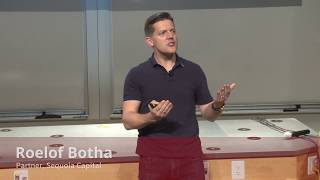
Sequoia’s Botha on Venture Capital Ambitions, AI, and Backing X
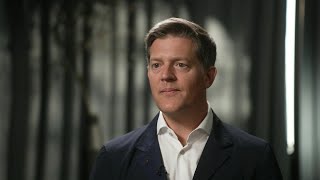
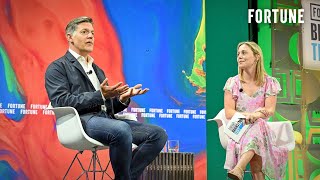
This is a YouTube video titled "Sequoia’s Botha on Venture Capital Ambitions, AI, and Backing X" containing an English interview conducted in October 2023. The content features Roelof Botha, a senior partner at Sequoia Capital, in a detailed conversation with an interviewer about venture capital strategies, the macroeconomic environment, AI investments, Sequoia's global operations, and specific company investments such as Instacart and X (formerly Twitter). The discussion covers Botha's insights on market cycles, long-term investment philosophy, and the future of technology and venture capital.
You've been through so many cycles now, two, three decades through technology? Two decades? Two decades in Sequoia? Yeah, I won't age you. You've been through so many cycles, so you've seen a lot. And Sequoia is famous for its pithy sort of market messages. In 2008, it was R.I.P. Good Times. Adapting to Endure more recently.
What's the message now? Focus on the fundamentals. I think the thing that I think about from the PayPal experience in early 2000 when the market melted down, we had seven months of runway left and no revenue. The only thing we could control is building a business serving our customers. And so that's the advice we give our companies today. Focus on the fundamentals of building your business because that's the only thing you can control in the long run and that'll help you achieve what you dream of. I'd say there's one small Twist to that, which is there are a couple of companies that don't have ideal product market fit or may not be capturing the full potential that they have. And we think they have a refounding opportunity to go back to basics and think about whether there's something different they could do to really help them achieve greater heights.
I'm curious what you think about the macro environment now. Jamie Dimon has said we're heading to 7% rates. The world isn't ready for that kind of stress. Tech really benefited in a 0% world. Where is this going? Is it the end of easy money?
It is the end of easy money for sure. But if I go back in history, and again, Sequoia has had over 50 years of experience. When we invested in Apple in 1978, the 10-year yield was over 8%. In 1987, we invested in Cisco. The 10-year yield was over 8%. In 1999, with PayPal and Google, it was over 6%. Today, the 10-year yield is only 4.5%. So great companies are built. in recessions, in high interest rate environments, low interest rate environments. And so that's what we focus on.
Last time we spoke, I believe you used a racing analogy. Where is the car now? Where is the Sequoia car now on the racetrack?
How fast is it going? The analogy we made that is if you're in a race car, if there's a corner ahead, you brake hard before you enter the corner. And then you need to find the apex and accelerate out of that corner. And so right now I think we're getting close to the apex and The leading companies are using this as an opportunity to extend their lead and to really hit the accelerator.
Instacart just went public and Sequoia was an early investor in Instacart. That's a $1.5 billion windfall for you. You did also invest at the late stage, $39 billion valuation, and it's now trading at around $8 billion. What did you learn from that decision? Is there anything that you would do differently?
Well, the key is that we invested in 2013. when there were fewer than 10 people in the company with the bright idea to change the world of online grocery shopping. The company valuation was $29 million at the time. And again, getting back to this notion of performance, in 2019, before the pandemic hit, Instacart had $214 million in revenue. Last year, they had two and a half billion in revenue, and they had more free cash flow in the first six months of this year than the entire revenue in 2019. And so, yes, we don't have a gain on the investment that we made in 2021, But there are four other financings we participated in that are very strongly in the money, and we're very optimistic about the company's future.
So does it change anything about how you would make a similar decision in the future, if given the choice? Right?
Well, we're long-term business partners of these companies. And so, I think the only two share prices that matter are the one when you buy and the one when you sell. And so at various points, prices go up and down. Public companies have share prices that go up and down every single day. For us, it's about the long term and our belief of what Instacart can become.
Sequoia has made some bold moves lately in the venture business. And you've gotten some criticism for holding on to post IPO shares. I believe Fred Wilson at USV said, Folks who invest in funds that do that should fire these funds. How do your LPs feel about this strategy? Have any of them moved on?
We launched the Sequoia Capital Fund at the beginning of last year. We announced it in 2021. And the idea is that we want to be a partner to our founders from idea to IPO and beyond. And for us, it seems unnatural to have this expiration date on your relationship with the company. And so 95-96% of our LPs available capital rolled into our new Sequoia Capital fund structure, which enables us to hold on to some of these companies longer. Now, I understand what Fred said. We were co-investors in a company called MongoDB, where I'm still on the board of the company. company, Maggo went public at a price per share of about $23. Today the company's worth $350 a share. More than 90% of the company's value happened after the IPO. And so I don't understand why if you have that kind of relationship, why wouldn't you help your LPs capture some of that benefit? Most LPs sell as soon as we distribute shares. And so if we have that kind of conviction about the long-term potential of the company, we should hold onto those shares.
So the plan is to continue to do that if the opportunity arises?
Selectively. We understand that not every single company has an ability to continue to compound as a public company. And so we need to be discriminating and discerning about which companies make it into the Sequoia Capital fund. But why not? If you think about, you know, Google went public and had a market cap of $23 billion. Today it's worth over a trillion. Nvidia went public at a $300 million market cap. We were the seed investor in them in 1993 and today it's also worth more than a trillion. They're just phenomenal opportunities to generate great returns by continuing to partner with legendary companies.
Venture is so different now from when you started. And one constant is that Sequoia is one of, if not the most sought after name in the venture capital business. Now that you're in the driver's seat, to use another racing analogy, you are the senior steward. What will it take for you to consider your tenure a success? So the reason I have the title.
Steward is because we are caretakers of a phenomenal brand and it harkens back to when Don Valentine started Sequoia. He didn't call it Valentine Ventures. He called it Sequoia Capital and as many people know, the Sequoia tree lives to be over 2,000 years. It's the longest lived tree in California. And our ambition is to build a partnership that endures and that means we need to leave it in a better place than we found it. And for me, that's making sure that we have a team that is able to take over the reins of Sequoia. And so when I recruit younger team members to join us, it's not to come work for me, it's to work with me and to have an opportunity to inherit the business.
Now, we're in London, so we have to talk about Europe. Sequoia just recently separated from its China and India businesses, but doubled down on Europe. Europe doesn't have the same wealth of tech companies that we see in Silicon Valley. Why do you think there's so much opportunity here?
Not yet. So I think you need to think about the ingredients for building great companies. Firstly, our Europe business, we actually structured that with one team, one fund, because we want to find the market leaders across the West. And that company might be a UI path that came out of Romania, it might be a Unity that comes out of Copenhagen. So we have a single team. If you look at the ingredients in Europe, there's incredible talent. About a third of the software development talent in the world lives in Europe. So there's latent talent. Many of these founders have now been part of other companies.
So.
The ability to work at a supercell and then spin off and build a company like Walt, the 14 companies that have spun out of Revolut. Increasingly, you're seeing founders spin out of these platform businesses and they have the inspiration and the confidence to start their own companies. And then lastly, the scale of ambition in Europe is completely different from what I saw 15 years ago. Founders here dare to dream big, and they want to build global businesses. And so we're incredibly enthusiastic about what we see on the ground.
You just met with UK Prime Minister Sunak, and Europe has taken a hard line on tech. Should Europe be deciding the fate of big tech? From a regulatory perspective.
I don't think that has a huge impact on the startup formation. In the same way that interest rates don't have a huge bearing on people who have bright ideas to solve problems for customers. I think some of the regulatory changes that are happening in Europe at a very high level don't really affect seed stage company formation and the ambition of young founders to build global leaders.
How is the formal separation from your China business going? Do you ever imagine or foresee competing with your former colleagues?
Well, we've structured in a way where each of the businesses will run fully independently. I think we each have an advantage in our respective regions. We may compete over time, but honestly, I think there's more opportunity for us to cooperate. We've gone from being siblings to being cousins. And if anything, we're probably going to pick up the phone and speak to.
Each other and find ways to collaborate rather than to compete. Sequoia is a huge AI investor. You're an investor in OpenAI, for example. There's so much hype about AI in general. What's hype?
What's reality? Reality and what's your strategy in between? So we've been making very active seed investments. 60% of our investments over the last 12 months have been in and around AI. Now, I was in Silicon Valley in the late 90s and there was a lot of hype around the internet and we went through a trough of disillusionment at some point around 2002 and I think in the long run the internet was far more profound than we could have imagined at the time. I think the same may be true for AI. The potential is immense. We liken it to the internet or to cloud computing or mobile and its significance. And sure there can be pockets of exuberance, but we have a very strong belief in the future potential.
I think you have 17 AI investments in stealth mode, which I was wondering, is that a record for stealth investments in one sector?
That may be. One of the most fascinating things, so our mission is to find these founders very early. We've had five investments this year where we found the teams and discussed investment terms before they'd incorporated.
Wow.
Because we endeavored to meet these founders right at the point where they started to think of these ideas. And that's part of the reason so many are still in stealth. They're very, very early stage businesses.
So what's cool besides AI right now? I mean, I've heard people say there's nothing else interesting out there in tech. Beyond AI, where are the most exciting opportunities?
I think there are opportunities everywhere. 40% of what we invested in wasn't AI. It was certainly not AI first or primarily AI. There are opportunities in healthcare. I've always been excited about the potential for bioinformatics, personalized medicine, the opportunities in defense technology, which I think is really interesting.
You backed Elon Musk's Twitter, or I should say X, $800 million check. How's that one going? Is that one going to bear out?
So my first job opportunity in America was given to me by Elon, and it was to work for X.com 23 years ago. So it's interesting full circle that it comes back. We're very enthusiastic about X. I think the things that have happened at the company in terms of changing the cost structure, streamlining decision making to get much more rapid product evolution, record usage levels on the service, a reinvention of the business model, full transparency on content moderation and veracity. And so we're very enthusiastic about the future. And it's still early days. Think again, we normally invest in companies and wait 10 to 15 years before there's an outcome. and it hasn't even been 12 months since the company was acquired.
So is it easier for you to call it X because I still can't get quite used to it?
I've adjusted.
Given we're in London, where do you think the best place is to start a company today? Is it London? Is it San Francisco? Is it Miami or Austin? Bill Gurley told me he thinks Silicon Valley is still the place to be.
For now, Silicon Valley is still the place to be. I think if you look at the last 12 months, Silicon Valley had about roughly 50% of all venture investment dollars went into Silicon Valley. Next was actually New York City and Los Angeles followed by London. And Paris is very close. But I don't think it's the availability of capital that matters most. It's getting all the talent together that you need to build a business. It's not just about the investment. It's can you hire the right product managers, the right designers, a finance person that understands how to work with technology companies. And Silicon Valley has never aspired to have a monopoly on this. We love it when company formation can happen anywhere and we encourage that because talent is far more distributed and we want to find those great founders wherever they may be.
So what's going to define the next era of tech investing? There was move fast and break things, then the year of efficiency. What's next?
Well, for now I think it's focus on the fundamentals. Companies need to focus on serving their customers and making sure they have line of sight on building a great business model.
More from Roelof
Sequoia’s Roelof Botha on Decision Making, AI, and the Next Trillion Dollar Markets | Ep. 28

Roelof Botha on PayPal Panic & Sequoia’s Long-Term Strategy | The Library of Minds

Fireside Chat: Roelof Botha (Sequoia Capital) on AI & Visual Tech with Evan Nisselson (LDV Capital)
Advice for Entrepreneurs and New Fund Managers from Sequoia Capital's Roelof Botha
Investing with the Best, Founder-Problem Fit, Pre-Mortems and Pre-Parades, and More — Roelof Botha