Lessons in leadership and decision making for engineers
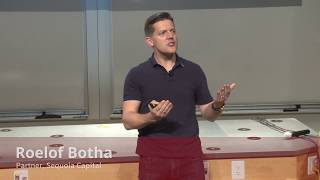
Roelof Botha, former PayPal CFO and Sequoia partner, and Mike Krieger, Instagram's co-founder, discuss leadership and decision making for engineers. Botha emphasizes intentional choices and risk-taking in building companies. Krieger reflects on key decisions that shaped Instagram's development and the importance of mission-driven work.
A lot of people in the room are CS majors or engineering majors and have aspirations to start companies. And the technical aspects of the engineering probably are not going to be the challenging part. It's actually all the aspects of leadership and management and finance and all these things that we don't pay as much attention to in an engineering field. that all of you are going to take interest in very soon if you decide to start your own company. And so Sequoia Labs is designed to expose people who are interested in starting companies to these very ideas. So today we have Rolfe Bortha, who is a partner at Sequoia. His claim to fame, or at least his first claim to fame, was he was the CFO of PayPal at the time it went public. So he brought that company public and has since gone on to Sequoia and has been a partner there for a while. He has worked with several founders. The list is too long for me to remember, so I will read them. I'm not going to read all of them, but he's worked with the company founders of 23andMe, Unity, YouTube, and Instagram. And he actually sits on several boards, including Jawbone, Eventbrite, Tumblr, Square, and Weebly. And as I said before, he'll be talking about decision making. And so without further ado, I will introduce. Right here. Go for it.
So I think about why I came to Stanford, why I came to Silicon Valley, drawn to entrepreneurship, the intersection of business and technology. And I think about how these two decisions line up against that aspiration. But this is a difficult decision. McKinsey is offering to pay me twice as much as PayPal. And more than that, they're willing to pay for my tuition here at Stanford. It's maybe not as expensive as it is now, but it's a big financial decision. Should I delay gratification, take this low-paying job at PayPal with the potential for equity upside and hopefully a rewarding experience in a startup, or take the safe choice and go to McKinsey. Well, as you heard, I made the decision to join PayPal, became the CFO, helped to take the company public, helped with the acquisition by eBay. Sequoia Capital was an investor in PayPal. And by being an executive there, I got to know the partners at Sequoia Capital. And that's how I ended up with an opportunity to interview at Sequoia and join in 2009. three. But if it wasn't for that initial decision that I made to join PayPal, I would never have had that opportunity. Never. Now you're all sitting here at one of the best universities in the world, and you're studying computer science, one of the most exciting fields of our time. You've clearly made a series of very smart decisions. But you know you're admitted to Stanford for what you have yet to do. Let me say that again. You are not here for what you've already accomplished, but for the achievements that lie ahead. Making smart decisions will determine whether you fulfill or fall short of your incredible potential. I'm delighted to have Mike here this evening. As you undoubtedly know, he was the co-founder of Instagram. Ten years ago, he was a senior here at Stanford. He was in this classroom. He was sitting in your seat. I look forward to hearing from him later about the great decisions that he's made that have shaped his career and have influenced incredible success. of Instagram. I want to shift and I want to talk a little bit about mission and about purpose. Most of the great companies have a clearly defined mission statement. Google aims to organize the world's information to make it universally accessible and useful. Several of you were here at the previous Sequoia Labs. You heard from Nate, the co-founder of Airbnb, whose mission is belong anywhere. Instagram's mission is to strengthen relationships through shared experiences. It's no surprise that the most successful companies have clearly defined mission statements. It provides a clear goal for decision making inside the company. Everybody knows where they're aiming. So let's turn that decision personal for a second. What matters to you most and why? What is your goal in life? What is your North Star that guides your decision making? For some of you, you want to go into academia. Some of you want to join some of the great technology companies here in Silicon Valley. Some of you may want to pursue a career in public service. And I'm guessing several of you are interested in entrepreneurship. Whatever it is, you need to find the answer to that question for yourself. Now, I'll be honest, when I was in your shoes, I was overwhelmed whenever somebody asked me, where do you want to be in 20 years' time? I only knew a few things. I was sitting in South Africa and I wanted to compete on the global stage. I love mathematics and science and business. But whenever somebody asked me, what's your five-year plan? My answer was, I don't know, because I've never been where I could have imagined I'd be five years ago. I don't want to make a fixed five-year plan. I want to accumulate alternatives and options and open up opportunities for myself. So think about what that North Star is for you. be intentional and realize that there are many paths that will get you to your goal. Now I want to dig a little bit deeper into meaning and into purpose. I'm guessing many of you have read this book, Man's Search for Meaning by Viktor Frankl. For those of you that haven't, we have a treat in store. This is one of the best books you'll ever read, and we have copies for everybody available at the reception afterwards. Frankl was a Holocaust survivor. The thing that kept him going in the living hell of a concentration camp was the hope that he would once, one day again, see his wife, and that he wanted to complete his life's work. Before he went to Auschwitz, he developed logotherapy, after the Greek word logos, which means meaning. At the time, there were two prevailing views in the field of psychology. There was the Freudian view that all we seek is hedonistic pleasure, and there was the Adler camp that thought that what motivates us is a desire to exercise power over other people. Frankl had a different insight. He realized that the most powerful motivator of all is a clear sense of meaning, a sense of purpose. So I'll ask you again, intensional. However hazy it may be right now, get a sense for where your North Star is. And don't worry about the twists and turns along the way. The path to success is not linear. It's not deterministic. The physicist Niels Bohr joked, Prediction is difficult, especially about the future. When the YouTube founders set about building the first prototype of the service, they had no idea they would build a company that would serve over a billion users globally. They were colleagues of mine, friends from PayPal. but they were willing to take a chance. Now keep in mind, when YouTube got going, smartphones didn't exist. The majority of US households didn't even have broadband, but they took their chance. They hunkered down in Chad's garage a few minutes from here in Menlo Park, and they built that first version of YouTube. When we partnered with them in the summer of 2005, they were just the three founders, and they'd signed up 9,000 registered users. That was it. If you want to be successful in Silicon Valley, you have to put yourself in a position to be lucky. Luck and skill are both necessary ingredients for success. Neither is sufficient by themselves. So you need to get out there. You need to expose yourself to new experiences, Meet interesting new people and give it your best shot. Now, when you accept that the future is uncertain, you don't think in terms of discrete outcomes. You think in terms of a probability distribution of outcomes. To illustrate that, I have a normal probability curve here. Events closer to the middle have a higher chance of happening than events are towards the tail. When you're trying to make a decision that has an uncertain outcome, you're not trying to predict the specific outcome. Instead, what you do is you think about how to shrink the uncertainty of your decision. How can you shrink the variance and improve your confidence? When I was weighing that decision about joining PayPal or McKinsey, I did two things. The first thing as I looked for advice. I had a classmate here at Stanford who was my girlfriend and is now my wife, and she helped me as we wrestled with this decision, and she was my thought partner. The other thing I did is I used the opportunity here on campus to do research. I wrote a paper on PayPal's business model to really help me figure out if the company had something that was enduring and defensible. When you have an important decision to make, seek the counsel of others and do your research. Now there are various techniques you could use to help you reduce this uncertainty. You can get additional data points, you can find a thought partner, you can run experiments. I'm sure we'll hear from Mike later. Instagram probably runs hundreds or maybe thousands of experiments every year to help them refine and improve the service. This framework is also helpful as you try to decide between alternatives. There are certain decisions that really have a probability curve that is completely shifted. It just has a better expected range of outcomes. And then there are decisions that change the shape of the curve. Now, the nerd statistician in me loves these curves because they have leptokurtosis. which is distribution curves with heavy tails. And as some of you may suspect, my partners make fun of me for using this terminology. And earlier this week, someone reminded me that the L word is banned inside our office. When Jim Goetsch recommended that we invest in WhatsApp, we had no idea the company would be as successful as it was. We admired the founders, we loved the service, and we thought it had great potential. And we could squint and we could dream about a scenario in which WhatsApp would become a globally dominant messaging service. We love investing in companies that have this potential to surprise us. Think about some of the decisions you face. Are there some that can surprise you to the upside? Now when you make decisions that have this potential for great outcomes, they're often trade-offs. One of them is the risk of failure. I'm guessing some of you know about Max Levchin, the founder of PayPal. I'm betting you don't know that he's first three companies all failed. But Max persevered. He took the learnings from every company and it helped him make the next attempt better. And in 1998, he packed his bags from Chicago, came to Silicon Valley and co-founded PayPal, which is now worth $100 billion. If you're not willing to make decisions that come with a chance of failure, you will never soar. Some of these decisions that have the potential for great outcomes come with another trade-off: delayed gratification. You may not realize this, but there's a nursery school right here on Stanford campus, the Bing Nursery School. It's been around for decades. In the 1960s, they ran experiments at Bing, famously called the Marshmallow Experiments. This is how it worked. A researcher would go into a room with a four-year-old. They were given a marshmallow and told that they could eat it, but the researcher was going to leave for 15 minutes. And if they came back and the marshmallow was still there, the child would get a second one. What happened was that about a third of the children resisted the temptation delayed gratification and got that second marshmallow. Now here's the interesting twist. Years later in the 1980s, they did follow-up longitudinal research. And guess what? Those same four-year-olds that delayed gratification ended up with better SAT scores, went to better universities, they even had lower body mass index scores. So when I think back to that decision about joining McKinsey or going to PayPal, that was a marshmallow test. Now making decisions is physically taxing. It's like an Olympic sport. And if you want to be at your best, you want to save your energy for the finals. I want you to look at this graph for a second. These are decisions made by judges. What you see on the x-axis is the ordinal rank in which prisoners were up for review by judges. And on the y-axis you see the proportion of favorable outcomes, a parole or a pardon. The first thing that struck me with this graph is the clear downward trend. If you're lucky enough to be up right after breakfast, your chance of acquittal is about 70%. You're unlucky enough to be at the end of the day, your chance is essentially zero. Now there's something else in this graph that sticks out at me, those two clear spikes. Does anybody want to hazard a guess? Yes. Close, very close, good intuition. Why is it not going? Whoops. Lunch break and snack break. Judges are professional decision makers, and even they are not immune to the effects of fatigue and hunger on their decision making. Now, I want to take you back to January 2009. Twitter is raising its Series C financing. I'd met the founders of Twitter in 2007, for their Series A round, and again in the summer of 2008 for their Series B. And in both cases we didn't get conviction to make the investment, so we didn't. And the Series C came around in January 2009. I was tired. I'd listened twice before. I said no twice before. I'm sure I had a case of confirmation bias to throw in there. I was also helping plan an offsite for us. I didn't even take the meeting. At that time, Twitter was worth $250 million. When I checked recently, the company is worth $17 billion. We could have made a 50x return for our investors. Hundreds of millions of dollars of gains. Boy, did I learn my lesson. Don't make important decisions when you're hungry, when you're tired, or when you're stressed. In 1975, Don Valentine, the founder of Sequoia, met Nolan Bushnell. I'm not sure if that name is familiar to many of you, but he was the founder of Atari. And that led to Sequoia investing in Atari, the Game Console Company in 1975. Soon thereafter, there was a young technician who was working at Atari. His name is Steve Jobs. When Steve decided to strike out on his own to found Apple Computer, Nolan introduced him to Don. And that's how Sequoia partnered with Steve and became an investor in Apple in 1978. A few years later, There was a young product manager working at Apple. His name was Trip Hawkins. And Trip had a passion for gaming, and he had an insight that this PC wave was going to take over the world, and there was an opportunity to build application software for consumers. So he went to Don, because Don was an investor in Apple. And he pitched him an idea for electronic arts. And that's how Sequoia invested in EA in 1982. Atari, Apple, EA. In the same way, the original PayPal investment in 1999 led to the subsequent investments in LinkedIn and YouTube because the founders had worked at PayPal. And the experience we gained working with PayPal gave confidence to Jack Dorsey and the Collison brothers to partner with Sequoia when we invested in Square and Stripe. Decisions feed off themselves. You don't want to think about a decision as only opening one door. You want to think about the series of decisions that opening that door results in. You should plunge down the rabbit hole of possibility. How many of you here know Unity Technologies, the company that provides a platform for building 3D and AR and VR applications? Anyone use it? I see a few hands go up. What you may not realize is how artfully the founders have had to tack over the years to get to this success. You see, Unity didn't start as a game engine. It started as a game company. that failed. The founders turned out to not be great game designers, but they built a really good game engine. So when their initial game failed, they turned around and they started to provide their game engine to other gaming companies. And that started to build an interesting business. Well, this was in 2006, so they were a PC and console gaming company. And a few years later, the App Store launched. and they faced a really interesting set of decisions. And at that point, we met them, and they wanted to take an investment from Sequoia so that we could become their thought partner. And there were two key decisions they were wrestling with in 2009. The first was how aggressively to pursue mobile as an opportunity. The benefit of hindsight sort of seems obvious, but you've got to remember how primitive those games were in 2008 and 2009. And why would you bet the company on this platform that has so few users? But we worked with the founders and we gained conviction that mobile was the future. And that bet paid off. Last year, over 50% of the top 1,000 games on the App Store and the Google Play Store were built on Unity's technology. There was another decision they wrestled with that year. You see, they bootstrapped the business. They were charging everybody for the software, so there were very few people who knew Unity. But it meant that they had a very small footprint. And when they took the investment from us, it gave them the freedom to consider alternatives. And one of those was to adopt a freemium business model. And it was a risky decision. We thought about it for months. But we made that decision. In the last 30 days alone, over a million developers have used Unity to build applications. We've really expanded the company's footprint and are a lot more valuable strategically. Now all along Unity has had a very clear mission: Solve hard problems for developers so they don't have to. And that's provided the framework for all our decisions. I have one last story to tell you this evening. This one goes back even further. It's 1987. I'm a 12-year-old, and I'm attending an academic vacation school, which is really just a nice way of saying a nerd camp. And I meet somebody exceptional. His name is Matthew Rabinowitz. We stay in touch. Matthew ends up being the gold medalist in our National Science Olympiad in South Africa. He comes to Stanford, where he's the number one physics undergrad. and he then completes his PhD in electrical engineering. Matthew did work in satellite signal processing, and he built two different companies in software and systems. And then in 2002, tragedy struck. Matthew's sister gave birth to a child that was born with a genetic condition that was undetected during her pregnancy, and the child died within a week of birth. Matthew was devastated. He decided to tack. His mission changed. He came back to Stanford, and he learned everything he could about biology and genomics. He is a genius. And he came up with ideas that combined his knowledge of biology, genomics, and electrical engineering to solve problems that no one had solved before, of making sense of small amounts of genetic material specifically free-floating fetal DNA in the mother's blood. In 2006, he started Natera. We invested a million dollars to seed the company to get them off the ground. And the company has a very clear mission: help people have healthy babies. They've served millions of customers, and today they're a public company. Your success will depend on the quality of your future decisions. And if you think about tonight, I want you to remember three pieces of advice. Firstly, be intentional. Find your North Star. Secondly, take chances. Take calculated risks. You will not achieve the success you dream of if you make a series of safe choices. Third, open doors that cascade to ever more possibilities. And along the way, don't eat the marshmallows. Thank you. Thank you. We have Mike Krieger. Mike, as you know, is CTO and co-founder of Instagram. Mike was a student here at Stanford. He has a BS, I guess, and an MS in symbolic systems. Mike oversees all engineering at Instagram. He's a native of Sao Paulo, Brazil. So let me sit down. So he and I both from the southern hemisphere. So we're used to having New Year's celebrations and balmy summer weather. So this whole northern hemisphere thing is a bit of a surprise. Mike's also very active in supporting the arts and philanthropy with a specific interest in income security and justice reform. So, Mike, let's start a little bit with how you grew up and what got you interested in technology in the first place.
So my first exposure to technology, my dad for some reason decided to bring a computer home when I was really young. I was like three or four years old and living in Portugal at the time. And he brought home this like IBM clone 386 thing and I and some the same way some kids like taking apart toys and putting them back together, I started just trying to take apart stuff on the computer and put it back together. So at the time everything was written in QBASIC, not everything, of course. They shipped a bunch of stuff in QBASIC. So you could hit edit, it was like the world's worst text editor, but it was there and you could change the program and it would stop working and then you try to figure it out. So it was that early experimentation and pretty soon after, and that's not that soon, but I was 10, 11, 12 is when when the web started taking off. And again, it was that same spirit of you could view source and start editing and then see how people done it. Obviously nowadays, sites are so complex that there's no way you're going to be able to actually take them apart in the same way. But that spirit of tinkering and experimentation for me was a really good entry point very early for me, as early as four and carried me through. Although I will say I did not think I was going to be in tech. In Brazil, there weren't really any role models around technology. If you wanted to work as a programmer, you'd probably go work for the government building election software, which does not sound exciting to me.
I thought they were rigged.
You gotta, you know. Somebody's gotta edit the code. And I realized that the thing I loved was telling stories and I loved writing and reading, so I was going to be a journalist. And I loved telling that story to reporters who interviewed me on Instagram, because they're all like, you made the right choice. But then that's where I was, I was at this crossroads, I was 18, I was figuring out decisions, like could not be a bigger decision at that point in my life, is do I go to the States, where it's a heck of a lot more expensive than staying in Brazil, where it's probably an order of factor of 20 cheaper to go to university there, even at a private university, and study journalism. And by the way, getting into the journalism program at the university I wanted to is actually harder to get into than Stanford, because the program has 80 people a year. And in Brazil, you apply to a major, and if you don't get in, you wait a year and you apply again. Or do I apply to schools in the United States and then I got into Stanford and now do I come here far away from my family? My family still lives in Brazil, like yes or no? And to me, the things I got most excited about, one was being in a community of people who were excited to learn. Like that was a huge thing for me, like just being around people who were curious. Two, not having to decide what I want to do the rest of my life at 18. You didn't have to declare a major. You didn't have to declare a major. So the idea of this liberal arts thing that you didn't have to declare early on was really appealing. But not the technology piece. That's what's funny. Even though I was super nerdy, grew up with computers, it wasn't like, oh, and I can go to Stanford and it's in Silicon Valley, and it's going to be this big thing. I always saw computing as this thing I did on the side. And it's funny because over the summers I was actually coding, not for money because it would be hard, there wasn't a PayPal at the time, so I couldn't really get paid in Brazil. But I was volunteer building stuff on top of Mozilla, like Firefox and Thunderbird. every sign would tell you that I was going to be a sign. But again, it's the value of role models where I just didn't see that as a valid career. So decided to come here. Actually wasn't sure if I was going to study journalism. Stanford at the time, I think still doesn't have a journalism undergrad. So I was going to come here and maybe study political science or something else that was more broad and then maybe eventually get an MS or an MA in journalism.
So that was the decision made.
It was come to Stanford and do something liberal artsy. Wow.
So what drew you into technology then? Orkut.
So does anybody remember Orkut? Probably nobody remembers Orkut. So Orkut was a social network. It was big in Brazil, right? It was huge in Brazil. It was the-- so the two things about Orkut, you should know. One is huge in Brazil. Orkut was the guy's name. He was like Google engineer. I think it was a 20% project. It ended up for a while being the biggest social network in Brazil. Or a while, actually, it was like what life ran on. Brazil is very interesting in terms of technology adoption. WhatsApp as well. I was using WhatsApp. 2000, probably the year after they launched because in Brazil it just became a thing. And I went to the, I was on Orca and I was like, oh, I'm gonna make some friends. And Facebook didn't exist yet. It was just getting started. So I was like, all right, I'm gonna like figure out who's gonna go to Stanford too. And there was one Orca group on the page other than the official Stanford one, which was not that official. But there was the Symbolic Systems Orca group, which I love and I like, I ended up declaring some sis and loved the program, but it is like Super nerdy. And I was like, there's some symbolic systems person that went out of their way to create an orchid page. And I was like, what on earth is symbolic systems? And I clicked through. And I think the website has gotten refreshed since, but at the time it looked like it was designed in the '80s. And it said, symbolic systems is an interdisciplinary major between computer science, artificial intelligence, cognitive science, philosophy, psychology. There's got to be at least one. And maybe they talk about natural language. And I was like, that's a lot of stuff that sounds really interesting. So that was the-- visit. That orchid visit totally changed my life because when I got here, I basically fell right into that program and fell in love with the idea of actually doing this for a living.
You need to put yourself in a position to be lucky.
Yeah, exactly.
What is one of the biggest lessons you took from being at Stanford?
I think the value of being able to build. So Scott Clemmer was my advisor. He's at UCSD now and I was really into interaction design and HCI, and I remember sitting down with him for one of our advising sessions. He's like, it's awesome that you're getting this wide exposure to these different things, but in some CIS, you don't get a very deep CIS exposure unless you really go out of your way to have more of a CIS concentration. And he's like, you will regret it if you graduate and you're lacking some really fundamental CIS things. So I ended up spending like an over-rotated and spending a lot of time taking those things. So that was really key. So being able to build in those early days is, I can't tell you how many people I've met who's like, I have a great idea. I just need to meet a CIS person to go build it. So the ability to implement a feature to the choir here clearly, but it was really key, like really key. And I think that was absolutely important. And two, it's finding the connections that you make at Stanford through all sorts of different things, whether that's classes or groups that you're in, and realizing that the cliche is that business school is about the people that you meet, but Stanford is absolutely about the people that you meet as well. I met my co-founder here, through the Mayfield Fellows program. I met people that I collaborated with later. second engineer was somebody I used to get dinner with all the time in my dorm when I lived over on West Campus. Like, these connections will recur so much and it doesn't have to be purely through your classes. And so, like, using that, I mean, you are in a position to be lucky and you will meet people that end up recurring over and over again in your life.
I overheard you earlier talking to Professor Kane about implementing something at Instagram that you learned here in a class.
Totally. Yeah, it's funny. It'd be like, so I was in CS 107 and one of the assignments was implementing a database that basically used pointer math so that you could index into this database. And years later, it's one of those great connection moments. I was like, I have this problem where we need to store a bunch of data that is totally indexable by an integer and needs to return another integer. And I only have four gigs of space to do it in because that's how much RAM we have left on this machine. Oh, I could use a pointer offset data store and I actually got to use it again. It was so satisfying to use a CS107 assignment, which I can't say that most of the other assignments that Stanford and CS were that useful. But that one, I'm like, yes, I can implement this. That XKCD where somebody has a crisis and the person's like, stand up back, I know regular expressions. It was that feeling.
So let's talk Instagram. How many users do you really have?
We have 800 million monthly actives.
But that's what the communications team has you saying, right? Yes. Okay. What's the real number?
Over 800 million.
All right, over 800. When will you tell us that it's a billion?
When we hit a billion.
All right. How many daily active users?
We have 500 million daily actives.
Wow. Several of them in this audience. How much money do you now make at Instagram?
A fair amount. Enough. No, but it's been cool to see that part build out. I mean, we like to say we started Instagram for a bunch of reasons, but we knew fundamentally that it was a platform that was visual. And when you look at great huge businesses that have been built, a lot of them have that visual thing at its core advertising obviously being one of them. television. It's interesting, the other cliche about Silicon Valley that there's definitely they hold in Brazil is like, oh, there's no thought to how you'll make money eventually. But I don't think that's true. I think there's businesses that start that are fundamentally never going to be good businesses. And even in early investor conversations, I think the reason we didn't get pushed to try to make money in month one was that the path to making money was fairly clear.
I agree with that. So what was the founding story? What was the aha moment?
Another big decision.
So I was working at a company.
That RoLoF actually invested and was on the board on, right? It was Meebo, which was an online chat startup. And we were doing well and the company was interesting. But I was noticing one really big shift. And this is like, this is, I think, classic innovator's dilemma in a lot of ways. Like people were starting to text in the States. They had been texting Brazil for a while. We had WhatsApp, but they'd started to do it in the US. which I know sounds crazy to you, because you probably got phones that had text messaging, but it was not a thing in 2007, 2008. And I did this user research trip, because at Meebo, I was like a split engineer PM UX person as a 40-person startup. You do a little bit of everything. And I went to Kansas City, Missouri. And if you wanted to study the future of the United States in 2008, you went to Kansas City, which doesn't make sense, right? It's from Kansas City. Nobody. I saw a hand back there. And the reason-- actually, I'm going to.
Ask for people to guess, and I bet nobody will guess.
Why? Oh, yeah? Because Google Fiber? No, I don't think that was like a twinkle in somebody's eye. No. Did Google even exist? No, they existed. They had Sprint's headquarters there. So Sprint was headquartered there, which meant you had a bunch of executives with children, and the children were all on the crazy unlimited data plan with the latest phones. So you basically had the city this micro community. This is luck because Elaine has family in Kansas City. That's the only reason we're there. It was one of the co-founders who was there. But we got there and we're like, wow, these kids are texting over 100 times a day. And I was like, this is going to happen everywhere. The trend's clear. Right now you pay $20 for 200 text messages, which was true at the time, but that's going to either get replaced by data-based over-the-top kind of things like WhatsApp, or they're going to have to make text messages free. We are an IM company on the web. Our lunch is going to get eaten by these text messaging products. And it did, eventually. So the shift to mobile was happening within it. It was just very hard as that company to make that shift because they were making all their money on desktop products that had advertising on sites. So interesting, it's very hard to make that shift too, and another key decision. So I liked the company, but I was excited to do my own company at some point. I had a 10-year plan where I was going to work at a 40-ish person startup. check, then work at like a five to 10 person startup check, and then finally join, like start my own company. And right around that time, I was spending all my weekends coding iOS apps because iOS was interesting. It was coming up and I was curious to learn. And over several weekends, I would see the same person at a coffee shop and it was kind of like a romantic comedy except it was a startup co-founder of romantic comedy where like make eye contact, be like, yeah. And we knew each other so there was like that previous context. And eventually, He came over and he's like, what text editor are you using? So we talked about, I don't know, BIM. So we got to know each other better because I'd met him at Stanford, so they had that initial connection. And he was working on a thing called Bourbon, which was a location-based social network that was HTML5, which was one of those decisions that was interesting because it got investors interested, but actually it was not a good product decision. then, and, but it was, I had a key difference for everything else that was out there at the time. So Foursquare existed, Gowalla existed, Loop existed, but all of those were text only. So you could, like, be checking into places, but none of them had visuals. And I never found that kind of fulfilling enough. But with photos and videos, it became less about, like, I'm doing this, and it's more like, hey, look, I'm bringing you into this experience a little bit. And, you know, a couple of months later, I kept saying, hey, Burb, in that, like, weekend project I was working on, I'm gonna leave, and I'm gonna make this my thing. are you interested? I remember where I was, the cafe I was sitting at. And I'd like to think that I've made a decision chart and pros and cons, but there's also some decisions that you just feel and you know. And I was like, I've had the vision flash before my eyes where like, oh, I don't have to commute anymore. I can work in San Francisco. That sounds awesome. I was taking the train every day down to work from San Francisco to Mountain View. I get to work on my own thing that I'm excited about. And that fulfills my purpose, which is a key question. When I graduated, narrowed it down that I wanted to work on one of two things. Either technology that helped people get closer together, so that you build empathy through shared experiences, or technology that helps you learn. It had to be one of those two things. And Mevo was used by millions of people to stay close and stay connected even when people were traveling or at work so that fit that bill. And Bourbon at the time really fit that as well. It's about staying close together. If you went to our website at the time, it was this landing page because we were still in beta and it said, A new way of connecting and sharing in the real world. and that was absolutely fitting into where I wanted to go. So I didn't have to deliberate very long, actually. It was like, I liked Kevin, I liked the basic outline of the product and the problem space, and I was ready to go. And sure, I meant I skipped a middle step in my tenure plan, but those are just made as placeholders that you replace anyway.
This is interesting. I mean, the vision has really stayed.
True to what it was at the outset. Yeah, people always talk about Bourbon to Instagram being a pivot, and it really wasn't. First of all, most of our backend code was like copy pasted from Bourbon because it just worked. And then two, like the vision was always the same. It was more in Bourbon, the main like verb was check in and then the extra thing you could do was add a photo or video. In Instagram it was you added a photo and eventually a video and then you could check in and then inversion was the pivot. But it was also like we went from, you know, like classic stories like, you know, Flickr making a game and then switching to a photo sharing website.
Like that's a pivot. Yeah, that's a big problem. The other ones are tax.
Tax, yeah, I like that. I'm gonna use that terminology. Change in direction.
Yeah, but you're still on the same boat.
Did you ever imagine Instagram would be this big? No, no way. So I know I didn't because I had to write a business plan, so I'm Brazilian, and the government was like, you want a visa to co-found this company, or you need to prove two things. One, that you have enough money and things, and two, just send us that business plan that you use to raise your money. And we'd raised 500K without a business plan because we had a demo and that was enough. And I don't know how many seed rounds you see with business plans, but they're usually pretty ridiculous. So I was like, all right.
It's usually a negative signal. Someone sends a 50-page document. It's like, why don't you build something.
Instead of writing about it? So I had to spend a weekend writing a business plan. So I was like, all right, I guess I should have paid attention to that business plan class. And I went through and I wrote this amazing business plan that I still have as a PDF. And the best part about it is our revenue and user projections. So in our wildest dreams, we were going to have 10 million users by year three, and I think make something like 4 million. It was some ridiculously low number that is embarrassing at the time. And I remember I started even lower, and Kev's like, I think you should 10x that. Those numbers are really small. We're actually off by 100x. So no, I had no idea.
So would you get truth? Look back at those early days. What are some of the defining decisions?
There were some pre-launch ones. So I'd like to break it down. Three main ones that I think charted the whole course for the company. One was followers versus friendships. So every other big product out there other than Twitter, which was growing but still not huge, since 2008, early 2000, sorry, late 2009, early 2010. So going followers was a big one. It was a bet, right? Like photos are really personal. Like I post my photos on Facebook. This is 2009, like only. And maybe Flickr, if it's like a really artsy one, like, I'm not gonna want strangers following me and seeing my photos. That's a weird bet. But we thought it'd be interesting. And we thought some interesting emergent behavior would get created. So we went for that. iOS only. Like we didn't have a website until 2012, basically. So going mobile first and mobile only, and then eventually adding Android, but I think going single platform was like, the right decision to start with as well. And the third one was having a differentiator in v1, which was the filters, which over time became very cliche and over the top. But at the beginning was a calling card basically where if you saw that photo on any other network, you're like, how did you do that? And photos coming out of cameras in 2009 were pretty bad. iPhone 3GS was the state of the art. It was like, oh no, these actually look good. Or they at least look interesting. So deciding to make that the differentiator, those were the three key ones. Just a little about the decision making process because it was just me and Kevin for a long time. We launched and shipped and scaled to over a million users with just me and Kev. And that was awesome. And I always get scared when I see founding teams of five or six because every person makes decision making exponentially more complex. And yes, they bring more sort of expertise to the table, but to be able to hash it out one-on-one and just say, all right, we have pros and cons on both sides. what's the cost of being wrong? Let's decide and build and then we can go back and not have to then have to persuade, as I now have to do, a company of over 1,000 that it's the right direction was a real luxury and it's what kept us moving fast. Like I've thought a lot about why companies get slower as they get bigger and there's a number of reasons, but the amount of time and you start speaking in corporate buzz speak, but like driving alignment is a thing I actually say with a straight face these days and it's what you do when you have a big company and you're like.
All right, like we need to align people against this mission and not having had to do that makes decision making way easier. So you made a decision in 2016 to shift the feed from being chronological to being algorithmic. Can you walk us through that?
Yeah, and it's an unpopular one, right? Like if I go on my Twitter feed, it's still people being like, bring back the chrono feed. But it was actually one of those decisions that you make because you see the future and you realize that if you don't make you will die the next day, but you will eventually be in trouble. So we were looking at all our stats and we realized a couple of interesting things. Like people were using Instagram more than ever, things were going really well, which is nice. Like when you're making hard decisions starting from a position of strength, like make those then, not when things are trying to go badly. But we noticed over time, people were following great accounts like National Geographic, different magazines, the New York Times. They have armies of people employed and many of them are posting on Instagram. So most people's feeds were, a bunch of top and interest accounts and maybe your friend over the weekend. And we did the math and we realized people were missing 70% of the content in their feed. So we were like, man, that's really bad. And over time, what that ends up happening is you don't see your friends post. So you're like, I guess people don't post to Instagram anymore. Maybe I'll post less. Nobody's actually thinking this rationally, but it's the kind of behavior that happens emergently. So we did algorithmic ranking for really one main reason, which is get you to actually see the content that is available to you, but you're missing out on basically because it's just getting lost because you're effectively sorting by a random function when you do chronological, right? It's the photos you happen to see when you load it and that's about it. So that was a hard one because the whole company was like, I don't know. Like people like the up to the date part and there was a bunch of like sub decisions we had to make that I think made that launch go well. And like, while like there's still people are like, I prefer the chronological feed. It's like one of those hard ones where like, No, you don't. When you look at the stats, it's objectively they don't, but there is an element of control that over time we've been trying to figure out how to reintroduce such that it's still an experience you feel under control. But we also know that over time that was absolutely, of all the decisions we made, that's when I'm like, that was absolutely the right decision.
How much did that dovetail with balancing celebrity accounts against personal accounts? I felt like there was a time two years ago where the service was gravitating towards the Taylor Swift that has 100 million followers or whatever. So did they really dovetail with this decision?
Yeah, it was definitely part of the same thing, which is as you start thinking about it. So we have an engineer, his name is Thomas, and he's gone deep on all this algorithmic stuff. And he has a great presentation he gave, which is like, I don't know how many likes you usually get on a photo roll off, like 100, 200, 30. 30 or 50. 30, 30 or 50.
If it doesn't, it gets deleted.
If it doesn't, it's important. So I would wager that your 31st like is way more meaningful to you than Taylor Swift's a millionth first like, right? And so, but she's gonna get a lot of likes because her photos are interesting and people are interested in following it. So understanding, we call it a value model where basically we think about the value of feedback being given and think about it that way means that you're optimizing as much for the people who are creating and putting themselves out there as you are for the viewer experience. So yeah, it dovetailed absolutely, and it was one of the most key things we did.
Interesting. Are you building a messaging service inside the app now?
Yeah, so we have Direct, and actually in some countries we have Direct as a separate app too. So we're definitely interested in the messaging space overall.
You're part of Facebook, right?
Yeah.
Don't they have Messenger?
They have Messenger and WhatsApp. And WhatsApp.
So why is there a third messaging service now?
So this is a really, so we internally, because I think problem solving and decision making obviously go hand in hand. I also like, if you find yourself having to make a decision between two things and neither feel right, it probably means you haven't actually solved the problem and you're like, you've got some false choice in there. So our main problem solving technique that we've used when we think about products is thinking about what role the product plays in people. You might have read or heard about this theory of like, what job are people hiring your product for? and it's not like to send photos, it's to stay close to your closest friends. It's to feel less alone. It's to like make a bridge with somebody you might not have gotten to know before. It's usually something deeper and emotional than just like the functional use for your product. So the reason why Messenger, WhatsApp and Direct actually can coexist and all grow is that they're actually all being hired for different jobs. Like Direct right now gets hired a lot for, Hey, I found this amazing thing on Instagram and I want to send it to my friend that really is going to enjoy it. So like we made reshares really easy. and hey, I'm getting used to using Instagram for stories now, but I want to be able to do some stories not to a lot of people, just to a few people, so we have the direct visual messaging and that's been a big focus. Messenger is I'm connected to my Facebook graph and they've gone off to this job of I want to be able to engage with them in as different ways as possible, right? So there's games, there's video, it's much more of a wide play and WhatsApp is I want to connect with people as quickly and efficiently as possible no matter what network condition I'm in. I used WhatsApp in edge in, like, I was on Safari in South Africa and it still worked. And like, they've done all of their work around performance and it's amazing. Like, there's so much respect for that team. So anyway, like, on the surface, it's all the same thing, but in practice they actually get hired for very different purposes by different people.
Can you talk to us a little bit about the work you're doing in philanthropy?
Yeah, because this is a decision making process too. So I realized in, like, I think it was about late 2014. My wife and I had, you know, people would approach us and be like, hey, we've got this interesting project. Would you like to contribute? And we were making a bunch of ad hoc decisions, which it kind of fits into like don't make decisions while tired. It's also like don't make decisions without some guiding framework, because otherwise what's your objective function? Like yes, no, yes, like that sounds like a good cause. So we stepped back and we're like, let's actually be a little bit more strategic about it. We started spending a bunch of time with Carrie Tuna and Dustin Moskovitz. Dustin was a founder of Facebook. Carrie was a reporter, I think, for the Wall Street Journal. And they've been super thoughtful about their philanthropy through the Open Philanthropy Project and GiveWell. And we sat down with them. And what was cool is that they approached philanthropy from a very thoughtful, almost framework-based perspective around selecting causes that are neglected, not enough people are investing in, ones that are very urgent, ones that you can have an impact that are tractable. And that was like the head part, and then we needed the heart part. And that was like, let's take that lens on problems out in the world, and then let's find the ones that really make us either impassioned or livid or whatever that emotion is. And for us, that was criminal justice, which is, I think, one of the greatest crises of our time in the United States. And it's just a fundamentally broken system. So that was our approach. It was like, we knew that systematically it was a problem, but it was also one we really connected with. And like that judge thing is, the perfect example of how like, unfairness built into the system and like, that's like the tip of the iceberg. And I think there's like, in the engineer in me, like, I like systems that feel that broken and unfair, like, are especially infuriating, you know? So that's been our focus. I'd say my wife spends a lot more time on it, but it's something we do together.
Before we go to Q&A with the audience, I have one last question for you. you were sitting here 10 years ago and there's an entrepreneur like you sitting at the front. What do you wish that person had told you?
Don't start a company unless you're willing to work for that company for a long time. I would sit down with other entrepreneurs and they were like, I was like, what are you doing? Because we were in a startup incubator kind of space and there were two kinds of types of founders. There's the founders who start companies because they want to start a company and there's founders who start a company because they want to go after an idea that they believe in or a problem where they have a purpose. For me, it was consistent throughout what we wanted to do and we would have, if the company got dissolved, the next company would have been very similar. If you look at Dennis from Foursquare, he has built versions of that idea over and over again because that is the thing that he believes should exist in the world and I think we would have been the same way. And then there's people who are just like, I just don't want a boss, so I'm going to start my own company. It's going to be cool. what you don't realize is success means I've been working on Instagram for almost nine years. That's a long time in tech world, right? I didn't think I'd have one job for nine years. I thought I'd move around. So it's a real long-term commitment to something and keep building it. So I guess choose carefully as you start joining things. I've seen a lot of founder breakups about a year into startups where they're like, wow, this is way harder than I thought. And actually things are going okay, but I'm not ready to do this for another five years. So make sure that as you start things, it's not just for the sake of starting things, because I know a lot of you will be entrepreneurs, but an area that you can see yourself thinking about for a long time without being like, oh, I shouldn't have started this. I'm not passionate about this area. I have a friend who's started two companies where he's realized over a couple years, I'm just not passionate about it. He's made very graceful exits both times, but it's still a journey.
All right.
Thank you so much for joining us tonight. And a big thank you to Mike.
And Ruloff for helping to host you all.
More from Roelof
Sequoia’s Roelof Botha on Decision Making, AI, and the Next Trillion Dollar Markets | Ep. 28

Roelof Botha on PayPal Panic & Sequoia’s Long-Term Strategy | The Library of Minds

Fireside Chat: Roelof Botha (Sequoia Capital) on AI & Visual Tech with Evan Nisselson (LDV Capital)
Advice for Entrepreneurs and New Fund Managers from Sequoia Capital's Roelof Botha
Investing with the Best, Founder-Problem Fit, Pre-Mortems and Pre-Parades, and More — Roelof Botha