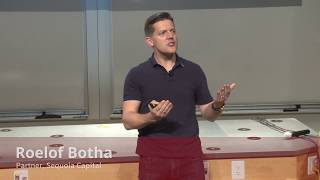
Roelof Botha on PayPal Panic & Sequoia’s Long-Term Strategy | The Library of Minds

Roelof Botha, Sequoia partner and former PayPal CFO, discusses managing PayPal through crisis and explosive growth. He explains why total payment volume became PayPal's North Star metric, how to choose between product and distribution, and what made YouTube, Instagram, and Square category-defining companies. The conversation covers building durable culture through mission and hiring for fit, plus how AI might reshape organizational design.
There's a crater in. I think it's Tanzania. The crater had formed and basically makes it very hard for animals to move in and out of this environment. And the lion pride that lives inside this crater is actually one of the least fit prides in Africa. Unfortunately, you don't have the benefit of forever living in a crater. As a company, you've got to compete every single day.
The Library of Alexandria was an attempt to capture all human knowledge. Fire and war destroyed it. Today we try again. Welcome to the Library of Minds, where you'll learn the frameworks and mental models of the world's greatest thinkers. And when our conversation ends, yours begins. Each guest has created a digital mind on Delphi that you can talk to anytime, anywhere. I'm Dara Ledgevardian. Let's dive in. All right, everyone, I'm super excited to have Roelof Beute here. Senior steward at Sequoia, one of the most respected investors in Silicon Valley, has invested in companies like YouTube, Instagram Square. He was CFO at PayPal during some of its most difficult times. And I'm excited to get to chat with the real Roelof right now. Even though your Delphi has been a good replacement.
Pretty good.
It's pretty good.
It's very good. I love demoing it to people.
Glad to hear. So you were CFO of PayPal during some very challenging times dealing with fraud. Things were breaking. Explosive user growth. I'm curious how you were able to keep the company focused on shipping while there were so many operational fires that could cause destruction. How do you encourage focus in a time where there are fires everywhere?
Well, I think we. We trusted each other as a team. There was something pretty remarkable about the PayPal team that if you go look at the original S1, the original perspective for us to go public, I think we had two people that were over 30 on the management team, Peter being one of them. The rest of us were all in our 20s, but there was a sense of camaraderie that we had and the way that we trusted each other. And the same with it. When you watch a great team perform, the handoffs happen very easily. The way that you pass the ball, knowing that somebody's going to be there to catch it. And so that enabled us to divide and conquer. And the engineering team would be able to focus on shipping products while other people were dealing with regulatory challenges or fraud challenges.
And that was just innate in the people who joined. Or did you have to work for that.
You have to work for that. And I think part of that was there was an initial kernel of the team that really came through referrals. Many of the original engineers were people that Max had known either from.
I.
Think imsa, it's a math school in Chicago. And then many of them have studied together at University of Illinois. And so they knew each other. So that already helped. And they were very careful in our hiring process to screen for cultural fit. And then we were very good at removing people who didn't make that. So I remember often times we'd make a hire and literally three, four weeks later, we just realized this person wasn't a cultural fit. And we would just, instead of trying to cover up for it and the person has the right technical skills, grin and bear it. We would just make the difficult decision in a hypergrowth phase of letting go of somebody who really was a cultural mismatch.
And at PayPal, there were a lot of metrics you probably could have tracked to determine what success looks like. I'm curious, what was the number one metric in your mind and how you thought about creating a North Star metric for yourself?
The number one metric in the lead is just total payment on him. So I told him we needed to understand how big the service was growing and we would obsess. I mean, I built a dashboard first initially, and obviously it was how many new customers were we getting? Total payment volume, number of transactions. But things like average transaction values don't change that much. So tpv, total payment volume was really the best barometer of economic activity within the platform. So that was our number one variable that we focused on. And then over time, we added things that were either operational, so excite uptime. And then we started to add more financial metrics over time. So did we convert any of this great payment volume into revenue, for example? Because when I joined In March of 2000, we weren't charging transaction fees and the revenue is zero. And we were hoping to make money on float, which wasn't a good business idea. So we changed that, obviously.
So when does it make sense to prioritize growth over revenue? Because I knew LinkedIn had a similar strategy. As many profiles as possible, and then revenue.
So if you take a step back, in general, I think business people, people often confuse what I think of as being false trade offs, false dichotomies. You know, I can innovate or I can perform. I can grow quickly or I can focus on revenue. I can stick to my knitting or I should broaden my product portfolio. And the truth is, the best companies do both. You don't have to make that. You don't have to make that as the strict trade off decision. And I'd argue often when you get them right, they feed on each other. And so our ability to continue to invest in our own growth was fueled by our ability to demonstrate that we're the business model and the revenue was starting to flow in. And so that to me is.
I.
Just want to make sure people understand that beware of false dichotomies.
And people do talk about it as a trade off.
I think it's lazy to do that. Now. Truth be told, if you're a 12 person company, the most important thing you should focus on is your product and whether it's delivering value. And if you can demonstrate that there's usage and traction, obviously it's much easier once you get to scale to be able to turn on this figure from a revenue point of view. And so at Instagram, for example, by the time the company was acquired, They've already had 30, 35 million user accounts that have been created. And it was apparent how the company would be able to make money. And the team was so small that they just hadn't gotten to it yet. But it was obvious how you would make money with that. But they were struggling to keep up with growth, truly, you know, 24, 7, making sure that they can scale and in that situation, also hiring a sales team and trying to figure out the business model. It just wasn't the right trade off. But we're talking about months, not years.
Yeah, makes sense. So I want to ask a question about Square started out as a niche card reader and now they're a full financial ecosystem. I'm curious if you know of any operational decisions they made early on to enable that adaptability from something so small to something a lot larger, or is that just something that happens organically? You can't really plan for it.
Always the vision all along, actually. So when I spoke to Jack about our initial investment, yes, it was a card reader that enabled you to get distribution inexpensively. But the vision was always turn this into a point of sale system. Build employee management, inventory management, all the other capabilities that you'd need to operate your business. But the card reader was the wedge because many of these small businesses still weren't able to process credit cards. So at the time that we invested in Square and Apple Block, I think there were around 25, 26 million businesses in America, only 4 million of which could accept credit cards. So the vast majority of merchants were incapable of print card acceptance. And that was the key book. And that gave a compelling reason for the company to grow the way it did.
And from a product perspective, they find the wedge. Because I think every company has a wedge and the overall vision. And I think the key point is when do you prioritize making the wedge very good versus when do you start to layer in things that enable vision? And so I'm curious if they balance both. If they focus on one. Until was just the crowd was just working.
They focused on. This is part of the criticism in the early days of the company that it was just payments and that the payments would commoditize over time. And if that's all that the company was, they would have been right. But it turns out they didn't because they used that initial wedge to then build all the software capabilities that are made the SMVs to operate. But the key was to get the reader out. And just remember, our phones don't even have audio jacks anymore. And that was such a key insight is how do you build a hardware device that would turn the signal that's in the magnetic stripe on your credit card into an audio signal through the audio jack to be able to feed it into an app that would, you know, get all the data needed to be able to authenticate a credit card transaction? That was a fabulous insight and just a great hook. So I'd say maybe for the first three or four months after the company started to ship product, they just needed to keep up with the growth of that. But very goodly, we started to build out the point of sale and other software capabilities. That was always the vision.
And you've invested in a ton of companies that have created categories from ground up. Categories that might have seemed weird at first. Posting photos online, posting videos online, creating a digital version of yourself. How have you seen the most successful category creators educate the market and kind of dominate the narrative of what this new category is.
The most effective way is building stellar products, honestly, and I know it sounds.
A little trite, so product first, product marketing, education.
Absolutely. We hosted Elon at one of our founder events a few years ago and somebody asked him about, you know, what's the most important thing? And he said, just make something useful. And it all starts with that. It's not that deep at some level. I mean, it sounds simple. It's actually hard to do. I'd argue that one of my partners, Jim, gets my this term. It was around 2010 when you really started to see app stores take off and distribution became easier than it had ever been before. And the phrase we had was product first. Because honestly, I think you could have built a pretty successful software business in the 1990s, whether it was consumer enterprise. If you had a B product with a distribution, you'd probably make it. And often you would sell software that would sit on the shelf and never get used inside an enterprise. And cloud delivery and mobile, we think upended that where you can go to G2 Crowd for reviews on enterprise software, you'll see reviews in the app store. Word of mouth is so much easier now. It's word of mouth. It's so much easier to hear from your friends. And so people just don't get duped with average products. The most important thing to focus on is building an absolutely delightful product.
I'm so glad you say that because another question that I was going to have, and I think I know your answer now, is this idea of distribution at all costs. Attention is all you need. Is this new trend on Twitter and you see all these companies getting millions of followers because they think distribution is the moat in an AI world where product can be commoditized with AI tools. Do you think that's another where we're revisiting the same mistakes of the past?
So this combination of adoption and retention, or you're being about the ongoing usage of a product, that's important. And when you obsess about distribution alone, if you want to think about a sphere, if you only think about distribution and you don't focus on the quality of the product and retention, the value of your business is growing by the surface area of the sphere as it grows. And you might grow very quickly, but the surface area is never going to rival the volume. And I'd rather grow more. More consistently, maybe a little more slowly. That's by having the density and it's the volume of that sphere as it grows. And that comes from retention. And so sure, people will try your product once they're coming back three months later. Does this become something that, you know, they wouldn't let anybody rip it out of their hands. You know, they'd be. One of the classic questions is how. How bad would you feel if this product went away? And a lot of products is like, ah, okay, life goes on. That's not a compelling product. I don't care how big your distribution is, because you can get this quick rise and then a quick fall. And we certainly saw a lot of that in the early days of the Internet as well.
Yep, saw that with Lensa and a couple other AI companies. And at Delphi, we think a lot about Building a company that can last generations, not just for the sake of saying it, but human legacy. If you were to have a Delphi, it should be around 100 years from now for your great grandkids. And I'm curious if what are key things that startups potentially get wrong in the early days that prevent it from being a really durable, durable business? Foundational things.
It's a mission orientation. Why do people join your company, give a care long term mission that drives down into values that govern the decisions that are made every single day. If you have a North Star that really motivates people and holds them together, I think that's really compelling. And then what are the compromises you make? You make compromises on that 100x engineer who's a cultural misfit for the sake of mutant productivity, but you know that you're sacrificing in the long run. It's all these short term, long term decisions. And I'm sure many of the people here in the audience are familiar with the marshmallow experiments that were on a Stanford, you know, 50 odd years ago where certain children were given marshmallows and they were told, if you didn't eat it in 10 minutes, you'll get another one. That was a test of delayed gratification. And those children who successfully waited for that second marshmallow ended up having better GPAs, went to better colleges at lower divorce rates and just a bunch of other things in their lives that went better because they fundamentally understood this trade off between long and short term. And so I think startups get into trouble when in desperation they make fundamental long term, short term decisions that come back through.
And are there any new kinds of decisions startups have to make when thinking about organizational design in this AI first world, like new kinds of roles, hiring less, raising less. What are maybe different decisions that are introduced now that we have these tools at our disposal?
That's a great question. One of my partners, Konstantin, has this great idea, he has a phrase which is will we see the rise of the billion dollar solo founder startup? And it's a provocative idea of how much can you actually automate A way to enable an individual to be able to leverage all that technology to build a business. And you know, I'd argue that the size of a company has shrunk dramatically over the last 20 years of my time in Silicon Valley. When we were at PayPal, we had to pay Oracle licenses, we had to buy sun servers, we had a full back end team that literally had to go negotiate with Colos for us to rack and stack servers, we needed physical infrastructure, we had to negotiate for backhaul to be able to get Internet traffic we needed for our service. And then just a few years later, you have cloud infrastructure and you're not hiring those for people anymore. They all look for the cloud service providers. And so we're abstracting more and more away, which makes it fabulous for founders because, you know, it's just less encumbranced for your idea to be able to flourish. And so there's an interesting question of what's the logical limit of that. So I think it's useful to think from first principles in these situations. And it's very easy to reason by analogy and just say, oh, I probably need one of these and one of those, and I need a person to do this and a person to do that. And I just encourage people to really think from first principles and examine the tools that are available and maybe there's a different way of doing it today.
Enjoying the conversation? Got a question you can ask Roelof's digital mind? Just check the link in the comments or description.
I listened to your podcast with Mario on the Generalist and you talked about how Brian Chesky experienced hardships in 2020, the lessons of which allowed him to succeed today. And I'm curious if there are any hardships that you think founders and startups actually should experience where it's like, oh, it's actually good that you're suffering in that way, because you're only going to learn that lesson if you experience it and not if I tell you 10 times.
I'm reminded of my high school English teachers that suffering is good for the soul. I think the thing that's really important for startups is to feel the pressure of fundraising timelines. And I realize it can sound very self serving sitting in there, but I'll tell you that if I go back to the PayPal experience, I'm sitting there. It's June of 2000, I've been there for three months, we have no revenue, we're burning over $10 million a month. And Mike Maroon shows up at our office at a board meeting. He says, what's your Runway? Why do you bother? We can always just raise more money. And Mike and the Sequoia team had realized that the environment had fundamentally changed and that we were likely to never or not never, but we would be able to raise money again on the kind of terms we had. PayPal raised $100 million at a $500 million valuation in March of 2000 with no revenue. And he really rung our clock and woke us up to the reality. And we had seven months of Runway left at that point. Seven months. And boy, we got religion. And so the same team that today is praised for having figured out how to build a successful business, we were Duncan Sailors, you know, not doing a good job back in the first half of 2000, running the company. We'd gotten product market fit, but, boy, did we need to get religion quick. And we did. And I'd say that the key innovations that enabled PayPal to go public and to be a fabulous business, all of those ideas came in the window between June of 2000 and September of 2000. We figured out how to fix fraud. We figured out how to get people to add bank accounts so we could route transactions from bank accounts or credit cards to lower our. Our costs. But there was just a dramatic period of innovation because we had no choice. And I'm pretty sure that if we had 12 months of Runway at that point, or 18 months, we would just kick the can down the road. It's a little bit like when, if you remember being a student and the professor gave you an extra week for the exam, did you study more? Did you study later? Waited for the last day. You generally studied later. And so for me, there's something about that, and it just came from a board meeting earlier today where things are going well, but timing is tight, and I could just see the energy in the management team on solving critical problems because they have to. And so it's a very rich period of innovation to really help set the foundation for your company longer term.
So act like we have six months left before we actually have six months.
I know, and I know it's easy to say, and that's why I pointed to the PayPal example, because we'd made that in mistake. I was part of the same team that didn't live up to that advice. And so it's a lived experience. There's an analogy for me. There's a crater in, I think it's Tanzania in Africa, where the crater had formed and basically makes it very hard for animals to move in and out of this environment. And the lion pride that lives inside this crater is actually one of the least fit prides in Africa because they can get away with it. They don't have competition from other prides sort of encroaching on their territory, and they sort of have a captive area where they can catch prey with relative ease. And so that environment is not bred a really fit animal, unfortunately, you don't have the benefit of forever living in a crater as a company. You've got to compete every single day and there are other people who are going to try to eat your munch. And so you need to think about how you breed that discipline yourself. You know, for those who haven't seen this, by the way, if you've ever typed in relentless.com into a browser, how many of you have done that? You've done that. Where does it go? To Amazon.com Amazon.com because when Jeff started the company, he had two choices for the name and he thought about Relentless and he thought about Amazon. He chose Amazon. Maybe a better name in the long run, but that Relentless, the fact that he chose that, it shows you a lot about the spirit and the culture that they have at Amazon.
Couple more questions, then I want to open it up to the team. Speaking of hardship, I'm curious if you're open to sharing what the greatest hardship of your professional career has been and what you've learned from it.
Well, the many, not just one. I'd say that that moment in June 2000 at PayPal when we had seven months of runaway, I just graduated. I was on a one year practical training visa. That was my one opportunity to maybe stay in America. And realizing the company had a good chance of failing, that was sober and we rallied as a team. I think the takeaway for me at the time was that despite all the challenges we had with the Fords, the regulators trying to take us down, ebay, trying to kill us with an in house payment system, the bad was we never gave up and we never had a Debbie Downer attitude about it. There was just a optimism in the PayPal team and a desire to just keep fixing problems and, and rally with each other as a team. That really stuck with me along the way. I'd say one of the other ones, maybe for me more recently at Sequoia, was dealing with the market meltdown in 2022. And we had seen a successful series of IPOs in 2021 and the market reached its peak probably in November 21st. And we distributed some of the shares that we had in what are fabulous companies. But the prices seemed spectacular, which proved right in retrospect. But we didn't distribute everything. And so as the market melted down, I think, which is very tough to, to stomach that decision.
What was a lesson from that one?
Well, the good thing, not to make excuses, the good thing is we've set up a fund structure. Now it's equival to square capital fund that enables us to hold the best companies many years after their ipo. And so in the cases of Door Dash, Airbnb, Snowflake, Unity, Instaguard, some of the companies that graduated into the Sequoia Capital Fund, they're all trading north of the values that they had in 2022, which is amazing. So, you know, for the great businesses they've been able to compound and eventually get back, or north of the original values that we transferred them into that fund. But I'll be honest with you, when you're in a public company that's worth X and then, you know, six months later it's worth half of X, you know, you can't help but second guess yourself and wonder if you got it wrong. And then it's really a test of about whether you believe in the business, you believe in the team. And with patience, in most of these cases, we've been rewarded.
Patience seems to be the common theme here.
It is, it's in duration. Arbitrage is sometimes something people talk about in the hedge fund industry. I think it's one of the things we benefit from at Sequoia is just thinking incredibly long term. I studied actuarial sciences, as you probably know, and my actuarial science professor in first year said, actuaries are trained to think decades into the future. Accountants are trained to think one year in arrears. And for some reason that phrase really stuck with me. Because actuaries have to price insurance policies or design pension plans. We have to imagine 30, 40 years down the road when policies start to pay out or the pension has to pay out to the pensioner. You have to think about all those contingencies and think very, very long term. I think that's the kind of mentality we have at Square.
You know, I'm on the trees, Sequoia tree.
Well, the longest lived tree in California. Yes. I'm on boards of companies that we first invested in more than 15 years ago.
Wow. And my last question is, what about Delphi got you excited?
I immediately fell in love with the idea of Delphi. And there are a couple of different reasons. One is it reminded me of some of the science fiction books that I'd read and sort of this idea that you could separate the, the brain of somebody, the memories, the personality of somebody, and somehow preserve that. But that to me sounded fantastical in the true sense of the word. It reminded me of a short story I'd read by Roald Dahl, William and Mary. I don't know if you've ever read.
I've heard of it. Some people, many people told me read.
It, you know, and it's a. It's husband and wife where the husband is diagnosed with terminal cancer and he has a friend who's a surgeon and they figure out how to preserve his brain and an eyeball. And so his wife's able to take the brain and his eyeball back to their house after his bond dies and sort of, oh, that's pretty amazing. This brain is still floating and he's still able to observe the world even though he's not alive anymore. So it's something about. I mean, maybe it really gets to the idea of being up to the Ferrero. Maybe that's part of it. The other thing is being able to retain memories. So all my grandparents have passed away at this point, but I have voicemails that they'd left me over the years and I saved them and I've stored them on my computer so that, you know, in Dropbox with a backup, so that, you know, if something happens to my phone, I don't lose them. And it, you know, sometimes I go back and I listen to those voicemails and I wonder if Delphi had been around, could I have a conversation with them now? Because I missed them.
I know the feeling. Awesome. Well, let's open it up to the team. Any questions? Sam?
Hi everyone.
So one of the things that is super important for success over the long term is the intercom complacent. And Sequoia's been at the top for a while and I know you've talked at some summits about how it's very important that you avoid complacency. How do you drive it? That's a day to day at Sequoia because it feels like it could be easy for people to join or be a part of it for a long time and then become.
I know it's a big risk in biology and in business. Extinction is the more 99% of all species that have ever lived are now extinct. Go look at the S&P 500 from 50 years ago. Most of those companies are no longer in the S&P 500. And so you have to actively fight it if you want to survive. And so that comes down to the culture you maintain, the sort of people you recruit, and just how you behave on a day to day basis. So give you one manifestation of that. If you come to our office upstairs where the investors sit in our kitchen area, the entire wall has something written across it in the hand, individual handwriting of every person on the team and what is written is, we're only as good as our next investment. And so when you go for a cup of coffee or a little snack, you walk up to this wall and you see your own handwriting and you wrote this. And so it's an escalation of commitment process where you're reminding yourself every single day, we're only as good as our next investment. And then you just have to decide if that's the kind of culture you want to belong to. I don't think our culture is the easiest. I think winning is fun.
What are the things that make you feel like it's not easiest? Like what happens that actually, besides operationally that phrase does.
Yeah. One of our CEOs, David Eturia from MongoDB, has a phrase that people will respond to what you inspect, not what you expect. There's a management technique, yes, everybody has the best of intentions, but, you know, I'm as lazy as the next person out there. And so I want my partners to hold me accountable. Our calendars, for example, Sequoia, are completely visible to everybody else in the partnership. So if I'm taking off, you know, a Friday afternoon and not working, everybody can see my calendar. And that's the kind of mutual accountability that we have within our team. And so you need to sign up for that and you need to figure out if people you're recruiting want to sign up for that and then even if they've been there for a while, do they want to sustain that and it's okay if people want to check out? You know, we've had situations where maybe 20 years in, somebody's made a bit of money and they just, their interests have shifted, they want to do different things in their life, that's okay. But if you don't operate at our speed anymore, it just doesn't work. Is the famous example of the American rowing team on the Olympics and just this idea that if you want to be in a rowing team, you have to keep pace with everybody else. And that's what we expected at Seque. Everybody has to keep pace, and if you don't, it's okay. But then we need to find somebody else to take your spot.
Alvin so one of the themes of your life as well as the SoC, is kind of an alternative thinking. And a lot of founders like, well, something that's super important is to have conviction in a very long term vision. And then a lot of times in the near term there's new changes, like you mentioned, environment changes, and they're like new data Points that you have to not factor in. And sometimes, and it's probably very common, you have to update that vision a little bit and you think about what that long term working looks like. But when you do that, usually you have your, your confidence can kind of falter. You're like, that's a little hit on what I thought the world's gonna look like. And if you do this enough times, you lose like a little bit of that conviction. And a lot of times people are following you as a leader because you're the one who's expected to have the best conviction. And that kind of drives some of the motivation. So how do you advise yourself or like other people to maintain the amount of conviction they have despite changes in the intern that might require them to update their vision?
That's a great question. And I think you pointed one of the things that's very hard for founders where they have to absorb so much as they do now. CEOs of companies have to do some of that as well. Where they, they're the absorbers of a lot of the vicissitudes of business and chill their teams from that kind of stress. You can't wear your emotions on your sleeve. It's great to have a co founder, by the way. It's actually one of the most daunting things. If you're a solo founder, you don't have that other person that's your counterbalance. So how do you do that? Well, it's important to update your priors. Since I studied statistics, I love that as a phrasing of this, you get new information, you update your priors and when you're a young company, you almost by definition are going to attack very aggressively. Ideally, you sort of have a sense of what your M Star is though. And so you know you're making little changes the whole time as you think about what your ultimate goal and vision for the company is. At some point you may need to revisit that and it may just not work. And that's challenging. I mean, I can tell you that it's a boy. In our early stage business, we make investments in, you know, two people with an idea. We make precede seed venture investments every single day. Half the time we make an investment, we fail to fully recover the capital. Now it might be that the company gets acquired and we get 80 cents in the dollar. Sometimes it's a complete shutdown. So it's, it is so brick. I mean we, we see that kind of failure mode a lot. And sometimes the founder takes that experience to build the next company. And you often actually see very successful founders have failed several times before. Max Lifgen who co founded PayPal had two prior companies that were complete failures a PayPal. So to me it's actually one of the beautiful things about Silic Valley is that not quite a badge of honor, but it's just not a negative to have had, you know, a failed experience. At some level you, you learn a lot from that. So keep on incorporating new information, shield as much of it from your team and at some point you may just need to revisit whether the idea actually still has mirror the original vision that you had may just not be accurate to your or it may be the customers are pulling you in a different direction, different from what you had in.
This I think maybe a good question to end is you were talking about duration, arbitrage and thinking about long term super important. What are some of the things you're doing right now to position yourself 13.
Years from now as an individual or as a partnership? Well, I think about a. I think about it mostly for the partnership because that's I feel my primary responsibility. We came up with a technique called a pre mortem and a pre parade at our off sites which you may be aware of and idea is you look down the road significantly and for a startup maybe that's 12 or 12 months or 3 years in our case we do it sort of 5 to 10 years on top of, you know, supply has been around for over 50 years and we think about what is going to be necessary to be a top venture firm five, 10 years down the road and if things go wrong, why and if things go well, what happened? What decisions did we make? And it's a really clarifying technique to get at first order issues because it's so easy to get distracted with the day to day. And so one of those, I mean we talked about it earlier. What should we be doing with AI? How do I make sure that we as a firm and as a team embrace all the technology that's available to make sure that we stay at the top? We've done a lot of that over the last five years. But technology is changing so fast and that probably is the biggest thing I worry about right now is if I was starting a brand new firm, how would I embrace technology to try to disrupt supplier? So we've got to disrupt ourselves. That's not going to happen.
Thank you so much.
Thanks for tuning in. If you enjoyed today's episode and want personalized advice from Roelof head to the link in the comments or description to ask his digital mind on Delphi.
More from Roelof
Sequoia’s Roelof Botha on Decision Making, AI, and the Next Trillion Dollar Markets | Ep. 28

Fireside Chat: Roelof Botha (Sequoia Capital) on AI & Visual Tech with Evan Nisselson (LDV Capital)
Advice for Entrepreneurs and New Fund Managers from Sequoia Capital's Roelof Botha
Investing with the Best, Founder-Problem Fit, Pre-Mortems and Pre-Parades, and More — Roelof Botha