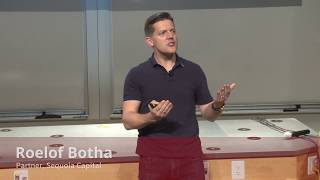
Roelof Botha: Sequoia Managing Partner’s Career & Life Strategies
Roelof Botha, managing partner at Sequoia Capital, talks about his path from PayPal CFO to venture capital, how he handles imposter syndrome, and frameworks for making long-term decisions. He shares lessons on emotional intelligence in leadership and advice for people early in their careers.
And action. Roll off. I'm 28 now. What were you doing when you were 28?
I was the CFO of PayPal taking the company public.
Great. And I have a party tonight called Ho Ho Ho Down.
And maybe you pursue something entrepreneurial and maybe it doesn't work out. But what does that lead to? Because life is a series of decisions and I think a lot of people focus too much on the incremental one-time decision. and they're afraid that this decision might not work out. But that's not the question. The question is think about a decade of decisions or two decades of decisions. Because how could I be so stupid to have made such a bad mistake? And it just motivated me to work harder to make sure I didn't repeat that. I didn't do these things.
I love that you and Hweifan met at the GSB. Could you provide more details of how you met in your first year and also perhaps any advice you might have for some of us, those of us who may still be single at the GSB.
Take the second one first. Don't worry about it.
Don't worry about it. Okay, great. Done. Easy.
Pursue your dreams. You'll meet interesting people along the way.
I don't chase, I attract is a mantra that people are talking about now, right? Like attracting good vibes. Is there a common pitfall that you see young career professionals make?
There are two that have come to mind. The first one we touched on earlier, which is.
[Speaking of which] Welcome to Cherie's Corner, a podcast where we dive into the topic of careers and hear from my friends and guests who are killing it in the business world so we can learn from their lessons, their wisdoms, and their mistakes. I'm your host, Cherie. And currently I'm a business school student at Stanford University. Previously I had experience working in tech and venture capital. In this episode, I speak with Roloff Botha. Roloff is currently the managing partner at Sequoia and he led early investments in iconic companies like YouTube, Instagram, 23andMe, MongoDB and many more. It's near impossible to go a day without using an app or a product that he and his team have invested in and shaped. In our podcast episode, he talks about the different career chapters of his life, from being hired by Elon Musk to join PayPal after he graduated Stanford Business School in 2000, to the early days of working in Silicon Valley in venture capital. Yes, RoLoFf is a brilliant investor who's generated billions of dollars in returns. But in our conversation, he discusses the career mistakes he's made and how he's grown both professionally and personally There are podcast episodes and articles out there where Roloff discusses his investment thesis and how he evaluates startup founders. But that's not exactly what I want to talk about in my podcast with him. Instead, I wanted to peek behind the curtain to learn more about the peaks and valleys of his life and his career, and to hear the advice he has for people in their early and mid career. Welcome to season three of Cherise Corner. Let's dive in. Roloff, you graduated the GSB in 2000. You've had an incredible career and we're so excited to learn more from you and hear some of your advice both on career and personal and growth and really excited to dive in there.
Looking forward to it. Thank you.
And before we get started on my questions for you, I give this opportunity for my guests to ask me any questions. So go ahead. Hardball, softball, here we go.
Sure. The first question is, you can buy a billboard anywhere in the world. What would it say and where would it be?
Also, I would like to preface, I have not seen these questions ahead of time, so they're happening on the spot. Billboards are interesting. Whenever I land into a new place, I always look at the billboards because it really shows the culture of a space. When you land an SFO, very different from when you land in LAX. And I've picked up on that. And sometimes I'm cringing when I'm looking at the billboards when I land in SFO, I'm like, this is so techie and so cringe. And when you're going to LA, it's very media centric.
Where would my billboard be?
To whom do you want to send a message, and what do you want to tell them? The way I want to answer this question is probably thinking about my podcast and my reach and my content. The message that I send out to my audience right now, mostly targeted towards early career women, mid career women, ages like 18 to 35, I'd want to send a message to them like I do now on social media, but if I were to have a billboard, it'd probably be somewhere near SFO as people are landing, getting off the airplane. And I think representation is really important in the tech space and also in industries where there are not as many women representation. So probably a billboard showing people who look like them that you can do it. If you've landed here, you can start that startup, you can be on that board, you can join that company and see yourself in that space.
Good. Do I have to answer mine or do I get to ask the next one?
You get to ask the next one.
The next one. What do you hold to be true but can't prove?
What is the question behind the question?
Your belief system. Things for which you have an intuition but you don't have conclusive proof for it.
The first thing that comes to mind, and I'm kind of thinking out loud as I'm talking right now, is my product gut. So before coming to the GSB, I was a product manager at LinkedIn for almost five years. And a lot of how I created products and worked with my partners, both design and engineering, was based off of my own product gut. And the way that I would manifest is through sometimes through design, UX design, A lot of it, you have some principles, but they're principles and they're not hard and fast rules. And sometimes I have a gut feeling based off of my experiences using apps or my experiences in real life, like why would this product work? Sometimes it's really hard to argue in those design meetings when it is an intuition and it can be more of an art rather than a science. Does that answer your question?
Yeah, no, that does.
Mm-.
Last question. If you had to imagine your ideal profession five years from now, without any financial constraint, so what would you be doing five years from now if money was no object?
I love this question. And my answer kind of scares me. I would be doing exactly what I'm doing now. In my dream state, I would have my own podcast and dreaming bigger than that, it would be my own media company. I look up to people in traditional media like Oprah Winfrey or Barbara Walters, Lisa Ling. Maybe they're more on the journalism side, but seeing the empire that Oprah has built with her talk show, with her book club, with her print media, can I do the same thing? in new digital media? And can I create content that empowers 100 million people around the world? My focus is mainly mostly on women, but of course men are also involved in that 100 million. But can I empower them to.
Reach.
Career heights that they might not have thought was possible through my content? And can I be the number one influencer, the household name that they think of? when they want to go to someone for business and lifestyle advice. I very much think of the intersection of the two because I think far too long, like when you look at someone and you see their professional career, that's all you see. But who is the person behind that? And how do we make sure that we bring our whole selves to work, especially when people feel so passionately about their jobs and emotions get involved and we'll talk, we have some room for conversation for that later. But how can we really tie those two together is my goal.
Very interesting.
What are your thoughts there?
I love the scale of your ambition.
Too big, not big enough.
No, that it's as big as it is. And then the questions are going to be along the way, are you making the right decisions consistent with that ambition? And we can get to it later in some of the conversation, but are you going to play it safe?
I can't play it safe.
But that means you need to make a bunch of decisions along the way to think long term and take calculated risks.
Now is the time to be risky. I, over the last five years, have worked in my dream job at LinkedIn and built the connections and the skills, the network, to be at the GSB now. And my greatest fear is that when I'm 50 or however old, you know, in the next 20 years, looking back on my life and being what if? What if I didn't make that choice? And one of the hard decisions now as I'm committing to this stake in the ground is like, what do I tell my mom? That is honestly my biggest fear. It's not the fear of not making money. I can do that. And I've seen that play out over the last two years through brand partnerships, through my content. It's how do I tell my mom? that this is the career that I'm moving towards when she has been like, you should be a product manager at Microsoft. And I was like, I can't do that when I'm leaving the GSB in June of 2024. I don't want to do that.
What do you think your mom really wants for you?
Of course she wants the best. She's coming from a good place. She wants financial security. She wants emotional, mental security. Everything she's done, my mom is an immigrant, has been to allow me to have security in my life. and now I'm throwing it all away, seemingly, to pursue an option that has less security.
It's a story we hear many times with our founders. I have been on the phone with parents, our founders, and of people we've tried to recruit to join some of our early stage companies with parents who are doubting their decision to join YouTube in the early days or to join Instagram or whatever the case is. And so just think about the long term. Yeah.
Could you get on the phone with my mom? We can call her up after this. No, I appreciate that. Just jumping in. Should we just go straight to- yeah, let's do it. I have some icebreaker questions, but I feel like we've broken the ice.
Okay, up to you.
This is about routine. How do you set yourself up in the very beginning of the day and how do you wind down in the evening?
So I get up at four and I take a two hour run. I then have an ice spot, just kidding.
I can't reach you.
I then do these things. They're the things that I wish I had enough discipline to do, but I don't do in reality. First thing in the morning as I make a nice pot of coffee, I love the taste of coffee. So that's passion. I exercise in the mornings. It's a way to just get it done. I found over the years that if I leave it later in the day, it invariably gets consumed by other things that are priorities and work priorities. And so I try to work out at 6:00 or 6:30 in the morning for an hour. until it's done and it really puts a bound to my step for the rest of the day. And I just feel good about myself. And I'm at least one of those people. I love exercise. I love to. I love to sweat. I love the strain. It's just. That's enjoyable. So I do that in the morning. I need a healthy breakfast in the evenings. I enjoy mostly reading as a way of winding down. I don't always achieve that. So sometimes I. lying in bed and I'm still going through my phone looking at last minute emails that came in or post on X or something like that. And I find that those nights I don't sleep as well. And so even if it's just five or ten minutes of reading on a Kindle or right now I've got a, I'm reading a novel, I'm reading Humor Seriously by a GSB professor Acker and I've got a joke book.
A joke book.
I literally have a joke book next to my bed and what does that mean? It's a book of jokes. It is a 800-page book. Pre-written jokes? It's an 800-page joke book. And I'll go through the book and I'll just look at the jokes and it just cheers me up to look at humor.
Oh, I see. You're reading a joke book. I'm reading a joke book. It's kind of like reading a comedy.
You're not like prepping by like reading the joke book. Like what are jokes that I can then like tell the next day? No, just I mean some of them are funny enough to repeat. So there's one which is, parents of teenagers understand why some creatures eat their young. which is relatable because I now have teenagers. So some of the jokes stick, but some of them are just, it's just a way of taking your mind off the stress of the day so that you can have a peaceful night.
I like that. I like that a lot. Instead of, I mean, there are different ways to wind down. Reading a book, less blue light, and a joke book, I think that's a nice way to get a good laugh in, especially if you've had a stressful day. That's every day.
Every day?
Oh, no. Then you sweat it out the next morning. All good. Yes. What are you listening to now? Spotify Wrapped was released yesterday for 2023. I don't know if you've taken a look, but is there a podcast or your number one artist that you're listening to?
I got home for dinner last night. I had seen the Wrapped release, but I didn't have a chance to listen to it yesterday. My daughter asked me immediately, have you looked at your Wrapped yet? And I said, no, I haven't yet. And she said, I want to let you know that I'm in the top 0.5% in the world. Wow, that's fantastic. At what? Taylor Swift listening. Which I thought was really cool. So I haven't looked at mine yet. What I'm listening to at the moment, I do listen to Spotify of the weekly playlists that come out. But I'm actually listening to Hitchhiker's Guide to the Galaxy, which I'd read many years ago, and I want to re-experience it. And I was on a two-hour drive recently where I just didn't have an ability to read a book. I just, I would've gotten motion sickness, and so I decided to start to listen to audible book. And now I've just maintained that. So, every now and again when I have 20-30 minutes where, you know, I can't read something else, I listen to the rest of the story. And it's wonderful to reread a book. It's obviously very different listening to it, and it's, I think, Colin Fry or Stephen Fry who is reading it.
So, it's a wonderful voice. Would it surprise you, and I'm not kidding you, I am reading Hitchhiker's Guide.
To the Galaxy right now. For the first time?
For the first time. It's the book that's on my nightstand.
How far are you into it?
Maybe a third of the way through.
It's a fabulous book.
And it might be better to listen to on audiobook because there's so many alien words in it that I'm like literally saying it out loud to be like, what is like a vogue on? You know what I mean? Just more specifically on the book, I'm like, what is a vogue? Or these just have so many like alien words that I'm like, it might be easier to listen to on audible. So someone's actually pronouncing it correctly. anyway, sidebar. Okay, great. So diving into career, Roll Off, I'm 28 now. What were you doing when you were 28?
I had an unusual path. At 28, I was the CFO of PayPal, taking the company public.
Great. And I have a party tonight called Ho Ho Ho Down when I'm at the GSV.
Yeah.
Did you feel the pressure at that time? Or what was your mindset being 28 and the CFO?
It was immense pressure. I mean, if you go back, so as you pointed out, I graduated in 2000. I ran out of money in second year of business school. So in, I'd met Elon through one of my classmates and he first interviewed me, I think, October 1999. and made me an offer to join PayPal. Well, X.com, the two companies merged. X and Confinity merged to create what then became PayPal. And Elon gave me my first job offer and I couldn't take it because I was in a student visa. I didn't have work authorization. And then he made me a second offer in December. Again, I couldn't take it. And then in March, I didn't have enough money in my bank account to pay rent in April. And I was sharing a house with four other GSBers and I was stressed and I borrowed money from My best friend who was living in London, my former manager at McKinsey, my now wife who was a classmate at the GSB, and it was embarrassing. And the money I had saved in South Africa to come to the GSB lost a lot of its value in the summer of 1998 when long-term capital management blew up. And so the rand lost 30-40% of its value overnight, and I basically didn't have enough money left. So when I got that third job offer in March of 2000, I took it and there was this wrinkle at the GSB where you could take a one credit class, you had to write a project note about it. It didn't count towards the credit of your degree, but it enabled me to start to work at the company part-time and earn an income. So I joined as a director of FB&A or director of corporate development. I have my offer letter still. For the grand sum total of $75,000, I became the director of corporate development at PayPal, which comes to another story I want to get back to in terms of advice, career advice for GSBers or MBAs in general. So I joined in a director role. I became a VP of finance towards the end of 2000. I started to run all the company's financial planning, fraud analysis, the risk management team all reported to me. I was at all the board meetings and then we filed to go public in the in September 2001. At that point, we'd been through a couple of M&A conversations with eBay, with CheckFree, with Citibank, a couple of other interesting meetings along the way. And when we filed the S-1, I was 27. We filed our S-1, I think, on September 18th. It was a week after 9/11. And shortly thereafter, I turned 28, and then we went public in February of 2003. to. So it was an unusual sort of quick turnaround. But, you know, my financial position was very different when I graduated at the GSB. My net worth was negative. I owed student debt. I was supposed to pay McKinsey back for the tuition that they paid for. For the GSB, PayPal ended up giving me a loan to be able to pay McKinsey back, but I had to pay PayPal back. So it was sort of in this Perpetual cycle of indebtedness. And so at some point, I freed myself from those shackles. But it wasn't easy.
That's an immensely stressful position to begin.
A lot of people who end up being successful anywhere, but especially in Silicon Valley, need to remember the role that luck played in their outcome. And so, you know, yes, PayPal ended up being a spectacular business. Clearly it was part of the result of the management team that enabled that, but man, we had a couple of near-death experiences along the way. yeah. And I nearly could have joined something else. I nearly could have gone back to McKinsey. I could have joined Goldman Sachs instead. The two other job offers I had, everybody else turned me down. I actually had lunch today with a GSB classmate, and I just remembered at this lunch that Perry Capital, TPG, like all these different hedge funds that I applied to, all these different private equity firms that I applied to, every single one that I interviewed, I turned me down. And so I didn't have that many options, honestly, when I got out of the GSB. But you make good long-term decisions. So this is, in terms of, I guess many of your audience members may have heard of the marshmallow test or the marshmallow experiments that were run at Stanford University. On children? Yeah, the Bing Nursery School, they ran these experiments in the 1970s. Are you familiar with them?
Where there's a marshmallow, kids have to wait. to eat them?
Correct. So the kids are given a choice. And if you go to Bing Nursery School, my kids actually were at Bing when they were younger. They still have these rooms that have the one-way mirrors and you can see experiments being conducted. And so that particular experiment was, here's a marshmallow. I'm going to leave for 15 minutes. If I come back, you can have a second one. So it's a test on delayed gratification. And about a third of the children delayed gratification and got the second marshmallow. marshmallow and one of the professors who conducted the experiments, his own child was in there. And later on, when she finished high school, he started to notice patterns and went back to look at the data. And it turned out that the children who delayed gratification and waited for that second marshmallow had better grades, went to better colleges, had lower divorce rates, sort of a bunch of other variables that fell into place by people who understood the value of delayed gratification. And by the way, a common tactic that worked was distraction. So the children who just kept on staring at this delicious marshmallow just always caved.
Sure.
And those who found a book to read or a toy and distracted themselves or something else did. So a lot of good decisions happen when you delayed gratification. So when I finished my undergraduate, I qualified as an actuary in South Africa. I took a 50% pay cut to become a business analyst at McKinsey. because I thought that would be a springboard to a different type of career and an opportunity to work internationally, even though it was a 50% pay cut from what I would otherwise have been earning. When I decided to go to PayPal instead of returning to McKinsey, I had to repay the tuition that McKinsey had paid for me to go to school. And I got paid, as I said, $75,000 instead of whatever the salary at McKinsey had been at the time. But I felt it was the better long-term business decision. or great decision to do that. And then similarly, when I joined Sequoia, it was after PayPal had been acquired by eBay, and I was offered the position to be the CFO of PayPal with a very generous equity package. Sequoia offered to match my salary from PayPal with no profit share or equity or carried interest in any of the funds. It was just you've got to prove yourself. And so I made that decision again, which worked out in the end, but it was clearly a suboptimal decision over the subsequent two or three year time frame if you measured it over that time frame. And so the idea is to have a longer time span of discretion to look much further down the road. So when I, as I mentioned, I studied actuarial science, and the professor of actual science always said that actuaries are trained to think 30 years into the future when accountants are trained to I think a year in arrears. And I've brought that to a lot of how we invest at Sequoia, which is just dreaming and imagining what would happen if this company succeeds. Because we invest in these very raw early stage companies. And a company like Natera that we backed in 2007 with a million dollar seed investment. Today it's a billion dollar revenue public company that's changed the face of diagnostics and maternal health. When we first invested in YouTube and there were three people with an idea and a website that had 9,000 users, you worked at LinkedIn. Reid and I were colleagues at PayPal. When Sequoia was the series investor in LinkedIn, there were seven people in the company and they had 21,000 registered users. Today they have over 200 million probably. And so you have to dream very long term and very big to imagine how might this kernel of an idea, this kernel of a company, this very early stage startup, how might they flourish down the the road. And what are the paws that it may take along the way?
I mean, you studied actual actuarial sciences. You're trained to think for the long term. One could argue. I think most people, delayed gratification is really hard. I can't imagine. I'm glad as a child I was not put in that experiment because I think I would have eaten the marshmallow. And I don't know what that would have told my mom or told me about where I would have ended up. What are the variables? or the frameworks that you have to help train those of us who are not so easily able to see the long term. Because in the variables that you were weighing in your stories, you mentioned compensation. You've taken pay cuts at several stages.
So three times. Major pay cuts.
Major pay cuts. So what was the trade-off that you saw and that you made in the moment that you're like, this the right thing to do?
So the two frameworks I would think about, one is one we actually apply to our investment decisions at Sequoia. It's a framework we use with our companies as they do annual planning and do strategic planning, which is the pre-mortem pre-parade framework. And I actually got this from Larry Summers. He's on the board with me at Block, formerly known as Square. And the idea is literally write down in five years time, What's the pre-mortem? Not the post-mortem, the pre-mortem. Things didn't work out. What happened? And then you run a pre-parade, everything has gone swimmingly well. What exactly led to that? And it's really clarifying to make prioritization decisions, making sure you're doing the right thing. We've applied it to ourselves at Sequoia. Never mind using it for investment memos when we make a new investment. We ourselves a couple of years ago did a 2030 And literally the one slide was Autopsy 2030, Patience, Sequoia Capital. What went wrong?
That's bleak.
But it's incredibly focusing and what we did at that one thought it's worth is we had every member of the team write a pre-mortem and a pre-parade and then we anonymized them and then we circulated it for everybody to read because we want the triumph of ideas, not the triumph of seniority to help us focus on the things that matters. And so for us, for example, the need to double down on our seed investing business, the need to build far greater capabilities and technology to help us build, you know, what is it going to take to be one of the best venture firms in the world in 2030? It just is incredibly clarifying when you take such a long range view and work backwards. Sure. So it's much, and that's maybe part of the essence is, you know, forcing that long-term framework and working backwards makes you realize that the steps you're taking don't lead to that outcome. So that's the one thing to do. You've got to ask yourself, if that's what I think my pre-parade is in five years, are the things I'm prioritizing this week leading me to that outcome or not? Are they the correct milestones to be looking for? And is this going to lead to that ball? So that's the one framework is for yourself, think about a pre-parade pre-mortem. So when I was thinking about joining Sequoia Capital, my choices were, I stay at PayPal, I'm the CFO, Meg Whitman has said that if I do well, maybe I can become the CEO of PayPal, a division of eBay. And that would lead to a series maybe that I, maybe I would lead PayPal, maybe I could take a general management position in a different business down the road. So that was one set of possibilities. And the other one was at Sequoia where, wow, isn't it incredible to be able to invest in such a broad range of companies and technologies? I'd be the novice. I was the most junior person at Sequoia Capital. I was at the bottom of the totem pole. and I had to learn everything. Super intimidating. But if that worked out, wouldn't it be super interesting? How many interesting companies and Technologies would I, you know, get to learn about? And that's. And if it worked out financially, I would do well in either situation. Honestly, I don't think it materially changes where I'd live and the vacations I would take or the car I would drive. Does it really make a difference? Probably not. But this felt like a much more interesting career long term. And so that led to that. decision. So that's one framework. I'd say the other one is this idea of options. What leads to more options and what closes options? What opens doors and which decisions close doors? So if you buy, you know, I think of a lot of my classmates took a very conservative decision right out of business school. But now you go from being, say, 28 to graduation. Now you're 30, 32, and you made a series of safe choices in the first few years after business school. does that lead to more interesting possibilities or were you close to possibilities? And maybe you pursue something entrepreneurial and maybe it doesn't work out. But what does that lead to? Because life is a series of decisions and I think a lot of people focus too much on the incremental one-time decision. So if I gave you a dice and said, roll the dice and your life depended on six coming up, that'd be a scary proposition. But I said, you had 10 rolls. It's pretty good chance six is going to come up once probably twice in that series. And so I think people worry too much about the next decision and they fret that this decision might not work out. But that's not the question. The question is think about a decade of decisions or two decades of decisions. And so if you do something entrepreneurial, who would you meet? Who are the interesting people you're going to come across? What are you going to learn about business that you might otherwise not learn if you're in a bigger corporation and you're, you know, a cog in a machine? And so I just think that's a very useful framework for people. So are you opening doors or closing doors?
Opening possibilities, closing possibilities. And I can see how the second framework played into your joining a Sequoia, where you're meeting, I mean, it's not even just options, it's just the opportunities that you're exposed to when you're talking to so many new startups and founders, as opposed to staying the more general manager route. Very interesting. I'm in a class called Engineering a Remarkable Life Now at the GSB. It's taught by Joel Peterson. And we touch on some of these. It's basically taking these frameworks that we see work well in the business context and then how do we apply it to our personal lives. And so we've talked about like person to be, someone to love, and work to do. as like the three frameworks, the three legs to stand on to have a remarkable life, and what are the strategies you can employ on a longer time frame? Yeah, cool that they have that class at the GSB.
Yeah.
Moving on to the next question. I'm glad we're going in deep here. I'm gonna keep us moving along. I wanted to talk about imposter syndrome. You joined Sequoia in 2003. I think you mentioned in the Tim Ferriss podcast that at that time, I mean, you mentioned now that you were a novice. You started in the beginner's mindset, but you felt a lot of imposter syndrome. What would you tell yourself then, given the information that you have now, what words would you tell yourself about imposter syndrome? How to combat it?
I think the truth is that many more people suffer from imposter syndrome than you realize. And so you're not, it's not unreasonable to have that series of emotions, but also realize that most other people do. And candidly, if they don't, I suspect they're psychotic or sociopathic, because you need to have a certain sense of humility and self-awareness to realize it's pretty daunting to be in certain positions. And so it was daunting to be a CFO at age 28. I mean, I was so scared I would make mistakes. Not only that it would ruin my career, but that it would hurt the company. I was working for and that sense of responsibility for my team and for our shareholders and that, you know, fiduciary responsibility I took so seriously. So I remember after we went public, Saban's oxy had been implemented and they had all these requirements on certifying your financial results. And I was so scared we'd make a mistake. Yeah. And I remember going into the office at midnight. the morning before we would file our SEC documents and I would stay up there for several hours for the end time, just reading through everything again, making sure every single number is tied, that there wasn't a word that was out of place. And so, so I think the truth is that many more people experience it. I'd say the advice I'd give myself back to the billboard question that I gave you earlier is dare to dream, you know, to be a little bit more daring. And I think about the the things I wish I had done better after I joined Sequoia in particular, there were a couple of situations where I was timid and not brave enough, and I should have dared a little bit more. I should have pushed a little bit harder for things in which I had conviction that I ended up regretting not advocating for.
Why didn't you at that time?
Well, there's the fear of looking stupid. You know, our business is about investing in these early stage companies where many of them don't work out. I mean, it was one of the things when I interviewed at Sequoia, Don Valentine was still alive and he interviewed me. And I'd met Don the first time when I was at GSP actually. He came to an investor conference and I remember sort of revering him and looking up to him. So it was even more intimidating than to be interviewed by him. And one of the observations he had was, you're going to struggle because you haven't failed enough in your life. Because if you're an exceptional early stage investor, you're not even right half the time. And they're probably only one in 10, maybe one in five of your investments that really are successful, truly successful outlier companies that have an ability to be acquired or acquired for an attractive sum or to go public. And he had that observation. And I felt that, you know, the first time we had an investment that we lost all the money in for which I was the sponsor, I cried in a partner meeting. I felt embarrassed.
Yeah.
You know, I felt embarrassed for the LPs we have. You know, we manage money for nonprofits, endowments and foundations in Sequoia. So when we lost money, I was thinking Stanford who's an LP in Sequoia or the Mayo Clinic or Cleveland Clinic or the Boston Children's Hospital. These are the sort of people who now have less money because I wasn't able to turn that investment into something successful. And so, so that's the reason you're timid is you start to experience failure and it you second guess yourself about an investment because you don't know exactly how it's going to unfold.
So what I'm hearing is that imposter syndrome, a lot of people feel it, and it might be the edge that I have to keep me reviewing my documents and making sure that my eyes are dotted, T's are crossed.
Yes, I mean, harnessed appropriately, it'll grind you.
Harnessed appropriately.
And then, but it can, and the opposite, by the way, if you think about all Greek tragedies, What is the common failure mode?
Hubris.
Yeah. And so the flip side of hubris is that humility that comes with having common sense of feeling like an imposter at times. And that can drive you to put in the extra hours. I remember the first board meeting we had at PayPal and I was still a GSB student. I developed the company's financial plan. and at the bottom of the cash flow, I'd made one calculation error in the cash flow. So the income statement was correct, but I'd messed up the cash flow. And the investors on the board were very focused on cash. I was much more focused on the p&l of the business and didn't pay enough attention to that. And it was pointed out to me in the board meeting. And I remember we were in Palo Alto on University Avenue. We had this office. I can't remember the address. It was opposite taxis. It was this burger joint that no longer exists. I remember sitting there after the board meeting, I thought everybody had left and I sat there and I cried as well. And Max Lefkofchin, the co-founder of PayPal, came by and he sort of gave me a hug and told me to just recover and fix it. I fixed it that night. And I didn't make a mistake in the board meeting after that.
Well, I really appreciate you talking about both the peaks and the valleys in your career. I think we love celebrating the peaks, but there's so much more to learn, I think, personally. Like, you internalize the learnings, but then also just talking about here on this podcast so much that I'm learning, and then I think also the audience will learn from hearing from the valleys as well. You mentioned in these two scenarios, crying, which it also sounds like you care so much about the work and then also making sure that you're doing a good job, that that's just somehow, like some way, sometimes that emotions are let out. How do you think about emotions in the workplace? And specifically, maybe even like in a gendered context, have you had people or even women cry in in meetings with you and then how do you approach that from a manager standpoint?
I've seen men and women cry at Silicon Valley. And I've cried here so that's at least one thing. We care so much. It comes from a place of care. I remember there was a... Did you take touchy-feely?
I'm taking it next quarter. Oh, excellent. Yes, so very excited for that. Quite nervous, but it's a flagship class. I gotta take it.
So for those who don't know, there's a class at Stanford that colloquially known as touchy-feely, but it's interpersonal dynamics. And it's a non-curriculum class in some sense because you have these T group sessions. But it's probably one of the classes that has stayed with me the longest in my career. And by the way, it's incredibly helpful in personal relationships as well. There's one concept in touchy-feely which is to stand your side of the net.
You'll learn about it.
I'm not supporting the class. And the idea about staying on your side of the net is only you can talk about your intent. Other people can observe the output of your intent, but they can never infer the intent. And when you stand your side of the net, you should always talk about how something that somebody did affected you. Don't attribute assumed intent to them because I didn't know what that person intended. And so my wife and I both took it. We weren't in the same tea group, which they'd have been in obviously. And it's helped us because now and again when you get in a discussion, it's tempting for us as humans to attribute intent into somebody else. Like, you know, well, you didn't, you know, treat me the right way or, you know, you didn't take my, my, you didn't support me, whatever. But somebody else, somebody else has a completely different worldview and something else is going on. So to give you a concrete example, you know, you can walk past somebody and not pay attention to them. They can then tell you, well, you were being rude because you didn't say hello. but now they've immediately made an accusation about your state of mind. And that gets you on the defensive. If instead they said, when you walk by and didn't pay attention to them, they may have said, I felt ignored when you walked by. And then you might say, I'm really sorry. I was thinking about something else and just didn't, you know, wasn't mindful about the situation. So the same situation, you express yourself differently, leads to completely different outcomes. So the reason I mentioned this in the context of crying or, you know, being happy is you've got to think about what the underlying emotion is. And the way it manifests is quite different because in one situation I have an emotional reaction. It might lead me to get angry. It might lead me to cry. For a given emotional reaction, one person might get angry and a different person cries. But they're actually experiencing the same emotion or they're feeling anguish or they're feeling embarrassed in a given situation. And so I've tried to not focus on the observable characteristics and instead try to focus on what's driving the emotion. What is this person experiencing and can we get to that root cause and forget about, you know, just observable?
That's very compassionate leadership. When I'm frustrated, it manifests in tears and I could find that, it's like, I don't want to cry. I don't want to have, it feels like my power is taken away in that moment, you know, like, need to pause, like not cry in that moment and then return when I can think a little bit more clearly and communicate more clearly.
In Tachi Fili, by the way, they talk about the dynamic range and, you know, there's sort of a baseline of an average emotional state. And I think you need to decide what amplitude you're willing to tolerate in your life. And there's certain people who trade off not wanting low valleys, but they trade off not having high peaks. you know, there's no free lunch. Well, you can't just truncate the curve and get rid of the valleys. It's just not how it works for me.
I have very high highs and very low lows. So it goes like this. I feel everything. My range is very Dynamic.
So as long as you understand that and then you can figure out how to harness that. So some of my most productive episodes have come from periods of valleys where I felt so upset with myself, disappointed. that it inspired and motivated me to work harder and to double down. I was so disappointed in myself after that incident at the paper, that first board meeting I attended, because how could I be so stupid to have made such a bad mistake? And it just motivated me to work harder to make sure I didn't repeat that. So sometimes you can harness that kind of energy for the positive. And then when you work in a team, you have to recognize that different team members may have different ranges. and that's a tricky dynamic to deal with as well. And so a lot of what I try to do here at Sequoia, and I learned that from the people who helped me through some of my troughs at Sequoia, is how as a team, as a partnership, do we support each other through these sort of episodes?
I wish all managers could take some form of touchy-feely. I'm excited to take that next quarter, and the word I keep hearing you say is harness, and I think, or like harnessing that energy or harnessing Imposter Syndrome and turning it into a positive, a place where we can learn. I'm going to keep thinking about that. In your podcast episode that we were listening to, you mentioned that you have written like 10 to the nine on your notepad to inspire and motivate you to reach a billion in returns for your investors. That's pretty intense.
Period. Welcome to life with your love.
That's a pretty hardo statement, I think. I mean, I resonate with that because I feel also very, like, career driven and, and motivated. I also consider myself a hardo as well. And after you've reached 10 to the ninth in returns, is it 10 to the 10th? So basically the question is, and I, I'm asking because I don't have an answer to this. When will it be enough? Career-wise, personally, is there an enough? And so there's also this concept, this is a very long-winded question, but like of atelic and telic goals.
I haven't heard of that before.
So the concept is if you're chasing a goal, like a telic goal that has an end to it, whether it's...
It looks telic, I don't know that.
I think it's the Greek word for end. I'll have to fact check that. There was a touchy-feely facilitator who wrote an article about this, about Atelic and Telic goals in your life. And after reading this, I was reflecting on the goals that I have. Telic goals can be something like getting a promotion or having a child or reaching 100,000 followers. It's a goal with an end. And once you've achieved that goal, a lot of people have reported feeling burnout. Because the thing that you were going for is now over. What do you do once you've reached that? And so he's just like, you should focus more on Atelic goals and the journey of it, like going for a mindless walk without a goal in mind, which maybe to you and me were like, we need goals, we need milestones, we need signposts to tell us where we're going. When will it be enough? Is it 10 to the 10? Is it next 10 to the 11?
So I agree with the comment that, if you have a definitive end goal, it's always depressing after that. I mean, I was most depressed not before exams, but after exams, because then I'd have a week of nothing to do. And then a day or two, I'd sort of walk around the house, you know, sort of feeling depressed, and I'd figure out, oh, the other things I could do. I can go exercise and read and hang out with friends and do other things. So. So I do think, I mean, there's clearly value in certain Milestones along the way of one's career. But one of my friends growing up in high school, always talked about how the fun is in the getting, not the having. It's the journey, not the destination. And so 10 to the nine was a way for me to feel as though I'd secured my role, my position at Sequoia, of proving that I can be a good investor at Sequoia. That was the reason for that milestone. Our venture funds at the time that I joined were around $400-$500 million. So if I could get to a billion dollar gain, in aggregate, it would have meant that I would have returned one fund twice or two funds on their own. But now I'm at around 10 to the 10. So that is the next milestone. But I actually don't track that as a milestone anymore. So I don't write 10 to the 10 in my notebook anymore because my goals have now changed. I think I clearly aspire to help us invest and partner with other great companies and build more great businesses. But in my leadership role now, what I care about most is the stewardship responsibility I have for Sequoia and do we have the right team? When the time comes for me to step aside and empower a next generation to lead Sequoia, have I done a good job recruiting that next generation? Have I coached and trained them to be able to take over and supersede what we've accomplished in a prior generation? And so my attention is turning a lot more to that dynamic and the dynamic of having a successful successful team. And so that currently is my goal, along with, you know, some of the strategic changes we've made at Sequoia by launching the Sequoia Capital Fund that enables us to continue our partnership with companies long after the IPO, and also the launch of an ARC program that helps us partner with companies right at the inception stage by being able to appeal to a much wider audience of seed stage and pre-seed companies. So these strategic initiatives, making sure that into their full potential and developing the team are my current objectives.
Interesting.
You have to keep professing. It's like when you get your personal best at some sport, you have to raise the bar for the next goal.
Sure. I mean, this also reminds me of talking about engineering a remarkable life. That class, Joel Peterson, the professor, says our lives are broken up into three stages. The first is learning in your 20s. earning in your 30s and 40s, and returning afterwards. It sounds like the focus has switched from maybe earning to returning as you're talking about all these different new programs that Sequoia has. And then also talking about returning, both KG, Catherine and I are part of the both a Chan Fellowship. at the GSB where thankfully this summer we applied and got in and were graciously given the opportunity to work on our own startup ideas through the GSB and through the program that you funded, which was super helpful and born out of, I know, 2020 times and conditions. Also talking about returning, you have a building at the GSB. That's pretty cool. What is that like? Like when you're on campus and there's a building and one that will be there, it's a legacy, it will be there forever. We're meeting professors, we're meeting classmates, we're using that space. I've never talked to a person who's owned a building before, so I want to ask that.
My wife and I made it the GSB.
Oh yes, I have a question on this.
So at that time, the new resident, Schwab was in its second year. I was in the East Wing and she was in the West Wing. So sort of East End boys and West End girls in real world. And we started dating in first year of business school and got married in 2003. We just had our 20th anniversary actually, which is a wonderful milestone. And so I think for us, we're both immigrants. She's from Singapore, I'm from South Africa. And for both of us, Stanford just holds an incredibly special place in our lives. because it was the way that we got to Silicon Valley, it was the way that we met, it launched our careers here in the Bay Area. And so we feel immensely grateful for the university. And so fortunately through, you know, what we were able to do career-wise following Stanford, we've had the means to be able to give back. It just seems that that's the right thing to do and to to enable the next generation to benefit. There were a lot of other people who provided the facilities and the scholarships and the professorships that benefited us. And so we feel an obligation to do likewise. Galcelono, who's the former dean of the school who had a big influence on our careers, we've endowed a professorship for him. We've made funds available for rising faculty to be able to support their research. And then for the building, I mean, to me as a poor student who came here in 1998 with not enough money to make it through two years of school, I'm very proud of that ability to be able to give back to the school. And, you know, what we did at least, Ofer and I discussed giving unrestricted use of the funds that we gave to the school, because we feel it's the dean and his faculties remit to figure out how to best use that money for the future of the school. And then the Bouterse-Chan program came about, as you mentioned, during COVID where I just felt horrible that there were a bunch of GSB students that weren't going to have summer jobs. And in my case, I depend on that summer job to provide me with an income. And I was worried that a bunch of students would not have that and that would impact their careers. And so Hoyt and I instantly agreed that we wanted to provide that support. And then it turned out that it actually was a great way to enable entrepreneurship because some of the people who pursue entrepreneurship had the financial means to do so, but what about those students who didn't? And so we love this idea that we can give that opportunity to students to pursue their entrepreneurial dreams and not have their personal finances be the constraint.
Well, your legacy and also generosity felt in this room very clearly between Catherine and me.
It's a pleasure.
I love that you and Hweifan met at the GSB. Could you provide more details of how you met in your first year and also perhaps any advice you might have for some of us, those of us, who may still be single at the GSB?
Maybe we take the second one first. Don't worry about it.
Don't worry about it. Okay, great. Done, easy.
Oh, just over. I think it's one of those, sort of, the more you look for something, maybe the harder it is to find it.
Oh, geez.
Yeah. And so just don't worry about it. I think life is full of possibilities. Back to the career advice from earlier, though, put yourself in an opportunity to meet interesting new people. There's so many times I've found out about an investment because I went to an event or I joined somebody's dinner or I went to somebody's party and you make connections, you hear about things or, you know, so sort of this idea of being open to new experiences and introductions to new people will lead to many possibilities. And so also, I mean, it's part of why we shielded our children from Disney content for a long time growing up, you know, especially for our daughter, this idea that many of the traditional Disney movies ended when, you know, happily ever after. Happily ever after. It was like, well, is the goal for a woman to just find a mate that seems so silly. And so that was the last thing we wanted to have for our daughter who at this point aspires to study PhD in microbiology. I don't want her to feel that her goal in life is to get married one day.
Sure.
And so, anyway, I just don't think you should worry about it too much. Pursue your dreams, you'll meet interesting people along the way.
I don't chase, I attract is a mantra that people are talking about now, right? Like attracting good vibes. And also kind of what you were saying in the beginning, what are the paths that you take that open up more opportunities? I know we were talking about it in a professional sense.
It's also a lot of apps these days that didn't exist, right? That's fair.
There's an app for everything.
There's an app for everything. So, my last name is B and her starts with a C. And in those days, we still had physical mailboxes to get our grades back. And so there were good reasons for Mr. Bouter to make sure that he was hanging around to see when Miss Chan was picking up her graded assignments. So it was one way we got to meet. I think there was one, I went out to Boston to interview for summer jobs.
Yeah.
And her birthday is in February, and I was stuck in Boston because of a snowstorm, and I couldn't fly back. for her birthday. And I got a number and I called her and I said, I'm really sorry, I'm not gonna be there for your birthday. And she told me subsequently, she answered the phone, she's like, okay? She's like, who is this? Does it matter? And for me it was really stressful that I was not able to be there for this, for this event. And then in the last quarter of first year, we finally had a class together. and it was human resource management. And I always liked to sit in the sky deck in the last row. And so she had picked a seat somewhere in the middle. And so I sat at an angle that was sufficiently oblique that I could not look as though I wasn't paying attention, but I could actually look at her during class. And at one point, there was a question that came up that no one could answer. And so two or three people, the professor went through and no one had an answer to the question. And I had an answer to the question, but I was waiting and I put up my hand and I gave the answer. And she turned around, who is this guy? So that was an important moment. We went for coffee a couple of times at Café Baroni in Menlo Park. You haven't been there? Next to Kepler's bookstore?
No, I haven't been.
Okay, you should go there. They have a great mocha that she used to so took it for coffee and then I cooked her a meal and we started dating.
Oh, I love that story. Okay, one very romantic and two, you remember this story with so much clarity. Where you guys were sitting in the classroom? Sounds like a story.
I can remember the dress she was wearing.
Really?
Yeah, she had this beautiful silk sundress. It was sort of a dark navy with yellow flowers.
That is really romantic, really sweet. Okay, I don't chase, I attract. I don't chase, I attract. I love that. Thank you for sharing. Okay. Is there a common pitfall that you see young career professionals make early on and something that you would caution against?
Sure. There are two that have come to mind. The first one we touched on earlier, which is being conservative with career choices because you don't think of them as a series of decisions. You focus too much on the individual decision at hand. And so I felt that a lot of my classmates out of the GSB made conservative near-term decisions, and then it became a cascade of conservative decisions that by the time they're 40, they might have looked back and wondered, you know, what happened. And so be open to things that are a little bit more Not risky per se, because it's all about being calculated, right? I mean, entrepreneurs aren't actually risk takers. They're risk mitigators. They understand the risks and they do what they can to shield themselves from those. But it's taking well-calibrated chances. So that's the one. The other one is joining the right company versus worrying about titles. So I was director of corporate development. at PayPal in 2000, most of my classmates joined companies and had senior director of EP titles, but they didn't pick the right company. And so I'd focus on company choice, quality of people over title and income levels, because again, you're optimizing over a different horizon.
Was going to the GSB worth it? And if yes, when did it click for you? Because I talked to many of my classmates and people who are maybe two to five years out, that like click aha moment hasn't quite materialized yet. And was there a single moment for you that you realized, okay, this is why I'd come to the GSB? And I know you had met you met your wife there, so definitely on the personal side. But I think all things considered, we'd love to hear your take there.
So my path to the GSP is quite different. My experience is quite different from many of the other students as an international student. So for me, it kind of happened when I got the call that I got in and I didn't get into Harvard. I got into Stanford. I would have preferred to come here anyways. But still, it was disappointing to get that rejection letter and then to get the call that I got into the GSP. I was living in South Africa. I've never lived anywhere else. And I had an ambition to compete on the world stage. And for me, just the idea that I was going to get to come to the United States, I've never been here before, that I would get to Silicon Valley, I was going to be in California, I was going to be at Stanford. I was so thrilled. Now, it was tough on my family. It was, you know, it's about as far as you can get from South Africa, if you, you know, sort of spin the globe and sort of figure, like, maybe Alaska is further, but it's pretty hard to get further away from where I grew up and I was alone. But that was a special moment for me. And, you know, if you think about the attributes that you get out of business school, you know, the three categories people talk about, brand, who you meet and what you learn. For me, I went to the University of Cape Town, a university you've probably never heard of. If you're somebody who grew up in the United States and you already went to a very good undergraduate, maybe that incremental brand value is not as much. I got to meet an incredible network of people. Again, I hadn't lived here before. I had no network at all. And so that to me was an incredible springboard. And in terms of learning, because I had done a business undergraduate and studied stats and math as an undergrad, I exempted most of the core curriculum in first year. But it gave me this opportunity to take all these other elective classes and just to learn, to soak up the experience of being at the GSB. And so for me it was It was a special experience from the moment I got the call, from the moment one of my managers at McKinsey convinced me to apply to the GSB in the first place, had arranged with one of his classmates to pick me up at the airport. So I thought, how was I going to get to the GSB? And I remember him driving down Palm Drive and seeing the Memorial Church behind it. It just, it felt magical. And it, you know, that feeling never stopped, honestly.
Oh, I love that. It's a sense of awe and wonder being on campus.
It's an incredible privilege to be at Stanford. I think for all of us, every now and again, just pinching oneself and just reminding yourself to be grateful for what you have, which is something they talk about in so many of these mindfulness books and apps and things like that. But there's a reason many faiths have adopted this notion of gratitude because deeply it is actually very meaningful to humans to remind themselves of that.
I was feeling that earlier this week. I was on the oval. It was a beautiful day. What a great day and what a privilege we have to be at Stanford.
You'll experience that even more when you go back to campus after you've graduated.
I am dreading graduation. I'm trying to figure out how I can add another year to be at Stanford. I'm like, do I want to study climate now?
Isn't about 40% of students now do dual degrees?
Yeah, I think, well, dual degrees, master's in public policy, also joint with the EIPER program. Not me, although I'm considering it now. I was just saying, it's what a lucky position I'm in to be on campus. and to be at Stanford.
You can go back.
I'll be sticking around. And then I want to turn our attention to your work at Sequoia and specifically your Crucible Moments podcast, which I'm sure many of the people watching this have already listened to Crucible Moments. What was the impetus behind starting the podcast?
Many different things led to it.
Wait, you're a content creator now too?
Yes. Although I didn't do the live interview the way that you're doing. Maybe I'll build my way up to that.
Or maybe with a bit more practice.
Maybe TikTok, TikTok dances? No, never. Maybe. Maybe later. A couple of reasons for this. Crystal moments is a word we've been using inside our walls for a long time. It's actually my partner Jim Gatz who came up with this word crystal moments. It wasn't my idea. It was a term that he coined for us. and there's a lot of things that we do as company builders. So Sequoia, yes, we're an investment partnership, we're a venture firm, but we don't view ourselves as that inside the building. We are company builders. And it's not to take away the credit from the founders and the management teams and all the people inside the building. And I felt that firsthand at PayPal. We were there 80 to 100 hours a week, and it was very different being that versus being the board member advisor. But There's a reason I only interviewed at Sequoia after PayPal. I didn't interview at any other venture firm because Sequoia has a very different approach in how it engages with its companies on the road to company building. And some of that is blocking and tackling day-to-day things. We need to recruit here, we need to recruit there, reviewing financials at a monthly board meeting or quarterly board meeting, a lot of important things that culminate into successful businesses. And then now again, there are these things that we call crucible moments. And there are a handful of them that really matter in a company's life. There may be one or two a year that surface. And spotting those moments and making the right decision are crucial if you want to deliver outsized returns. So the companies that we've partnered with when they were private companies at Sequoia today account for over 25% of the total market cap of the NASDAQ. And part of that we were able to achieve because we helped companies navigate spot and navigate through these crucible moments. And we think that is something truly distinctive that we've done. And we were there with these founders and we wanted to shine a light on these stories because it's not something that people often realize. It's not the sort of thing you read about in the press. And so we thought it'd be incredibly interesting and inspiring for other founders and even for for people in their personal lives to understand that they're these Crucible moments that have this big bearing, to share these examples from our own history with Founders and tell the stories as a way of illustrating that for others. And the situations will never repeat, but it'll be instructive to understand how did this company deal with management transition.
Yeah.
With an M&A acquisition offer, with a business line extension, with a business model transition. These huge decisions that the company has had to wrestle with and how do we share those with others?
Yeah, now that, I mean, I've listened to a few of them. They're basically cases. They're case studies.
A case study in the voice of the founder.
Yeah, a protagonist.
With us because we were there with them. And the thing is interesting, part of what we wanted to do with Crucible Moments is some of them are outside driven. So when Brian Chesky talks about what happened at Airbnb or Julia Hartz talks talks about what happened at Eventbrite when COVID struck. And both companies saw their businesses dwindle. How do you respond? How do you respond in that crisis? So some of the episodes and learnings of Reactor, but if you think about the Block episode, formerly known as Square, Jack talks about, you know, multiple founding moments. And the company came up with this idea for Cash App four years after we first invested. And today Cash App is half the company. It's remarkable. And in that case, the company proactively spotted a new opportunity and forged ahead with a new business model innovation and a new product launch that wasn't obvious at all. And that was a crucial moment decision for Square at the time. And so, and the same applies, you know, since you asked about people's careers, especially as you approach graduation, there's so many possibilities that are in front of all these students that are about to graduate. And so, In some sense, maybe there's a crucible moment that's announced itself to you, but often they don't announce themselves. I know you doing everything you can as a student who's about to complete the MBA to identify all the possibilities. What are the things that may surprise you to the upside? What are the things that you're going to be delighted you did 10-20 years down the road?
This past summer, being a part of the fellowship, it It might be a crucible moment. I have to look back on it, right, and kind of pick out what is a crucible moment. But I've worked as a part-time content creator for the last three years, never full-time, and this summer I was testing out my hypothesis. Would I even like doing it? It's been like a side hustle. When I make it my full job, my career, am I still getting as much energy out of it as I was before testing that hypothesis, would I like it? Am I able to make money from it? And am I able to create a strategy that I can see myself moving through over the next 10 years? So I wonder if this summer was a crucible moment for me.
It is because you're trying to make a career decision that is maybe an alternative path from what you would have done otherwise. And then when you face a crucible decision, you want to gather as much information as you can to make a high conviction because crucial moments aren't just about throwing darts and seeing what sticks, right? It's about being very purposeful. If you're going to make this decision, how do you make an informed decision? A high confidence decision? It may not be correct. You want to make it a high confidence decision. And obviously, you can correct if it turns out that things are different. If a company launches a product that.
Doesn'T make sense, then they can recover. I think it goes back to earlier in our conversation, fear of failure. have to get over that, right? There has to, there have to be many failures that we learn from. Fear of looking stupid have to get over that and being really intentional with these crucible decisions. And if it doesn't work out, harnessing that energy and figuring out what we can learn from what has just happened.
Yeah.
Roloff, those are all the questions that I have. Is there anything that I missed or anything that you'd want to talk about in the last couple minutes. Maybe for the next episode.
Okay, awesome.
Thank you so much.
Thank you.
Oh, this was so fun. Thank you guys. This was great.
Thank you.
Thank you for joining this episode of Cherise Corner. Before we get into the takeaways, please like, comment, and subscribe. I'd also really appreciate it if you could share this podcast episode with someone who might find this content helpful. Alrighty. Let's get to the takeaways. The first takeaway is our conversation around failure. You are guaranteed to fail if you are trying hard things and failure is not a bad thing so long as you can harness that energy and learn from it. In fact, if you're not failing, you might be playing it too safe in your personal or professional life. Let's be real though, failure does not feel good. It sucks. The most important thing to do after failure is to learn from it. I loved how Roloff opened up about the mistakes he's made in board meetings and in investment decisions, how he's harnessed the failure as motivation to grow and to turn it into a learning moment. If you can make this mindset shift, your learning will be exponential. The second takeaway is that I was pretty blown away about our conversation around emotions at work. Just from our discussion, you can tell that Roloff has a lot of emotional intelligence and he uses that work to manage difficult conversations. It really clicked for me when Roloff talked about standing on your side of the net and deciphering underlying emotions and seeing how it manifests differently in different people. Before each podcast episode, my team and I do tons of research, and we all know that Roloff is a legendary investor. But in this conversation, I've developed a really deep respect for him in learning how he invests in himself and invests in his team. He's a leader that I admire and would follow and work for. The third takeaway is, oh my gosh, how refreshing is it to hear about the insecurities of your heroes? It's the real talk and the vulnerabilities in this episode that really blew me away. It makes business leaders seem less scary and more relatable. And that's what my podcast is all about. Hearing Roloff talk about the fear of looking stupid the battle with imposter syndrome early on in his career, and the regret he's felt when he didn't voice his opinions. These are all things that I have felt, we have felt, before. To hear a respected leader like Roloff share those shameful feelings makes me respect him even more. If someone successful like Roloff has gone through those motions, those feelings, and made it to the other side, there's hope for us yet to achieve all the things that we want to achieve in our personal and and professional lives. Thank you so much for tuning in to this episode of Cherise Corner. I'll see you next time. Bye.
More from Roelof
Sequoia’s Roelof Botha on Decision Making, AI, and the Next Trillion Dollar Markets | Ep. 28

Roelof Botha on PayPal Panic & Sequoia’s Long-Term Strategy | The Library of Minds

Fireside Chat: Roelof Botha (Sequoia Capital) on AI & Visual Tech with Evan Nisselson (LDV Capital)
Advice for Entrepreneurs and New Fund Managers from Sequoia Capital's Roelof Botha
Investing with the Best, Founder-Problem Fit, Pre-Mortems and Pre-Parades, and More — Roelof Botha