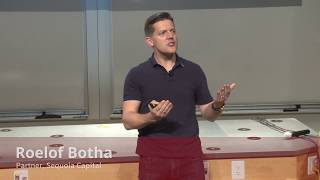
Fireside Chat: Roelof Botha (Sequoia Capital) on AI & Visual Tech with Evan Nisselson (LDV Capital)
Roelof Botha, managing partner at Sequoia Capital, talks with Evan Nisselson about his path from PayPal to venture capital, his investment philosophy, and where he sees opportunity in AI, healthcare, and visual technology. He shares how team and long-term vision shape his bets on startups.
We'Re up to our next fireside chat. I'm thrilled to introduce a friend, Mentor, brilliant person, Roloff Bortha, is the managing partner and steward of Sequoia Capital. Roloff has been spent over 20 years building companies in Silicon Valley. We're talking more deals about some of the ups and downs and fascinating world-changing brands that he's collaborated with. We actually met about 20 years ago just after he joined Sequoia in 2003. So the title of this slide is actually comes from Roloff's bio page at Sequoia, which I love and agree with. To be successful in this business, you have to be contrarian and right. Hey, Roloff, thanks for joining us.
Hello sir, nice to see you.
Yes, it's been a little while. You've got a different space in the background there. What's the rock behind you?
This is actually a picture of the Sequoia entrance here in Menlo Park and you correctly identified the rock. It's actually a cross-section of a fossilized Sequoia tree. It's a bit of a spoiler alert for those that haven't actually visited but I normally ask people to guess how old this particular cross-section is. And it's not the age of the tree at death. You can count the rings. It's about 900 years old when it died. When did it die? And if you walk around the back, you'll see a little placard. And this tree was alive 38 million years ago.
Oh my God.
So when this tree was alive, the Himalayas didn't exist because India had not yet collided with Asia. The Alps didn't exist. Antarctica and Australia were a single continent. And for me, it's just a very powerful symbol of trying to build companies that lost, companies that endure.
I love it. I would never have guessed that number of years, but it is a great context. Let's start. So we've got about 35 minutes or so. We'll do a little bit of past, present, and future interactive. You can ask me questions, but I've got a bunch for you, and we'll just kind of have a fun conversation with our audience. So starting, When you were at Stanford University Graduate School of Business, there must have been tons of startups that you could have joined. Why and how did you join PayPal in 2000 as head of corporate development and then later as CFO? How did you choose them?
I didn't have any other choices. No, so I'd come to America. The first time I'd set foot was when I came to Stanford and I had a background of studying as an actuary. So I did a lot of mathematical finance and statistics in my background in economics. So I didn't have, you know, I did CS1, but I wasn't a programmer. I wasn't a software developer. But I was really intrigued by the idea of what technology here in Silicon Valley could do to transform the world. I loved financial services. And so PayPal was one of these companies that was a combination of financial services and technology. And so that was appealing to me. I only had two other job offers. One was to return to the consulting firm McKinsey, where I'd worked before, and another was to work at Goldman Sachs in New York or in London doing banking. And so every other place I interviewed and turned me down. And so it was a bit of necessity. The other dimension was that I'd run out of money in second year of business school, and I needed to make an income. And so Elon had made me three different job offers, and the third one he gave me, I accepted. and I work basically part-time for three months while I finish my degree so that I can have enough money to pay rent.
Very practical, not surprising, Roloff, but also I think, you know, through the years after that, when you're at PayPal, what do you think is the biggest thing you learned then that you still resonates with you today that still kind of impacts your actions and your approach to working with entrepreneurs.
There's so many things to learn from the PayPal experience. Just to give you a sense, when I joined in March of 2000, we had, I don't know, 30-40 people. We had no revenue. We were burning $8-10 million a month. We just raised $100 million financing at a $500 million valuation. This was literally a sign of the peak of the times. And as they crashed about two weeks after I signed my offer letter, which was Terrible timing, obviously. We had to figure out how to build a business model very quickly. So by June of 2000, we started to charge transaction fees. The burn rate had grown to over $10 million a month. We had seven months of runway left. I remember Michael Moritz, who was on our board, drumming into our heads as a management team that we needed to focus on our runway so we could extend it. And so we went from having no revenue to, I think, in the teens that year to 100 million the next year to 240 million the year thereafter. So when you think about that revenue growth rate, It was remarkable. But we had to get religion on cost reduction and figuring out a business model very, very quickly. In the meantime, we had to tackle the four challenges: the competitor challenge of eBay who had a competing payment service and was trying their best to kill us; the regulators who kept on trying to shut us down because we were sort of at the boundary of what was considered acceptable or standard practice. And so there were so many things to figure out along the way. The thing that resonates most to answer your question, though, is team and culture. And we had this team of pretty young people generally who didn't have a tremendous amount of experience. You know, by the time we went public, I was 28. Max Levchin, who is the co-founder and CTO, was also in his 20s. Peter and David Sachs and Reid Hoffman, the rest of the management team, you know, they were maybe in the early 30s. We were a young, young team at the time. And, but we bound together and we were in it together. So that was a very important part. And then a related concept that I've used is favor slope over intercept. So imagine just visually, intercept is sort of a reflection of your accumulated experience. But what's your slope? What's the rate at which you're continuing to grow? And so ideally you have both, but if I had to trade them off, I'd rather trade slope for intercept.
And tell us more why?
It's the rate of growth. It's your willingness to absorb new information and just to keep getting better as opposed to saying, well, this is what I know and I'm not getting any better at it. And in many of our startup companies, there is no template. There is no, people have done it five times before and you can just leverage the experience. You're sort of figuring out new frontiers and that's part of what I find exciting, is investing in businesses for which there is no blueprint. you have to make it up as you go. And to do that, you need ingenuity and a willingness to learn.
I love it. I agree. Obviously, you mentioned several challenging ups and downs during the PayPal days and similar to many startups that you've invested in and partnered with these days. But I guess, in the late 20s, what was the, to you, what was the most challenging puzzle or situation that you kind of still gives you flashbacks during those days?
About the PayPal experience?
Yeah.
I'd say the thing that I reflect on is how we underestimated the company's long-term potential.
Interesting.
So, you know, look, we faced a serious challenge because about two-thirds of the payment volume of PayPal in 2002 when we agreed to the acquisition was on eBay. And the fact that the post-merger integration worked so effectively at accelerating both eBay and PayPal's payment volume showed how important integration would be. And so eBay had its own payment service and they kept on not executing. And Peter Thiel had this fabulous quote that I always remember, which is when somebody's shooting at you and they don't hit, you might conclude that you're bulletproof. But it may just be that they're a bad shot and eventually even a stray bullet could kill you. And it's very-- That's great. If eBay had figured out how to compete with us, I do think it could have been very dangerous. I do think it was logical for us to have accepted the acquisition offer at the time. Maybe we could have figured out a long-term business deal. But what I underappreciated was the compounding potential of PayPal in the long term. I mean, PayPal today, I haven't checked today what their market cap is, but it's probably in the $60-$70 billion range. It had touched over $100 billion at some point.
Yeah.
PayPal has compounded its revenue by about 20% a year for 20 years after it was acquired.
That is a-- It's amazing. Yeah, absolutely amazing. And obviously, the growth from the internet and the people online and everybody transacting with payments digitally continues to grow. So now it makes sense. But back then, I agree, I wouldn't have imagined it would have compounded that much.
And so that's the thing that as we know at Sequoia, one of the things I try to instill in our team and I try to be very disciplined about is how do you think about that long term? Because we all struggle with that imagination. And my worst mistakes as an investor is the failure of imagination. And so I try to just remind people, just, I realize we're thinking a quarter ahead, a year ahead, maybe two years ahead, but imagine in 10 years time, what might this look like?
I know I'm going to add those exact words to my future emails roll off when we try to look for our next co-investments. So right then, when you were at eBay after the acquisition and they were offered a chance to stay on a CFO post acquisition, you chose Sequoia. What was that? I mean, obviously both are exciting and very different. Do you reflect upon that decision and what led to it specifically, aside from Mike Moritz probably hounding you?
I certainly don't think about it much these days. No, of course not. Back then I thought about it because the opportunity to work at Sequoia so Meg Whitman had offered me a position at PayPal with a certain salary and a set of options that would have transformed my life, way more money than I thought I'd ever have. And that when I joined Sequoia, they offered to match my salary and that was it. So I was leaving an enormous amount of potential money on the table for this opportunity to work at Sequoia and to learn. And so that was a difficult decision. I mean, it's a trade-off decision you have to make. And I think about the marshmallow experiments and sort of can you trade off the potential for something much more valuable in the long term if you're just disciplined. And so that was a marshmallow test for me. And part of what attracted me was the culture at Sequoia. Even though Sequoia had been so successful, it was clear to me that the partners here weren't resting on their laurels. And the phrase that I kept on hearing through my interviews was, We're only as good as our next investment. And so that to me said a lot about the culture of the firm. And I didn't interview at any other venture firm. I didn't contemplate going anywhere else. It was only here. And I'd seen what Sequoia had done for us at PayPal as the board member and as an advisor to us. So my choice was simple. It was only this one. And then the decision in venture capital was it was just super interesting. You get to learn about so many different businesses. Now, it's also humbling, right? You go from knowing a lot about your domain. I'm an expert in payments and I'm a CFO of a public company. And here I am, the person who knows the least about every new company that walks in. I don't know anything about these new categories. And man, that's daunting and intimidating, but it's also fun and challenging.
It's also exciting and, you know, an opportunity to learn more. We were talking to Esther Dyson, who you know as well, earlier in our summit today, and she said she always changed roles because she had learned something and wanted to learn something else and wanted to kind of explore new things that she didn't know about and obviously build value, but also it's all about learning. I, you know, in order to transition to a little bit of the present, like past and present, I remember back when I was an entrepreneur and I was fundraising for a startup that I had founded and talking to everybody.
Digital Railroad.
Digital Railroad, you remember it. I'm giving flashbacks already. But anyhow, so we were talking to everybody and couldn't get a meeting at Sequoia. Finally, I got a cold call from Mike Moritz at 10:30 after I already had a whiskey. and he was hammering me with questions. And he said, okay, fine, can you meet me tomorrow morning at 7:30 a.m.? And that's when you and I met. Thinking back then when I was talking about photography and creative community, et cetera, not creative content, creativity and visual tech, from then to now, what aspects do you remember from that conversation? And kind of as you've watched us evolve with LDV, What resonates the most in your mind?
Well, there are two funny pieces which aren't the most important business ones. First is you and I figured out that we both like Tom Waits. That's correct. Which is a fascinating one. And then I think I try to lecture you on your diet and try to encourage you to eat healthier. Actually, no, no.
As a friend, I appreciate that. I transitioned from a coffee and banana to coffee and yogurt and nuts. I don't think about you every morning. I can't blow your head up like that, but it definitely was a positive impact among other things in business. Yeah, although my daughter now tells me.
She'S like, you know, when you give people unsolicited advice like that, it's not a way to make people happy.
I'm a glutton for punishment, so I keep on coming back for more.
I'm a glutton for punishment, so I keep on coming back for more. More seriously, what I remember is you had this inkling about building a marketplace for photography, and what you developed was sort of this marketplace for professional photographers to connect with those who'd want to consume those images. on their websites. And I think back to the earlier comment about what PayPal became, I don't think we fully appreciated at the time how important those insights were, how important visual imagery would be, how big the internet would be, how much people would consume this, how important that was as a companion to the experience. And so when I think about the investments we made, and I know we'll talk about some of these later, but whether it's moving images or still images, the impact that that's had on so many of the investments we've made, And I think back to that meeting we had, and you had a vision for the future and the impact of visual imagery on consumer experiences was completely spot on.
Yeah, it was interesting times. It's always the timing, and as you said, people on a team and many other variables that go into building a business. But no regrets, and let's transition to, we were co-investors in Mapillary. and on the board together in Matt Bolari. And I was always impressed with how succinct and valuable your input was. But how do you decide in these meetings when to share your thoughts and when to not? I mean, separate from my breakfast, you know, eating style, but more about, like, there is this. I mean, I think this is important with everybody and, and how and when or how do you measure and and decide when to share input versus not.
I try to, to first, there's probably an internal monitor of what is my share of voice in a particular meeting. And if I'm, if I feel like I'm speaking too much, I really want to dial back to make sure that other voices are heard. So that this is in terms of an absolute level of how much am I contributing? And then, am I speaking because I want to say something or do I really want to further the conversation and help the entrepreneur think about something? Because I think there's also the temptation to show off or to just like the sound of your own voice or to sound smart. That doesn't help. Are you asking a question that really helps the founder iterate on their idea or challenge them in a way that maybe gives them conviction that the path they've chosen is the right one, but they now have a stronger conviction because you've illustrated a different avenue, they've considered it and they've shut it down. For me, are you really moving the conversation forward? I haven't think about whether I can get an entrepreneur, even in a pitch meeting, but also in a board meeting, do they open up a notebook and write something down about what I say? Does it make them think? Does it make them reassert? And if I can't achieve that, then I'm not really helping the conversation.
I agree. I think it's, I mean, this is a topic that I think about a lot because from being an entrepreneur for 18 years and now an investor for 12, It's really easy to talk, but it's really hard to provide valuable insights and support to entrepreneurs to help them succeed at the right time. And I agree, I try to be silent more often than not, but it's always challenging at the early stages.
One of the really important things is to ask questions and not to be prescriptive. And I know this because I've been on the other side of the table. where if you're inside a company, there's so much that happens on a daily basis. And then PayPal was crazy. I mean, we were working 100 hour weeks. We had management meetings on Saturday mornings because the week was too busy. Most people were there on Sunday afternoons. I mean, we were just, it was such a cauldron. And so a lot changes between board meetings or even between conversations with board members. And so that gave me an important insight that no investor will ever have the nuanced understanding and the full texture of what it's like inside a building. of a company every single day. And so be very careful about making statements, far better to ask questions. Be Socratic in the way that you approach things.
I agree. And it's also important what type of questions. We can talk about that a little bit more towards the end as we talk about personalities of investors and entrepreneurs. Let's talk about investment opportunities that you and I are both excited about that also leverage visual tech, so healthcare industry. Give us some of your thoughts of what I know we talked about in our pre-summit interview online. to kind of kick things off. But tell us a little bit more about your thoughts on what excites you in healthcare that relates to visual tech.
So there's a company that I listened to recently being spun out of Stanford with the idea of bringing better or augmenting the clinical decisions of a physician by leveraging the knowledge base that exists and doing so through a multimodal approach. So it's not just by looking at the health records that have text information, but also looking at the images. So can you look at the history of previous MRIs and the associated diagnostic reports that were produced and combine those to be able to make much better clinical decisions at the point of care? That kind of an opportunity to me feels absolutely fascinating. You know, a lot of the MRI technology, for example, you know, when people go for scans, it's relatively crude. that you have this 3D volumetric series of images of the scan, and yet you only look at it one slice at a time in 2D. And when you look at how cancer changes, for example, there's this very rudimentary way in which they measure it. Well, why don't you use algorithms to do a full 3D volumetric analysis of how tumor has changed and augment that with the rest of the clinical assessment. So, you know, these sort of examples to me feel incredibly promising.
I agree. I mean, one of our investments is in Ezra, which you and I have talked about in the past. and there's others, but the availability to your point of augmenting doctors, I think augmenting humans in every industry horizontally across every vertical visual data, multimodal models of data is going to be extremely valuable. And the exciting part back to what you said earlier, it's about the team and about finding the right people at the right time in my mind. But how do you, when you get all you get Tons of people pitching. What are the different personality traits? What gets you more excited and what gets you less excited?
You write that there are different personality traits. I may have told you this one before, when I joined Sequoia, Don Valentine was still alive. And he pulled me aside one day, first couple of months after I joined, and he said, Roloff, we invest in a two by two matrix of people. Exceptional, not exceptional, easy to get along with, not always easy to get along with. We mostly make money in one of those four quadrants. Your job is to figure out which one it is.
I love that.
It sat with me for a while and the insight obviously is that founders are exceptional people, but they don't take the world as it is. They feel so frustrated by an opportunity they see or a problem that they face that they feel inspired to go build a company with all the challenges that come along with company building. to go and change the world in the way and they want to shape the world in the way that they see it, not just accepting it for what it is. And that, by definition, is somebody who doesn't take no easily. And so, you know, that comes in many different shapes and sizes in terms of how difficult, you know, what does difficult mean? Obviously, difficult isn't just being bombastic or rude to people. It's just, you know, these are people who are smart. They think from first principles. and you need to embrace that and work with that. And I think one of the challenges, if you're an investor and you don't check your ego at the door, I think you're really gonna struggle.
I like it. No, I agree. So we talked about healthcare. What are a couple other verticals that are exciting, aside from obviously finding the right people at the right time that are exceptional in the right way? What other verticals excite you that, you know, think, that you haven't seen or that excites you, period.
All of the above.
Yeah, I knew you were going to say that. But I'm going to ask you to say one or two that just, I get it, Rollo, come on.
But the challenge is, and maybe my background has been a little bit more eclectic than most. I'm on the board of Unity, which is a developer-focused company. MongoDB is a database company. YouTube and Instagram are consumer companies. Square is a financial services company, or Block as it's now called. Neterra is a Genetic Diagnostic Business. These are all just very, very different businesses. In each case, there was some other attribute that attracted me to the founder, the idea, the space. In almost all cases, there was no script for the business. There was no known path for taking said product or innovation and having a blueprint, as I said earlier, for how do you build a go-to-market, how are you going to charge for this, what's the business model for this? I'm really open to ideas from anywhere. Because none of these were ideas that were in the general milieu. They were just, when you meet a founder and you go, ah, this totally makes sense.
Which is a perfect transition to the next one, because it really relates to the core of at least our Fireside Chat title, which we're meandering around with. It makes sense when you do it, there's no blueprint. But then, you know, fortunately they're enduring, hopefully enduring companies. It doesn't always happen, but that's the goal. But typically, I mean, what percentage of the time are those investments? Did people say you're crazy? I mean, for me, as you and I have talked for years, I, you know, majority of the time they say, I'm crazy, and I just kind of stumps in very different situations. So how, you know, how do you.
To promote their products with beautiful imagery of the products that they had, because images sell. So that was an example of what we saw. At MongoDB, really? NoSQL, that's a toy document database. That's like a toy thing. No one's going to build a real application on this. Anyway, so in each of these cases, there are naysayers and you just, you know, you need a thick skin.
I fully understand, but also figuring out when, and I think I've shared this with you that of the last 12 years and since I founded LDV Capital, probably the first five years when everybody, when we do deep diligence on these deep technical teams, they say, Evan, it's technically physically impossible to do that. And I said, But, and if it works, it's huge. But they all said that. So I would lose a lot of sleep in the first five years. And then after that we say, well, if they don't say that, then we're worried. If they say it's easy, then actually for us, it might not be earliest and early enough or deep tech enough or leapfrog enough. which I have to then also to your point be careful not to have blinders and only do that. But it's a balancing act. That's kind of become our sweet spot on what we do and what we know. So we stick with it. Okay. So on your LinkedIn bio, you love helping exceptional founders realize their highest ambitions. And so we've talked a bit about this building enduring businesses, building other aspects. I mean, highest to realize the highest ambitions. Do you think Sometimes, as you mentioned earlier, the compounding of PayPal, sometimes we don't know what the highest of highest ambitions are until years later. So, I mean, how do you look at that as being your personal goal or a personal goal?
So, there are two things that I think I really want to help entrepreneurs with. Firstly, is to be a shock absorber, not an amplifier. So when times are down, I think it's the job of a board member to help show you up, but conversely when things are good is to challenge you, to think about what you could do better and to not become complacent and to not suffer from hubris. The other piece of it is a question I often ask founders, which is what is the scale of your ambition? Do you dare to dream? And so I was actually with one of the MongoDB executives earlier this week He reminded me when the company was approaching 100 million in revenue, annualized revenue, and the team felt good about themselves as they should, I asked them the question, what's it going to take and what is the company going to look like when we get to a billion in revenue? It's not a question the company had really focused on and it led to a bunch of changes in the orientation of the team because they set their sights on a very different 10x goal from where they were at the time. and help them gear up for where they are now as a business. And so I think I've had the benefit of seeing companies and seeing compounding and I can bring that to bear and hopefully help people avoid the short-sightedness that I suffered from when I was at PayPal, when I didn't quite appreciate the long-term potential.
Yeah, I think that's important for everybody. But I think the biggest challenge for me in that similar situations is that what I love but is also challenging is every year of the growth of a company, those ambitions and those challenges change. And also to your point, I love, we have about 40% of our investments in Europe and the rest of North America. So the cultures of every entrepreneur is different in the background and the switching challenges to hopefully be valuable and helpful is something that I love but struggle with. And I don't know if that resonates with you as well as far as the balancing and all of our personal lives as well. on a day-to-day basis to your point earlier.
Yeah, look, and it's not for everybody, but the question I want to have for the founder is, and it's a Steve Jobs quote, about do you want to make a dent in the universe or not? And if you want to, if you really want to dare to dream big and go for it, we'll be here to support you. And if you don't, it's okay. This is your decision. It's not for me to judge. And so, Unity is a public company worth $10 billion or so today. many years ago, in 2016, we had an offer for the company to be acquired for $600 million. And obviously, if the founders wanted to go ahead, we wouldn't have blocked them, but we encouraged them to keep going because we thought there was so much more potential in the company. And so we said no. As a VC, it could have been a great win for me, it would have looked good, Sequoia would have had a nice victory, but we just said, we think there's so much more here, there's so much more potential, let's keep going and build a much more consequential company. And we did.
That's great. So a couple more questions. We're almost heading out towards the end of our chat. I mean, we could talk for hours and I always enjoy it. And I'm sure the audience is enjoying it as well. Who inspires you the most every day?
Who? Huh. Who's the founders? I draw enormous inspiration from being able to walk into a meeting and listening to somebody describe their new idea. There's this, people talk about Tiger Woods and golf or Novak Djokovic and tennis. Djokovic talks about how part of why he's so good is he loves to hit tennis balls. Tiger Woods loves to hit golf balls. I love meeting founders. To me, it's a great recipe. It just draws so much inspiration from listening to people who want to change the world.
I agree. Two more questions. We talked a little bit earlier about about different sectors, and I know it's not a focus on what sectors, but if you say 20 years from now, which visual tech are you, could you be most excited about? 20, 30, you're like way into the future, multiple decades. What excites you the most about the potential?
I'm very excited about a different modality for how we interact with devices, and I struggle to imagine that in 20 years we're going to have these small form factor mobile devices and screens we have today where we all, you know, develop these weird neck problems.
I went to the doctor the other day because of that.
That, to me, I have a very hard time imagining that that's our end state. And so whether it's, you know, if you want to be really futuristic, is it a contact lens that helps you sort of automatically display things to the back of your eye? Maybe that's, you know, too science fiction because you can't get enough power and performance and that kind of screen factor. But, you know, Could you, you know, could we bring spectacles that give you that kind of a visual experience that is always on, you interact with your voice? You know, not quite Vision Pro because that's heavier and much more of a dedicated experience. It's not an interactive experience, but that to me sounds really interesting.
I agree. I've been hoping for the retina cam for a long time, but I think historically I thought of more of it, obviously with My earlier focus on professional photography and creating, I thought of it more of a, you know, I just blinked and I took a picture of you. But the whole concept of a retina cam or retina glasses sounds exciting and scary, which is typically all about different technologies in the future. The last question, what's the one sentence of advice that you want to give first-time entrepreneurs in our audience? to help them build successful businesses.
Dare. Dare to dream. Dare to dream. I just worry that too many people worry about the short-term risk of their own company and they almost check their ambition and their ideas for fear that people think that they sound crazy or stupid and to not be thin-skinned about that. and to dare to dream big, to go do something interesting and to not be intimidated. And one of the most beautiful things about Silicon Valley in particular, but I think this is one of our best exports, is failure is okay. So many of the great successful companies have come from people who had one or two failures before they got there. Max Levchin had two failed companies before he started PayPal. And now he's running a firm, another very successful business. So failure is not a scarlet letter. It is experience that can accumulate. And so even if this isn't the idea that takes it there, maybe the next company will. And so it's a repeat game. It's not a one-off game. And so dare to dream. Go for it.
I love it. Roloff, thank you very much for joining us, for sharing your insights and wisdom with our audience. It's always a pleasure. We could talk forever and I hope to see you again personally and in person one of these days soon. I wanted to thank you again and talk very soon. Bye-bye, Roloff.
More from Roelof
Sequoia’s Roelof Botha on Decision Making, AI, and the Next Trillion Dollar Markets | Ep. 28

Roelof Botha on PayPal Panic & Sequoia’s Long-Term Strategy | The Library of Minds

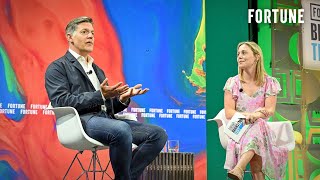
Advice for Entrepreneurs and New Fund Managers from Sequoia Capital's Roelof Botha
Investing with the Best, Founder-Problem Fit, Pre-Mortems and Pre-Parades, and More — Roelof Botha