Sequoia's Roelof Botha on wild rides, best practices &Future of Policing demos cutting-edge security
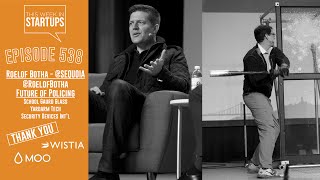
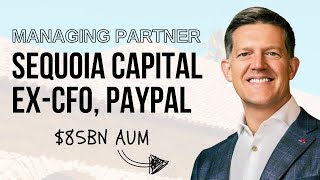
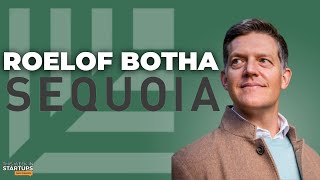
Roelof Botha, Sequoia partner and former PayPal CFO, talks venture capital strategy, startup growth at YouTube and Instagram, and Sequoia's Scouts program. He discusses how VCs make decisions on startup sales and demos cutting-edge policing technology from Launch Festival 2015.
Today's episode of this Week in Startups is brought to you by Wistia. Take control of your video marketing with powerful tools and analytics built specifically for business. Go to wistia.com/twist to get your free account today. And by Moo, an online print and design company that helps you stand out and make a lasting first impression. Stand out like an IPO bound idea at a hackathon with premium business cards from moo.com Moo creates premium quality, customizable business cards and promotional materials. The range of high quality cards, Top-notch paper and exclusive design templates make it easy to create a business card as memorable as you. For extra wow, try Printfinity, giving you the option to print a different image on every card. StandoutwithMOO.com On today's episode of this Week in Startups, at Launch Festival 2015, Jason talks with Rolaf Botes, partner at Sequoia Capital and former PayPal CFO. Also on today's show, the future of policing panel from Launch Festival. with panelists School Guard Glass, Yardarm Technologies, and Security Devices International.
That's what it's all about, man.
They said, money is the root of all evil, but funny how it feeds my people. We ain't gonna live like equals until we get the money, spend the money, and defeat you. Yeah, money is the root of all evil.
What?
Funny how it feeds my people. Yeah, we ain't gonna live like equals until we get the money, spend the money, and defeat you.
There are five or six venture capitalists who I have on my short list of when I have a founder that I've invested in and they're starting to break out and I think they're gonna come on out, Rolf. Yeah, join me. Rolf? Rolf? Rolf? Rolf? I always mispronounce his name. Rolf, nice to see you. How's everything?
Good, thank you. Hello everybody.
So there's a list of five VCs out there who I think can really transform a company. When I have one of my angel investments start to move, you know, to that A round, B round, I email them and you're one of those five on that list, and you have an amazing reputation as a venture capitalist, and you started doing it about eight years ago?
12.
Is it 12 now? Wow, time goes by fast.
12 years and if I just off the top of my head, I know YouTube, Tumblr, Evernote, Instagram, Instagram, Square, Square. I mean this is a list of amazing, amazing startups. Over those 12 years, you've got an amazing reputation as being incredibly helpful as a board member. You're on the board of my company, Inside, What have you learned is the role of a venture capitalist? When are they at their best? When are you at your best?
I think the role is based around asking questions and helping an entrepreneur navigate and solving their own problems. I think the temptation often for someone who has an operating background is to step in and try to to do it themselves, to try to solve the problems on their own, and to tell the entrepreneur what to do. But candidly, a venture investor is never inside your building 80 hours a week. They have context and they can help you see the forest from the trees, but they don't have the nuance details. And I think the best thing to do is to ask good questions to help the entrepreneur solve the problems on their own.
And when you ask it in the form of a question, it suddenly becomes a conversation. as opposed to a dictate or an argument or something? I think that's maybe the deaf thing about the sort of framing that you've done in this way. What is the reaction typically with entrepreneurs when you ask questions? And can you think of an instance where, you know, one of those questions led to, you know, a really good outcome?
Well, I think it often happens that I think the thing to be very careful of is you don't have, as I was saying earlier, you don't have all the answers. And so the last thing I want to do is walk into a company board meeting and say, I think you should do this with the product or do that with the product or you should definitely hire this person rather than that person. Because I don't have all the nuanced context that the entrepreneur does. But I think I provide perspective and help ask leading questions. If you decide between this VP of engineering and that VP of engineering, you know, and I interviewed them, I noticed these things and those things. Did you pick that up as well? How do you think this person is going to fit in with your culture? Do you think this person has the right skill set for the needs we have in our business? And asking questions like that so that we together can come up with the right answer. Like, I don't arrive with answers. I arrive with a framework and a set of experiences that hopefully can help you as an entrepreneur get to the right answer.
Let's go in a time machine back to YouTube. This was an incredible rocket ship of a business. but super challenged obviously with the lawsuit of the decade in our industry. What was that like with Chad and the eventual Google purchase? I mean you can't say everything about that experience but when you look back on it, what do you think made that business so special? And then what was it like navigating and what were the leading questions and the framework of the decision to sell and how to deal with these Viacom and Sumner Redstone lawsuits?
About 20 questions in there.
Yeah, you pick which ones you like.
It is a wild, wild ride to be involved with a company that grew as quickly as YouTube did. It was a true rare experience. When we invested in the company, YouTube had 9,000 registered users.
9,000.
9,000 registered users. They were the three founders and two other ex-PayPal engineers who were involved with the business.
Business.
They were working out of Chad's garage in Menlo Park. They didn't have an office, so they actually stayed in Sequoia's offices for about three or four months as their first business address just to help them grow to being, you know, 10-15 people and not have to worry about getting real estate. And Steve had set up a daily email that would summarize the key statistics from the company. And I think one of the things we learned from PayPal is being very good about understanding the what are the key metrics of your business? What are the things that you track every single day to help you give a sense, help give you a sense of where you're going? It was fascinating to get these daily emails because like every single day it was just these new records and the rate of growth was just stunning. I think the decision to sell, we had a very, very hard meeting at one of the music studios, actually before the Viacom suit. And it's pretty hard dealing with Hollywood sometimes if you're in Northern California, if you're a tech company. And I think that was a very tough meeting. And Google, to its credit, I think, made an incredible offer. And Google deserves a lot of the credit for the success of the company since the acquisition, because they did a lot right to provide infrastructure, support and capital for YouTube to grow and to scale without smothering the company. I think Eric Schmidt was very deliberate, apparently, inside Google of telling people, Listen, you know, I know there are 50 of you that all want to rush and go in hell, but just think about it. There are only 55 of them. So, you know, if we all descend on San Bruno, we're just going to.
Smother the YouTube culture and creativity. And 1.6 billion or something like that.
What would the company be worth today.
Independently in your mind in this market? It's hard to know because we don't have visibility into the company's financials. so, you know, I speak to people and sometimes I hear about the scale of the business and there's billions in revenue, but it's unclear exactly how much, how much of that is profit at this point. The company obviously has to pay royalties or share revenue with some of the people who provide content. And obviously serving that many videos globally is a very expensive endeavor. So I don't know what the profit profitability is, but, you know, might could be worth 20 billion, could be worth 50 billion.
Somewhere in that range with a billion monthly users. How do you advise startups of when to sell? Because it's not exactly in this market where founders are keeping control of their companies. The VCs actually don't have a super amount of influence or as much as they once did in when the company sells. Instagram you invested in, I believe at a 500 million $1 million valuation and 60 or 90 days later they decided to sell at $1 billion.
Am I roughly correct? Roughly correct. The key is to not have sold Facebook shares as soon as possible, which we didn't do. We kept on holding those shares and.
Facebook obviously has had a fantastic rise as everybody knows.
They've gone 10 or 20x since that acquisition. So we held our shares for a long time because we had a lot of faith in Facebook's business as is not evident. We ended up with a better return than the 2x that I think you were implying.
Right.
It was a 2x to win 60 days on a large number. So even that was extraordinary.
Yeah, but we didn't have the money at that point. It was just all paper game.
Yeah. So did you tell them, don't sell? What was your advice? Because if you only ask leading questions, you know, and you're getting the framework, is that a point where maybe you needed to say, you know, just put your foot down and say, Do not sell this business, Kevin.
That's very hard for us because I think at the end of the day, we don't have control, we don't have a veto on an acquisition, and you can lead a horse to water, you can't make him drink. And our belief is that we want to provide counsel to an entrepreneur that often we don't think it's the right time to sell, if we think the business has incredible legs. One of the things that we take away from our 40 years of experience sequoia is that you're often surprised on the upside by the winners. So we had a very interesting statistic that we analyzed once, which is if you'd bought every single Sequoia company at its IPO and held it until today, you would have made more money than if you'd bought when we invested and sold at the IPO. Which is obviously a lot of this.
Is counterintuitive because you would think the gains of tremendous-- the private company, yeah.
Is in the private company stage. But the point of that is that there's a small number of companies that end up being incredible long-term thriving businesses. I mean, Google is worth more than 10 times what it was worth at its IPO. So when you think about it, 90% of Google's value today came post IPO. LinkedIn today trades at, I don't know, north of $250 a share and went public at, I don't know, $30, $40 a share. So in the case of LinkedIn, 80% of the company's value came post IPO. So I think part of our insight is that if you have a winner, you want to hold it as long as you can. And there are several Sequoia partners who to this day hold stocks from companies that we invested in in the 1980s. And you just keep on holding those stocks. Many of them are just great businesses great management teams and why would you want to sell your shares? What are you going to do with the cash?
Hey everybody, let me take a moment to tell you about a product I love and use every day. It's video hosting from Wistia, W-I-S-T-I-A, Wistia. It is awesome and who uses it? Mailchimp, Moz, HubSpot, Zendesk, Carmen Miller, Sam Adams and of course this week in startups, they've got 140,000 customers and they are growing like weed. Now, why do we use it? Well, if we use a free service like YouTube, we have all YouTube's ads and collaterals and garbage and it looks terrible and it's not customizable. So it looks bad and everything that YouTube does is in service of increasing their metrics, not your metrics. Well, what are your metrics as a business? Well, for me, it's collecting emails. Two, it's having people on my domain, my site, making it look beautiful, not having that ugly thing that comes up at the end of like a YouTube video that shows all the different videos of other people that I don't want to send my users to. I want when the video ends for them to watch another episode of this Week in Startups. I can control all of that with Wistia. That's why I use it. And it works perfectly on Facebook and Twitter with the cards and you can play it natively on those platforms. It's gorgeous and it'll give you a ton of support. You want to take control of your video. Video is a huge asset and you want to do it professionally. The analytics program is amazing. You can see on a user by user basis how long they're watching and if they rewound and Watch a section twice, all this kind of great stuff. Tons of support, super easy to use, and it's built, a lot of their new tools are built for marketers, so collecting emails and that kind of stuff. And you don't have YouTube or Vimeo doing that kind of stuff. Those platforms have their own goals, which is selling ads and keeping people on their platforms and stealing those users from your platform. Start your two week trial for free on Wistia. Wistia.com/twist. No credit card is required because they're so confident that you're going to love the service like I do. And you can upload as many videos as you like, wistia.com/twist. twist, W-I-S-T-I-A, wistia.com/twist. I love the product. I love the team. And it's been fantastic for us. We got control of our own videos again. And we are now collecting emails every day, dozens of emails every week, hundreds of emails every year, thousands of emails to build our direct relationship. That is not have an intermediary between it, telling us how we can talk to you, our fans. We have a direct relationship. It's brilliant. I love Wistia. All right, let's get back to this amazing episode. Let's talk about WhatsApp.
This was just stunning. $19 billion sale or something like that. And nobody really was monitoring this company because you guys had funded, I believe, every single round.
Yes.
And this insider round or whatever people refer to it as, what was the decision making there? How did that go down?
Well, I think there's another reason, by the way, that WhatsApp was a little bit under the radar, which is it wasn't as popular in the United States. It was actually one of the challenges that we thought through when the announcement came out is how do you communicate the value and the scale of WhatsApp to a US investor audience who probably don't use the application? But if you travel to South Africa, if you travel to Singapore, if you travel to India, if you travel to Europe, WhatsApp is obviously, you know, phenomenal service. I think they now have over a half a billion monthly active users. The decision for us to lead a subsequent round of an existing company is always a tricky conversation, almost by definition, because at some level the entrepreneur likes the idea of the easy button, if you will. They don't need to go and spend months potentially fundraising. They don't know who the new partner is going to be that they get involved with their business. And then there's always the tension though that an entrepreneur may feel that if we make them an offer, could they do better by testing it in the open market? And that's a very interesting tension point and that's just a candid conversation between us and the entrepreneur. And sometimes we have these conversations and the entrepreneur says, I would really like to go and test the market and obviously we fully support them and help them do that and sometimes I say, you know, I like the idea of the offer that you've given us and I prefer to just take that offer and keep on running the business. And that's what happened at WhatsApp.
Let's talk about the earliest stages of startups. Seed funding is something that venture firms don't do obviously. But now the A rounds, it seems like a lot of venture funds are saying we don't actually want to make an A round bet. We want to move up the stack and make the B round bet and overpay. So if we don't know if Slack's gonna be a hit or we don't know if Square is gonna be a hit, just come to us when it's a hit so we don't make a bet on the number two by accident. And Jason Horowitz came, said this at one point, and I guess they pulled back on it, but it seems to be the case they don't do the A rounds anymore. They want things that have escape velocity. What's Sequoia's position on that? Will you make a bet in the A round? before it has escape velocity?
We're very much a Series A firm. I mean, so many of the investments we've made over the last, as I said, 40 years of our existence have been Series A investments. You know, the initial investment in Cisco in 1987, the $900,000 Series A in Yahoo in 1994, the Series A investment in Google before it had a business model and sort of was up and running as a business, the initial investment in YouTube, LinkedIn, these were all Series A investments and we really think of that as the bread and butter of our business. That doesn't mean that if there's an interesting Series B, we're not going to pursue it. So Square, for example, was a company where we looked at the Series A and it was pre-launch and we didn't get there in the decision and then after it launched, within a few months we saw the traction and we reconnected with Jack and we fell in love with the business and we led their Series B. series be? And so we're willing to do that, but we don't want that to be the only thing we do.
About six years ago, you asked me to give you a call, and you ran an idea by me about the Sequoia Scouts program that you had. It's public that it's out there now. I'm not sure exactly how much is public, but a decent amount. Tell everybody what your concept was with the Sequoia Scouts and what the program is and how it works and where it's at today.
So the idea behind the Sequoia Scouts program was that there are many entrepreneurs, sort of today's entrepreneurs, if you will, people who haven't yet made significant amounts of money, who are obviously leading many of today's interesting companies, but don't yet have liquidity themselves. They're often being approached by entrepreneurs with interesting ideas, for advice and for counsel, but they themselves don't have the wherewithal to be able to invest in these companies. And so what we did is we organized the pool of capital by going to our limited partners and getting them basically to give us a pool of capital that we enable these scouts to invest and where they get the vast majority of the upside from making those investments. And so we think, at this point, I think we've helped over 200 businesses get off the ground. I mean the idea of the Scouts program is really to focus on fledgling businesses. And so, you know, our Scouts, as I said, have invested in over 200 companies. Some of those have now gone and are part of the billion dollar club.
More from Roelof

Sequoia’s Roelof Botha on Decision Making, AI, and the Next Trillion Dollar Markets | Ep. 28

Roelof Botha on PayPal Panic & Sequoia’s Long-Term Strategy | The Library of Minds

Fireside Chat: Roelof Botha (Sequoia Capital) on AI & Visual Tech with Evan Nisselson (LDV Capital)
Advice for Entrepreneurs and New Fund Managers from Sequoia Capital's Roelof Botha
Investing with the Best, Founder-Problem Fit, Pre-Mortems and Pre-Parades, and More — Roelof Botha