How a 24-Year Army Veteran Built 360K LinkedIn Followers by Telling Stories
Mike Quinn, a 24-year Army veteran and founder of Tenova, built 360K LinkedIn followers by posting daily personal stories with almost no AI generation. He argues authentic storytelling beats generic marketing, and warns that AI-generated resumes risk making applications look identical.
Chapters
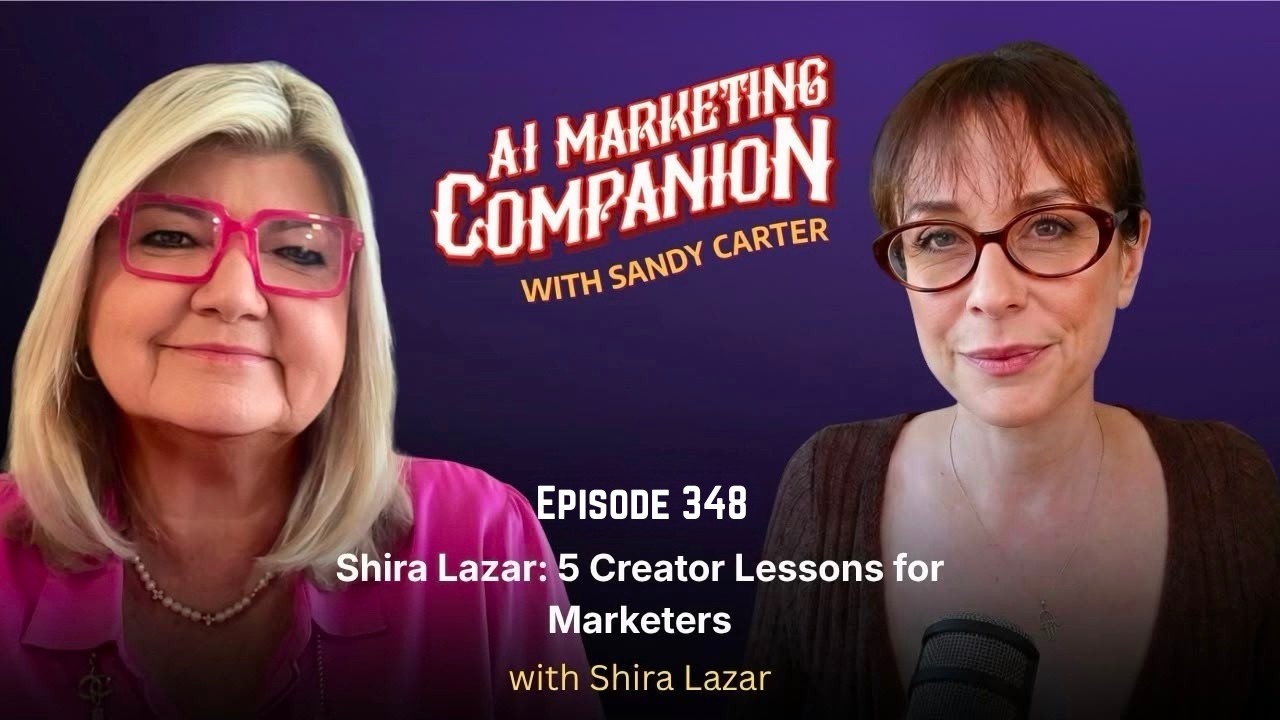
Well, welcome back to our AI Marketing Companion. My name is Sandy Carter. I am your host of this wonderful podcast, and I really appreciate you guys tuning in and listening to us today. We have a really interesting subject, and it's very timely because we are going to talk about America celebrating our 250th anniversary. We have Mike Quinn who's going to join us on the show today, but before I introduce him, I just want to do a big call out and a big thank you for our two sponsors. We have SEMrush who does SEO and GEO for marketeers around the world, including my company and my business who I use SEMrush for every day. And as well, Breveo. Breveo is just a great small business CRM tool. In fact, those great emails that you get when this newsletter comes out about the podcast, those are all sent from Breveo. So I use both of these tools. They're very easy to use and very valuable. Too. So let's go ahead then and get started on our podcast. I'm so excited to have— and is it Sergeant Major? I didn't ask you that question.
Sergeant Major.
Yes, Sergeant Major. Okay, Mike Quinn. He is the founder and chief growth officer of Tenova, which is a very interesting name. He'll probably talk to you about that here in a second, which is a service-disabled veteran-owned small business. And he's got his Hire Military brand, which you can see in the background there on his side. Yeah, he, he's a 24-year US Army veteran, former counterintelligence agent, and he's had deployments to, um, let's see, Iraq, Afghanistan, the Philippines, and founded his company in 2017 to close the gap veterans face moving forward into civilian careers. I didn't get to tell you, but I actually worked with the veterans coming into Amazon when I worked at Amazon. It was He is, this is pretty cool for marketeers in particular. He's a 3-time LinkedIn Top Voice. He has a following over 360,000 people and monthly social reach of 2 million. So you definitely want him to mention you on his LinkedIn post. He's a Forbes Coaches Council member and he, he's the creator of the Digital Networking Professional Program. And his brand promise, I love, it's teamwork and innovation. So Mike, welcome to the podcast today.
Thank you, Sandy. It's an honor. I'm super excited to chat with you all today.
Oh my gosh, you have so many amazing accomplishments. But you know what's really top of mind is America is throwing itself a party for 250 years and you live right there in Washington, D.C. We just chatted about that. And I just learned that for the first time, Reagan National is grounding all their flights on the 4th. The D.C. airspace will also be closing, closing, and the skies over the National Mall are also being cleared for military flyovers. All the fireworks, all the celebrations that are going on. Now, you gave this country 24 years and you're right there in D.C. So I'm interested in, you know, what goes through your heart and your mind as this story of service that shaped the brand and the mission you lead at Tennova, all this is happening right now.
Yes. So, Sandy, I, you know, I'm the kid, parent, child of a single parent. So my mom was a bartender. We grew up in Philly. We did not have a lot. And, um, you know, all the people I grew up with really didn't end up to— in, in some of the neighborhoods I lived in did not end up doing that much. And luckily I went to a good school and I, when I felt lost, I joined the Army and that was right after 1 year of college. And I'd spent 18 years traveling the world, 24 years total in the military, but 18 years were living overseas primarily. Um, I've been in Europe, Asia, the Middle East, Central America. I, I mean, just like all over the place. And you know, what I'll share is that there is no, nowhere that gives you the same opportunity we have here in America. Like I would never have been able to go from being the single, the child to a single parent bartender to where I am today in any other country in the world. It's just not possible. And that's what I get whenever I talk to people. That's what I get when I talk to the Uber drivers that came here from other countries or people that started businesses from other countries is that America gives us such incredible opportunity. And having seen it around the world from the poorest of the poor on up, I'm thankful for that every day. And being in D.C. area just makes it so much more powerful.
Yeah, it's really— it's fascinating what America does. I mean, it gives everybody such a chance. The American dream, right? We hear this on Shark Tank all the time. American dream. Now, America 250 is, I think, a big marketing moment that's coming up. Brands everywhere are trying to wrap themselves in red, white, and blue for the big celebration. Now, as a Forbes Coaches Council member, you live in the marketing world, and we talked a little bit about how you think about marketing differently. I want to hear about that. But how do you think that companies honor America's 250 in a way that feels authentic and earns trust versus just a marketing thing?
So I'm not a big fan, and you see this on LinkedIn and other platforms. Everybody puts the happy birthday or the, you know, happy 4th of July, or, you know, any of the holiday posts they did, you just do these ubiquitous posts that really don't mean anything. And I think if companies just focus on promoting the event, they're going to get lost. Like you're not going to stand out in any way, shape, or form. No one will really connect with your content in a way that makes them remember your company's name or think anything at all about your company just gets drowned out in everybody posting about the events. And so what I think that they should be doing is they should be collecting stories. They should be talking to their clients. They should be talking to their employees. They should be talking to their customers and they should be collecting these stories and then using that to highlight it. And it's easy ways you could do that. You could talk to any of the veterans or veteran family members. Or family members of first responders that are in your organization and hear their stories. You know, what brought them to your company? What makes them enjoy being a part of your team? And by sharing those stories in a patriotic manner, you could wrap all those up into a nice, you know, fancy video. That's how you really like tug on the heartstrings. That's how you make people really trust you, because it's not an advertisement. It's people just like you sharing their stories.
You know, I love quotes, and one of my favorite quotes is, "Tell me the facts and I'll believe. But if you tell me a story, it will live in my heart forever." And so I always try to tell those stories too. Why do you think more companies don't do that? They don't, they don't really tell a story. Why do you think that is?
I honestly, and this isn't going to sound nice, I honestly think it's a byproduct of legacy marketing people. I think these are people that grew up in the print media and early days of the internet marketing where the commercials and advertisements and everything else were the cornerstone of what brought them to where they are today. And so now you have these people that have been doing marketing for 30, 40 years, and it's hard to change. It's, it's hard to understand that the advertisements are not going to have as much reach when AI can give everybody the same tools you have. And you've gotta find new ways to connect with your audience, to connect with your clients, to connect with your partners. And it's just hard for people to change. And I think it's gonna take the next generation, the people that have really grown up, the digital natives, the people that are really focusing on find— not just using AI as a tool, but using it as a force multiplier to be able to do that. But I also think that marketing jobs are gonna shrink. I think you're not gonna need the same amount of people to put the same amount of content out. And you're not going to be the same amount of people to collect the data that you're going to use from it. All that's being done by AI. And so, I really think the flexible people that start to realize that we buy from whom we trust and trust comes from relationships. So, those ones are going to be able to build these campaigns that really drive, you know, sales or the bottom line. And that's what we have to focus on.
You know, it was interesting. I was just watching some of the highlights of of Cannes this year, which is a big marketing and branding show. I usually go. I couldn't go this year, but I noticed that this year there was a lot of discussion, of course, about AI. But what really came through was trust, authenticity, and community. Now, I know you've built this big LinkedIn following, over 360,000 people. You reach 2 million people every month. How is AI— how are you using AI to create your content and grow your audience? And what are you teaching veterans in your digital networking program about using AI to amplify your own voice? Because frankly, you know, when I go out to LinkedIn, I feel like I'm reading the same article over and over again. I don't feel like different. Right. So what's your advice?
So I don't use AI for my LinkedIn content.
Oh, so you don't use AI at all? Nothing?
Not for my LinkedIn content. No, everything's myself. So for me, I've just, the, the way I've built this network is I've posted basically every day for 9 years. Once a day, I capture moments. So I really focus on either a photo, an event, a question, a topic of the moment. And I capture that moment and I put it on LinkedIn either as a photo with some words or a quick story. And, and since I've been doing it so long, um, it's easy for me to tell that story. I literally just type the LinkedIn exactly, almost exactly as I would tell it in real life. And so, um, what I do tell other people that are looking to build content and to kind of build their LinkedIn portfolio is they can still grab those moments. If they don't feel comfortable writing it, then they can leverage, uh, AI tools to help them craft their post a little better, right? With spacing and word choice, things like that. They could definitely use tools to use that. But I, I'm, I think the important distinction is also who, What is my intent on LinkedIn? Like, what am I trying to grow? And I'm not selling, I'm not selling t-shirts or I'm not selling makeup or I'm, you know, I'm building relationships with people that I may have to work with at some point in the future. And so for me, it's very important to be authentic. It's for people to know it's me, to hear in my voice, to see me in the photos and in the comments. And so, yeah, it's all me, but for people that are new, I definitely recommend using an AI tool to just help you get, help you craft the format. You don't want like 6-line paragraphs. You don't want too wordy of a post. You know, they can definitely do it really quickly and easy with a tool.
Yeah. As long as they still have their voice in it. Right. Because otherwise, like, like I forget the line, but it's something like this stopped me dead in my tracks. I think I read that so much. And I know that's coming from, you know, from AI. So how much time do you spend doing your LinkedIn posts, would you say, a day?
Just creating a post? Mm-hmm.
And creating the post, like thinking about it, getting your picture, and posting it.
10 to 15 minutes, maybe.
10 to 15 minutes a day.
Yeah. Yeah.
And what about for your company? Do you do the same for your company?
So I don't do it for the company. I have some people on the team that do the company, because we don't want— it was— I did it early on, and my voice was the company voice. And so there's no diversity there. We reach less of an audience. So the company is— other members of the team do the company voice so that we have a better brand reach.
And for the company, do you advise the same for them just to write it, or do you use tools?
So that, uh, the main person that does it, she writes it herself and then she puts it into an AI tool and says, make this into a better LinkedIn post. And so they get the, they get the spacing and the words and the terminology better. That she always runs everything she sends through an AI tool to check it to make sure it's done well.
I see. You know, I used to, I used to put on some of my stuff, you know, 100% by a human. And then I realized, like, people would call me out because I am— I have— I don't— I can't spell. Let me just say that. And so I would misspell words in my post and they'd be like, oh, I know that it's you because you always misspell words. I'm like, oh. And so I started running it through AI so that it wouldn't have the misspelled words in it. And then people are like, oh, wait, you can't say this is 100% human now. Because you're running it through the tool. So anyway, what do you think about that for credibility? Like, do you think that people should, if they're going to use 100% human, not even have AI like edit it for content? I mean, for grammar and spelling too. What are your thoughts?
I mean, I would say when you type your post, you get the little red squiggly line if it's spelled wrong. So I mean, technically it's the same thing. I don't have an issue with that. Um, if it's, if it's your words, I, I think that it's fine. It just, the problem is, is if you have AI, so, so when I talk about using LinkedIn, it's about building relationships and trust at scale, right? So you want people to know who you are, know what to do, think of you when they have problems that come up, or think of you when they need something, right? Or, or take the call when you call them, cuz they recognize your name. And so if somebody else is doing your content, it's not really you.
That's true. That's a great point.
And so again, for me, it's not about, you know, buy my Hire Military t-shirt. It's about, you know me. And so if I need a call or, you know, if you're hiring for something, you need help, or if you need something, you know, you realize, you know, and trust me, you know, I'll get it done because you see me and hear my voice every day. So the reality is I just want people to make sure it is, like you said, authentic. It's gotta be you. It's gotta be your voice. When it seems too, when they use the same words and it seems too like dry, then we never get to know you. And if it's only work and we never see anything personal, then we know it's just work and we don't get to know you. So you have to have a mix of the personal and professional in there as well.
Yeah, it was so interesting because one of the first times I posted something personal, someone immediately called me out and they said, this is not Facebook. This is, this is LinkedIn. This is work. And I said, yes, but I bring my full self to work. So I need to be able to express that. So it's really fascinating how many people will call you out for different things, which they probably wouldn't do if you were sitting across from each other. But it, it, it is interesting the power social gives people.
Yeah, I, I agree 100%. I tell people, treat LinkedIn exactly as you would real life. Don't say anything to someone that you wouldn't say right to their face the first time you met them, cuz you get access, right? So you could send a message to just about anybody. And just make the big ask. But you would never do that in person. No one would ever say, "Don't talk about your kid or your favorite sports team to your face. I don't want to hear that." No one would ever say that. And so, for everything we do from engagement to comments to posts, it should be things that you would say to anyone in your company, right? It would be things that you would say to anyone the first time you met them. And conversely, You know, don't touch any topic that you wouldn't say to every single person in your company, right? Like, so if you're, if I was at EY, I was for 2 and a quarter years, I was a senior manager at Ernst Young and I had to learn, you know, don't post about anything that's divisive because you lose half your clients. You could lose half your customers, half your business partners, half your employees. And so I always tell people. You know, really focus on the topics that you, and share the good, share the successes, you know, highlight your team and do that in a way that's non-divisive, that brings people together instead of trying to share anything divisive because you're not gonna convince any random stranger that they're wrong via social media. All you're doing is, you know, kind of alienating half your audience.
It's a great point. So, um, Mike, you know, as our country is turning 250, uh, everything right now I think is being reshaped by AI, AI, AI, AI, and it's going fast. And faster. In fact, this morning I was telling someone, my daughters love the book Alice in Wonderland. And in there, Alice says, I have to run twice as fast just to stay in place. And I think that's how a lot of us feel. So through your Hire Military and your SkillBridge program, how are you preparing service members and their spouses to compete, to lead in an AI-powered economy that exists today?
I think there's a couple elements of this. The first thing is choosing roles that are not going to be replaced. By AI in the very near future. I have one of my very good friends, he's a veteran as well. He processes medical claims, right? So they come from the doctors, he checks to make sure they're complete, sends it back if they need to fix anything, and otherwise he sends it for payment. And I asked him, I said, do you work with any AI tools? He goes, yeah, they have us working with an AI tool right now. I said, you're training your replacement. You're, you're going to be out of a job in 1 to 2 years. There's no reason AI can't take that over once it has all the specifics. And so for me, I talk to a lot of people. If you're, if your job is just about taking data from here, repackaging it and putting it over here, you're out. I talk about a lot of like now I'm, somebody brought up to me, what about project managers? You know, how much of their job is going to become AI? And, you know, as far as everything from scheduling to budget to everything else. So, I want people to really focus on how easy would it be for AI to replace that job and not choose that job because you want some kind of longevity when you get out. The other thing I teach is, you know, how to help yourself stand out. I have another friend that, um, was, got a last-minute request to update a resume that hadn't updated a resume in years. I don't do this for almost anybody, but they're like, Mike, I need help.. And so I took the, the horrible resume they had and I, I just pulled that in and said, can you make this resume better in an AI tool? And this is the job and here's the job description. And it went, and there it was. I reviewed it. I made a couple quick tweaks and I had a great one-page resume, sent it back to them within an hour. They were like, oh my God. And so, you know, um, there's no excuse to not tailoring a resume. Anymore. You know, any AI tool, you can put your resume in the job description and it'll tailor it for you. And so, uh, a big thing I'm teaching veterans is that you can make your resume pretty good just by using the right AI tools. And I've got, um, my good friend Dan Savage, uh, he was a mentor of mine when I got it. He, he just built a, a, a coaching and mentoring tool for veterans called Proximo. Uh, another guy, Brad Tachi, that I know from— he's actually living in Japan, He created Best Military Resumes. So there are two great resources for, you know, service members, veterans, military spouses to use to leverage AI to help them figure out what's next.
That's really good. Yeah. And I also, you know, as a marketeer, I play with marketing tools a lot. So I was playing with Ploy this weekend that helps you redesign your website. OCA has an AI CMO that you can use to advise you as well. So even in the marketing field, there's tons of tools out there nowadays. I would say don't get overwhelmed. Like, you can't try every tool, even though I am trying to try every tool because I teach about it. But there are so many tools out there, and if you find a tool that works for you, I think that's a great way to see what the future is too, right? Where things could be replaced, no matter what types of jobs that you're, that you're doing. When I was at Amazon, I helped veterans look at marketing or go-to-market jobs. And these are some of the things that we, you know, that we chatted with them about as well.
I love it. I, you know, I think one of the things that we're coming to, uh, is you've got AI helping write resumes and you've got AI at, uh, applicant tracking systems that reviewing resumes and ranking resumes.
Yeah.
And so what I'm starting to see, just like you mentioned about seeing posts with the same taglines, you get the same resumes that come in. They all look almost exactly the same. And so I think what's going to happen now is you're going to see people lose out on that. It's going to be easy to get lost in the sauce because everyone's using AI to write it for the same job and they're submitting to the same platform. And so what I really think is going to be separating the haves and the have-nots in the future isn't necessarily monetarily based. It's going to be relationship-based. You know, how do you get that referral? Who do you know that's going to say, hey, You know, I know Sandy, she's awesome. You need to talk to her because otherwise you're going to submit your resume into a pool of 800 to 1,000 candidates for every job. And it's going to be close to impossible for a recruiter to not miss the gem. And so I really can't focus enough how people need to, need to build relationships and trust. They need to spend time every day growing their network so that it AI becomes a multiplier instead of something that loses you in the system.
Yeah, I agree with that. I would also say one more thing because I'm interviewing right now for jobs and somebody sent me a resume from a referral. Mm-hmm. And it was clear that they had run it through AI because I actually wanted to speak with them right away. I was talking to them and I said, hey, tell me about your time that you did this. And the guy's like, oh, I didn't do that. Why are you asking me that? And I was like, it's right here on your resume. So what had happened is— Yes. He had used my, my job description and taken his resume, and I guess AI embellished, or— so make sure you read that resume before you send it out there too, right?
Yep.
Yep.
And that's, that's a huge part. Recruiters have to talk to every candidate to make sure the person matches the paper. And I see that all the time where I'm like, you didn't write this. You are not this person on paper.
Yep. So yeah, it is. It's really true because you forget about it. So I know your company name is a combination of team and innovation. I talk a lot about AI First and Human Always. That's the latest book I wrote. I'm curious what, you know, military is known as having great teamwork, great leadership practices, and the way that humans and AI work together, I think there are some parallels there. What do you think marketeers could learn from how the military builds trust in a team and on a team?
So to me, the way we build trust in the military is we actually get to know people. We spend so much time together and we know You know, their family, the holidays, you know, where they come from, what makes them who they are, what their goals are, what they like, what they don't like. You know, you get to know people and when you know people, you know, relationships and trust, right? And so I think marketeers really need to look at how they can highlight their team, right? How you can collect, how you can collect information that tells their personal stories. I had a, there was a, um, a Navy captain, uh, he just made, he just got pinned on his one, his star to become an admiral. Uh, his name was, uh, is Chris, Captain. Now I guess it's Admiral Chris Chaudahill. And he was the, um, commander for the aircraft carrier. I think it was the Eisenhower. And while they were out at sea, you know, every day he would highlight one of his sailors in the ca— sitting in the captain's chair with a cookie. From the galley and every, almost every day. And you just see a smile like they're sitting in the captain's chair up in the bridge on an aircraft carrier with a cookie and just a little story about that, about that sailor. And some of them were like so young. I'm like, oh my God, they're babies.
Yeah.
But everybody I talk to knows who he is, thinks well about him. I really connected with the fact of hearing these sailor stories that they're, that their parents were sending notes saying, could you highlight my sailor? You know, I want to see my kid sitting in that chair. And so I think that, you know, it's kind of genius, but I think that companies could do a better job of highlighting their team, not just like, you know, this is Mike, he works in the marketing department, but like, this is Mike's story. This is what brought him here, you know? And I think that everybody that knows Mike will instantly love the service, the, you know, the company, the product, whatever it is. And then people that have a similar background to Mike will, you know, so you're building those connective tissues, those fibers, the relationships and trust through the stories of your team and of your customers or clients. You know, one other quick story. I have, we used to cut our Christmas trees down. And it's genius. So in Middleburg, uh, Middleburg, Virginia, you'd go pick out a tree, you cut it down, and when you take it to pay for it, they would say, if you show us that you just posted that you're at the Middleburg Christmas Tree Farm, we'll take $20 off your tree. Well, there was like 7,000 people posted about it and they probably jacked the prices up $20 before they took it off. You know, but I mean, you're, you're collecting these stories.
Yeah.
And they see me and my kids with a tree and Middleburg and they want some of that experience as well. And so we've got to figure out ways to leverage AI to collect that content and make it viewable in a way that's scalable as well.
And human. I mean, it's about a human experience, right? I love that too. Well, I know we're coming down to the end, but I do want to do one exercise with you and one question for you. Do you think that the America's 250 celebration Um, has it been marketed well? And two, if you had to create an AI-powered marketing campaign for America's 250, what would it look like and what would the story be that you think it should tell?
Oh, so I, I don't think it has been marketed as well as it could have been. I'm not trying to be divisive here. Our, our country is divided. Mm-hmm. And so unfortunately there's a portion of the country that doesn't like it as much because they voted for the other person. And so I don't think that people can see beyond, you know, who's in charge and realize that we really have the best country in this world and the opportunity that it's given us all. And so I don't think it's marketed— been marketed as well. I think they could have done it better with more of a grassroots marketing strategy, you know, using, you know, encouraging, you know, service members to tell their stories, first responders to tell their stories on social media. You know, government people sharing their stories and, and what they're going to be doing at the event, you know, getting people to share, you know, why they're going to be there, why it's important to them, why America 250, you know, that's what I would really love to see is more people sharing their specific stories on what America 250 means to them. And there's still time for them to do that. But, you know, I would love to see like personal stories like you know, uh, I, I spoke with one service member who joined the Navy cuz he was homeless living under a bridge.
Oh, wow.
And he became a nuclear, um, technician and made it through that schoolhouse and got out and got a 6-figure job. And I mean, it changed his life. And so again, nowhere else in the world can you do that. And so that's what I would do.
Yeah, that's, I think that's really interesting. You know, I was at CES this year. In January, and they did a really good job on the World— this— on the soccer match, the football matches going on now. I think they did a really good job there. Um, I wish they had done more, but I did do— I don't know if you can see these— these are little red, white, and blue bracelets. They're, they're from the Word Project, and they have USA on them. And what you do is there is this little— I love this marketing, I think it's genius. I don't know if you can see this little tag.
Yep.
But you can give— you register the bracelet and then you give one away. And when you give one away, you watch it. It travels like all over. So one of the bracelets I gave away, it went to Wyoming, went down to Florida. Somebody gave it away, went up to Maine, went back to Oregon. And I just thought, wow, what— I mean, what a really cool way to tell a story. And you're passing on, you know, red, white, and blue and USA. I thought that was a really good way to, you know, to amplify and to tell the story.
So I love it. I'm a former counterintelligence agent and you just put an RFID tracker on people without their knowledge. So, so just like, it's like you just AirTagged them and didn't tell them.
So maybe, maybe I don't think they can track precisely where I am right now. When you register the bracelet, you tell it where it is.
I know. Let's move on to the next topic.
That's right. Okay. So as we move on, this will be our last question. As we move on towards, let's say, 275 instead of 250, what is your hope for the country and for veterans and the role you see in AI, of AI in opportunity and hiring? What's one thing you want everybody to take away as the episode ends today?
You know, I believe that the playing field is gonna be leveled with AI. Everyone's gonna have access to the same resources, the same tools. And so I think there's a real opportunity for even more growth. But there's also an opportunity for, for it to become like this in society, like we see in some of the science fiction, you know, kind of movies. And so what I would encourage everyone to do now is when they have access to these AI tools is to start playing with them. Start learning how you can use them to make your work life more productive, how you can use them to do anything more productive as a tool so you don't get left behind. And, you know, same thing goes for veterans. You know, I tell them that they could do anything. You could leave 20 years after the military. I never thought I was going to start and run my own business. Like, I never thought that, but opportunity comes when you spend more time and, you know, you work hard and you build relationships. And I think You know, AI just gives you more time, right? So if your work takes a little less time, cuz you're leveraging these tools, then you don't just work less. You should, you know, optimize your time and spend that on something that would help you continue to grow. And that's what I think that a lot of veterans will hopefully start to learn is that they can start investing a little bit of that extra time now and it compounds so that, you know, again, the sky's the limit for what they do next.
Yeah, I love the IKEA story. I don't know if you've heard it, but IKEA went in and they decided to automate a whole bunch of roles that IKEA does today. But instead of firing the people who were left, they had this genius person who said, we've got this gap, like, for designing rooms and your, you know, what does your bedroom look like with all this IKEA stuff in it? So they retrain those people because the, you know, having taste and all that today isn't really AI. And so they move those people to have that taste and that design to help others. And I love that story because to me, that is really the spirit behind AI. It's not to just replace us, it's to give us time to do what we're really good at, that creativity that really, you know, helps so many others.
Exactly.
Well, thank you so much and thank you guys for listening to the AI Marketing Companion today. Hopefully you got a couple of nuggets out of here. You know, one of the takeaways I would— I got from Mike was story, story, story, story, story. Tell a story. Authentic, you know, be authentic. Use the tools, but use it to complement what you are saying and try it, right? Like, you know, I call it playstorm. Get your hands dirty with AI. No matter what part of marketing you're in today, you can do that. And I do want to say a huge thank you to SEMrush and to Brevit, who I use every single day, literally every single day. And I do thank them for sponsoring the show. So thank you, Mike. Thank you for coming on and thanks for spending your time with us today.
Thanks, Sandy Carter. It's been amazing. I appreciate you.