Will AI replace marketers? A mother and daughter get real
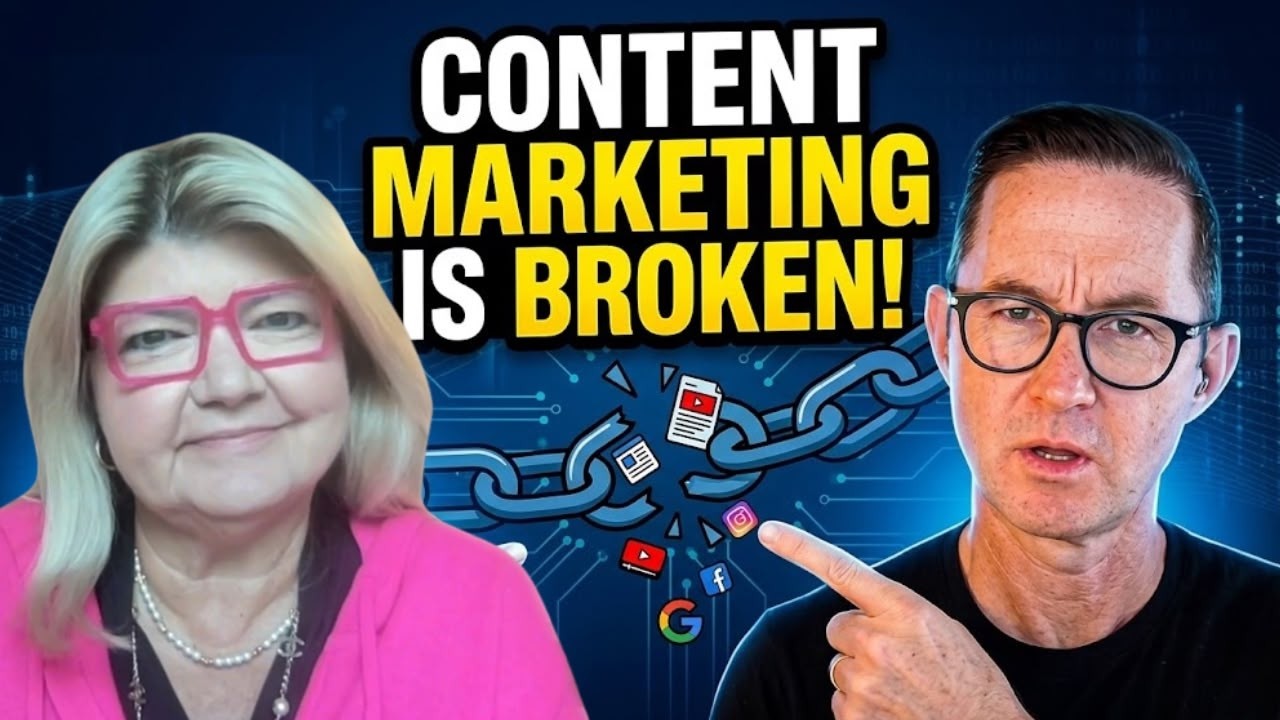
In this informal podcast‑style interview, veteran marketer and podcast host Sandy Carter talks with her 25‑year‑old daughter Cassie Carter Allensworth about the impact of artificial intelligence on marketing careers. They explore whether AI will take jobs or augment them, how AI can be used as a thinking partner rather than a replacement, and where the line is drawn between delegation and loss of personal judgment. The conversation highlights generational differences: younger marketers often seek instant answers from AI, while older professionals treat AI as a systematic tool that informs research, storytelling, and workflow. Specific marketing tasks that are already being automated (analytics, competitive research, content drafting) are contrasted with areas that still require human creativity and judgment. Sandy outlines three core skills future marketers should develop—judgment, storytelling, and workflow thinking—alongside solid AI literacy. They warn about the dangers of unverified AI output, the risk of homogenized brand voices, and the importance of maintaining a human layer in content. The episode concludes with practical advice for young professionals: experiment with AI on real work, double‑check results, keep personal integrity, and use AI as a last‑resort aid rather than the first option.
Chapters
Okay, so I'm 25, I work in marketing, and everywhere I look people are talking about AI. Some say it's going to change everything, but others say it's overhyped. So I thought instead of guessing, I'd sit down with someone who actually knows what's going on, my mom, uh, and ask questions I think a lot of people my age might be wondering. So Give us some examples.
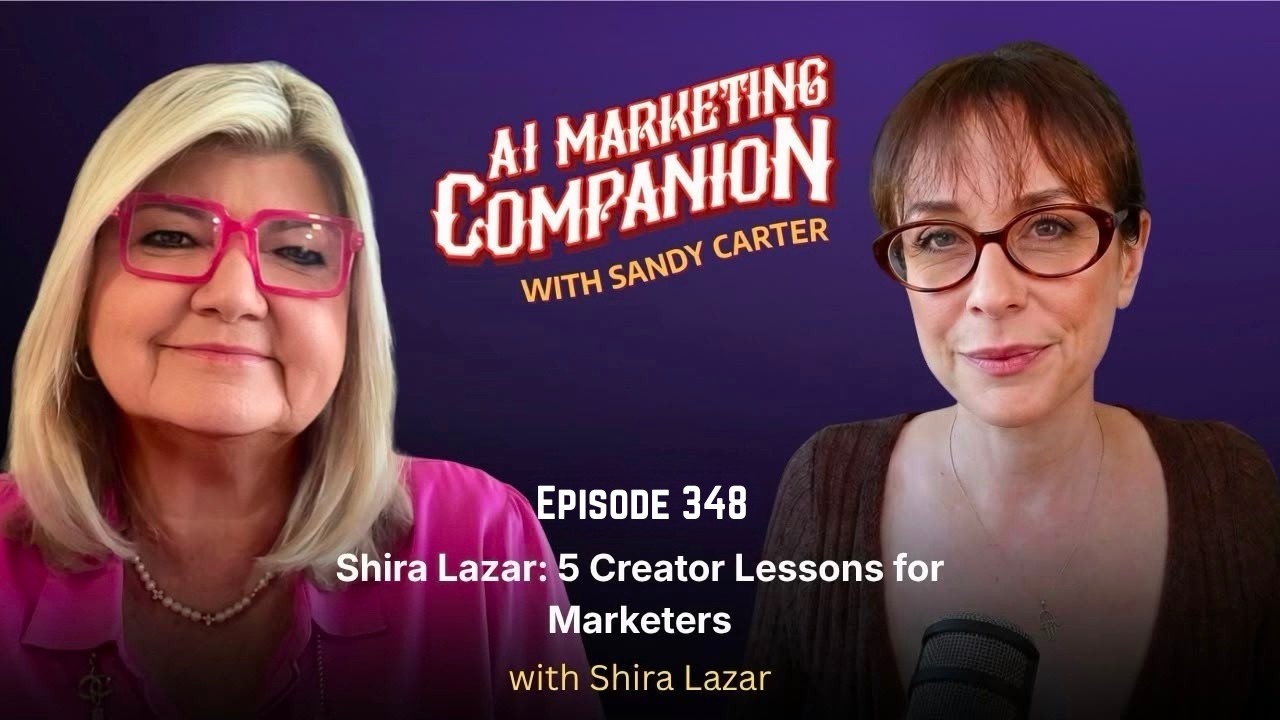
So it sounds like you might be worried. First of all, I should say my name is Sandy Carter. I'm the host of the Marketing Companion podcast, and this is my daughter, Cassie. She had some questions, so we thought we would get on a podcast today and kind of chat this up. And I think the first question you have is, should I be worried that AI is going to take my job? Is that right, Cass? Yes. I would say maybe. Some jobs will be taken over by AI, but I think more likely many of the jobs that you're looking at taking are going to be changed by AI. So for example, you're an artist, right? Yes. In fact, for one of my books, you helped me design the COVID art for it. And you used a combination of your art and artificial intelligence, right, to come up with that cover.
Yes.
I think that's what we're gonna see more of is humans augmented by AI. I think the work will be shifting and how it gets done and where it gets done. So for an example, for me, just like I gave the example for you doing a book cover for, before a big keynote, I use a tool called Notebook LLM. And on Notebook LLM, I debate my topic. So maybe I feel really strongly about something, but I need to hear the opposite side of it. I have Notebook LLM debate the topic for me. So it'll say, oh, I disagree with this and this is why I disagree. So I think that that is really powerful. I think my point of view then can be argued. I can hear the opposite side. It pushes me to find holes and makes it sharper. I think most people your age use AI to write faster. Would you say that's the case today? Yes. I'm going to use it to think better, to think more clearly. And I think maybe that's the difference is that you shouldn't really be worried about will AI take my job, but how can I use AI to make me stronger at what my job does? And how do I make myself a better employee as we move forward.
That makes sense, Cassie? Yes. How do we differentiate when AI has taken over entirely and where we've stopped thinking for ourselves?
Oh, that's a really good question. There's lots of research on that where when you delegate thinking to AI, your, your brain actually stops working. And in fact, I just saw— I don't know if I showed it to you or not, but I just saw this really funny video where this guy walks into the store and he's like, oh my gosh, what do I do? So he gets out ChatGPT and says to the clerk, I'm looking for something. And the guy is like, oh my gosh, he's looking for something. He gets out ChatGPT and types in, what should I say? He's looking for something. And they go back and forth and back and forth because they've delegated all of their thinking to someone else, right? So you should never do that. I never just type in, oh, you know, write me a note and don't read the note. Don't think about the note. Or ahead of time, put in there, I want to talk in this note about these 3 things and here's kind of how I want to phrase it. I use AI more to spur my thoughts on than to replace my thinking process. And I think that's a really smart question, Cassie, to be asking. Is how do I make sure that this doesn't replace who I am and what I think?
Right. Because I know a lot of people in my— at my age do that. They immediately go to ChatGPT or whatever they look up and immediately just start like, how do I do this? Or if I'm given this example, how do I make it blah, blah, blah? And that's— that was it.
They do that. I'm just curious, why do you think people your age do that today?
We're lazy. We don't want to work for— we don't want to work for it. Okay. We want to be just given the answers, but we don't want to work hard for the outcome. We just want to be given the outcome, whether it be good or bad. Um, I, I wouldn't want to do that because I want to learn, I want to grow, I want to learn how to do something with my own physical body and own physical, like, mentality and without AI being able to pitch in and tell me, you know, this is how you do something, but I wanna know how did you get to that conclusion without doing— it's like being in math class. Like you can have the answer, but the teacher will always ask you, well, how did, what steps did you use to get there?
So, yeah, that's a great, that's a great one. Yeah.
What's changed recently with AI that actually matters for someone like me in marketing?
Well, you know, I think a few things, some of the things we just talked about. I think that AI went from just helping you prepare and went from just answering a question, how do I do this, to helping you prepare, helping you decide, and helping you kind of execute on it, right? So for example, you know, I write articles for Forbes because, you know, I stay up late writing those articles. And I don't just kind of sit down and ask ChatGPT or Claude to write me an article. I'll do a lot of research online. I'll do research in Claude. I'll do research in ChatGPT. I need to make sure I double and triple check because ChatGPT and Claude and Perplexity all still hallucinate as well, right? And so, you know, I really need to leverage AI to pressure test my ideas. What am I missing? What angle did I not know about? So for example, I was writing an article tonight. I started a draft of an article tonight for Forbes, and I had found a couple of stories that related to it. But I asked Claude, what did I miss? And sure enough, a really awesome story I missed. I just didn't have enough bandwidth to go out and look at everything that's out there. And so, you know, that used to take a whole team for me to do that or a lot of time for me to do that. Now I can do it when I just sit down and really, really, really focus on what's happening. So I think the change is not just kind of the speed, but I think it's the depth. And I think if you use it right, back to your earlier point, Cassi, I think it can actually improve your thinking, not substitute your thinking, but improve how, how and what you think as well. Right.
When you look at marketing specifically, what parts are already being replaced and what will still really need humans?
I think a lot of things that are being replaced today are something that's repetitive. So for example, a lot of my marketing clients that I work with, We're seeing like doing analytics on a landing page that's being automated. So now you can get the data and then you can make the decision on what to do and how to do it. Or things like, you know, doing research, like I just talked about for Forbes. If you're in marketing and you're doing marketing intelligence, you know, you and I were just talking about your company. How do you figure out what your competitors are doing and where the gap is? You can do a lot of that research. And I think a lot of that will also be automated as well. So I think many of the tasks that are just straight, you know, hey, I need to look at a number, I need to look at the research, I think those type of things will be replaced. I think the human part will be judgment, creativity. I still remember that one ad that Nike had, and they put all this AI compute power on it, but it was still the humans that came up with a really cool creative tagline, right? And I think, I think what you want to be able to do is you want to, even if you're using AI to, you know, to help you formulate your thoughts, your outline, you still want to react to it. You still want to refine it. What hasn't changed is your judgment and how you're using your judgment. I think AI can give you, you know, 10 copies of something and You know, you're going to know which one's right for you, for your brand, for the moment. And I think that's still you. That's still Cassie, right? Just think about your drawings, Cassie. When you do those drawings, you know, you'll throw away some of them, but then you'll, you'll get it. You just know. How do you know? It's like hard to decide, right?
Yeah, I think for me it's very personal and it is to many artists that whether or not they feel like they've, you know, made a line proper, or, you know, because I do watch a lot of artists online and they tend to sketch it out first. But for me, I feel like sketching it out makes it more sloppy and then it's harder to go back. But they've made tools now in multiple different apps where you can make copies of that same one, go over it multiple times, and then combine them, and and then you have the finished product that you want. I haven't yet worked with that, but I've definitely seen different artists do that for sure. And that's something that I think is, is going back to your point, very personal to the artist or to the marketing person or to, you know, whatever your specific job is.
Yeah, I think that's a great point because, you know, knowing what's right sometimes, you know, a lot of times when I was coaching my team, they'll be like, well, just tell us like what, is what's going to be the thing that you pick. And sometimes you just don't know, right? It's like you have to see it to know that it's right, or hear it to know that it's right, or read it to know that it's right.
Yeah, I do, I do find that to be very true. Um, sometimes when I'm proofreading, I tend to go back and read it and I'm like, wait a minute, that didn't sound right. But the more I do it, the more it sounds better, and, or it sounds, you know, as like a rough draft of writing, which, you know, of writing your books, you have rough drafts and then you have final drafts. So in that process in between, you tend to find out, well, that sounded good, but ultimately it didn't make sense. Um, or this makes sense, but it doesn't sound good. So you kind of have to find that balance in the middle. And I think all of it is about balance. Um, so a lot of this is just thinking of something, balance where AI can help balance you out, and then the final product. Mm-hmm.
I agree. I agree.
What's the difference between someone who actually uses AI and someone who's actually ahead?
Mm, I think that a lot of people today still use AI as a tool. And I think the people who are getting ahead are using it as a system. So let me give you an example of that. Like, you know, I look at customer questions all the time, support tickets, feedback, what people are asking for. You know, that's real data. And then I use that to shape my marketing messages, my campaigns, and my content. So if we get a lot of people that are confused about something, or a lot of people who are like, wow, this is like the greatest thing, but maybe I didn't even think about that use case. So instead of me guessing what people want, I'm actually working with what they are saying. And I think that's a very different way to see this whole thing, is to frame out this like a system, not like a tool. I'm not just going to AI and saying, hey, write me a post for my customers who want this. I'm actually doing the work, getting the questions, you know, exploring what they really are saying, how they're really saying it, which I think really makes a difference as well, and then leveraging that as a systematic way to, to, to view this. And I think that's what most people do when they're wanting to really stand out, is to use it as a system, not just one little segment, right?
And I think that's when you asked me before why you think my generation does that. And I think that it's part of the using it as a tool and instant gratification, because we are a very instant gratification generation. Um, and I've noticed that they're just using it as a, like, tunnel vision mindset, just where, oh, this is the one thing that I needed, I'm not going to go look it up, I'm not going to go do the research, I'm not going to have ChatGPT explain it to me, that's the answer and that's what it's going to be. But unlike you, you do the research, you take the time to go look to, to make sure that did ChatGPT or AI in general get this right, because I know I've seen a lot of posts where people will ask, uh, ChatGPT how to spell, uh, December to ChatGPT, and they'll put an X in it, and then they're like, spell it out, there's no X. But then it's like, oh, I see your mistake. But AI also makes mistakes. It's not perfect. It's still growing. It's still evolving and learning, just as we do, um, when we are young and, and we need help and learn. Um, I think that It just takes a mind to see what needs help. So, are brands going to start sounding the same if everyone uses AI for content?
This one is absolutely true because today I was reading some posts. Um, you know, we had some free time today and we were kind of hanging out. In fact, you and I went for a walk today and I was reading some stuff and it was like all starting to sound the same. So yes, I think this is already happening today, right? You can feel it. It's overly polished. It's clean and it's completely forgettable. I think the brands and people who are going to stand out are going to bring a point of view, a real experience. This is why I love telling stories. You know, you always— you know, I tell a lot of stories about you and your sister, but this is why I love to tell stories because they're real. It feels human, right? You can relate to me because you know that story is something that's from me. I think AI can help like shape the story or shape a structure, but the story itself, I think it has to be yours. It has to be owned by you. It has to be owned by the brand. And so I think honestly, the more AI people use, that human layer becomes the differentiator. I don't know if you saw that commercial, but the other night there's a commercial about this guy and he gets into the car and it's a Waymo, so he's not driving himself to work and it goes like a different way. Then he stops at a coffee shop and he goes, no sugar, and the robot pours like all the sugar in. And so like everything he was doing that morning, people weren't listening to him. And then voilà, there's this bank and the bank is, I think it's I can't remember the bank's name, so I won't call it out. But the bank comes in and it says, hey, sit down, and has a person talking to him. And that human layer becomes a differentiator. So we're already starting to see companies say, hey, come to us because we're not just going to send you off to a robot. We're going to personalize what we do for you. So I do think I'm already seeing it, aren't you? Like when you read a post, you're like, didn't I just read that?
Right? Yeah, I do see that a lot, especially on Facebook or Instagram. And I did notice that a lot of when you're on the phone and you have to talk to a doctor or talk to your bank or, you know, just get a hold of anybody in general, you don't get, um, you don't get a person, you get AI, you get a robotic voice. And then you say, um, you know, assistant or whatever, you know, whatever you can do to get to a person. Um, and I just remember doing that all the time and I'm like, hey, I need help, but you're just an automated system. But it'll say, I can take full sentences. So you give it a full sentence and next thing you know it says, I'm sorry, I cannot complete this. But if it was a person, they would kind of understand and have that human layer to them to think about what you're asking and then give you a clear answer for it. So I, I completely understand that one. So, um, if I want to stand out in my career, what skills should I be building right now?
I think probably 3 skills that you should be building, and I know you and I have been talking about these a lot. Um, one is judgment. We just talked about that, right? How do you know what's good? How do you know what's not good? Um, AI can give you lots of options, but you have to choose, or you should be choosing. I think the second one is the one we just talked about, which is storytelling. I just, you know, my favorite quote is, "Tell me the facts and I'll believe, but tell me a story and the story will live in my heart forever." I still give presentations and when I'm out keynoting, people will go, "Oh, I remember that story about the pancakes. Oh, I remember that story about your daughter wanting the mug. Oh, I remember that story." they, they really latch on to the stories because I think the story makes it memorable. And I think the third is what I would call workflow thinking. So not can I do the task, but can I get it done in a faster, smarter, more effective way and leverage other things? So when I look at people, I'm not just looking at output anymore, I'm looking at how they got there. And you made this point right up front, right? Like, I don't want a black box. I want to understand how it got there. Now, of course, all of these are wrapped in AI. I think anybody your age today needs to know AI and really needs to know it well in order to get a great job, right?
Right.
Do you think most people your age believe that?
Yes, that this is where we're headed, that it's not going to be something that just comes and goes, but it'll be something that stays for for a long, long time. I can't say forever because I don't know, but it'll definitely be something that's around for generations for sure.
And I'm curious, I'm— what advice would you give people my age for working with the next generation, for how to make you guys feel comfortable in the age of AI?
Um, let me think about that one for a second. Um, I guess be patient with us because we, we also don't know what we're doing. We're learning just as much as you guys. But I think you guys grew up in an age where technology was really starting to kind of take off, especially with computers, cell phones, TVs, you know, just simple things like refrigerators and microwaves and things like that. But now we're entering a time where all that is changing and you have that instant gratification right at your, you know, the tip of your fingers and you have the computers that that you can just look up anything, or, um, you know, you can Google search something and you find a picture and Google search it. You know, that's all something that, that you didn't grow up with, but my generation did grow up with. Um, so we kind of have an advantage on you, sort of, because we grew up with it. Whereas I'm not calling you old school, but, you know, I'm, I'm basically saying that you didn't grow up with that, but we did. So we have a— we kind of have a leg up on that. Um, and you guys are also learning but it's— I think we just have to kind of come together and say, hey, this is what I know because I kind of grew up with it. This is what you know because, you know, you're learning about it. So how can we come together and use that to make it better and not just say, well, you don't know what you're talking about, or you don't know what you're talking about because you're young, you're old, whatever. Um, but just kind of come together and say, hey, this is what we're doing, this is what I have, this is what you have, and make it a puzzle piece that fits together.
I think that's really interesting because, you know, someone like me, I've done all the roles in marketing, so I know how they're all supposed to be done or how they have been done. So the workflow pieces are pretty easy for me, but the tech is easy for you, right? Like, you know, a lot of times I'll come to you and I'll go, okay, um, how do I do this in TikTok? How do I do this in Snap? Like, what happens? And so I do think you're right. I think combining the two together is really important. I think that domain knowledge is something that I really worry about for you guys, Cassi, because a lot of the entry-level roles are now being cut out. You're not going to get that on-the-job training for how is it supposed to work or learning from others. They're almost just going to skip over it. I do fear for the next generation that they're not going to have that kind of intern-ish-like experience. Because it's just being skipped over. So that is something that I do really worry about for that next generation, like you growing up in that world today.
Right. And we are at 22 minutes.
Okay. So we can take about 3 more minutes. Do you want to ask one more question, Cass?
Sure. Let's see. Let's see. Let's see. What is one mistake people my age are making with AI that could actually hurt them?
Wow. Well, I think one of the biggest mistakes is, well, maybe it's a couple, I don't know, but you know, just not double-checking your work. Like the other day, I got a note from somebody who wanted to sit down and do mentoring with me. And it was clear that the note they sent me came from AI because it said, insert person's name here. And they just sent the note to me. So they didn't really read it or, you know, they'll they'll not double-check to make sure that it's accurate and what the data is that they're giving me is true. We had a hackathon and somebody submitted something and it wasn't even accurate about themselves. So I could see that they had sent it through a system. So I just think, you know, understanding that you guys are smart and you're smarter than a computer. You know, they used to say, are you smarter than a 5th grader? I think you're smarter than the AI in a lot of cases. So that confidence level that you have in yourself, you know, to make sure that you are, that you're feeling like I don't just have to depend on the computer or the AI because it told me this, you know, I think that again, that thinking, right? I'm hoping that you guys don't delegate your thinking. I just think that would be the worst, positively worst thing that could happen to the next generation. Is to outsource your thinking, but to keep that uniqueness, uh, that you have as well.
I do fear that we won't be doing that. We will just delegate AI to everything, unfortunately, because a lot of people don't want to think. It's that instant gratification. They don't want to think for it. They don't want to do it for themselves to get out of the funk that they're in because they don't know what to do. When you don't know what to do, and you ask simple-minded questions, then you're going to get outcomes that can't help you. But if you ask questions and, um, what's that saying? Idiots don't ask, uh, idiots, idiots don't ask questions. But people who want to know more, they want to learn. They, you can tell who's smart because they keep asking questions. They keep wanting to know more. But the people who don't want, don't ask questions, don't want to know anymore, they won't ask questions because they just want it. To be done and over with.
That's a great point. And in fact, one of my friends wrote this book, it's called The Creator's Code. And what she was trying to do is figure out for all the really super innovative people out there like Elon Musk and Jeff Bezos and others, what do they do differently? And she found one thing that all those people did differently, and that is ask a bazillion questions. They just kept asking questions. They weren't satisfied with the first answer. And so if you're not satisfied with the first answer and you keep asking, you're typically going to come up with something that's more, you know, more innovative for sure. Okay. I know we're running out of time. What I'd love us to do, Cass, is maybe end with, you know, what do you think? What would you advise for people your age today that they need to do this week around artificial intelligence? Like, what would you say that they should start looking at?
I don't know.
Should they just, you know, play with it, use it for something that's real?
If they don't know what it is or, you know, which could be, definitely play around with it, see what it can do. But never, never, never lose your own integrity, your own thought process, your, you know, what makes you you. Because then you're no better from AI. You're no different from AI. So I think as long as you keep to who you are and, and work with AI and have it as your almost last option instead of your first option, then I think we'd be in a better outcome for sure.
Yeah, and I would say what I would advise everybody to do this week is to use AI for something real, like that's how you're going to learn it. And I would say use it for work. I was looking at a study the other day. It says that most people are using AI today for home projects, which are good. But I think using it for work, a presentation, or helping you to, you know, kind of frame up some arguments or something would be great. And then have it debate you, have it challenge you, have it find your gaps. And then third, you know, come up with that human add, like what is that story you can add or what's that real-world data that you can add in? And I think you'll start to see the difference for sure. But I thought it was really helpful, Cassi, for you to come on this podcast today. You know, I've been getting a lot of questions from lots of people about what do we do with the next generation and what should we teach them? And in fact, a lot of people have asked me to write a book. Maybe you and I could write a book together on that. What do you think about that?
I think that would be a good thing to do.
Like that could be really—
we can get both sides of two different generations.
Yeah, that's right. And I think it would be really interesting on just how people are using it. I watch my teams, you know, I have marketing and sales teams and customer support teams, et cetera, across the board. I think it's really interesting to see how different generations are using AI. So thank you, Cassie. Again, Cassie, Cassie Carter Allensworth here, my, my daughter who decided to come on and ask me some questions about AI. We thought it might just be fun for you guys to hear what that next generation is really thinking about and really asking today. So thank you, Cassie. Anything else you want to end with?
Nope. Thanks for bringing me on, I guess. Thank you for asking questions and getting a younger generation's point of view.
Awesome.