Behind The Scenes Of A TFSA Training Call
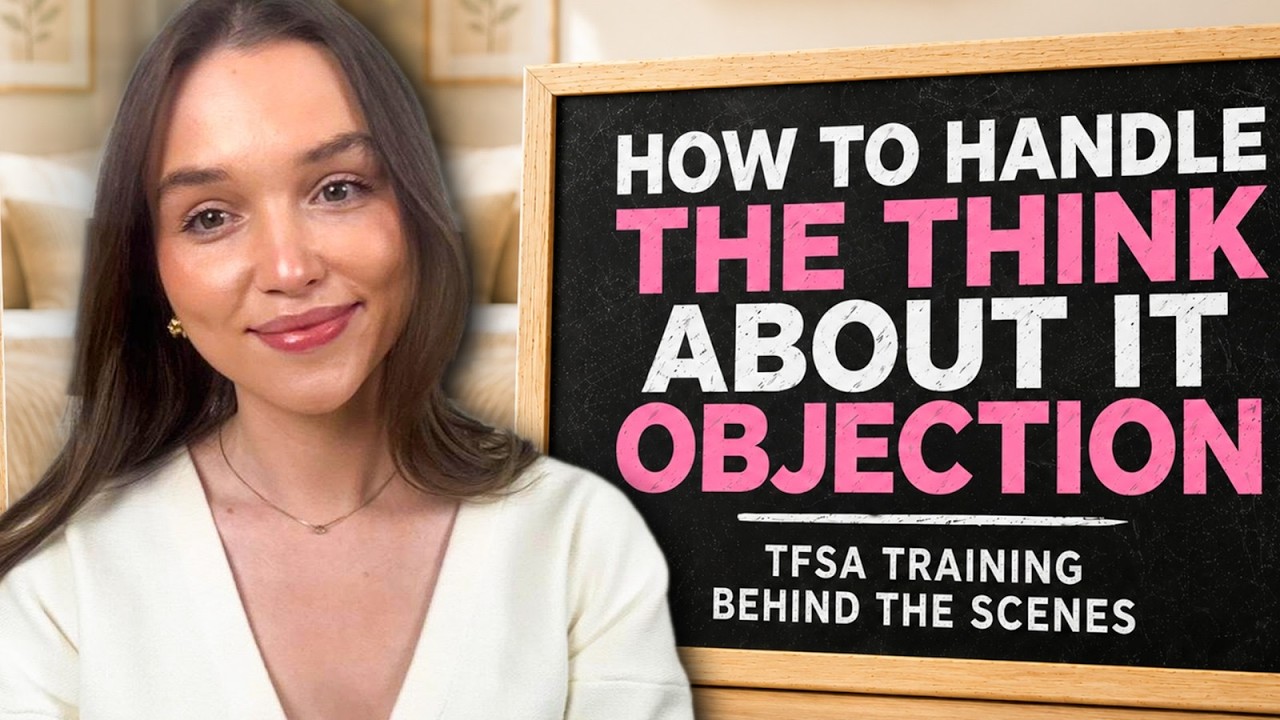
In this live sales‑training session, Shelley Young walks a group of closers through a concise, repeatable system for handling the common “think about it” objection. She frames the objection as a smokescreen that always hides one of five deeper concerns – money, partner, time, trust, or fear – and explains that the root cause is usually weak discovery. The core process is a three‑step “Diffuse → Identify → Handle” framework: first defuse tension and signal partnership, then probe until the real objection surfaces, and finally address it directly. Shelley introduces a looping technique that re‑anchors the prospect to their original why in three escalating emotional loops, followed by a “last‑resort” personal story that uses vulnerability to break through remaining resistance. Throughout she stresses the importance of calm, low‑energy tone, role‑play practice, and a discovery audit (money qualification, decision‑maker confirmation, urgency lock) to prevent the objection from appearing in the first place. The session also includes Q&A on how much looping is appropriate, handling partner objections, and managing internal resistance as a closer.
Chapters
I think it's really inspiring, so thank you for sharing. Let's get into it. I think this has been our biggest group ever, so everyone wants to know how to handle the think about it objection. And I'm gonna be honest, and I'm gonna pre-frame this and say this is gonna be the most simplest training ever because it needs to be the simplest training ever. Like, handling the think about it objection is so simple But so many people overcomplicate it. All the social media tactics complicate it. I used to freak out when I used to get the think about objection. Like, my whole body would like tense up. My heart would be pounding. I'd be like, I have no idea what to do, the direction to go in. What does think about it mean? Like XYZ. And once I developed this strategy, you can do it with your eyes closed. Now, are you going to close everyone who gives you a think about objection? No, but the important thing is the better you handle it, the better self-regulation you can have, and obviously the more people you can support and you can close. So yeah, take notes. Obviously this call will be in the training anyway after, um, and it's going to be super simple but very, very effective when done correctly. So Let's dive into it. What think about it actually means. Think about it is 100% of the time always a smokescreen. When a prospect says, I need to think about it, they are literally telling you one of 3 things. They are afraid of the money, they don't fully understand the value yet, or they don't trust themselves to make a decision. That's it. The real issue, obviously we know if you came to the pre-handling objection training, is your discovery wasn't strong enough. That's it, facts. However, we're not gonna focus massively on that today. We're gonna focus on if you get it, if your discovery wasn't strong enough and you get it, how do we handle it? The think about it objection is almost, well, it's never a real objection, almost never a real objection. It is a smokescreen, a polite exit from a conversation where the prospect Doesn't yet feel safe enough to tell you what's actually stopping them. 9 times out of 10, if you're getting the think about it, you've missed something in discovery. You haven't pre-handled money, partner, or intent. You haven't anchored the investment, confirmed who's making the decision, or created urgency around why now. And when you leave those open-ended, it creates hesitation. The objection is a symptom. It is not a problem. The problem lies back into something that has been missed. So of course, think about it comes up because you haven't doubled down and given them a solid enough reason for them to make a decision then and there and for them to not have hesitation. So you want to blame yourself in a, in a positive way because you know this can be resolved. Think about it is not a no. It is a signal that something was missed earlier on, and it's our job in that moment to then go, okay, something was missed. Let's find out what was missed, and we want to go into detective mode. So always, always, always, step 1, defuse. Agree, remove tension, and open the door back up for conversation. What this does, it signals you are not going to fight them. So they won't fight with you. You are on their team. We are like, let us say you are here and they are there on Zoom. You want to be next to them, like holding hands, best friends, like you are on their side. It opens up a door for them to share what is actually going on. Let us be real. Whenever you have had a problem in your life, would you share it with someone you did not trust? No, you would only confide in someone you would trust. So make sure you are the person they confide in. And it puts you back in control of the conversation without them realizing it. Because they're so caught up in their emotions, they don't realize by just you diffusing alone that you are still the leader and you have control of that call. And it buys you space to move into step 2, which is identifying the real objection. So when you diffuse first, the moment a prospect says they need to think about it, most likely if you don't know how to handle it, you're bracing yourself. They expect resistance because Every single person most likely has been in a situation in real life or virtual where they've had a sales rep who have been pushy or a bit manipulative or really focused on the sale. It's human nature for us to expect that from a salesperson. So they expect resistance, they expect you to be pushy, they expect you to jump into persuasive mode. When you don't give them that energy, something shifts. They relax, they open up, and this is exactly what you want. Diffusing is not agreeing that they should think about it. It is removing the tension so they stop being defensive. A tense prospect will not tell you what's really going on. A relaxed prospect will. Your energy here matters as much as your words. You stay cool, you stay calm, genuinely curious, deep, low tone. You speak slowly. You're not being pushy. You sit back. Like I've had calls in the past where I was objection handling like this. I was like la la la la la la. Like because I was feeling it. Now I'm like yeah, okay, no problem at all. You need to think about it. And I'm so cool, calm, and collected. It makes the other person have the same energy because people will always match the energy of the leader. Most salespeople get tight and like kind of. Aggressive when they hear that kind of think about it because it's quite triggering. Their body language changes, their tone shifts, and the prospects will feed it immediately. You've always got to remember, thinking about it is not personal. It's not a rejection. It's not an attack. It is that person has a fear or a problem and you're just there to help it. So script, how to defuse, very simple. Someone says, yeah, everything's great, but I just need to think about it. You say, that is no problem at all. I totally respect that, but help me understand so I can help you. When you say you want to think about it, what is it you want to think about? Pause, silence, let them do the work. And I'll talk about looping in a moment, but if they're like, no, I just want to think about it. Yeah, totally not a problem. But when you say that, what is it? What do you mean by that? Just so I can help. And you just always, always diffuse and loop back until they tell you what the real reason is. And the more silence you put between them and yourself, the more that they'll start blabbing, and they will tell you the real reason, which is what we need. Step 2, identify the real objections. So they've said, I need to think about it. You've said, No problem at all. Totally understand. When you say you want to think about it, what is it you want to think about it so I can? What is it you want to think about so I can help? Then they're going to give you the real objection. So this is part two of the process. Once you diffuse, your job is to uncover what is really going on. They are only there are only going to be five objections hiding behind the think about it. You probe gently and persistently until they never. Until they tell you. So, this kind of links back, thinking about it out loud, to one of the trainings we've done, maybe on mindset, maybe on kind of Lucky Girl and getting what you want. I realize now, the reason that I don't take no for an answer is a lot from objection handling, and you'll start to build that muscle too. You cannot take no for an answer. If you get off a call and you don't know the reason behind the think about it, You failed miserably. Not to be harsh, it's true. As a closer, you have not done your job at all. If you've got off the call and you know the reason behind the think about it and you can't close, fine. We can't get everyone. We'll work at it last time. But it is super important to know the real objection, and it's very simple to handle as long as you persistently loop, which again, I'll get on to looping in a moment, but you consistently loop until they tell you what that problem was. When you know the 5 objections can be money, partner, time, trust, fear, it's as simple as it gets, because you're going to start to sniff it out and to be able to actually help them. So, money, it's a bit expensive, I need to see if I can make it work. Then we can do logical, emotional money, which we'll do in another training another day. Partner, I need to run it by my partner or husband. Perfect, we can do emotional, logical partner. Time, I've got other cool books, I'm not sure if it's the timing. Other calls versus a competitor, Or, I don't have time to do the program. We know how to handle it. Trust, I want to do a bit more research, I've been burned before. Nothing to do with the program, only to do with the fear inside them. Or fear, I wanna make sure I'm making the right decision. Something is holding them back, they either don't trust you or they don't trust themselves, and it's our problem to uncover. Now, all of those are an objection with themselves, and all of those are in the training, and I can also do different trainings on them, but the point is, We need to get one of those out of them. And sometimes, if you're dealing with a really fearful prospect, you're gonna get 2. You're gonna get, oh, I need to do a bit more research, and then you probe, and then it's like, oh, it's actually like, the money is so scary, and it's all my savings. Bingo, that is it. But you wanna be persistent until they might even go through all of them. Oh, I need to speak to my partner. Oh, I don't have enough time. Oh, I need to do more research. And you just keep on being persistent until you get the thing spot on. The real truth is X. And you can be like, help me understand if you really had to think about it, just so I can make sure I've done my job correctly, which is a big one. If you've tried to be persistent and be like, but help me understand when you say money, or help me understand when you say time. If they're being wishy-washy, the final straw you can do is, help me understand just so I'm making sure I have done my job correctly, because then you're making them feel a little bit guilty. No one wants to make sure, no one wants to make anyone feel like they haven't done a good job. And always they go, no, no, you've done your job perfect. It's just X. And then you've got the real objection. So, you've just gotta keep on pushing and keep on reframing, and all the different reframes are in the modules, until you get the real reason. Any questions on that so far? 'Cause that's kind of a lot of information. It's very simple at its core, but it can be a lot you're wrapping your head around it? Hands up if you do, use the react button.
Cass?
Yeah, I was wondering how much looping are you going to do until, like, what enough is enough, let's say?
Until they've told you.
Oh, why?
Until they've told you the real objection, basically.
And how can you like try to keep on going without sounding pestering or pressuring?
Tone and energy is a big one. And there's a structure and a strategy and some scripting that you need to follow, which you will follow. But at the end of the day, aside from that, You just want to be real and just be like, so if they're just doubling down, let's say we have the worst prospect in the world and they will not stop saying the words, I need to think about it. They just won't budge past it. You can, you need to bring logic in that moment because when we're highly emotional, we're up in the clouds. So we need to bring them back down to planet Earth. And that's going to come with a pattern interrupt, which is in the training, which is going to be like, Look, you told me you need to think about it multiple times. Like I said, totally respect that. I am on your side. I genuinely want to help. But I need to think about it is very vague. So, let us really break this down. What are you thinking about? And totally fine if you want to think about it for the next 12 months, you can. But what is it? Because we could jump off this call right now, and if you are just thinking about it, but you do not quite know, then you are really thinking about nothing. And then you are not going to get closer to your goals of providing for your family. So what is the think about it? Now, that is just me speaking from the heart, but it is sticking to the scripting of diffusing, not caring, logical. So it is bringing them back down from the clouds and pushing them away. Think about it for a year, but what is the reason? And you are still doubling down.
Yeah, I see. And is there any moment that you try to reframe their thought pattern, let's say, it's like, oh yeah, well, I need to think about it for X, I don't know, I have some holidays coming up, I have this, I have that, I have the other. Is there any point where you stop probing and you're like, you keep on doing this, nothing is going to get done kind of thing, and you're going to be in the same situation? I don't know, it's like a bit It's like a bit challenging there, the needs to think about.
So holidays is a different one to, let's say, I have a sick relative, to I need to wait till I get paid. So it really depends, but I would say to answer that question in the most simplest way, is the way you wanna think is, how can I isolate and put this objection so much in a box that it is so crystal clear? Because all of those things are a smokescreen. So that is still not the real problem. And I would use logical tone and logical language.
Mm-hmm.
So always think, smokescreen, put that aside, what is the problem? Put that aside, what is the problem? Always push the smokescreen to the side, to get the real problem. I'm scared of doing this. I don't have the money right now. I need to speak to my partner because we have shared savings. I don't trust you, really. Until they say one of those things out loud, we have to keep saying exercise, exercise.
Hmm.
Okay, cool. And one more and done. If they say, maybe you already are going to go through this, if they say like, oh, I just don't trust you, or like, I don't, I'm not really sure about this, what you're telling me about, you're going to ask more? Like, why are you not? Or what?
Yeah.
So if someone said, I don't trust you, like, I appreciate you sharing that because most people wouldn't say that out loud. Like, thanks for sharing that, first of all, because that's really important. So always reward them for being open because it is important. And then be like, when you say you don't trust us, why? Break it down. Let's go through it together. Because you're on the call. So you've spent an hour with me, and most people don't spend an hour with someone if they don't fully trust them. So what's coming up for you?
Got it.
So it's always diffuse, identify, handle. It's the same pattern, which is why I said this training is so simple. Objections seem so complicated because there's so many you can get, but when you always refer back to the same pattern— I appreciate you sharing you don't trust me, most people wouldn't— diffuse, um, Most people wouldn't spend an hour on a call. So, like, when you say you don't trust me, what is it? Identify, and then we handle.
Okay. Are there any places we can find, like, different branches of how the conversation can go? Obviously, it's going to come through experience, I can imagine, whilst I'm actually going to have these conversations. But are there any patterns that this conversation can go like, oh yeah, I don't trust you because you're a salesperson. I don't trust you because I don't know what you're trying to tell me? It like seems a bit, wow, you know, I don't trust you because X, Y, and Z, because I don't know, I don't like your voice or something like that.
Um, I would say the AI roleplay bot would be quite good for that, and also roleplay with each other and just throw random objections. Because if I created a training on every single thing a person could say, that training would probably be like a gazillion hours long, because it's like humans say bizarre things, like whatever they can to get of fear. Like, literally, I've had people tell me their money's in a shoebox under their bed. I've had people tell me, like, the most bizarre things. The amount of people that say family members have had heart attacks, I'm thinking, well, not everyone could have had a heart attack all at once. Like, people will say whatever. So, it's more that you want to— you don't want to practice for that event because that event can be anything you want, and which is why people complicate it. So, I'm really glad you just asked that because you want to practice the pattern. Diffuse, identify, handle. That is what you wanna get exceptionally good at. So because I know that to a T, you could throw anything at me and I could handle it. I'm not always gonna close the deal, but I'm gonna know what the real problem is at the end of the day. So on your role-play calls, focus on diffuse, identify, handle, which is, which is this training.
Yeah, got it. All right, thank you.
No worries.
Amira?
Are you there?
We can't hear you. Oh dear, we'll move on and see if your audio is back up, um, in a moment. Uh, Klein?
Hi, Shelley. Hi, everyone. Um, I was just wondering, when it comes to, you know, you mentioned that objection is a symptom that we missed to double down? So because I think that the— go ahead. Yeah, I think the think about it objection is more, I don't know, typical in a closer call. But my question is like, how do you think I should like double down Throughout the call in a setting call.
Does my question make sense? It does. So let's say you propose a booked call and they say, I'll get back to you, which actually does happen. You would just diffuse and identify and handle. So, I'll get back to you. No problem at all. Um, when you say get back to me, what do you mean by that? So no problem at all is the diffuse. Identify is the what do you mean by that? Oh, I'm just super busy right now. No problem, this will only take 2 minutes. Does that sound fair? Oh la la la la. Um, and then let's say no, no, I can't do it right now. No problem at all. Um, I know we've just spent the last 20 minutes together. Um, we don't absolutely don't have to book you in if you don't feel comfortable right now, but just help me understand. I know we've gone through the call and, um, and it's been a pretty positive one. So is the reason you wouldn't like me to get you booked in with an admissions officer right now That's the identify section. It might take a little bit longer, and then they'll tell you, and then you'll handle, oh well, I'm going on vacation next week. And then you'll be like, oh, no worries at all. So we actually have the weekend available, XYZ. Would that work?
Yes.
So you would just do the same principle. It would just be on kind of like a shorter thing.
Okay, I think I'll just handle that if that comes up then. Okay, thank you.
Amazing.
Amira, are you back? I think she asked a question in the chat. Uh, which—
let me check.
My chat's gone missing.
I found it.
Um, how would you approach the time objection, and would you have the same detailed approach? So yeah, so you would do the same thing. This whole format is the same. I don't have the time. I don't have the time. No problem at all. When you say you don't have the time, what do you mean by that? We're identifying the real objection. Well, work is super busy at the moment. Totally get it. A lot of the women in our program have the same. They have a super busy schedule, hence why they're looking to get into remote sales. The problem is the reason. So when you say you don't have enough time, Let me see if I can help, just to see, you know what, you don't have enough time, or maybe you do. How many hours per day could you dedicate to remote sales? 10 hours. Amazing. We typically say 7 to 14. So as long as we help you put that roadmap in place, so you're time blocking your day accordingly, do you feel 7 to 14 would be doable? Yes. Amazing. That's how I would do it. Uh, Alexandra.
Yes.
Hi.
So my question is about the partner objection. If they say like, I got to talk to my partner, does that mean that the setter hasn't done their job? Because the setter's job is to make sure that the partner is on the call, or?
Not always, because someone could get through the whole call, not mention they have a husband. They're looking to get into remote sales, for example, to build more financial freedom, and no husband's been mentioned. It means you haven't done your job as a closer in the discovery. Because you should know everything about them. You should know, like, if they're not married, if they're married and they haven't told you, you haven't got to know them good enough. So you should pre-handle partner when it comes up in the beginning. Now, sometimes people will just throw partner and it was never going to come up. Like, it's typically if someone's got a boyfriend or a girlfriend that it's less— it's not as serious as a marriage, right? So people might not mention it as much. And then at the end, they'll just throw in the boyfriend. Now, I would argue If someone has a boyfriend or a girlfriend, that is a smokescreen because who is making the decisions around their boyfriend and their girlfriend? You make a decision around your husband and your wife. A boyfriend and a girlfriend is not that serious in reality of life. So if it is boyfriend and girlfriend, smokescreen. If it is husband, could still be smokescreen, but it is a little bit more serious and could be logical. And you would just identify when you say you want to speak to your husband, is it for more emotional support or is it because they are helping you fund the program? Funding, logical, makes sense. Emotional, smokescreen, we can still push.
Okay, great. And should I as a setter like push them like to make sure that their husband is on the call, or should I like say like, is it a boyfriend or a husband? Like, how should I know if I like push?
So it depends on what you're selling. High ticket sales, you can't really. You can add, is there any other decision makers? But it's kind of weird for high ticket sales to do that. But if it's like a business opportunity like Airbnb where someone's actually starting like a business, 'cause sales is a career. It doesn't affect anyone but you. Business affects a lot of people. So you'd be like, is there any other decision makers involved, any other business partners involved that we should know about in the setting call, which will double down and bring them on a call?
Okay, thank you so much.
No worries. Katjana?
Hi, Shelley.
Hello.
So frame-wise for us as closers, other than understanding that it is our job to diagnose and help others, how can we— and obviously detaching from the outcome— how can we beat that resistance within ourselves in the beginning where when you're entering sales for the first time, you almost feel like if you don't take no for an answer, like that continuing to probe, it can feel uncomfortable, right? How do we build, like, how do we get past that resistance internally?
I would honestly say the main thing is honestly just experience. The more you do it and the more you burn leads, I've burnt leads in my time, I just have. The more you do it and you're like, you know what, why did I just do that? And you realize you don't get the result that you want from it anyway, you're gonna learn pretty quickly. Now, no one ever taught me this is a thing. I was taught burn the lead or they buy, and that was like, rewarded, whereas you guys now know that's not the way. So if you do it, you're going to feel icky after because it's not going to align with you anyway, and you're going to realize. So as long as you're self-aware enough to catch the pattern, watch the callback, see what triggered you, train on that trigger, you won't do it again. And it will just be the bounce back of watching your call to train on the trigger.
Okay, so you think it's just the combination of almost like the experience that it teaches the nervous system that nothing bad is going to happen if you continue to push? Because that's something that through like role-playing in this very early stage with my boyfriend, it feels almost uncomfortable sometimes to continue probing when someone is saying like, okay, you know, um, I really need to think about this because of X. And I understand the concept of looping, but what I was noticing is resistance coming up inside of me. So what I'm hearing from you is it's just the experience of kind of doing that over and over again that it becomes a little bit more normalized.
Yeah, for the most part. And a second thing on that which is more controlled is knowing all the things to say. I'd say it feels uncomfortable and unnatural when you kind of almost run out of things to say and then you're just kind of fighting for it.
Yeah.
Whereas if you really know all the ways to probe and to loop, which will be just really rehearsing and practicing all the different ways where they're like up here in your mind, then you'll feel so much more comfortable and in control. Because I think that's probably what took me a while because I didn't know what to say. I felt out of control, so I was saying all the different things and it just felt icky. But the more you practice, the more you'll know and how to do it.
Perfect, thank you so much.
No worries.
And step 3, looping. Once you've identified the real objection and addressed it, You move on to loops. This is when you bring them back to their why, progressively deeper each time, and you run these until they commit. So let's start from the beginning. They've said, everything sounds great, I need to think about it. You've said, totally understand, not a problem. When you say you want to think about it, what is it? Just to see if I can help. They've said, I don't know, like It's just a bit expensive for me right now. And you've gone, no worries. When you say expensive, do you mean logistically you can't afford it right now, or it feels a little bit uncomfortable? It feels a little bit uncomfortable.
Bingo!
We have got the objection. It's money fear. Now we're going into looping. Loop 1. These are just examples of how you can loop. What do you feel you need to do to put yourself in the best position to achieve more income for your family? So let's just say they've said, yeah, it just feels a bit uncomfortable. You would say, Totally appreciate you sharing that with me. I understand, I've been in your position before. I know that making a decision like this to invest in yourself the first time is very uncomfortable, but can I ask you What do you feel you would need to do to put yourself in the best position to achieve more income for your family? That is one of their goals, or to do XYZ. Whatever the goals and whatever you've talked about for pain and discovery, first loop, and it's a gentle loop. We're not going in hard. We're just reminding them of why they're here in the first place very gently. Each loop gets emotionally more Intense. You are not convincing them of anything new. You're grounding them and you're reminding them of why they're here in the first place, what they have told you they already want. Loop number 2. So, they might answer, yeah, well, I need to take the step. I do know I need to do it. So, what choices, decisions, and actions do you need to take, do you feel, to become the person that is that financially free, to become The identity of the woman that you want to be, achieving XYZ. And then la la la la. But I'm not sure. I want to think about it. This is a funny one. I'd maybe change the language for this one. I have said this one in the past. Okay, fair enough. But when it comes to you being able to make more money, what do you need to do so that when you go to bed tonight, you know you're doing everything you can? to put you and your family in the best possible position to have that financial freedom. That is intense. You can adapt it to whoever it is. You would not say that to an 18-year-old because she is not, she does not care about providing for her kids, right? You would adapt it. But it is light, medium, hard. And you run the loops until they commit, or until the last resort. People might not commit. You might lose a deal. But basically, you want to put Full responsibility and ownership on this person. Now, these need to feel 100% natural to you. You can't just script them. Trust me, I've tried to script them. It's ridiculous. You want them to be as normal as possible. So you would almost build your own loops. All these might feel perfect, but the thing is, it has to feel like you would say it to your best friend if you're going to say it to your prospect. to put that accountability and ownership on them. And this is almost like a mindset reframe. Like, you have identified the proper problem. Now, if this is money logics and they genuinely don't have the money, you can't do your loops, obviously, because they're going to be like, well, I want to do this, but I'm just broke right now. I need to go and, you know, get another job. Fine. This is when it's any smokescreen. Any emotional, any fear, any trust-based conversation. Once they've identified it, this is what you do. As we always say, a man convinced against his will is of the same opinion still. Stop trying to logic them into a decision. We have to really touch on the main problem. And then last resort of the whole objection before you call it a day. Personal story. So you've looped them, they're like, yeah, I know I need to do it, but I just feel quite scared. You've done all 3 loops. No, I know I should do it, like, you are right. And then you go here. The last resort, your personal story. When logic fails, lead with vulnerability. Stories sell when scripts cannot. Now, you could do a mountain reframe. You would have seen that in the training. You could do a skydive reframe, and I've done them and they do work, but the personal story works the best because you're being genuinely raw and real. Now, this only works if you have a personal story. If you don't, you don't, you can't do it. But if you do, amazing. What you don't want to do is make this all about you. I've seen closers do that where they just yap on about their struggles and it's actually irrelevant. The prospect doesn't care. You want to make this succinct and powerful. If you've identified and looped and they're still stuck, you share your story. The script can be something like, can I share something personal with you for a second? And they'll say, yeah, of course. Tell them about a time you were afraid, you invested anyway, you did the thing, you made it happen, and what was the result. Framework is fear, action, outcome. Vulnerability builds trust. It shows you are human and it shows you have been where they are. Use your story. Your personal story is not an opener. It is the last resort, the ammunition you use when the loops are not working and the prospect is still stuck in their head. This is the moment you get human. You've defused, you've identified the real objection, you've run the loops, they're still hesitating. Logic is not necessarily going to move them forward. They are emotionally blocked. In that moment, they are paralyzed in fear, and the only thing that's going to break through the hesitation is emotion from you. Your story is the most powerful tool you have in this moment because it's real, it's personal, and it shows them that the fear they're feeling is exactly what you felt too. Your story must include the moment you were, the moment you were exactly where they are now, basically. So you're putting yourself in their shoes. Afraid, uncertain, unsure if it was the right decision. Number 2, what it cost you, the sacrifice you made, the fear that you had to overcome, what you had to give up to make that happen. Then what it gave you, the sacrifice outcome, your life on the other side, so on and so forth. So for me, I could be like, well, actually, let me go through the whole thing and then I'll give you an example. And then the question that brings it back to them, if you felt what I felt right now and you did it anyway, where could you be in the next 6 months? So, for example, you could basically be like, I totally understand because I was in your position 3 years ago. I was heavily in debt and I invested the last of my savings into a high-ticket mentorship and went all in. And then found out the next week that I had a £6,000 car bill and had no idea what I was going to do. I was petrified. I was basically my back against the wall. I was in all this debt and I had no idea what I was going to do. And all I could do was try something I had never done before. So, I pushed through that fear, which sounds crazy in the moment. I do not know how I managed to do it, but I Took all the might in me, I pushed through it, and it gave me the life I have now. I've moved to Dubai, I've retired my mum, and I live life on my own terms. This is nothing that I ever had as a nanny, and honestly, I didn't even believe I could make it happen myself.
Perfect.
Short, succinct, straight to the point. And that can be about anything, but you're just making your story as profound as possible to show how bad of a position you were in and how good it is now. This works because it shifts the dynamic from a seller and a buyer to 2 people sharing real conversation. It validates their fear without feeding it. They feel understood, not pushed, because you've just kind of pushed with the looping. So we want to take the foot off the gas now and have a bit of a personal moment. It gives them a model for what doing— doing the hard thing actually works out well. They're seeing They've seen some— not seen someone else do it, but they're hearing another story of someone else in the same position as them doing the bad thing. And it is impossible to get defensive against genuine vulnerability. So they can't get defensive of you. They can't, you know, clap back because they're going to— because you've just shared a personal story and that would be basically rude. You cannot logic someone into a decision they are emotionally hesitant about. So the story bypasses the logical brain and speaks directly to the emotional one. This is where their decisions are actually made. Your story is not a script. It has to be real, and you have to deliver it from the heart. Obviously, you practice it beforehand and know kind of what you're going to say, but then you deliver it from the heart because it obviously is from the heart. So, before we move on to the real fix, that is how you do it. Now, that is a lot of information. You want to strip it down to your core and then add layers onto it. Doing that is all you need, literally all you need to handle a think about it objection. And yes, it may loop into other objections, which there's trainings and we can do more trainings on, but at its core, that is how you handle it. Now we know the real fix is go back and audit your discovery. You are the problem if you're getting this all the time, and We basically want to look at the bigger picture. So most people struggle with this objection and spend all their time trying to get better and better at handling it, but they're focusing in the wrong places. And you're putting all your focus in something that could be just completely avoided. If your discovery is weak, you are building uncertainty throughout the call and you are not building trust, which is why you're losing the close. When your discovery is strong, you will very rarely get to think about it like, Every now and then, and it becomes simple to manage. Or you win some, you lose some, and you don't close the deal, and it's fine because you have done all that you can. So I can't stress that enough. Yes, we want to learn these principles. Yes, we want to know how to handle it, but not until we have done the discovery. I didn't do objection handling training until I was making 10K months. Like, that's how serious I am about the discovery. The discovery is everything you need. And then after you have made that discovery as perfect as it can be, you add in your objections at the end. So your discovery audit questions, 3 questions. Did I uncover the real pain or was it surface level? Did I probe deeply enough to find out what's actually driving the prospect? Did I qualify money before I pitched? And did I confirm that the investment was available and ready? Did I lock in urgency, and did I establish a clear and compelling reason for why now, not someday? When these 3 things are solid, the think about it will be very rare, and you will not need to be perfect at the objections because you're never going to get them. So that is super, super important. So cheat sheet, first thing first. As a recap, number 1, diffuse. What that does is removes tension. You don't push back, you are on their side. That's not a problem, help me understand. Number 2, identify. Find the real objection behind the smokescreen. What do you specifically need to think about? Number 3, address. Handle the real objection directly. And find out money, partner, time, trust, fear specifically. Find it specific. We do loop 1, reconnect to their income goal. Loop 2, connect to their identity. Loop 3, appeal to kind of how would you feel if you laid your head on the pillow tonight? You can do something similar to that. But basically, the reason for that is, is to try and take them out of the moment and think of future self, of how they're going to feel if they leave this decision on the table. That is the goal and agenda of that question. You can change the verbiage to what you feel comfortable with. And then last resort, personal story. Go human, be real. Um, and for your discovery, your prevention checks: did I handle money? Did I confirm the decision maker? And did I lock in an urgency of why now? So you've fixed the symptom and you've fixed the problem as it arrived with both of those. And that is how you handle it.