FULL High Ticket Sales Course For Beginners (1+ Hour)
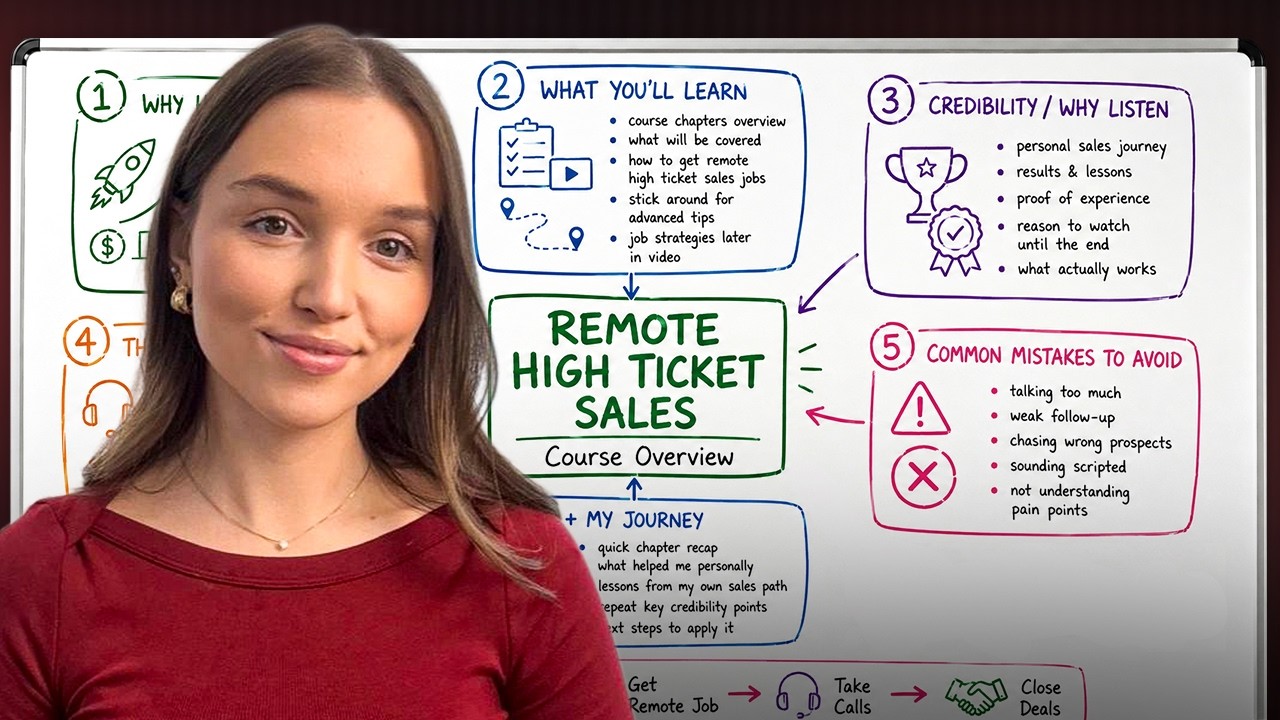
In this hour‑long, free video Shelley Young delivers a comprehensive beginner’s guide to high‑ticket remote sales tailored for women. She begins by defining high‑ticket sales—selling premium courses or coaching programs priced above $3,000 on commission—and contrasts it with traditional, low‑price, high‑volume sales. She then introduces her "feminine" sales methodology, emphasizing connection, emotional intelligence, curiosity, and confidence over aggressive, push‑y tactics. Shelley explains the two primary roles in the industry—appointment setter and closer—detailing the skill progression from setting to closing and why starting as a setter can accelerate learning. She outlines a step‑by‑step strategy for landing a remote sales job, including clarifying the ideal offer, finding unposted opportunities, building internal referrals, vetting offers, and treating the interview as a sales call, providing six common interview questions and model answers. The core of the training covers the anatomy of a sales call: pre‑call research, warm opening, deep discovery (current state, desired future, cost of inaction, obstacles), tailored offer presentation, objection handling through curiosity, and a natural close that arises from genuine alignment. Shelley highlights frequent beginner pitfalls—talking too much, shallow discovery, premature pitching, emotional desperation, neglecting call reviews, and being on the wrong offer—and offers corrective habits. For scaling, she stresses rigorous call reviews, seeking mentorship, asking for higher commissions, maintaining a network, and staying in a continuous learning mode. Throughout, she shares her personal journey from a £1.8K nanny to a top‑1% female closer earning $38K months, establishing credibility. The video concludes with a pitch for her Female Sales Accelerator program, which provides structured training, live coaching, mentorship, a private job board, AI role‑play tools, and a community to help women replicate her success.
Chapters
Hey everyone, welcome back to my channel. Oh my goodness, do I have a video for you today. This video is something I genuinely wish existed when I was starting out, because when I first got into high ticket sales, I went on YouTube trying to find a proper beginner's guide, and I just couldn't find one that actually covered everything, right, that actually felt honest, that was actually made for women, not applying, you know, the masculine pushy tactics. So I decided I was going to make one myself, and this is it. This is a full high-ticket sales course for women, completely free, completely honest, covering everything from what high-ticket sales is to how it's different from anything you've ever tried before, How to get your first role, how to show up on the calls in a feminine way, and the mistakes that are going to cost you if you don't know about them before you start. I'm going to be here for a while, so grab a coffee. Like, I want you to get comfortable, get your favorite drink, get your notepad and pen. And if you're serious about changing your life and your income, stay till the end because I'm going to be walking you through something very specific and very effective to actually get hired in this space, because everyone tells you all this fluff online, but I am going to tell you what actually works. And trust me, what I'm going to share with you, no one is sharing online right now, so make sure you stick around. So first things first, here is what I'm going to be covering. First things first, I am going to break down what high-ticket sales actually is and how it is different from traditional sales, because that difference matters more than most people realize. Then, I'm going to be talking through my feminine approach to sales, which is something I feel very strongly about and is something that I believe is a genuine superpower that women have in this space. After that, we are going to get into setter versus closer, that conversation. Which path should you take when you're starting out and why? Then, I'm going to be walking you through how to actually get hired. And this is the part I really want you to pay attention to, because this is where most people go wrong. And I'm going to share my exact approach that got me hired out of 150 applicants, and I'll be giving you the real interview questions and answers that actually work. Then, I'm going to be talking you through what happens once you're on a call, how to approach prospects, the feminine sales framework I use, and what to do and what not to do if you wanna close and make money as a high-ticket closer consistently. Then I'm going to cover the most common mistakes beginners make that hold them back, some of which I made myself when starting out, and the mistakes I've seen countless women make. And finally, we are going to be talking about scaling, how to go from your first paycheck to making $10K a month and beyond. There is a lot in this video, so make sure You take notes, feel free to pause and rewatch sections if you need to. This is meant to be your guide that you watch, rewatch, and come back to. So let's get into it. So I want to start with telling you a little bit about who I am and why I feel qualified and why I know I'm qualified to be teaching you this, because this really matters. Let's be real, every man and their dog, as soon as they make a $10K month these days, try and sell a high-ticket sales coaching course, and I think it's totally wrong, to be honest. Like, if you are going to be teaching people how to do this, then you need to have done it consistently time and time again. So my name is Shelley. I am the founder of the Female Sales Accelerator, a sales academy built for women who want to break into high-ticket remote sales amongst the top 1% female sales reps in the industry. But let me take you back to the very start. Before sales, I was a nanny making $1.8K a month, and even before that, I had a business that completely crashed burn. I spent 4 or 5 years building an equestrian clothing company from scratch, and it didn't work out, and I was left in tens of thousands of pounds worth of debt. I felt lost. I literally did not know what I was going to do next, and that's when I came across high-ticket sales. I invested in a mentor. I started as an appointment setter. Within 3 months, I replaced my nannying salary working part-time in the evening, and from there, I transitioned into closing full-time and was making £10K a month within less than 90 days. I literally remember sitting there thinking, I've heard people talk about this, but I didn't actually believe it could be me. You don't. You only think of what's possible amongst your circle, amongst your colleagues, amongst your friends. It is kind of wild. And when I realized what was possible for myself, I became obsessed. More training, more core reviews, more questions, more consistency. And I climbed my way to the top of the leaderboard But I was taught how to push. I was taught how to force. I was taught how to hustle like a man. So although I was able to get to 10K months very quickly as a closer, I was burnt out and exhausted, and I knew something had to change because I wanted 10K months consistently. I wanted even more commission, but I didn't want to sacrifice my life and my freedom in the process. I wanted to help even more people change their lives, but I couldn't keep running at that capacity. So instead, I tapped into my natural strengths, my feminine EQ, my intuition, my trust building, my connection building, and I taught myself how to sell the feminine way. And within months, I was hitting $38K months in commission, top of the leaderboard in every offer that I worked in. I became top 1% female closer in the industry, and I generated over $5 million in sales, and I was closing consistently around 70%. Now, the average is 20%, so you can see it was kind of crazy. Then I moved into leadership where I trained sales teams, and I helped them scale to over a million a month in the B2C space, teaching the teams how to drop the masculine tactics and sell in their feminine energy. Every single team member was making more money than ever they had before, and I got to see inside the business, understand what makes a sales team win, and figure out what separates closers making $5K a month to the ones making $50K a month. From those results alone, I've been able to move to Dubai. I've been able to retire my mom, who was working as a nurse for over 25 years. I've been able to pay off all of my business debt and truly build a life of peace. This isn't about the Birkin bags or the business class flights. Don't get me wrong, They're amazing. I love those things. But for me, this journey has truly been about getting out of scarcity, getting out of survival mode, and getting out of operating in my masculine energy on a day-to-day basis, and finally building a life of true peace, true security, being able to give back to my loved ones, and be able to remove myself from any situation I don't want to be in because I have The financial freedom, and the time freedom, and the location freedom, and that has completely transformed who I am as a woman. Cut to now, I teach women exactly what I did. I've helped hundreds of women worldwide go from zero experience to hitting 6 figures in sales. A record is helping one of my students hit $50K in a single month of commissions. Can you believe it? It is crazy. These are women who came from nursing jobs, who came from corporate backgrounds, HR, hospitality, retail, accounting. No sales background, no connections in the space, no idea where to start, but they started anyway. I tell you this not to brag. I tell you this because I want you to know I've actually lived this. I didn't just read about it. I didn't just take a course and then start teaching it. I built a career from the ground up. I've worked inside of these teams. I know this industry inside out, and this is why I know I genuinely can help a woman like you. So let's get into the training. So let's start at the very beginning. What even is high-ticket sales? High-ticket sales in its most simple form is the process of selling premium courses, online education, or mentorship services that's typically anywhere above $3,000 on the behalf of a business, earning a commission for every sale that you make. You are not the business owner, you are the sales professional working for that business, and your only job is to have conversations with people who have expressed interest to that business, to that product, understand what their situation is, and help them make a decision. These are warm, hot inbound opportunities. This is not cold calling, this is not outbounding, this is only speaking to people who are interested in making that change or buying that service. That conversation typically happens over Zoom or over the phone, and in some cases over the DM. They are warm leads, meaning this person you're speaking to has already shown interest. They've already done their research. They already know that they want it. They've watched the video, they've filled out the application, they've booked a call. They came to you. You were not cold calling strangers, like I said, which makes closing deals so much easier because you are helping someone with something that they know they already want or need. The commission structure varies, but typically as a closer, you'll earn anywhere from 10% commissions to 20% commissions of the sale. So let's say if you're selling a $10,000 coaching program and your commission rate is 10%, that's $1,000 per close. Close 10 of those a month, that's $10K. Close 20 of those, that's $20K. And that's not even me fluffing that up, that's being conservative. When I was closing for the career coaching tech offer, the packages was $10K. I made $1,000 per sale. So when I had my $38K a month, I just closed 38 deals. Like, it's as simple math as that. That is the math of this career. And for a setter, you typically make around 5% commission. So with a base salary of $1K to $2K, you can make typically anywhere between $4K to $8K a month by answering interested prospects on Instagram or over the phone. I'm not trying to make this sound easy. Truly, this is how it works. Now, how is this different from normal sales? This is super important because normal sales gets a bad rap, and I'm not surprised. It's masculine, it's pushy, it's forcing you. Traditional sales like retail or B2B or car sales or telesales is very different from what I'm teaching you here. In most traditional sales environments, you're dealing with a lot of volume, lower price points, high-pressure tactics, and often fixed salaries with a very small bonus structure on top. The ceiling is capped. There is a boss above you, and there's a territory, there's a script that you're told you have to follow, and the money you can make is limited by the structure you're working within. Whereas with high-ticket remote sales, it's different, literally in almost every way. First, price points are higher and business expenses are lower, which means your commission is higher. One sale can be worth a week of what you make in retail sales. Second, you're working remotely. Your office is wherever your laptop is. You can work from home, from a cafe, from another country. As long as you have a Wi-Fi connection, you have full location freedom. Third, there's no income ceiling. Your income is directly tied to how good you are and how many calls you close. The better your skill, the more you earn. There is literally no salary cap. Fourth, the leads are warm. You are not cold calling. You are not convincing strangers to spend thousands of dollars. You are speaking to people who have already expressed an interest and want to know more. Fifth, and the one that most people don't talk about, is your skills compound. Every call you take makes you better than the last. Every objection you hear teaches you something. Every lost deal is a lesson, and over time, the skill stacks and your results start to compound in a way that almost feels unfair compared to how much you used to work for far less. I was working 6 AM till 6 PM as a nanny, making $1.8K a month. I was working less hours in high-ticket sales, making 10x more. It's crazy. And the 6th, you get paid for the time you put in. The hours you put in is the reward you get out, opposed to other careers I've done in the past. Like I said, with nannying, I was capped for the hours that I was working. I was capped at the hourly salary of £12 an hour, and that's what I got paid every single month. If you're in a corporate environment, you're only going to get paid more for your experience in that company, which takes years to build and years to compound. The better you do with sales, the more money you actually make. Now, I want to talk to you about something that I genuinely believe is the most important section of this entire video, because this is what makes my approach different, and this is the thing that I personally think is the biggest untapped advantage that women have in this space. For literally so long, I thought— well, I knew the sales industry was dominated by men and the culture that came with that, which was aggressive, high pressure, and very masculine energy. The classic always be closing mentality where you push for the yes, overcome every single objection and never take no for an answer. And look, some of those approaches do work in certain contexts, but I want to be very honest with you about what I've learned from my own experience from 3 years working in this industry and from working with hundreds of women as well. The aggressive, pushy, masculine approach does not feel natural to most women, and when something doesn't feel natural you don't do it as well. You feel uncomfortable. You feel like you have to overcompensate. You feel like you're trying to push too hard or show up as someone you're not. And the prospect feels that, which puts them off, which means you make less money. But here's what I've learned: women do not need to sell like men to dominate the sales industry. In fact, I believe the feminine approach is actually more powerful when it is used correctly with confidence. Because feminine energy in sales is about building genuine connection before anything else. It's about asking questions and actually listening to the answers. It's about creating safety in the conversation, making a prospect feel heard, understood, and not pressured. It's about having the confidence to be honest, even when that honesty might mean the person doesn't buy, and it's about trusting the process instead of forcing an outcome. These things like connection, empathy, emotional intelligence, patience are the things that women are often very good at. We are literally born with these natural strengths, and in high-ticket sales where you're having conversations about someone's life, about their goals, about their fear, their money, these qualities Are a massive competitive advantage. I want to give you a really simple way of thinking about it. In the masculine, pushy approach, the sales rep is trying to get the prospect from a no to a yes. They're pushing, they're handling every objection with a technique, they're trying to convince the prospect into doing something they don't naturally want to do. But in the feminine approach, you're not trying to convince anyone. Instead, you're genuinely trying to understand. You'll be asking questions, you'll be going deeper, and you'll be creating a space where the prospect can be honest about how they actually feel and what's stopping them. And because of that safety, and because of that connection, the prospect opens up, they share more, they get clarity on their own situation. And when clarity happens, Most people sell themselves. This is not about being soft in a negative sense of the word. This is about being precise, asking the right questions at the right time, being comfortable sitting in the silence after you've asked something important, and not rushing to fill every pause because you want to push to get the sale. Trust me when I say this, some of the biggest and most expensive closes that I have had have happened In the quietest moments on the call, when I asked the deep question, when I stayed quiet and let the other person on the other end of the screen arrive to their own truth. Now, let me show you what this actually looks like in practice. So first up, we have tonality. The way you speak matters just as much as what you say. In high-ticket sales, your tone should feel warm and conversational, like you're talking to a friend. Not pitching a product. When you feel nervous, your voice tends to go faster and higher, so slow down, let your voice drop slightly, take pauses if you have to. It sounds small, but it completely changes how you are perceived on a call. Next up, we have listening more than you speak. The biggest mistake beginners make is talking too much. On a well-run sales call, the prospect should be talking at 60 to 70% of the time. Your only job is to ask good questions and listen deeply. Not listening to plan the next thing you're going to say, but actually listening and understanding their mindset. There's a difference, and prospects can 100% feel it. Next, we have curiosity over agenda. When you have an agenda, when you're focused on closing and collecting cash, it can be sensed. In how you ask questions. You will start leading the conversation towards answers you want instead of genuinely finding out what's wrong and what the truth is. Your mindset when you're going into a sales call is to be genuinely curious. Your only job is to understand that person's situation fully before you ever talk about what you offer. And then we have creating safety. This is something I come back to over and over again. People do not make big financial decisions with people they do not feel safe with, and that safety is built up through how you show up. You do it by being calm, by being non-judgmental, being honest even when the honest thing is harder to say. For example, if the offer isn't right for someone, tell them directly. That honesty builds far more trust than any sales technique ever will. I've had multiple sales calls where I've said, I don't think we can help you, and I don't think that you should be buying this product. And 9 times out of 10, the person will be like, no, no, I now need to 100% buy the product. That wasn't even like a sleazy technique. I was just being honest, and they're like, no, no, I really want to do this. Or they'll be like, thank you so much. No one has ever been that direct with me before. Either way, you are following your moral compass and you are doing the right thing. And finally, confidence without pressure. Confidence in sales is not about being loud or dominant. It's about being so secure in what you're offering and so grounded in the conversation that the prospect feels settled just by speaking to you. They feel safe. When you believe in what you're selling, when you genuinely want to help the person in front of you, that shows. People can feel it, and that is far more powerful than ever having some sleazy sales script. This is literally the foundation of what I teach inside the Female Sales Accelerator, and everything that follows in this video sits on top of this foundation. Now let's talk about where you should actually start if you're new to this space, because there is so much confusion, and honestly, I think there is so much bad advice online. So there are 2 main roles in high-ticket sales. There's your appointment setter, and there is your closer. Let me break down what is what and which one you should do. A setter, sometimes called an SDR or an appointment setter, is a person who has the initial conversation with the inbound leads. This can happen over Instagram DMs or over a phone call. Their job is to start the conversation, build enough interest and rapport, and then book that person in for a call with the closer. As I said earlier, setters typically earn 5% commission on every appointment booked that closes. This role typically comes with a base salary as well. So it's pretty nice when you're brand new starting out looking to transition away from your full-time job. A closer is the person who actually gets onto a sales call. They go deeper in the prospect's situation, understand their goals, understand their pain, present the opportunity, handle objections, and close the sales. Closers earn typically 10% and above commission per deal closed. Most people, when they discover high-ticket sales, immediately wanna be a closer. And I completely get it. You see the income, you see the lifestyle, you see the commission percentages, and you think, why would I want to do anything else? But I want to give you an honest answer to this question because I get asked it all the time. Every single woman that joins my program asks, should I be a setter or should I be a closer? If you genuinely have no sales experience, no understanding of how these conversations work, Going straight into closing is quite hard. The calls are long, the stakes are very high, the objections are more complex, the decision the prospect is being asked to make involves a lot of money, and if you don't have the foundations, if you haven't built the conversational skills, the listening habits, the emotional intelligence for these kinds of conversations, you are going to struggle and you are going to lose deals that you should have won. And losing deals as a closer means losing a lot of money, so your income suffers directly. And if you underperform for a long time, you also very well may lose your position as a sales rep. Now, there is also a setter, which not many people actually talk about, which is the middle step. You're doing shorter qualification calls, and this role basically gives you something invaluable, which is repetition because you're having real conversations with real inbound prospects every single day, but in a lower-stake environment. The company's revenue is not on you directly. You're learning how to talk to people, you're learning how to understand their problems, you're learning what questions open people up, you're learning how to build rapport quickly and how to handle it when someone pushes back. You're getting hundreds of hours of practice that a closer would take months to accumulate. I personally did setting for 3 months before I moved into closing, and I was top performer in the setting department before I made the transition. I wasn't just waiting around to be a closer. I was obsessing over the craft in that role, getting every conversation reviewed, asking questions, anything I could think of to improve, improving week on week, day on day. So when that opportunity came up to moving to closing, I was more than ready. I literally closed my first deal on my first ever closing call because I'd put in the time and put in the hours, and I was far less nervous and far less scared to take those conversations. So My advice really for a beginner is if you can get into setting first, take it, even if the income feels a little bit smaller than what you want, because the skill that you can build in that role will make you a dramatically better closer when you get there. And you can always tell the difference between a closer who did setting first and a closer who didn't. And you will actually get to your income goals faster than you think because you've got such a solid foundation. However, if you do go straight into closing, make sure that you're on an offer with a strong onboarding process and real support, not one where they just throw you into calls on your first day with no guidance. The offer matters enormously, and I'll explain why shortly. Okay, how to get Get hired the real way. This is the section I told you to stick around for, and I meant it. Getting hired in remote sales is where most people get stuck. They apply for jobs on public Facebook groups, LinkedIn posts, free communities, and they get absolutely nowhere. And it makes them feel like the opportunity isn't real, or like they need experience first. Or that they're just not what these businesses are looking for. But that's not actually the problem. The problem is your approach. Let me explain why public job posts or cold DMing business owners never works. Because by the time, for example, the public job board, by the time that role gets visible in a public group or a public job board, it has already been seen by hundreds of people. A significant chunk of these people have experience and have been in the industry for a while and look more attractive on paper than someone just starting out. And if you're new, competing for those roles on volume is not a winning strategy. You need a different approach. Just like cold DMing business owners, by the time you've sent your DM, hundreds and hundreds of people have done the exact same thing. Because that is the only method being taught in this industry. So I'm going to take you through exactly what I did and what allowed me to get hired out of 150 applicants with zero sales experience. So step 1, know what kind of offer you actually want to work for. And what I mean by this is before you start applying to any roles, Get clear on what you actually want to sell. This matters more than most people realize. The best closers I know are selling something they genuinely believe in. When you believe in the product, you show up differently to calls. You speak about it with conviction. You can handle objections from a place of genuine certainty rather than trying to remember a script. And frankly, it makes makes your job more meaningful. As a woman, we naturally want to pour into people, build connections, so it fills our cup by filling up other people's cups. So think about a space that interests you. It could be fitness, it could be health, business coaching, career development, financial education, personal development, relationship coaching. These are the type of offers that are in the high-ticket sales space and more. So pick the world and pick the environment you actually wanna be in. Step 2, find the right offers before they are posted publicly. The best companies in this space are not posting on these public job boards. They're pulling from their networks, or they're waiting for the right person to come to them at the right moment through connections. So your job is to find those companies first. Instead of the job postings. And the way you do that is by looking for signals like active paid marketing, which can be a video sales letter, it can be a webinar funnel, a clear booking link for a high-ticket offer. Basically anything with consistent content present or real testimonials or case studies from real clients and an existing sales team. These are the signals you look for. Then what you want to do is you want to go and find 10 or 20 companies in your chosen niche that fit that profile. Look on Instagram, YouTube, Facebook, podcast platforms. Find the coaches and offer owners who are actively running ads and actively putting out content, clearly selling something at a high price point. These are your targets. Simply reach out to people in their company who work for them instead of applying directly on a job board. Which brings me on to step 3, get inside the company before you apply. This move almost nobody makes, and it is the single biggest competitive advantage you can have as a beginner. Instead of emailing the offer owner directly or filling out a cold application form, find someone who already works inside the company. It can be a setter, a closer, a triager, or a team member of any kind. Then connect with them genuinely as a peer, as someone who operates in the same world and who wants to learn from someone with more experience. All you have to do is simply start the conversation with something specific, something that shows you've actually paid attention to them or their role. You can do this by asking a genuine question about their experience, or about their journey into sales, or about a country they've traveled to, or a book they've read. Build rapport, be genuine, build a friendship. That is how connections are made, because when someone inside the company likes and trusts you, they will tell you things no job listing ever would. What the commission structure actually looks like, or whether the leads are good, what the culture is like, whether the offer owner is someone actually worth working for. And in many cases, they will put your name forward before the role was ever posted publicly, and that referral is worth more than any application you could literally ever send. I want you to actually think about this: 5 genuine relationships inside 5 companies that you actually want to work for and get hired by is way faster than 50 cold DMs or 50 cold applications straight into the void. Remember, quality over volume every single time. And you can absolutely take what I'm teaching you in this video and implement it yourself and start seeing progress. I want this free training to genuinely be valuable, genuinely be something that I never had. And I do not believe 1,000% of the time you have to pay someone before you are allowed to take your first step. But what I also want to say, and what I want to pre-frame, if you will, is there is a difference between information and mentorship. And it's super important to know the difference because this is where so many women lose months. Information tells you what to do. Mentorship shows you whether you are actually doing it correctly, catches the mistakes you cannot see yourself, reviews your calls, redirects you when you're applying to the wrong offers in the wrong places, and gives you a proven path instead of forcing you to piece together every single piece of information in trial and error. Most people do not fail at this industry because the opportunity isn't real. They fail because they try and build a high-income skill with inconsistent effort, no feedback loop, and a strategy that's made up of random free videos from 10 different people. They keep changing their approach, they don't know what they're doing wrong, and eventually they just assume they're simply just not cut out for sales. If you are serious about creating a $10K a month outcome, then you cannot bring a $1K level of effort and a $1K level of strategy and expect the result and somehow have $10K in your bank account the next month. The size of the outcome has to be matched with the level of skill, support, repetition, and personal responsibility you are willing to bring to it. And I say this with love, and this is the exact reason I created the Female Sales Accelerator in the first place. It's not to replace the work. You still have to show up, you still have to execute, and you still have to work. It's there to compress the learning curve by giving you training, personalized feedback, core reviews, community, direct access to better opportunities, so you are not trying to solve every problem alone. I'll give you one example. The simple job search itself— women I work with inside my program receive instant access to hundreds of inbound opportunities every single month. These are highly vetted roles that have come to me wanting to hire my sales reps. So instead of spending weeks trying to find people in these companies, cold DMing people, outbounding, applying for all these cold applications, and guessing and competing with a sea of people. They can focus their energy on becoming the strongest candidate and performing once they get the role, because all of their jobs are in front of them, and all they have to do is apply to the roles that they feel aligned with. Okay, step 4, vet the offer properly before you accept anything. This is something that I feel very strongly about because I've seen so many women, especially women who are desperate to get started and desperate to make money, accept their first offer and say yes without actually looking at whether it's a good opportunity. This is a terrible mistake because a bad offer means you're stuck in a role that will hold you back for months— cold calling, working for free, not getting paid, no training, no team, no support. Here's what you actually need to look at before you get accepted to any role. Does the company run real marketing? Not just an Instagram page with nice photos, but actual paid ads or a content strategy that is bringing in consistent leads. Because without leads, you have no calls, and without calls you make no money. And even if you're excellent at your skill, you still can't make any money. Are there reps on the team already making the money you want to make? Ask the offer owner, but don't just take the offer owner's word for it. Ask to speak to the current rep if possible. Find out what the top performer is actually making and what the average performer is actually making. That gap will tell you a lot. Is the offer actually proven in the market? Are there real testimonials, real case studies, real clients who have got real results? If the offer is brand new, unproven, you are essentially a guinea pig, which is a massive risk that you will be taking on your career. Does the company have a proper onboarding process? Are they going to train you? Are they just going to throw you on calls and see what happens? A company that invests in their reps' onboarding is a company that wants to keep their sales reps and values their sales reps, and that's what matters. What the commission structure actually looks like and how does the payment work— get this in writing. Ask about pay dates, ask about how commission is tracked. Most women are scared to talk about money. You cannot be scared when your money is on the line. Even ask what happens to a deal if it gets refunded. This information is super important, and if an offer ticks all of these boxes, it is an offer worth working hard for. But if an offer has gaps like weak marketing or no proof of concept or no onboarding support, it is going to make your life significantly harder regardless of how good you are at selling. Okay, now let's talk about the interview, how you should show up, what you should say. Let's talk about how to actually get hired, because even with the best approach and the best referral, you still need to show up and actually interview and make a good impression. The most important thing I can tell you is this: an interview is a sales call. You are the product, and your job is to sell yourself by presenting your transferable skills and your character in the most compelling way possible. So I'm going to give you the 6 most common interview questions you will face and exactly how to approach them. First things first, the tell me about yourself. This is probably one of the most important questions in your entire interview. This is your first sales pitch, and most people blow it by either rambling or giving their whole life story, or being so vague that they don't leave an impression at all. So the framework I use is simple. Start with a brief overview of your relevant background, transferable skills, then the personality traits that actually make you right for the role. One or two personal details that show character, for example, like the sport you played competitively, or the challenge that you overcame that shows you that you are beyond just your work history. For example, if you've come from a hospitality background, you could say something like this: I've spent the last 3 years in customer-facing hospitality roles where I was dealing with high volumes of people daily, but I always prioritized building genuine connection with everyone that I spoke with. I'm someone who is deeply resilient. I've played competitive sports for 10 years, which taught me the results come from consistent work even when you don't feel like showing up. I'm now looking to channel everything I've learned into a career where my income is tied directly to my results. You are basically showing how you are bringing those transferable skills, that super important. Next up, what are your strengths? So pick 2 or 3 that directly relate to sales. For example, like communication, resilience, coachability, emotional intelligence, persistence. And don't just list them, demonstrate them. So I like to say the STAR method: situation, task, action, results. So I'm going to give you an example. My biggest strength is resilience. In my previous role, I faced rejection and difficult conversations daily, but I learned very early on to see this as part of the process rather than a reflection on my ability. That mindset helped me stay consistent even on the hard days, and I think that's one of the most important qualities you can have in sales. You're not just telling them that you're resilient, you're showing them what that looks like in practice and connecting it directly to what they need from a sales rep. Next up, we have, what are your weaknesses? The strategy here is to pick a real weakness, not a fake one, because interviews can see straight through that, right? But one that you're actually working on that isn't going to disqualify you from the role. It might even give the interviewer more trust in you. So make sure you put a bit of thought into that. So you could say something like this: sometimes I can be a bit perfectionist, and in the past this has slowed me down. I've been working on finding the balance between doing something really well and moving with speed, because I know in sales volume matters just as much as quality. Or you could say, I naturally talk quite fast when I'm excited, so I've been practicing slowing down my pace on calls so the other person feels at ease. Both are a genuine weakness. Neither of them are going to be deal breakers, and both of them show self-awareness and commitment to growth, which is exactly what a good offer owner wants to see in a rep they're considering to hire. Next up, we have, what's your experience? Most beginners panic here, and I get it, so did I, because you have no previous experience. But do not panic, there's always a workaround, I always say, because this question is actually pretty easy to tackle. The answer is to focus entirely on your transferable skills and reframe your experience through a sales lens. Think about every time you've had to persuade someone, every time you've had to build trust quickly, every time you've had a difficult conversation to navigate. For example, in retail, hospitality, customer service, teaching, nursing, nannying, coaching— all of these have elements that transfer directly into sales. So, you can say something like this. While I don't have formal sales experience, I genuinely feel like I've been selling my whole life. In my hospitality role, I was building trust and rapport with new people every single day, often in very short amount of time. I was upselling, I was consultative, I was handling complaints and turning difficult situations into positive ones. I believe trust is the most important element of any sales conversation, and it is something that I have always done naturally. And if you do have sales experience, even just a little bit, be specific. Use it to shine. Use numbers where you can. Show results where you can. Tell them why you ranked so high on your team. Tell them what you did. So any kind of corporate sales, face-to-face sales, share it. Next up, what are your career goals? This question is a trap that a lot of beginners fall into without actually realizing it. They say something like, I want to be a closer within 3 months, when they've literally just been hired as a setter. Or, I want to start my own business soon. And suddenly the interviewer starts to wonder how long you're actually going to stick around. Because they need someone they can rely on. If they're going to pour time and training into you, you know, if they're a good company, they want to know that you're going to stick around. Now, you could want to be a closer in 3 months, or you could want to start a business soon. That's fine, just don't tell them. The right answer is one that actually shows ambition without creating anxiety about your longevity. So you could say something like this: My first priority is to master the craft and become consistently a top-performing sales rep. I have an income goal of $10K a month, but I'm not in a rush to get there. I want to earn it by genuinely developing my skill. Long-term, I'm ambitious, and I'd love to move into a leadership role or a closing role once I've proven myself. But right now, I'm completely focused on being the best I can within this role and adding real value to the team. That answer shows drive. It shows you being real and realistic, and it reassures them that you're not going to disappear in 60 days. And last but not least, do you have any questions for me? Always, always have questions prepared. It shows that you are proactive and you genuinely care about the role. Don't ask generic questions. Ask specific ones that actually show you've done your research and that you're evaluating them just as much as they're evaluating you. Remember, we are women. We do not chase, we attract. We have to switch our mindset from, do they want me, to, do I want them? So here are some questions that work really well. First of all, what does success look like in this role in the first 90 days? What does the top performer or team member make, and what makes them different? Next, is there ongoing training or core review support in this role? What does the lead quality look like right now? Are leads coming in consistently through paid marketing, or is it more organic? And what is the closer turnover like on the team, which is basically like the churn rate? These questions do 2 things. They show the interviewer that you are serious and that you have actually thought about this properly, and they give you information you actually need to decide whether this role is worth your time. Not all roles are built the same. That is a big mistake people make. They think, once I get a role, I'm good. It is not true. We have to make sure we are getting high-caliber opportunities if you want to make $10K+ per month. One more thing on interviews is it's not just what you say, it's how you show up that matters as well. So this can be your background on a Zoom call— it should be clean, it should be professional— and your appearance too. You should look put together. Most people are scared to say this, but it's really important. Treat this interview like you're interviewing for a high-level corporate role, because in many ways you are. Make eye contact with the camera. Speak slowly and clearly, smile genuinely, and remember, calm confidence wins every time over nervous energy and anxious energy, even if the calm confidence is something you have to fake at first. Okay, so you've got the role. Now what? This is where the real work begins, and this is where I see the biggest split between the reps who go on to make serious money And the ones who plateau and the ones who quit. The difference almost never comes down to the script. It comes down to how you show up on every single call, day after day, even when you're tired, even when you've had 3 no-shows, even when your last 5 calls didn't show. That consistency and that discipline is what builds the skill, and the skill is what builds the income. So first things first, before the call, do your research. Know who you're speaking to before you log on or before you dial. Look at their application, understand their background, their current situation, and what they've told you that they want. The more you know going into the call, the sharper your questions will be and the faster you'll get to what actually matters. Next, get yourself Into the right headspace. This can sound fluffy, but it genuinely matters. If you jump onto a call feeling scattered or anxious or desperate for the close, that energy transmits. So take 5 minutes beforehand, breathe. Your only job on this call is to understand a person's situation fully and genuinely help them. That is it. Not to close them, not to hit your numbers, but to understand and actually help. When that's your intention, you will always show up completely differently. The opening of the call. The opening sets the tone for literally everything that follows, and the most important thing you can do in the first 2 minutes is make the prospect feel at ease. Be warm, be human. Don't go straight to the formal script. Have a genuine, brief moment of connection. Ask where they're calling from. How's their day been? It shouldn't be excessive, but it should be just enough to settle kind of the awkward, nervous energy. Then set the frame, something like this. The first part of the call is really for me to find out a little bit more about your background, what you've done in the past in regards to X, and what you're doing now. And really, I guess, to understand what it is that you've been looking for just to see if we can help you in the first place. If we can, I'll walk you through that today, and if we can't, I'll just let you know, because sometimes there are some potential clients that we can't always really help. You know what I mean by that, right? That framing does something very important. It signals that this conversation is not a pitch. It takes the pressure off the prospect, and it sets up the discovery as the priority. Which it should be. So, moving on to the discovery. Discovery is the heart of everything great in a sales call. If you get this right, everything else will become significantly easier. If you rush it, or if you skip it, no close technique in the world is going to save you. Your job in the discovery is to understand 4 things deeply. Number 1, where is this person right now? What does their current situation look like? Their income, their lifestyle, their day-to-day reality. Number 2, what do they want instead? Not the surface-level answer, because everyone really wants more money or more freedom, but what actually mean— what it means to them specifically. What would their life look like if they had it? Number 3, what's it costing them to stay where they are? This is the layer that most sales reps skipped. The cost of inaction, like the time, the money, the emotional toll, the opportunities that they're missing, is what creates urgency. When someone can articulate the cost clearly, they feel the real weight of their decision. And number 4, what stopped them so far? Have they tried anything before? What happened? What fear or belief system is keeping them This is where the real objection almost always lives, not at the close, but here in the discovery, if you go deep enough. And the questions that I love and the ones that help me create a safer space are, walk me through, what does that actually look like for you? Why does that matter to you specifically? Or how long has that been the case? After every answer, go one layer deeper. If someone says, I just want more freedom, Don't just move on. Ask, what does freedom actually look like for you? What would you be doing differently? Keep on going until you hit something that's real, that has an actual emotional weight, because this will be the truth as to why they're on the call, and the truth that you'll come back to later. Like, not just, I want more money, because that means so many things to so many different people. One of the most powerful things, in my opinion, that you can do in the discovery is actually stay silent after you ask these types of questions. Let the prospect fill in the space. Some of the most honest and important things people say on a sales call comes from those pauses, the moment they've given their first answer and they keep on going because you didn't rush to respond. Next, transitioning to the offer, because once you've done a proper discovery and you genuinely understand this person and where they are and where they wanna go and what's been stopping them, the transition to talking about your offer should feel natural. It should be a logical next step in the conversation. So, something like this you could say. Based on everything you've shared with me, I actually think this could be a really good fit, but let me walk you through exactly what we do so you can tell me what you think. Then, you explain the offer, and the key here is to connect connect every element of what you offer directly back to what they have told you in the discovery. Do not read from a generic features and benefits list like a rehearsed pitch. It should feel like a personalized presentation that says, you told me your problem is X, here is specifically why we can address that. This makes people feel like they're being helped rather than sold to. And that feeling is the difference between a yes and a no. Next up, handling objections. Objections are a normal part of every sales call, right? And the most important thing to understand about them is that most objections are not what they appear to be on the surface. So, for example, I need to think about it. It's rarely about needing more time. It's usually about not feeling certain enough to actually make that commitment. That uncertainty is almost always tied back to a specific fear, like a fear of it not working, or a fear of wasting money, or a fear of what people will think, or a fear of making the wrong decision. Another one is, it's too expensive. It's rarely about money. Most people say that even if they have the money, right? Because what they're really saying is they're not sure if the value matches the cost, which means you haven't fully connected the offer to their specific situation yet. And next up is, I need to talk to my partner. It is sometimes genuine, but often it's just a way of buying more time and getting out of making a decision and actually making a commitment, because that person is not fully committed to making a decision by themselves. When you hear these things, the worst thing you can do is fire back With a rebuttal. That feels like pressure and it makes people defensive. Instead, get curious. Ask what specifically they want to think about. Ask what makes them feel uncertain. Ask what their partner's main concern would be. Your job is to make the vague thing specific. Because once you know what the real fear is, you can actually address it. And once you address the real fear by going back to what they told you in the discovery, by reconnecting them to the cost of staying the same, by being genuinely honest about the offer and what it can do and what it can't do for them, most objections dissolve on their own. And finally, the close. I want to say something about closing that goes against what a lot of people teach. The close is not a technique you apply at the end. It's not a magic line. It's not about pressure or urgency or manufactured scarcity, right? The close is the natural outcome of a conversation that went right from the beginning. When you have built genuine connection, when you have done a deep discovery, when you have presented the offer in a way that speaks directly to the person and their situation, when you've handled their concerns honestly The close almost always happens by itself. The prospect says yes because they've arrived at their own conclusion, and this feels— and they know that this is the right decision for them. And that is the feminine approach to sales in its purest form. You are not pushing anyone to make a decision. You are creating the conditions for them to make their own decision and them trusting that this is the right step that they should take. Okay, so we've gone through the what, we've gone through the how. Now I want to take you through common mistakes that I see beginners make, and some of these I made myself, and I've also watched plenty of women do it before, and all of them are avoidable when you know about them. Number 1: Talking too much. This is the number one mistake. When you're nervous, when you're trying to fill in the silence, you explain more than you need to. You pitch when you should be listening. You talk about the offer when you should still be in the discovery, and it's not gonna work. You're not gonna close the deals. The rule that I simply live by is the prospect should be talking more than you on every sales call. If you're talking more than them, something is wrong. Next, moving on too quickly from surface-level answers. When someone gives you a vague answer like, I just want more freedom, I just want to make more money, most beginners accept it and move on to the next question. Do not do that. Like I said earlier, you should be going deeper. Ask why. Ask what that means for them. Ask what their life would look like versus Now and then. It is important. The real answers are usually never in the first response, especially because you're a stranger. You have to probe and clarify deeper. The third is pitching too early, because discovery is not a box to tick before you can start selling them. It is the most important part of the call, and I've seen so many beginners rush through 3 or 4 questions and then launch into a pitch because they're excited and they wanna show off what the offer does. When you do this, you're pitching at a stranger because you don't know them enough yet, and it shows. You need to slow down. You need to stay in the discovery. You need to build genuine understanding, genuine connection, to understand their world. The fourth, and it happens a lot, getting emotional about the outcome. This is a big one. When you need the close, When you're watching the month, when you're desperate to hit the numbers or the commissions, it shows in the call 100% of the time. Your questions start to become leading, your tone changes, you start managing the conversation towards a yes instead of genuinely exploring the truth, and the prospect feels it all the time and it puts them off. The best thing you can do for your close rate is detach from the outcome from every individual call, and it sounds easier said than done. Your job is to purely serve the person and find out if you can genuinely help them. If yes, the close will always follow 100% of the time. Next up is not reviewing your calls. This is the most expensive mistake you can make in terms of development. Every call you do, don't just review it, review it as a learning opportunity that you can grow from. After every call that didn't go your way or go the way that you wanted, you should be looking back through it. Where did the energy shift? Where did the prospect go quiet? Where did you talk too much? What did you miss? Because the reps that improve the fastest are the ones who always have an honest relationship with their own performance. Next up, being on the wrong offer. I've said it already, but it's worth saying again. If your leads are bad, your close rate will be low no matter how good your skills are. If your offer has no proof of concept, no strong marketing, no qualified inbound leads, you are fighting an uphill battle every single day. Before you conclude that you have a skill problem, make sure you don't have an offer problem because they look the same from the outside, but they're not. They're completely different. And last but not least, trying to do this entirely alone. The free content trap is very real. I call it YouTube University. I made a whole video about this, but I want to say it clearly here too. You can watch as many YouTube videos as you want, but if you have no feedback loop, no community, no mentor who's actually done what you're trying to do, your progress is going to be slow and your mistakes are going to be expensive. Investing in the right support is not optional if you want to build this career in this space properly and quickly. So let's say you've got your first role, you're on calls, you're making your first commissions. Now how do you actually scale? Because there is a huge gap between making $3K or $4K a month and making making $10K, $20K, $30K a month. And most people hit the lower end or plateau because they don't understand why they can't break through. So I want to share what I've learned from my own journey and of course helping women through the process as well. First of all, you have to get obsessed with cool reviews. The single biggest lever in your income is your skill, and your skill improves faster through honest Rigorous call reviews. Not just watching your calls back, but actually analyzing them. Where did the prospect go cold? Where did you miss that question? Where did you fumble on an objection? Where did you rush? Do this after every call at first, whether it was good or bad. The good ones will teach you what to repeat, and the bad ones will teach you what to fix. What you can also do is ask to have your call reviews by your sales manager or your mentor. Put yourself forward. Be the person who actively seeks feedback. I can tell you from experience, the reps who actually get their call reviews are the ones who get noticed and get supported and get promoted. The bar is surprisingly low in this industry. Being the person who genuinely wants to improve makes you stand out almost always immediately. Know your worth and ask for more. I've always asked for more. I've always delivered results first and then ask. That combination of consistent performance followed by direct conversation about what you want next is important. If you want to move from setting to closing, make it known. If you want a higher commission rate, ask for it and back it up with your numbers. Offer owners want to keep good sales reps. If you've got a proven track record as a good rep, you have far more leverage than you think. If an offer dies, do not panic. Offers get shut down, business owners pivot, teams get restructured. This is part of the industry, and reps who build long-term careers here are the ones who understand it and prepare for it. The way you prepare for it right is by always developing your skill and maintaining your network, by having relationships with people inside other companies. So for whatever reason you want to move on from your current offer you have somewhere to go. Through connections, many opportunities come through that. By treating every role as a place where you're learning and growing, not just a place where you're connecting a paycheck. Through implementing this method, I was able to find a role that could literally triple my income. I wasn't working more hours, I just transitioned into an offer where I could work smarter. And invest in your skill continuously. The best closers I know are the ones who are still in learning mode even if they're making great money. They're still getting their call reviewed, they're still asking questions, they're still in communities with other high performers. The moment that you feel like you know everything is the moment that the growth stops. So always stay curious, always stay coachable, and always stay hungry. The energy that you can bring with that mindset separates closers making $10K a month to the ones that are making $50K a month. Okay, so I've covered a lot in this video so far, so let me bring it all together. I've talked about what high-ticket sales actually is, and they're earning commissions on premium offers remotely with warm leads and unlimited income ceiling. I've talked about the feminine approach, that women don't need to sell like a man to dominate this space, that connection, emotional intelligence, and genuine curiosity with soft confidence is not a weakness. They are the most powerful tools you can have on a sales call. I've talked about setter versus closer and why starting in setting gives you the reps and foundations you need to genuinely become a great closer. We've talked about how to actually get hired, which is by building relationships inside companies before roles are ever publicly posted before you accept them and showing up to interviews like the professional that you are becoming. We've talked about how to run a sales call, like the importance of discovery, listening more than you speak, going deeper than the surface-level answers, and creating the conditions for the prospect to make their own decisions. We've talked about the mistakes to avoid, like the common ones such as talking too much or pitching too early or getting emotional about the outcomes or not reviewing your sales calls or being on the wrong offer. And we've talked about scaling, where you obsess over core reviews, asking for more, and staying in learning mode even when things are going well. So before we wrap up, I want to take a moment to talk about what this career has actually meant for me personally, because Money is one thing, but the money represents the freedom that it gives you, the person it allows you to become, and that is the most important. When I was a nanny making $1.8K a month, I was working hard. I was showing up every day. I was doing everything right by the conventional definition, but I was still barely getting by. I was still feeling trapped, feeling like no matter how hard I worked, the ceiling was always there. I remember the fear of investing in my first mentor. I remember not telling anyone except my mum, and I remember working my nannying job in the day and doing sales calls at night because I was too scared to let go of my safety net before I had a proven concept to myself, before I had proven it to myself. I remember hitting my first $10K month and sitting there thinking, is this actually real? And now I teach women to do what I did. And the thing that moves me the most is not the income numbers. It's the messages I get from women who tell me they've quit their corporate job, that they booked their first solo trip abroad, that they're supporting their family financially for the first ever time, that they feel maybe for the first time in their adult lives actually free. And this is what this skill can give you. I know how it feels. feels to want it but not be sure if you can actually do it. I've been exactly there, but I promise you, if I can go from being a nanny with a failed business behind her to where I am now, this is genuinely possible for you too. You just have to take that step first, because if you want what you've never had, you've got to do what you've never done. This is the exact quote I told myself the day I stepped into this industry over and over again, when I was scared, when I was unsure, when I was hesitant, because competence grows after you do the thing, after you start building the knowledge. Okay, so that is the full beginner's guide to high-ticket remote sales the feminine way. I genuinely hope this has been useful, and I genuinely hope it has given you a clear picture of what this career looks like, what it takes, and what it can give to you. If you've watched this far and you're ready to actually start, then I want to help you do this properly. The Female Sales Accelerator is my program built for women specifically who want to break into this space the right way. Inside, you get the full A to Z sales training blueprint, weekly live group coaching calls, one-on-one DM access to me personally, one-on-one support calls, a private job board with access to the best opportunities in the space, an AI roleplay tool that helps you build your skill fast, a private female-only community with ambitious women who are on the same journey to you, and a custom roadmap to make sure you're getting the personalized support you need. Everything I've shared in this video is the foundation, But the program is where we go deep, where you get the feedback loop, the connections, the support system, and everything else you need to actually make this happen. Not in years, but in a matter of months if you follow the blueprint. There is going to be a link in the description. Go and have a look. If it feels right, book in a call and let's have a conversation. I promise I will be honest with you about whether I think I can Actually help you because that's how I work. I don't work with thousands of women. I only work with the right women in order to get the results we do. I have been where you are, sitting on the other side, and I say it always to my ladies, if we're working together, you and I are a team. And if you're not at the stage yet, that's completely okay too. Subscribe to the channel, keep watching, keep learning, And whenever you feel ready to take the step, I am here. Thank you so much for watching, and I'll see you in the next one. Have a great day.
More from Shelley





The Girls Buying The Bags Aren't Influencers - This Is What They Actually Do.