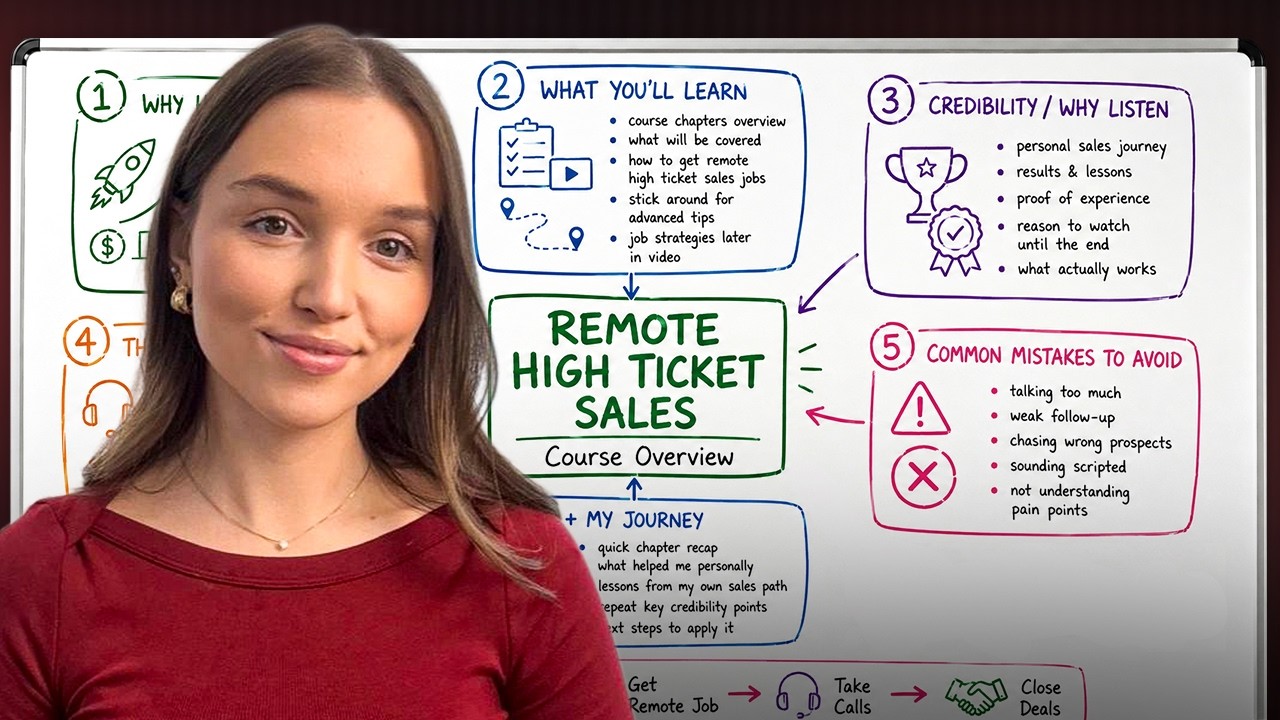
Shelley Young (creator of the Female Sales Accelerator) presents a short training on mastering sales pitches. She teaches a three-step, practical process: (1) structure your pitch into clear "pillars" (breaking the offer into digestible chunks), (2) use tie-down (temperature-check) questions plus sprinkled social proof to keep prospects engaged, and (3) explicitly link what the prospect said in discovery to the specific features of your program. The video emphasizes simplicity, memorability, and converting the pitch into a collaborative solution rather than a monologue, and ends with a CTA to join the Female Sales Accelerator.
Chapters
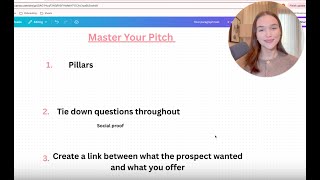
Hi guys, welcome back to my channel. Today we're bringing you another training. I get so many messages from you, lovely messages from you girls complimenting the trainings and saying how valuable they are when you implement them in to your sales calls, which I love to hear. So I will keep making more. The next one that I'm going to be making today, if you haven't guessed it, is mastering your pitch. I get a lot of questions on how to pitch products and how to do it in a way where you're not word vomiting at the prospect. So I'm going to take you through this. It's going to be a very short but sweet training. We're going to take you through everything you need to know at its most simple form. This is how I like to teach. This is how I teach the girls in my program in the female sales accelerator. We do not need to over complicate things, we do not need to do crazy tricks. My approach is to make things as simple and as digestible as possible and make sure they are very results focused. So let's just dive in. I'm back at you today with my typing skills, so let's see how far we get. But number one, first things first, to master your pitch, we need pillars. Okay, so when I talk about pillars, I mean breaking the pitch down, breaking down what you're saying into chunks. So for example, let's say if you're selling an Airbnb coaching, you would want to break down the mentorship into very digestible segments. So an example of this could be, okay, so I'm going to break the program down into pillars to make this as digestible as possible. Pillar one, we have the A to Z blueprint of everything that you would need to set up your Airbnb and to scale your Airbnb. Pillar two is live training calls. Pillar three is all the contracts and agreements. Pillar four is the one on one training support. And pillar five is the network, for example. Now you would go into each of those in a little bit more detail but essentially you are like sub categorizing each phase of the program. So instead of just like word vomiting and doing like a 20 minute pitch on all the different areas that the program offers without giving like structured breaks, this is going to really help the prospect take in the information, not feel overwhelmed and make sure that they can remember it and it's digestible to them so you don't get hit at the end of the call with yeah, so I just need to think about it because it's a Lot of information. We want to pre handle that objection by breaking the pitch into pillars and allowing them to really remember the highlight reel of what you offer and what we offer within the program. Okay, so number two, we want to ensure we are doing tie down questions throughout. So what do I mean by tie down questions? Let me tell you, tie down questions are basically follow up questions and positive based reinforcement to make sure the prospect is engaged, they're in the conversation. Because if it's a lot of information, they can sometimes kind of like switch off. So we want to make sure they're engaged, they're in the conversation and we're temp checking the prospect throughout. So what I mean by temp checking is temperature checking if the prospect is hot, medium cold, for example. So an example of this is how does that sound so far? Any questions on that so far? How do you feel about that so far? Anything where you'll bring the prospect into this information? I'd love to hear your thoughts. Like what do you think of the one on one coaching, for example? It's really important to do this. I would say maybe every two pillars, depending on how many pillars you have to your program. Maybe if you've only got three pillars after every pillar is any questions on that or how does that sound? Or what part of this do you feel will be most beneficial to you? I know we do that after the pitch too, but really just bringing the prospect into the conversation, making it a partnership rather than you just kind of telling them everything you're doing and making it more of a sales pitch, that is the difference. We don't want this to be like a sales pitch. We want this to be a solution to their problem. So by engaging them in the conversation makes them feel like it's more of a solution. Another thing which is like a subsection to the tie down is something that I love, which is social proof. So that could be social proof in the sense of one of the other clients. For example, let's say if you're speaking to someone who works a full time job and they're also a mum and you know you have women in the program or men in the program who are full time and are also a parent, you could maybe add a bit of social proof through your pitch and say and yeah, and the program is self paced as we have a lot of women in the program actually who work full time. They're also busy mums. So it's important to make sure that it's well structured and that you can kind of visit it in Your own time. Something like that is a sprinkle of social proof to make sure the prospect knows, you know, okay, this is actually tailored for me. I can do this too by showing other people in their shoes do it or have done it and have seen success. And last but not least, number three in mastering your pitch is we want to create a link between what the prospect wanted and what you offer. So what the prospect wanted and what you offer. Okay, so, oh, we're going crazy. So what do we mean by this? So what we mean is we want to make sure in the discovery, we ask the prospect, what is it you're looking for in a program? Like what are you looking for in a mentorship or what support do you feel you would need? That is super important one to make sure that we can offer what they're looking for. Let's say if your program offers no one on one and this prospect really needs one on one, then it's probably not the right fit or vice versa. So. And then we want to use that link in the pitch. So if we're talking about one on one, you can be like, and they really want one on one. Remember Lucy, when you mentioned you want, you know, you feel you benefit from a lot of one on one support and that kind of personalized approach. Well, I love that you said that because within the program we actually offer daily one on one support where you could message your coach, send them questions, send them properties and really work with the experts who's been there and done it to help guide you through what are your thoughts with that? So see what I did, you're creating the link between what they wanted and what you offer. You're showing them that you really care and that you actually remember what they said. So remember when you said this is going to keep them engaged and feel connected. And then you are also adding a tie down question to that link and that is the key to really building trust, rapport and connection throughout your pitch so the prospect doesn't get bored, doesn't switch off and really is wowed by the service that you offer, is really wowed by the product that you offer. And that is it, guys. That is my three step process to mastering your pitch. I know you'll find this super valuable. When I started selling in Pillars, it really, really did change the game for me. It makes things so much more easy, so much more digestible for both you and the prospects. You're not exhausted and it really shortens things down. We don't need your pitch to be too long we don't want to bore the prospect. We just want to get straight to the point. And I know this will absolutely help you do that. So let me know what you think in the comments. I'd love to hear it. Um, let me know if you try this in your sales calls and how you find it. Um, and yeah, and if you like this approach and like the other trainings that I have and you're looking to be part of the female sales accelerator, where you can master the art of sales the feminine way, then there'll be a link in my bio. You can fill out the form, you can book a call with myself or my team, and we can book a call and discuss further. See you in the next one. Bye, guys.