Don't call me crazy because I sleep with mouth tape on. The science behind mouth breathing.
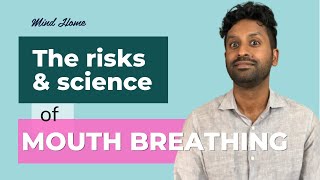
Vivek from Mind Home explains why 70% of Americans mouth-breathe at night, linking it to dental problems, hypertension, anxiety, and snoring. He traces how softer modern diets and smaller jaws made mouth breathing easier, then describes how mouth taping transformed his own sleep and breathing within weeks. Stanford is now studying the practice.
Chapters
Don't call me crazy because I sleep with mouth tape on. If you've heard about mouth taping, or maybe not at all, you might think it's some crazy new health hack, but it's actually based on a lot of science. In this episode, I'm gonna quickly summarize the science behind it, why mouth breathing is so dangerous, and the benefits of mouth taping. And I promise the benefits are not small at all. Hey guys, it's Vivek from Mind Home again. I'm excited to go into this episode, mouth breathing Breathing has definitely been an issue with me and something I investigated quite a bit, and mouth taping has definitely been a huge benefit in my life. So I'm excited to dive into this issue again with you guys. So if you think about it, just so start from the basics, when was the last time you learned how to sleep or how to breathe? As far as I know, there isn't any real class for either of those things. So how can we be sure we're doing both of them correctly? And the related science about both of them is pretty new. So while we've been breathing and sleeping since we were born, it's not clear if we were doing it correctly. That said, if you're a bedtime mouth breather, you're not alone. It's estimated that around 70% of Americans breathe with their mouths open while sleeping. So what about you? Do you breathe with your mouth open? Let me know in the comments below. I'd love to hear. If you're not sure or if you're definitely a nose breather, also leave a comment. While mouth breathing may not seem like a major issue, there's many, many negative consequences of mouth breathing. Issues range from gum disease issues, cavity issues, bad breath, but the problems aren't just limited to your mouth. Things like high blood pressure, related anxiety, snoring, asthma, fatigue, weight issues, and at the extreme, potentially even Alzheimer's. And the issues aren't just limited to adults. Related research has shown issues with young children as well and their ability to focus and their attention. As you can see, the issues range quite a bit and can be very consequential. That's why for me, mouth breathing is one of the most dangerous and underappreciated issues that Americans and people around the world are facing. And if you want to dig into the science and the research of this topic, I'm going to leave links to like a bunch of the research that I went into and I was looking into when I was learning about this topic. In the description below, so definitely check that out. So mouth breathing leads to all these issues, okay, but how did we get here? Like, were humans always designed like this, imperfectly as mouth breathers, or was there some sort of change that occurred? Well, evolution is an amazing thing. Humans have been designed over billions of years, so no, we were not originally mouth breathers. But to be clear, mouth breathing seems to have become an issue for humans in the last 300 years. And when you look at old skulls of humans, their teeth and jaws and face were perfectly designed. But around 300 years ago, with industrialization, many changes occurred that have caused negative effects on our jaw and our air passages. And researchers have been able to prove this with hard data. When looking at archaeological records, it's a hard word to pronounce. We've seen our skulls actually decrease in size. Hard to believe, but actually true. Even the famous scientist Charles Darwin had seen this occur during his period of time. In his book, The Descent of Man, he talks about how the jaw and, and facial structures were decreasing in size. He assumed that it was related to the foods that we're eating that were causing this problem, and modern researchers agree. They believe that the softer foods that we're eating, a decrease in breastfeeding, environmental issues including air pollution and indoor circular air has caused our jaws to change over time. These changes in our jaw structure have caused us to more comfortably breathe through our mouth instead of through our nose, which is how we were designed to do. And this is why there has been this increase in mouth breathing. Both during the day and especially at night when we're unconsciously breathing. So is there a solution to this? Is there anything we can do to fix this problem? Well, that brings us back to mouth taping. For me, I got interested in this topic through a podcast that I listen to pretty regularly called The Broken Brain Podcast with Dr. Mark Bahena as the guest on one episode. And he talked about the issues related to mouth breathing and how mouth taping was a simple, easy fix that we could try out. While at first I thought mouth taping sounded totally crazy, I knew I was a mouth breather. And so when Dr. Mark Bahena mentioned this as a solution, I thought, why not give it a shot? And while I tried to sleep properly, I always had sleep issues and other physical health issues that were causing problems in my life. So I thought this was definitely something worth investigating. So I went to Amazon, Ordered some mouth tape, and a couple days later it arrived at my house. When I got it, I wasn't sure if I could actually breathe through my nose. I was so accustomed to breathing through my mouth and thought that was normal. I wasn't sure, so I actually put some on while sitting up like this, and I could actually breathe totally fine. I even laid down and found it pretty comfortable. But, you know, when I actually put it on and went to bed and my girlfriend was sleeping right next to me. She was like, you're totally crazy. Our normal bed routine is, you know, turn off the lights, give each other a kiss, and I already had some mouth tape on, so that made it a little challenging at first. So while the benefits of mouth taping at first wasn't clear, I gave it a shot for a week or so and I quickly could see the difference in how I was sleeping, how much more rested I felt. It was a night and day difference. No more bad breath issues, no more snoring, which also my girlfriend was super appreciative of. No more aches and pains. I often would wake up with so many different aches and pains in my knees and my back. No more of that. I actually felt rested. I couldn't believe it. I almost thought that that's just how people sleep. They wake up and they have all these issues still even after their sleep. But after using mouth taping for, A couple weeks I was convinced no more, this was going to be my issue. I actually created a video about my experience after 100 days, which you should be able to find right over here. So while mouth breathing may seem totally innocent on the surface, it's actually much more dangerous than we really appreciate. And mouth taping presents a very simple, easy solution to this problem. And there's research on the benefits of mouth taping currently being done. And while the results are still not out, Stanford is doing a major, major study on this. That said, many of the leading researchers on the topic, including Dr. Mark Bohannon, James Nesser, the bestselling author of the book Breathe, and also James McCune, the bestselling author of the book Oxygen Advantage, are all supporters of mouth tape. While this simple piece of tape may not only be your bandaid for your sleep, it may also provide various benefits for your entire general health and mental wellbeing. So no one has the right to call you or I crazy if you decide to use mouth tape when going to sleep. If you like this video, let me know. If I missed something that you wanted me to talk about, also please let me know in the comments below. I'm always trying to improve. And if you did like the video, give us a thumbs up, subscribe to the channel. Thanks so much and have a great rest. Mirthful-intaglio.










