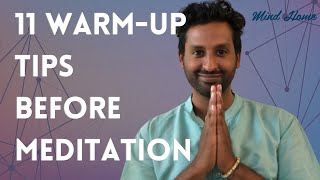
In this video, Vivek George, a daily meditator with over 1,000 hours of practice, shares his personal "warm‑up" routine to help listeners enter a meditative state more easily. He frames the tips as a series of dos and don’ts, likening them to a warm‑up jog before a run. The advice covers mental, physical, and environmental preparation: reading a physical book, engaging in focused exercise or hobbies (yoga, painting, cooking), journaling to externalise thoughts, deep intentional breathing, finding a quiet space (including nature), cultivating gratitude, timing meals to avoid overeating or hunger, steering clear of social‑media and phone distractions, not meditating too late at night, avoiding loud music with lyrics, and refraining from alcohol or other intoxicants before practice. For each tip, Vivek explains why it helps calm the mind and improve focus, and he encourages viewers to experiment with each for a few days to see what works best for them. The video ends with a call to action for comments, likes, shares, and subscriptions.
Chapters
Hey guys, it's Vivek from Mindhome again. I'm super excited to share my favorite warm-up tips to get you into a meditative state and have the best practice possible. So as you might know, I'm a regular meditator. I meditate every single day. I actually meditate twice a day for an hour each. And I've been doing this for over a year now. I've racked up about 1,000+ hours of meditation. So I really understand what it takes to sort of get yourself into a meditative state and what things throw me off and what things actually help me get into a meditative state. So these are my favorite tips, do's and don'ts for things you can do to help you get into a meditative state and to avoid all the noise and chatter. That often pops into our head. So with all that practice, I've come up with a bunch of different things that I find works pretty well to help me, you know, calm my mind and focus when I sit and meditate. I think of it a bit like taking a warm-up jog before a big run, or, you know, maybe warming up your voice before a big singing performance. A bit of like a warm-up. So I'm going to share my favorite tips, but just keep this in mind that we're all different. I recommend trying each of these out and see what works for you and what doesn't. Give each a couple days' try because maybe one day something will help you, but the next day it doesn't. Give everything a shot, and I recommend trying them for a few days before you say no to something and yes to something else. I broke down these tips into dos and don'ts. We'll start with the dos, and the first one is to read a book. So reading a book is a really great tool to help calm your mind and focus your mind and then transition to meditation. And the reason is, is if you're going to read a book and to actually comprehend that book, you need to be focused. And to, you know, in the process of reading a book, it's actually, you know, very calming, relaxing activity. And this is different than, you know, saying reading a blog or reading an article online. A book is very detached, you know, you don't have this electronic stimuli, you don't have the notifications. So reading a physical book or at least on a Kindle will help calm your mind and also focus it to meditate. Number 2 is exercise and doing a hobby that you're mentally engaged in. So yoga, painting, cooking, these are all different activities that both require your mental engagement and they're also oftentimes very calming. For example, yoga, it requires you to really focus on both the pose and on the breath. And then when you want to sit and meditate, you already naturally have a focused mind and you've cleared out any of the thoughts that are usually in our head throughout the day. So number 3 is journaling. So journaling is less about focus and more about getting the thoughts that are in our head out into the world. So oftentimes when we sit and meditate, part of the problem with focusing on our breath or whatever we're focusing on in our meditation is that we have a lot of thoughts going on our head. And by journaling, we're taking these ideas that are floating out in our head and we're materializing them in the physical world. So by journaling, your, your mind is more relaxed and allowed to calm down because it doesn't have to feel like it has to remember all these different thoughts because it knows that it's actually here on a physical piece of paper or some sort of document where where it'll exist and you don't have to remember it. Number 4 is deep intentional breathing. By doing this, you're actually talking to your mind and telling your mind, hey, listen to me. You're going to focus on taking a few deep intentional breaths. And this is a natural transition to going back to your normal meditation of focusing on your breath because you're telling your mind, hey, focus on this object that we're going to use in our normal meditation. And you're getting the hang of keeping your mind on that particular object that you usually meditate on, which is your breath. Number 5: quiet space. So if there's a lot of chatter, noise, TV going on, these are just opportunities to get distracted. So whenever possible, try to, you know, move yourself into a space that's quiet. And this includes nature too. You know, if you're a new meditator The sounds of birds and the wind or ocean can be all distracting. So, you know, as a beginner, definitely highly recommend trying to find yourself in a quiet space. That alone will calm you down and help relax you so that you can focus your mind on your breath or whatever you're focusing on. So number 6 is gratitude. Just before you sit to meditate, take a moment to try to think about something you're grateful for. This will help calm you down and bring some peace to you. And it doesn't have to be a long, long laundry list of things. It could be a single person, it could be something you love, it could be a movie you watch, whatever you're grateful for. And bring that into your, your thoughts just as you sit to meditate, and that will calm you down before you practice, as you practice. 7. Avoid overeating before you meditate. I find if I give myself like a 1 or 2 hour break since my last meal, that's the perfect time to meditate. That way I'm not too full or too hungry when I sit. If you had this really large meal and then you meditate, you're probably going to get a little bit tired from all that food digesting inside your body. And the reverse is true as well. If you're starving, then you'll be distracted and thinking about eating. So it's— in that situation, a light snack is totally fine, but don't overeat. 8 is to avoid social media. So social media is a mental stimuli bomb. You know, between all the photos and comments and updates from your friends, this can fill your mind with so many different thoughts that are completely distracting when you're sitting to meditate. On top of it, which I know is really hard, is I would even recommend trying to avoid checking out your phone too much before you meditate. Between messages and email and news, This can be very distracting once again when you're sitting to meditate. If you, you know, try to remember meditation is about personal care, about taking care of yourself. All these things will be around when you come back and you finish up your meditation. 9, don't meditate too late at night. I definitely know this one well. Oftentimes I get busy and I, you know, have to meditate late at night. Unfortunately, when we meditate late late at night, we're tired and exhausted from a long day, and oftentimes you'll be nodding off and more like dreaming instead of actually meditating. So avoid trying to meditate too late at night. You know, maybe give yourself like an hour or two before even going to bed if you're on the later side. Number 10 is loud music. Everyone loves music, but loud music can be often very distracting, especially if it has lyrics and and sounds that are sort of jarring, and that can distract you from your actual meditation. So while it might be something you want to try at first, as you continue on with your practice, you'll notice that music will probably more than anything distract you from your actual meditation. Number 11 and final tip is to avoid drinking too much or taking other intoxicants before you meditate. Well, you know, being social and having drinks is perfectly fine. In regards to meditation, it really can inhibit your practice. Meditation is a practice of awareness more than anything. So if you're taking things that could inhibit or, you know, mess with your awareness, you're not going to get the fruits of your meditation practice. So that covers my top tips for warming up before your meditation. As someone who's practiced for a while, definitely your mind will become more calm and relaxed as you continue to go on with your practice. But these tips will help you until then, so give them a try. And if you have any other suggestions or things that you've done that have helped you, please leave a comment below. If it was helpful, please give us a thumbs up, share with a friend that might be useful for, and and subscribe to our channel. Thanks so much. Have a great day.