S3E38 Reprogramming Beliefs, with guest Ryan Christensen
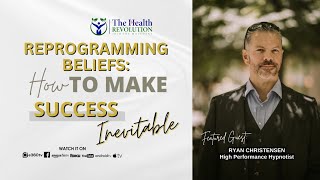
Ryan Christensen, a hypnotist and author, explains how subconscious beliefs block success and how hypnosis can reprogram them. He shares his own diagnosis with autism and bipolar disorder, and walks through how clients have used these techniques to resolve inner conflict and move forward.
Questions this video answers
Beginning of 2020.
End of April / beginning of May 2020.
July 29, 2021.
www.ryanthehypnotist.com.
@RyanTheHypnotist.
Chapters
Revolution, the program that shows you how to have a life of vibrant well being in a world full of noisy health trends. We bring you clarity. We reveal the science backed strategies that truly work in a sea of fads. We explore the physical strength, emotional resilience and mental mastery. These are the keys to an enriched life. Join us for inspiring interviews with champions who've conquered life's health challenges. Are you ready to unlock your potential to live with vitality and purpose? Then join the Health Revolution. I'm your host, Adriana Morrison, health and fitness expert, speaker and a mom who understands. Embark on this transformative quest together. We're about to change the game. Starting now. The information provided in this show is intended for educational and entertainment purposes only. Viewers should use their own discretion and consult with a healthcare professional for personalized guidance and recommendations. Welcome everybody. You are watching the Health Revolution and we're excited that you are joining us today. I'm your host, Adriana Morrison and no matter which way you're tuning into us, please don't forget to hit the subscribe button because we want to stay connected to you. Also, at the bottom of your screen there is a tab for show episode notes. This is some important information that you're going to want to reference after today, so make sure that you're aware of that. And for all those who are joining us today, whether you've been a viewer with us or you're a brand new viewer, it is all about elevating the physical strength of the body, emotional resilience and mental mastery. And today we're going to talk about what it means to master the Winner Peace formula. What does that mean? Of course, in terms of life, we all want to win, we want to succeed, and we want to transcend ourselves into a new, greater level of strength. Today we're going to talk about that. We're going to really dive into mindset and how impactful this is in our lives in more ways than we realize and the takeaways that we can apply in different areas of our life. I'm excited to talk to our next guest. I'm excited for you to get to know him first. Check this out. Watch this. Meet Ryan Christensen, a professional hypnotist, entrepreneur, and author of Winner how to End Inner Conflict and Make Success Inevitable. Ryan helps high achievers and neurodivergent professionals unlock their potential by transforming subconscious beliefs for lasting success. His journey, shaped by addressing depression, autism and bipolar disorder, led him to create groundbreaking techniques for deep personal change. Today we will dive into Ryan's inspiring story and powerful methods for achieving clarity, focus, and success. Ryan Christensen, welcome to the show. How are you doing?
Really well. Thank you for having me on. I'm excited.
I'm excited about our conversation. You wear a lot of unique and different hats. The hypnotist hat. You are an entrepreneur, and then of course, you're an author. And we're going to get to all these. But you know what really excited you to dive into this mindset and go deeper to understand the mind. And where did your journey begin?
Wow. Well, my journey really began in childhood in a lot of ways. I grew up in Kansas and realized very early on that the world worked for everybody else and not for me. So it's been a lifelong journey to try and figure out why, you know, what's. What's different about me. How does the world work? Why does it work for everybody else? And so it's been something I've been looking into basically my entire life. I didn't find out that I had autism until last year, actually. Same thing with the bipolar disorder. So I kind of had to find a way to navigate the world when nobody knew what was wrong with me and nobody could help. That kind of led me to basically turn my mind into a machine that reverse engineers human behavior later in Life. Back in 2019, 2020, I was heavily into my intelligence career. I was working as a contractor in D.C. doing counter proliferation, counterterrorism operations, working to save the world. And the world rather stubbornly refused to be saved. And that's kind of when I realized I had to change track, change professions, change my direction in life. And that led me to really start doing a lot of work on myself. Between 2019, 2023, I tried basically every modality, every tool you could think of to fix my head, get myself sorted out. But what I realized along the way was that nothing really worked the way that people said they did. Therapy didn't solve things in the long term. Cognitive behavioral therapy didn't solve things in the long term. I go work on beliefs in these different coaches and it shift things a little bit, but it wouldn't get to the deepest parts. You know, tried psychedelics, you know, tried energy healing. I tried basically everything. And along the way, I understood that each and every one of these theories, each one, every one of these modalities had some underlying assumptions, underlying set of implicit assumptions about how the world works, how the mind works, how people work. That kind of created a box or a set of limits as to what that could do. And so I started unpacking Those assumptions and figuring out, you know, what is the actual limits. And if these things aren't true, how do things actually work along the way? I got certified as a hypnotist back in the beginning of 2020. And that really gave me a lot of insight into what was going on in the back of our heads. Because our subconscious mind is really responsible for processing the world so we can understand it. And if it gets it wrong or if it's messed up in some way, or sets and sets of meaning that don't really service, then we understand the world to be. And what we perceive with the world is also doing that stuff. I just kept on digging and realizing how these presets came about. And start as I was working clients, I started to understand all these different themes that kind of ran through everybody. Everybody had a story that rhymed. Everyone's is individual, but every story sort of rhymed. I just kept plugging away and found ways to take apart those old beliefs, create new ones that actually allowed us to live a better life.
You know, I love how you first of all, very eloquent of, of what. What made sense to you to dive into and just take and unpack a little bit more to understand the mind. Why do we get it wrong in, in what you in your studies? Why? What is it about our subconscious that we. We just seem to have a hard time struggling with?
Man, that's a really good question. So if you look at child development and sort of the way we grew up in our earlier years, up until about five, six, seven years old, we really don't have the rational capacity to understand the world in a nuanced and complicated way. So we're drawing very kind of rough, high level emotional conclusions about who we are, how the world works, and how we need to move through the world. Because these are simple and because they're relying based on essentially observation of the world and the people around us, we get it wrong. We just are not sophisticated enough to understand what's really happening. So we're taking a lot of things at face value. We're not really doing the deep digging. And these emotional conclusions basically get stuck in the back of our mind and the subconscious mind as the rational mind develops. Okay, There's a concept in hypnosis called the critical factor. It's kind of the wall between the conscious and the unconscious mind. What that means is the stuff that's back there you can't really touch when you're in a conscious state. And from that point on, your unconscious mind judges true and False based on what it already believes. So if we have this idea, like, for example, that we're not good enough, then you get successful in business, you get successful in football, whatever that happens to be. That doesn't really match. I'm not good enough. So it doesn't really have that permanent change. Right. You still have that idea that I'm not good enough to got to work on myself. I got to improve, constantly prove myself. Okay. Since there's no way to really get that. Get to that from a conscious mind. Almost every single technique we use these days is conscious, you know, conscious discussion. Right. Coaching, exploring these things. And it's sort of like detailed one on one level. We never actually get back there to address those emotional conclusions. Right.
Do you think. Do you think that it's dangerous for. Do you think that we're afraid it's too dangerous to. To go back there? And what does there represent?
What.
What could there be?
Yeah, yeah. It actually. A lot of times that is exactly what it is. You know, a lot of us have been through a lot of rough times in our life. There's a lot of places that we don't want to go. There's things about us we don't like. There's things about us we wish were not true. And confronting that can be very difficult, can be very painful. And I think that really limits a lot of what we want to do. We get very comfortable staying in that rational space because our emotional reactions are so uncomfortable and we wish they were true and they don't really make sense. So it's difficult to do that. And hypnosis, in a lot of ways, is a really challenging, kind of scary thing. You know, it doesn't have the greatest reputation, this old mesorism. Let me go ahead and swing a pocket watch in front of you and take over control of your mind. That's very threatening. And it makes it hard. It really makes it hard. Fundamentally, though, you know, hypnosis is a voluntary process. You know, I'm leading you into the state you have to agree to follow. You never lose free will, you never lose control. And in fact, your moral compass is sitting in the back of your unconscious mind. And we're giving that place more control as we get you in hypnosis. So I can't really do anything to mess you up, if that makes any sense. But it's a matter of surrender. And surrender is really hard, especially for those of us who are very driven. We like to have that control. We like to do that ourselves. We like to have that Impact, hard to give up that control.
Very true. So in your discovering of what could help you completely understand where you're mindset, did you stumble upon hypnotism? Was. Were you introduced to hypnotism? What was that like for you?
Yeah, I was actually, you know, into 2019. I was looking for the next big thing. And I was actually thinking about becoming a psychologist. But I was gonna take about six years and half a million to get my PhD, which is unappealing in your 40s. But I was in one of these men's groups doing some work, and one of the guys there was a hypnotist. He was talking about toxic shame and emotional baggage. Like, sure, you know, got some of that. Raised Catholic. It happens. And so I did a session with him and just kind of felt like lighter. It's like if you're carrying around a backpack with £50 and you take £20 at it, it's a lot easier to do everything. That really caught my attention. So February 2020, I went ahead and got certified as a hypnotist because it allowed me to kind of dip my toe into that. That world of helping people one on one. And right after that, everything shut down. Right. The pandemic hits, everything's shut down. I've got all this time on my hands, you know, because I'm working classified stuff. Can't work from home. So I ended up working with a bunch of people online, realized I had a bit of a talent for it, got some more training, some more tools, and launched my business in end of April, beginning of May 2020. It's just been keeping on going since then.
What's been the feedback that you've gotten so far? Is there a level of curiosity that that is just ever apparent for those who discover that this is something that's in your wheelhouse?
Yeah. Like every time somebody goes, so what do you do? It's like, well, I'm an author, hypnotist. It's like I've never heard of that before. So it's always an interesting conversation. Right. Kind of get a reputation. I joined a social club here in Austin. I've kind of got a reputation already as like, kind of the most interesting man in the world, which is fun. Right. And it allows me to have these really interesting conversations of like, hey, here's some things that we didn't really know. Here's some things we don't play with. Right. Kind of gives people another option, kind of open the aperture for them and give them some more ideas of the way that they can improve their lives.
Do you notice a trend in life where, whether it's one decade to the next or maybe generational wise, from all your studies, that we just get lost in the fields. Is there a certain way in which we are there certain trends that, that, that tend to plague us as in being an obstacle for us to believe maybe an imposter syndrome or believe that, you know, maybe we're not good enough or have the fear based mentality that just makes us feel paralyzed.
Yeah. So I think it comes down to two things. Number one, in the west we are very, very heavily focused on rationality, right? We had the whole enlightenment, the whole Renaissance science really kind of had that war with religion, right? And so there's a heavy, heavy emphasis on rationality, heavy, heavy emphasis on individual action, right. The next thing I would say is, you know, if you look at things from like an attachment theory kind of perspective, you know, 70% of people have an insecure attachment theory style of some kind. Which means that as we were growing up, we experienced a lot of negative emotion, right? We didn't get our needs met. We're struggling. Maybe even you're growing up in an environment where there's abuse going on. And when you're in that space where you're experiencing that kind of negative emotion that intensely that often it gets to a point where it's just too much. And so we start to disassociate and distance ourselves from that, right? Where if we're looking at emotions as pain and you're experiencing that much pain, it's really hard to want to engage with that, right? So a couple things happen. Number one, you're distancing yourself from all those negative emotions and there's this powerful desire to be like, I just want to feel good. Whatever I have to do to feel good, I'm going to do that. That's where a lot of things like if you look at biohacking, right? Let's go ahead and just like chemically induce that, right? Let's go ahead and exercise and like exercise my, my feelings weight, right? Let me go ahead and go to the gym and, and crank out a new PR on the, on the bench because my girlfriend broke up me, right? All these things are, you know, and this is, you see this everywhere where it's like, let's go ahead and get around that emotional response. Let's go ahead and create a physical physiological response, right? So we don't have to feel those things. We medicated away in all these different ways, right? Even meditation Is about what, distancing yourself from your feelings. Right. So all these different coping mechanisms we have are all about getting away from and making those feelings go away, which makes it really hard to want to engage with them and explore them.
So do you think this is how society has evolved, has, has a lot to do with that? Or is it just that it's always been that that pattern of ours from a human, from a humanistic standpoint, that this is how, this is how we tend to cope versus society, Technology, the advancement of one decade to the next and the speed at which we're doing it. Do you think that that, do you think that plays a bigger role than we realize or, or how does that play a role for you?
The way I kind of look at it is it's almost a West versus east kind of thing, right? If you look at say Asia or India is a great example. They didn't, they never had that science, religion split, right? So exploring emotions, exploring that inner world, exploring spirituality is just a very accepted part of things. You know, you look at say China and Japan with like Buddhism and so forth and so on, all about going into the inner world and exploring that inner world. Now if you look at Zen, they're trying to get away from their thoughts and emotions. But like that same principle is there. You don't have that same pervasive idea of exploring your inner world. Here in the west, it's all about what you know, not what you feel. What you feel is always wrong in this space, right? What you think is always right. So it's like, no, I know I'm good enough. I know that I don't write and I feel this. So like this emotion must be wrong not because it's incorrect, but because we don't want it to be true. But the reality is the left and right parts of your brain are looking at the world from different perspectives and different resolutions. That rational part of your brain, very detail oriented, very individualistic. The right part of your brain, that emotional brain. High level overview Trees and forest. We're coming up with these different conclusions because we're looking at them from different perspectives, which means you have two different trees truths at the same time. You have two different correct answers at the same time, just from different perspective, right? And so you have to look at things from a what has to be true for both of these things to be correct. That's where the exploration starts.
So then the being able to rationalize with the two truths. Can we live with the two truths? Is there one? Are there instances in which one prevails over the other. It is. Are there instances where it is better for one to prevail over the.
The other? Well, I don't look at it as prevailing. Right. Because again, they're both correct. Right. So it's a matter of like, okay, in this instance, which one do I need to use most? Right. Or which one's best for me to solve this particular moment. Right. So maybe in the moment, got to go with this rational thing, but this emotional conclusion is not going to go away until you explore it and figure it out. Right. So a lot of the things that we deal with, like imposter syndrome and like social anxiety and so forth and so on, is just this overarching emotional conclusion. If I'm not good enough and there's something wrong with me being applied to individual situations. Right. And if you're looking at things from a sort of change standpoint, takes a long time to clear things out. If you're doing tree by tree. Right. If you can think of it as, you know, metaphor I use. You've got a big box in your head with label on the side of it, says, I'm not good enough. And there's a million things inside. The standard approaches, take one out, put in a different box one by one by one. It's like, maybe really good, you're taking out 20 time. Right. But there's a million things in there. It's going to take forever. As you're doing it, more stuff gets stuck in. But there's a label on the side of the box. Why don't just take off the label, put on a new one. I'm not good enough. I am good enough. Nobody says I can't. Right. If you do that. Yeah.
And, and I, I love, I'm very fascinated by this because it just carefully unpeels some of the compartmentalizing we've done over the years. And so how easy or how simple is it for us to begin doing that versus somebody who really wants to? And they're just like, I can't. I can't conceive being able to do.
So that's part of the problem is it's very difficult to do that on your own because on a rational, conscious level, you only have access to what your unconscious mind decides to give you. And it's only going to give you things that it feels are safe to give you. Right. So we only have individual pieces of the puzzle. We don't see that whole picture, that whole theme. Right. Because these emotional conclusions are the narratives through A series of evidence, right? Conclusions we draw through time, you know, through the different experiences we've had. And it's very. You can't really get there from rational perspective. Right? You can't go from the trees to the forest because we're generalizing from individual data points and we almost always draw on the wrong conclusion. So why it's so challenging. But from a hypnosis perspective, if I can open the door to your unconscious mind, then I've got access to everything in there. And as a, as a, you know, former intelligence guy, I know how to ask the right questions to get the right information to put the pieces of puzzle together. Looking at it from a high level view of, instead of saying like, you know, why am I procrastinating? It's like, okay, you're not allowing yourself to succeed in life, you're not allowing yourself to live a good life, but you're trying to solve a problem by doing that. Your mind is holding you back for a reason. It's trying to help you in some way. So all we got to do is figure out the problem it's trying to solve, figure out how it's trying to help you. And once we can understand that, once we can understand the change in logic that created that, we can go about taking that apart and rebuilding into something new. But it's not something you can do on your own as an individual. Because if your mind is holding you back, it doesn't trust you. So why is it going to let you change? All the things you want to do are things that it thinks are dangerous, so why would it let you change? Right? So you kind of have to have a new neutral third party come in and do that negotiation for you.
So what do you say to the person who's like, you know, I got to figure it out on my own. That's just how I can grow, I can be stronger, I can learn. What do you say to the person that's, yeah, I got it, I got it.
Good luck. You know, I hate to say it that way, but it's like there's. There are fundamental limitations to what you can do with your mind. If you're trying to be in conscious control, you just do not have access to your unconscious mind. That's not how it works. I wish it worked differently because it would be a heck a lot easier. Because one of the most frustrating things about my journey is that a lot of times I knew exactly what was wrong, I knew exactly how to fix it, and my mind would not let me do anything. So I'd have to hire somebody else to do that work for me. And because I figured out, you know, the might a lot of things about the way the mind worked that I don't see anywhere else, I had to figure out a way to frame the problem for them so they could use their tools due to the work I needed done. It's a really difficult process, but there's limits to what we can do on our own.
I'm sorry, this just simply are, and this is fascinating. We're going to continue this conversation. First, we're going to take a break. Stay put, Don't go anywhere. We will be right back after this.
So nad is something that we use for people who are going through withdrawal symptoms, whether it's opioids, whether it's alcohol, GABA receptors in our brain is something that alcohol affects when we drink. So when you're going through alcohol withdrawals and I give you the calm bag or give you calm with GABA in kind of gives your brain that kind of fix, so to speak, of the alcohol to help with the withdrawal symptoms. I'm not saying it gets rid of them. I'm not saying iq. You get gabbling, you're good to go forever. That's not what I'm saying. Again, just like everything we offer, it's a relief.
Introducing Launchpad, the perfect partner to help you launch your dream project to the world. We know that time is of the essence and we're here to help you make the most of it. With Launchpad, you'll get access to the most advanced digital tools and strategies to take your idea from a mere concept to a fully fledged success. Whether you're an aspiring entrepreneur or a seasoned pro, we have everything you need to make your mark in the world. Launchpad, your ultimate launch partner.
Welcome back to the health revolution. Spend quality time with our guest today, Ryan Christensen. He's a hypnotist entrepreneur and he is the author of the book winner piece. And before the break, we were taught, we were having an incredible conversation and we're going to continue that about how, how the subconscious mind, how we're affected by it and some of the barriers that we have come across that do prevent us from being able to, to tap in and succeed and just grow from where we are in life. And Ryan, before the break you started, you were sharing some different elements about how important hypno, how hypnotism can be extremely beneficial. And I've just got to ask before we dive into the book, you know, what were some surprising things that you discovered about you as you were laying the foundation to do the work that you're doing today.
Oh, man. One of the things about autism is, especially, you know, in my situation where I didn't know what was going on and, you know, nobody could really help me, is that life kind of just isn't worth living in a lot of ways. And so from a very young age, you know, I gave up on life very young. And there were a couple of moments where, as I was going through this work, I remember one time in particular, I realized that I actually had value. I actually had worth. There was a moment where I was talking with a guy about beliefs, and I realized I was sacrificing myself. And it actually hurt. The interesting thing is if you throw away trash, doesn't hurt, doesn't have any value. So because it hurt, I mean, I. I did have value. That was an interesting revelation because I never really thought about that before. So then I had to figure out how much value I have. At another point in time, I realized that, you know, I have a tattoo on my chest that says, I am Alive. Date is July 29, 2021. Because that was the first day in my life that I actually believed that life was worth living, that could actually get what I wanted. It took another two years for me to really finish that process. But I was doing a hypnosis session with a lady, getting some work done on myself, and I realized that day that I didn't have to justify my existence anymore. I'd been living basically to serve others, to serve that higher good, to be that night in charming armor between the darkness and the Innoc. And that didn't. I didn't have to do that anymore because I wanted to live. I didn't have to create a new reason. And that realization actually broke my brain so hard, I thought I was on psychedelics for, like, three days. Crazy. And that really kind of started showing me. It's like, wow. Like, how deep and pervasive these beliefs are and how much work our mind does just to keep us safe and keep us going. But more importantly, it meant that because our survival mind is really so focused on keeping us alive, it doesn't really care if we're happy. Unfortunately, it just really doesn't. So the. The conscious priorities we have, the things we've gotten chosen in life, kind of take a back seat to those subconscious needs. So if you're not getting what you want in life, you're getting what you need on a deeper level. There's just another part of you that has a higher priority that needs to get that met first before you can get what you. What you want in life.
It's pretty fascinating how. How you frame it that way. And so in becoming a hypnotist, obviously, the other role, the other hat that you wear is that of author. And I want to dive into the book Winter Peace, which I have right here, how to end inner conflict and make success inevitable. Talk to us about the. The behind the scenes with. When you decided to give the green light on the book and. And who's it for?
Yeah, so it was actually a situation where I realized I created something very special. You know, the modalities that I use, the techniques that I use, the way that I structured everything. It's a very different approach to hypnosis work in general. And I've got these very different ideas of how the mind uses belief to process the world and set things up. And I felt like I needed to get that out there in the world. So I felt, you know, started doing this whole process of trying to figure out all, you know, package everything and mind map it out. And I spent about six months doing that. Just got nowhere. One of my friends told me about this guy named Joshua Lysik. He's a ghostwriter. He's also a hypnotist. Like, aha, this guy is gay. Right. So I ended up starting work with him. I just dumped like 10 hours of audio on him. It's like, here's everything I can think of about my situation. Here's everything I think about, all these theories. Here's everything I can think about, how. How it works. And so he took that, and about a week later, he had. The first draft is about 80% done, which was phenomenal. It was great. Oh, man, he nailed it. And we spent about 12 weeks kind of going back and forth editing various things, getting all the different chapters and stuff in the right order, adding some stuff that needed to be in there that we hadn't seen the first time. Easiest thing in the world. It was great. You know, after that, he did all the rest of editing, got the. The COVID put together, did all the publishing work to get it up on Amazon and everything else. It was a great experience.
And so the how to end inner conflict and make success inevitable. What is the one theme that you want for people to understand about this book and the goal for this book for the reader?
Great. So basically, we get held back in two ways in life. Either we're kind of stuck where we're like, there's a gap between where we are and our potential, or we're sort of stuck where we're chasing success, we're going after this someone thing, and the rest of our life suffers because of it. You know, we've all known these opportunities who are really highly successful, and their personal lives are just terrible. You know, they're neglecting their family and neglecting their health and so forth and so on. But fundamentally, it's all the same thing. Your mind is trying to help you, trying to protect you from something. And it just is using as certain set of tools to do that. Okay, so once we understand what our mind is trying to protect us from, once we understand what these, you know, negative belief sets that are, are that we have, then we can do the things we need to change those. And as soon as we do that, your mind can actually work as a unified team. There's not the friction we have anymore. Right. Your mind isn't fighting against itself, it isn't fighting against you. And when you build that unified team, you know, unified in purpose, working towards the same goal, every part of your mind is available to work at maximum capacity to get the things you want in life.
And do you think that for the person who has limiting beliefs about what they think, their, their talent, their assets that they have to the world, do you think that it is if they truly want for more, but they feel like, I just can't picture, I can't, I can't picture me being able to just flip it and be like, you know what? I, I, I, I am worthy, I am worth being, I do have value in this world. How do they flip that script?
Oh, man. Well, for one thing, you know, it's kind of like I was saying a little bit before, like, if it hurts not having that, then you have to have value. Because if you didn't have value, throwing yourself away wouldn't hurt, right at that point. One of the traps we get into is trying to prove to ourselves how valuable we are, right? Trying to do it from the outside in. But again, subconscious mind judges things based on what it already believes. If you don't believe you're good enough, you can't really prove that from the outside in, unfortunately, no matter how hard you try. But what you can do is get agency, right? By going out there, getting fit, start working on things, learning new skills, you start proving to yourself that you have capacity, you've got capability, you're able to do things you could, able to change in the world. You've got agency, you've got power. And that's the start of building things in that right direction. You know, I tried everything in the under the book, under the sun to fix myself. And every single thing helped, every single thing moved the ball forward, right? So whatever tool you feel you need to use at the time, do that because it's going to help getting there to the finish line. This is what I think you need, right? You've got to get down there in that subconscious mind. You've got to figure out what those root causes are, those big picture beliefs. You've got to fix those. Everything else gets you to 20, 30 yard line. This is what I think gets you across the goal.
One of my favorite things to do on our show is to just dive deeper into books. And I'm just absolutely fascinated by your book. There's a few areas I do want to to talk more about with you on chapter two. You talk about solving where the problem is. And you know, one thing that you said here, and I'd like to share you with, with our viewers, a little snippet you said. The conscious mind thinks about what you should and should not do and about what you want and don't want. The emotional mind thinks about what's good and bad or right and wrong. It's concerned with deeper meaning. This is important because we want to make sure we're solving the correct problem on the correct level of your mind. So is this complex or is this simple yet story developing?
In my mind, it's very simple. The way I look at it is every part of your mind has its own job, right? Like if you look at your body, the heart does its thing, the lung does its thing. You know, your nervous system does this thing. You look at your mind, the audio, audio cortex processing sound. But there's a difference that processes language, right? So these different parts of your mind are just processing reality and doing these different jobs. Okay. We have to figure out where the problem actually is, right? So if you know you should do something, but you can't, it's not a logical, rational mind problem. It's another problem over here. It's around that emotional side. Or maybe you an instinctive mind, you know, pleasure, pain, kind of thing, actual physical safety thing, right? So you got to do that diagnostic to figure out where it is. If you're always approaching it from that left brain rational point, you can't actually solve the problem where it is because this isn't the part that's wrong. You know what you should do, you know what you want. It's an execution piece that's Wrong somewhere else.
When do emotions go completely. I don't want to say out of control, but when, when are there indicators where emotions are having too much say in the experience of what's going on with someone processing either a moment, a situation where they're trying to navigate through a certain circumstance? When is it too much? Or where are some of the warnings, signs when emotions just get way off the rails?
But again, the. The emotional response you get is just a signal from your unconscious mind of like, hey, this is how I'm seeing the world. This is a problem we're facing. I need you to help me solve it. Okay? So when you have those very intense emotional reactions, basically your mind is screaming at you for help. Should probably listen a lot sooner before it gets to that point. Right? Because it's asking you for help to solve a problem on your behalf. Right. So when you're having severe emotional reactions, that just means you're facing a very, very big problem. And instead of trying to push the situation, step back, step back, take a wider view, figure out what's actually happening here, give yourself some space from that situation to calm that emotional situation, you know, that emotional reaction down. So you got some space to engage that more rational, logical thing and start doing the investigation.
And for the person who is in different situations where they're continuing to grow, say the person who is making career of. Make just making the case for their career, they've gotten. They're taking on different roles. They're really putting one foot in front of the other. You know, what are. What are some best practices that you like to do or that you encourage others to do, to embrace, just to have that. Just that equilibrium of understanding what the mind is asking for, for keeping emotions in check, but making sure that we're putting our best, our best foot forward, we're playing the right cards, right?
Right. So again, I look at emotions as very helpful signals. Right. So in my mind, if I'm feeling bad, I'm actually doing it. Right. Okay. Because if I'm feeling afraid, that means I'm coming up against a challenge I don't know how to solve yet. Right? Something that's actually a big challenge for me. That means I'm growing. That means I'm challenging myself. If I feel sad, that means I've lost something of value. Right. Which means I had something of value to begin with. Right. If I. If I never feel shame, that means I've always hit the standard, which means the bar is probably too low. Okay. So in a lot of ways, to me Feeling bad is a good thing because it's meaning that I'm actually, you know, facing problems that I can't solve. It means I'm growing. But for people who are very high performers and are just rolling and rolling and rolling, everything's working right. Probably means that there's stuff that you're not actually facing, right? It's, you know, there's other areas of your life that you're not working right. You see so many people, like I said, they're on that 247 grind set trying to build their business, and they sacrifice everything else. So if everything in your life is feeling good and everything's working just the way you want it to, maybe take a step back and take a wider view of things, are you actually living a full life? Are you actually enjoying the success that you have? Right. Are you taking vacations? Are you taking time? Right. Are you taking care of your health?
You know, and so a lot of people will have an issue with being able to make wise decisions, even though there's that level of uncertainty. What helps you decide? How do you compartmentalize when you're approaching something that just. It remains to be seen, and I'm speaking more in global terms, but when you're looking into the future, when you're trying to set yourself up to. To be able to handle whether something is a big decision of any sort, of what are some best practices that you like to. That you like to do even with. Within hypnotism, but that you've ingrained into many areas of your life.
So for me, there's basically only three rules. To get everything you want in life, you have to be your authentic self to the maximum extent possible. You got to listen, you got to be curious, okay? So if you're being yourself to your maximum extent possible, you know, you've already done all the work to integrate yourself. There's not a part of yourself afraid of. Then you know that you're heading the right direction, okay? And you can look at each one of these parts of your mind as having a compass. Right? Instinctive mind, pleasure, pain, the emotional mind. Good, bad, right. Wrong. Rational mind is true and false. And the consciousnesses should and should not, you know, want and don't want. So if you move in the right direction, you've got that north star where you're heading towards, and everything's pointing north. All these compasses are pointing north. Everything's good to go, but along the way, you're going to start feeling something off. Okay? So when I'm making a Big decision, just kind of check in. Is everything still aligned? Yes. Good to go. If things are not aligned now, you need, now you know which part of this problem you need to focus on. If things don't feel true, if there's something that feels off that way, got to dig into the facts of the situation. If something feels off, doesn't feel right, doesn't feel good, doesn't feel right, you know, then you need to step back and figure out what things look like from that 30,000 to view, right? How are things aligned with who you are and your mission as a whole, right? So all you really have to do is listen to yourself. Your mind is sitting there trying to help you at all times. You just gotta let it do it.
Then gut reaction is. How much weight does gut reaction hold? Where is it on the whole, on the general landscape that you've, that you've explained so eloquently?
Well, for me, that's sort of like the emotional mind and the instinctive mind kind of throwing up that red flag, right? You can experience it as a, a sensation in your body. It could be just a thought, it can be an emotion that you have in your head. It can show up in any sort of way, right? Every single one of those things is trying to tell you something. Get that gut reaction says something off. There's something off, right? It may not be something specific, maybe it's matching a pattern of something before, but you need to take it, step back and look at it, right? If anything feels off in any of these different ways, listen, take a step back and do the investigation. Because your mind is trying to tell you that you're heading in the right direction, in the wrong direction in some way.
Now diving more into the book on chapter seven, you've. I love what you said here. And you and I talked prior to today about some of your thoughts. Your thought process on this chapter 7 is entitled, is titled make your emotions work for you. Again, a little snippet that I want to share with the viewers. We have to come. We have come to understand that there's nothing wrong with you. Because the challenges we all face are external, outside, impersonal. Thus, emotional signals received once interpreted as pain and trauma and the like are in fact requests for help. Nothing is wrong with you. Nothing was wrong with you either. Those times in places that you used to think of with discomfort, no longer because you did the absolute best you could with the resources that you had in order to survive, which you did. It worked. You did the right thing. Every time you are now, can you elaborate? Can you say more about that? Because I felt like you started off chapter seven with a very bold statement of this is. This is no misunderstanding. This is very clear message.
Yeah. So there's a. There's several different pieces of that. The first is that, you know, there's sort of this narrative of emotions are pain. They come from wounds, they're caused by trauma. But every single thing that we feel is just our own interpretation that was going on in the world. Right. It's our own interpretation. Nobody made us feel this way. Okay. It's our interpretation of situations happening. And when we're talking about traumatic events or really intense negative emotions, that's simply a situation where your mind was screaming you for help. It screaming at you for help trying to solve a problem, and you couldn't find a way to win. You didn't have a good answer. Right. But there's five survival responses that we have, not two. We talk about fight and flight, but there's also freeze and fawn, and most importantly, flop. You watch a couple guys get in a fight, crowd gathers around him. One of them starts losing, tries to run, can't get away. What does he do? He falls to the ground, curls up in a ball, protects himself as best he can because that's the only option he has. So in those situations, we call it traumatic, where we just didn't have any other option. We did exactly the right thing. We protected ourselves best we could, just endured. Right. And that works. Think about Martin Luther King, you know, changed history just by being able to take everything that came his way. That's powerful. That's resilience. Right. So you use the tools available to you at the time. If you had other options, you would have taken them because nobody wants to do that. Right. So there's that situation. And when you're looking at these different emotions as just your mind asking questions and trying to help you solve problems, then they're not as scary to engage with. Right. It's okay. It's a good thing because your mind is trying to help you, even when you feel bad.
This is important. Food for thought. We're going to continue our conversation first, let's take a break. We're coming right back. Don't go anywhere. We will be right back after this. Thank you so much for watching the Health Revolution. Our show is growing and it's all thanks to viewers like you, no matter how you found us. Please hit the subscribe button so we can stay connected and continue to deliver amazing content to you. Hi, I'm Adriana and welcome to Fitbites. Today, let's talk about cholesterol, what it is and how to keep it under control for better heart health. Cholesterol is a fatty substance that's in our blood. While your body needs some cholesterol to function, too much can lead to plaque buildup in your arteries, and that can increase the risk of heart attack and stroke. Now, the key is to balancing your LDL or bad cholesterol and HDL or good cholesterol. To lower ldl, focus on your diet. Replace saturated fats like those in red meat and butter with healthy fats from nuts, seeds, avocados, and fish, for example. Foods high in fiber, such as oats, beans, and fruits can help also reduce bad cholesterol levels. Exercise plays a very big role, too. Regular physical exercise helps to raise your LDL to good cholesterol, which protects your heart. Aim for at least 30 minutes of moderate exercise most days. Days if needed, talk to your doctor about medications or supplements that can help manage your cholesterol levels. Remember, small lifestyle changes can lead to big health improvements. Take charge of your heart and your health today. Stay tuned for more fit fights with Adrienne. Welcome back to the Health Revolution. Out the Winner Peace formula and what this means to succeed in life. We are spending some time with Ryan Christensen, hypnotist, entrepreneur, and author of the book Winner how to End Inner Conflict and Make Success Success Inevitable. And Ryan, before the break, you brought up some incredible points as to, you know, the, the type of choices that we make. Look, just the, the introspection. And I wanted to bring up chapter 10. You know, we talked a little bit about it before today. And chapter 10 is titled now that Everything has Changed. You know, I love how you talked about one section here. It says your, your motivations are changing. You're going to need to take another look at your life and what you're doing and why. Start looking at the reasons behind what you were doing. Which brings us to wants versus needs. What we want is usually based on what we believe we needed in the past but didn't get. This is not always obvious. The goals we create in many ways designed to fix a problem of the past. Can you talk a little bit more about that and just the impact of what you meant in chapter 10?
Sure. So there's, again, there's a lot to unpack here because this is a very new space that we're kind of moving into. When you think about something like a belief that I'm not good enough. Right. And you don't like that conclusion. So what do you do? You go out there in the world and try and prove yourself, right? Trying to prove to yourself that you're good enough. Which leads you on this treadmill of like always chasing success. But every time you reach a goal, feel good for a minute, don't feel good anymore, have to set another goal, okay? But when you get to that point where you are good enough, that constant need to prove yourself goes away. Which means instead of having to play life like a video game where you're putting points in the scoreboard, you actually get to approach life in a very different way. Get to play it like an infinite game, like Simon Sinek says, right? Rules change, players change. The goal is to keep it moving, keep playing, right? You start to be able to look at things in terms of impact instead of terms of money. You know, if you think about say the difference between like an Alex Hormozi and an Elon Musk, right? Alex Hermosi is trying to create this big billion dollar conglomerate. Elon Musk is trying to make humanity a multi planetary species, right? Completely different scale, right? But you can't get to that place if you're on this truck in this treadmill just trying to prove yourself and deal with your insecurity.
And I think that that's, that's pretty powerful because we're still, to this day with a lot of, with all the technology that we, that is now part of our lives, we still, underneath it all, this is such a common thread for so many that they find that they're facing. What surprises you the most with the talents you discover in others.
I'm sorry, what do you mean by that?
So what, what surprises you the most when you're, when you're learning, when you're interacting with others, when you're sharing your story, you're sharing your message that maybe that they've just story developing for them, that they've just, they've not tapped into all that they, that they truly can be.
Well, I think that the, one of the biggest things that always surprises me is that they don't recognize how resilient and capable they actually are, right? If you're one of these people that's kind of been held back all your life where this gap of potential, right? How much have you been taking care of yourself and protecting yourself in the world, right? These guys who are like heavy treadmill guys, like how much success have you done? Like, why don't you allow yourself all these other rewards and it's simply just being Able to take that step back in that wider perspective, just like, oh, my Lord, like, look at all the stuff I actually have. You know, look at all these things I've actually gotten right. You know, talking about a minute ago. You know, you've always made the right decision. You always have. You know, to the extent that is possible for you to do in that moment, given where you're at, you always made the right decision. You always won in the way that you needed to. Right? And just being able to help people understand that, one of the most rewarding things I do.
So with the hypnotism, I want to circle back to that. What has been. What has been a. One of your memorable experiences in guiding someone to really utilize this to help them succeed and to grow and to prosper?
Oh, boy. That's a really excellent question. I think that one of the most memorable and most powerful moments, and this is a little bit sensitive. I was working with a client who had gone through, you know, emotional, physical, and sexual abuse for her entire life, you know, all the way until she left. And then in her first marriage. And it was a situation where, like, she was the only victim in the family. She kept on saying, you know, I'm not allowed to be happy, not allowed to be happy, not allowed to be happy. And what I realized was, you know, her father was singling her out because she was the only one that this guy couldn't break. Right. The rest of the family was subdued. The rest of the family was playing ball, except for her. She was always staying happy in spite of it. And having her understand that it was her strength that meant that she was the target just changed everything for her. She's like, oh, now it's just not a victim. Now there's nothing wrong with her. No, she was too strong for this guy to break.
And so with the aha moments. Do you find that it is helpful for those to continue with hypnotism to just either. To cement the path that they're now on in which they're able to grow, or do you feel like sometimes it's just that this is all the. All the healing that they've done, or do they have a little bit more of healing to do, or. What's your take on that when you're.
The thing that I really like about my approach is that because I'm looking at these heavy, overarching emotional perspectives and beliefs, the goal for my clients is to get them to a place where there's nothing wrong with them and there never was. There's Nothing to heal and there never was. They're good enough as they are to deserve whatever they choose. Don't have to prove it to anybody. Kind of bulletproof, right? Why would you want to be anything other than good enough? Why would you want to change that? If there's nothing to heal, you're kind of done. If there's nothing to fix, you're kind of done. And beyond that, you're just learning new skills and new ways to navigate the world. And it doesn't matter what happens out there in the world because it can't ever touch that. Because again, that critical factor. Does this match I'm good enough? No. Gets ignored. Somebody tell you not, you know, you're not capable? Nope. Somebody tells you like there's something wrong with you? Nope. You just don't have to do anything. So you don't have to do anything to maintain the state, which is a beautiful thing about this. You can just focus on learning how to live life in better ways.
And you know what I love about that is that it's just, it's almost like it is done. It is the, you know, and we've talked about this before, that it's not that this mandatory ongoing still working on you in this regard, but that taking the tools and utilizing them and so just the growth happens. But now it's just a new perspective that is being implemented. And I think that's pretty powerful and empowering in a lot of different ways because now it's, it's safe for the person who feels better powerless. Now they've taken their power back and now it's like new set of lenses on and we're looking at things differently. And so that's, that's pretty incredible. We're going to go ahead and take a quick commercial break. Stay right there. Don't go anywhere. We will be right back after this. Welcome back to the Health Revolution. Today, Ryan Christensen. He's a hypnotist, entrepreneur and author of the book Winter how to End Inner Conflict and Make Success Inevitable. We've been having a powerful converse conversation about the Winter peace piece formula. And Ryan, where can viewers find you in the virtual space?
So My website is www.ryanthehypnotist.com. you can also find me on Instagram at Ryan the Hypnotist. And of course I'm on LinkedIn as well. My book is available on Amazon on all the different formats. And actually today, the day that this episode airs is actually gonna be free on Kindle for anybody who wants to go ahead and download it all I ask is you go ahead and leave me a nice review on Amazon if you liked it.
And I, while telling you, I. Your words are pretty powerful. Obviously you're very eloquent in describing how, how we can easily unpack this to learn and not be intimidated by this process. And now you've got me fascinated about hypnotism and the, and the benefits for that, for what we can all take away from. What do you have going on for the remainder of 2024 going into 2025?
Well, I'm really here to promote my book. I mean, here to get, you know, help more people one on one. I've got a lot of podcasts coming up. I'm going to be very active on LinkedIn. I'm actually looking at doing some work to get some clinical validation of all this to actually be able to do scientific, you know, scientific proof and quantify it. Hopefully to do some work with veterans here in the Austin area.
Yes. And by the way, November as of this airing, of course we know that we are honoring veterans. Thank you so much for your service. I do want to make sure I say that and also what, what is the one message that you want viewers to take away from this, from our time together? If nothing else, what is the one message you want to make sure that we, that we nail and we, we get it right?
The one thing I would say is that it is actually possible to be done. Healing and self improvement work does not have to be a lifelong process. There is an end. There is a way to do it. The book is designed as a written hypnosis program to get you there as far as it can on its own. And there are people like me that can get you the rest of the way.
And I'll tell you, I, I am loving this book and I just want the viewer, the viewers to understand how powerful this is. Ryan Christensen, thank you so much for spending time with us today. I really appreciate you. I'm learning a whole lot and it was, it was absolute delight to talk to you today. Thank you so much.
Thank you so much for having me. It was wonderful.
And for all our viewers, of course our website is on the Internet, the thehealthrevolutiontv.com you can subscribe to our newsletter. You can also email us with any show episode ideas that you would love for us to have and cover upper corner of your screen. You're going to find our QR code. Feel free to grab that. And then of course every Tuesday and Thursday each week you can find us on the Achieve TV channel on E360TV, 10am Pacific, 1pm Eastern. And that is all the time that we have for today. Until next time, take care of yourselves. We will see you soon.
Sa.
More from Ryan

How to Improve Yourself as a Man with Celebrity Ghostwriter & Writing Coach Joshua Lisec ft Hypnosis
Talking About... How To Reshape Your Emotions In A Relationship | Behind The Shades Show
#124 - From Inner Conflict to Clarity: Unlock the Power of Subconscious Mind with Ryan Christensen
Unlocking the Mind: Ryan Christensen on Overcoming Internal Conflict and Embracing Curiosity