Why Change Is So Hard
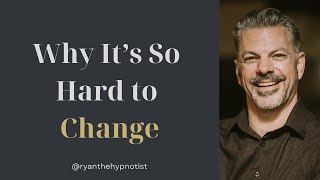
Ryan Christensen explains why change is hard: conscious thought arrives 500 milliseconds too late to control most behavior. The basal ganglia and emotional beliefs act as gatekeepers, filtering what you perceive. Hypnosis works fastest because it directly rewires these unconscious beliefs, while meditation and therapy take longer.
Questions this video answers
May 11, 2024.
Observe, Orient, Decide, Act.
About 500 milliseconds (half a second).
74 milliseconds (0.074 seconds).
Chapters
Welcome back. Today I'd like to talk with you all about why change is so hard. All of us are working really hard on ourselves. We're trying to figure out ways to make our lives better, ways to improve ourselves, ways to navigate life in a better way. And for some reason it always ends up being harder than it should be, harder than it needs to be. I'm going to talk to you today about why that is. So we need to start out by asking the question first, who we are. And this is really important for a lot of different reasons. See, here in the west, we've got a huge, huge focus on us as a conscious being, right? We're moving through the world, focusing ourselves as a conscious experience. The experience we have mainly via conscious thoughts, making choices in the moments via conscious thought, making plans for the future, consciously trying to make sense of the past, consciously. We're trying to understand everything through the lens of consciousness and rationality. And that's a problem because it means we have this huge tendency to focus on solving all of our problems as a conscious process. So we're doing the affirmations consciously, program targets for success, we're doing cold showers, we're doing knuckle push ups and stuff like that. We're engineering habits to support a process. You know, atomic habits by James Clear for example, is the most perfect example, is creating these routines to accomplish goal. If we're ever asking the question of how do I do this? It's almost always that we're focusing on a conscious, rational approach, approach to solving the problem. Thing is that we are more than our thoughts. And we come to this through things like meditation work and a lot of spiritual stuff. And the thing is, reality is that if we're focusing solely on our consciousness and our rationality and what we think, we're ignoring the rest of us. We're ignoring the fact that we have feelings, we've got instincts, we've got intuition, that we've got impulses, that we have all these other ways of knowing that aren't dependent upon rational conscious thought. If all we are is conscious thought, evolutionary psychology wouldn't exist. There wouldn't be any need to understand ourselves from any other perspective. If all we were was conscious thought, emotions would be irrelevant. And yet pursuing happiness, pursuing pleasure, pursuing those good feelings is one of the most important things that we do. The thing is, this ignores the rest of us. We have feelings, we have instincts, we've got intuition and impulses. We are not just our thoughts. If all we were is conscious thought, evolution psychology wouldn't exist. We wouldn't need to understand ourselves in any other way. We'd just be able to deal with ourselves as conscious, rational beings. If all we were was conscious thought, emotions would be irrelevant. But we deal every day with our emotions. Trying to ignore the negative feelings. We try and pursue the positive ones. Trying to be happy, trying to be fulfilled, trying to be content. If all we were was conscious thoughts, all debates would be totally rational. It'd be very easy to come to agreement because everybody would agree on the facts. Everybody would be in a rational process. We wouldn't have all this chaos and disorder we see in the world. If all we were was conscious thought, Marketing wouldn't work. Because marketing plays on things like our instincts, on our impulses and our emotions. So the other parts of us really matter, even if they're not under conscious control. So what's more important? We often think that conscious thought is the most important component of how we navigate the world. But the reality is that conscious thought comes last in how we process information. There were a number of studies done in Germany in the 1970s that actually demonstrated that we don't become consciously aware of something happening in the world until half a second after it's already occurred. The instinctive parts of us, the unconscious parts of us, react to the environment in milliseconds. There was a study I saw that said that your reaction to a car coming at you happens in 74 milliseconds. 74/1000 of a second is how quickly you react to that event, which is way faster than the 500 milliseconds it would take for you to even be aware of it. So before you even consciously realize what has happened, you're already moving. You're already taking action. We have emotional reactions to events, people, smells, environments, thoughts, none of which we consciously choose. We're not even aware that the emotion is happening until after we're already experiencing it. So we definitely can't get in front of it before it starts. We have these intuitive flashes of insights that come into us out of the blue. We've got impulses that run directly counter to important conscious values. How many times have you heard of somebody who wants to commit, quit smoking, but keeps on getting these cravings to smoke? How many times when you're on a diet, do you want to eat the candy bar? Do you want to go for the ice cream? Do you want to have the hamburger? So in a lot of ways, conscious thought is the least important factor. Because there's so much more going on for us. There's a concept called the OODA loop, which stands for observe, Orient, decide and act. This is something the Air Force came up with in the 70s for dog fighting. And it kind of explains and describes how our mind processes the world. I'd like to expand on that a little bit because there's a. Looking at it in this way gives us a little bit better understanding of what's really happening. The first step is that our unconscious mind receives information from the world around us. We see, hear, touch, taste, or smell something. Your unconscious mind then processes that information, figures out what it means, and takes any actions it needs. For example, when that baseball is flying at your head at 90 miles an hour, it just ducks. It doesn't wait to ask anybody else. It just takes action after it's done everything it needs to immediately do, and then packages up all that information in a collated, sort of curated way and sends it to your conscious mind. Your conscious mind then receives all that, which means not just the things you see, hear, touch, taste and smell. Not only then do you become aware that you're perceiving them, but you also all the thoughts and all the emotions that go with it, because your unconscious mind is sending those thoughts and those emotions to your conscious mind to tell you how it is understanding the world and what it wants you to do response. Then you have this portion where your consciousness, where your conscious mind evaluates and processes all that information and decides what it needs to do in response. And then it sends that response, sends that decision back down to your unconscious mind for action. Your unconscious mind gets that, of course, processes it again, and decides whether or not it's actually going to take action. And this is an important piece of the puzzle because a lot of people don't focus on this. We think as soon as we take a decision, we should be able to take action on it. But there's another process. There's another part of your unconscious mind that has to evaluate whether or not to do the thing you've told it to do. And that's called the basal ganglia. There's a gentleman by the name of Luca Delano who wrote a book called the Control Heuristic. And it's all about how the gatekeeper, the basal ganglia is essentially the part of your mind that sits between your consciousness and your action parts of your mind and decides whether or not to do things. It can't imagine, it can't plan. It does not use logic and is only making decisions based on how similar things have made us feel in the past, which Means that it is our emotional mind that is deciding whether we're going to take action on something or not. It's our emotional mind that decides whether or not we can take action on the things we decide. Our emotional mind is the gatekeeper to action. So here's how we end up trying to change things. Nine times out of 10, we try to manage what our conscious mind receives. We're trying to find ways to cope and distance ourselves from the thoughts and the emotions that we do not want to experience. And the next thing we do is we do a lot of work on trying to manage that conscious mind decision making process. We try to make better decisions, we try and do metacognition, we try and do all kinds of things to make better choices with what we receive. But that's the only places we focus our attention. And that's a problem. When you're trying to manage your conscious mind, what it receives. You're trying to manage the emotions and the negative thoughts you receive. One of the most classic ones, of course, is meditation. Trying to learn how to distance yourself and create space between the feeling and the perception of the emotion and the reaction and the choices you make in response to that emotion. This is distancing yourself from the thoughts and emotions, essentially disassociating yourself to some degree. A lot of people will use things like cold plunges and exercise and sauna to try and make themselves feel better. Try and get that dopamine and that serotonin going. And essentially what you're trying to do here is physiologically force, force a mood. It's medication itself. Medicating yourself with exercise and saunas and cold plunges, trying to spike your neurochemistry. Of course, there's medications such as SSRIs and other antidepressants and so forth and so on that can also physiologically force that mood. There's some things like somatic work, body work and breath work that are all about emotional catharsis, okay? Stuck emotions, moments you haven't processed fully in your life, doing some work to go ahead and allow yourself to move through and let go of that emotional content. Affirmations, of course, are another one we try and do. Trying to convince yourself of something through repetition, trying to change how you feel about yourself or change how you think about yourself through brute force and brute repetition. And all these methods are just helping you cope with your thoughts and emotions. They don't change much, if anything at all, with how those emotions and those thoughts are actually generated. And more importantly, they suppress useful signals about the world around you. Because your unconscious mind is sending these emotions, these negative thoughts, because it's trying to make you aware of what's going on in the world around you. Distancing yourself from them or suppressing them, or physiologically forcing a good mood instead means you're missing out on really useful information about the world around you and about yourself. The processing and deciding phase of consciousness. It's also really easy to do. Education. All kinds of education are trying to give yourself new conscious and rational frameworks to navigate the world. Whether that's traditional school, whether that's non traditional school, school of hard knocks, right? Whether that's self education, books, Internet, YouTube videos like this, things you see on Twitter and TikTok, anything you see on Instagram, you're trying to educate yourself and give yourself new frameworks to navigate the world. Coaching, of course, all kinds of different coaching is really, really useful for this as life coaching, performance coaching, relationship coaching, business coaching, exercise coaching, all these things are again getting you different frameworks to process and design through the world in a better way. On a conscious and rational level. Talk therapy is all about this as well. Whether that's cognitive behavioral therapy, traditional psychotherapy, understanding your past and managing your reactions to your emotions. On a conscious level, again, you're not getting down to the emotional level, not trying to change how those emotional states are generated. You're trying to understand and react to it in a better way. Psychedelics are an interesting one and then do give us direct access to that unconscious mind, to that emotional mind and so forth and so on. But it's primarily about getting insight and creating sort of like new peak experiences that can guide us. It doesn't actually change a lot about how we feel, except for allowing us to process certain events in our lives. Now all these, of course, are designed to give us better frameworks for making better choices, and that's a useful thing. They're designed to teach us specific skills and a specific, specific arena of life. And most of these assume that emotions are either not useful or an impediment of to success. We are trying to change the emotional state or trying to manage the emotional process so that is no longer in our way. We view the emotional process as an obstacle. Now here's how we could try and change things. Instead of just focusing on how the conscious mind receives things so we can better cope with things and changing how our conscious mind designs things, what about going upstream into that first phase of the OODA loop, the observe and orient phase, and change how our unconscious mind actually Processes the world around us, how it interprets the world around us, how it acts in response to that, how it generates the emotions and the thoughts that it then sends to the conscious mind. Because if you can clean up that initial phase, there's no need to worry about what you're receiving, because you're receiving clean signal. You're not getting bombarded by all these negative thoughts and emotions. Then, after the conscious mind decides, instead of trying to beat our head against the wall, trying to force ourselves to do stuff, why not change how the unconscious mind processes and reacts to those conscious mind's decisions? Why not make it easier to take action once we've made that decision so we don't have to fight ourselves and beat ourselves up to make it happen? And that thing is, that's possible. Getting into the unconscious mind to change how it processes and reacts to the world around it changes how it processes and reacts to the decisions we make is entirely possible. And it's not even hard. I'd like to talk to you about the mind as a. In a little bit of a different way. I look at the mind as basically being comprised of four parts. And you can look at this kind of like a company, all right? At the bottom layer, you've got your instinctive mind. This is the most primitive part of your mind. It's concerned primarily with survival, with your physical survival. These are the line workers in your company, okay? They're the people that actually make things happen. This is a part of you that's driving the car, that's dodging the baseball that's making you hungry, that's actually eating the food, okay? Your emotional mind is concerned with relationships. It's concerned with relationships with people around you and the world around you. It's also concerned with the relationship you have with yourself. These are the supervisors in the company that are actually supervising the workers. Your rational mind is concerned with objective facts. It's concerned with how things work out in the world. It's concerned with facts. It's concerned with things like, oh, gravity works. And how does gravity work? This is your senior management types. And then consciousness, of course, is concerned with the future. It's concerned about what we should do, what we want to do, things that haven't happened yet, things that we want to happen in the future. And that's acting mainly as a CEO. So what usually happens is if the workers don't have the answer, they ask the supervisors. The supervisors don't have the answer, they ask the rational mind. They ask the management. If the management doesn't have the answer, then it has to go to the CEO. And this is where things are so difficult for us because they're all operating independently. Anytime the emotional mind doesn't have an answer for what it needs, it has to ask consciousness. So it has to raise that emotion to the level of conscious awareness. Anytime the rational mind doesn't have an answer, has to raise that thought to the CEO, has to bring it to conscious awareness. And that's where a lot of the problems that you're experiencing come from. So each level of your mind uses different tools to analyze the world again. They're each has different jobs, they're operating in parallel and independently. Okay? Which means they're not talking to each other by default. Each of those parts of your mind reaches its own conclusions without consulting other parts. Which means your emotional mind is deciding on its own what things mean. It's not asking what the rest of it what the rest of your mind, what it thinks. It's just deciding on its own. Your rational mind is also doing the same thing, which is why you need a third party to resolve conflicts between them. When you have a conflict between what you think and what you feel about a certain situation, what you think and what you feel about yourself, they got to ask somebody else got asked to see how, AKA consciousness. This is why you get bombarded with all the negative thoughts and emotions. But the good news is that it is possible to train them to work together and resolve conflicts without you by giving the other parts of yourself, by giving the other parts of your unconscious mind what they need in that moment to figure out what's going on. Rational emotional mind. You have left hemisphere and a right hemisphere of your brain. All right? This is another one of those, like physical sort of evidences for these different parts of your mind. Left hemisphere brain is the rational mind. It's concerned with details. It's practical, it's orderly, it's control oriented, it's reality based. The right hemisphere of your brain is the emotional mind. It's concerned with the big picture and that's really important. It's holistic, it's intuitive, it's very judgmental, and it's synthesis oriented. It's not oriented on as far as the details, as far as the individual. How individual things work is concerned with the bigger picture and how things fit together. Both are driven by beliefs with different resolutions. What I mean is different specificity. So the emotional mind is going to have a belief of, for example, I'm not good enough. It's a very common thing that a lot of people feel is I'm not good enough. The rational mind takes that, that overall feeling of I'm not good enough and makes individual beliefs from that, like, I'm not tall enough, I don't make enough money, I'm too fat, my hair is the wrong color, I'm not driving the right car, my mom didn't love me when I was young. Whatever the heck that individual belief is, that's just a more specific version of that bigger picture, I'm not good enough. All right? And this is really important because the detailed rational beliefs are derived from the larger emotional beliefs. And the emotional mind ignores the details and focuses on trends and patterns. This is why it is so difficult to shift the emotional beliefs that we have ourselves, because they're not concerned with individual events, at individual details. So the emotional mind basically is looking at the forest as a whole, where this is. Rational mind is looking at all the individual trees. The emotional mind is concerned with what these larger patterns and trends, the stories that run between different events. It's not concerned necessarily with that one time you got turned down by somebody for a date. It's concerned with how every time you've gone out there and every time you've tried to go up to somebody and all these different relationship failures as a whole paint a picture of I'm not good enough. The rational mind is the part that's concerned with how each incident is different and unique, like why this person said no, why that person said no, whereas your emotional mind is not. Both of them are going to draw different conclusions from the same data, and they're going to come up with different beliefs again with different resolutions, different specificity. The rational mind does not care about emotional conclusions and vice versa. Facts don't care about your feelings. Gravity works whether you wanted to or not. And your feelings don't care about the facts. When you fall down and you feel angry, you don't care about the fact that gravity works. It's not going to change the fact that. How about how you feel? The other thing is, when you're looking at things from a rational perspective, you're looking at those individual trees, right? So you're trying to change individual things. Like if I'm not making enough money in order to feel good about myself, okay, well, I'll make more money. But changing one tree, cutting down one tree or dozens, doesn't really change that overall conclusion. Doesn't change how the forest looks, not really. And again, overall, if you're looking at the forest, it doesn't change the fact that this individual tree is dead or this individual thing is different from the whole, okay, rational, logical and emotional. Very different things. Looking at very different things at a very different scale. And they do not care about each other. They just really don't. So the rational mind is really easy to change. It responds really well to new information. Why? Because it's detail oriented. It can segment things out very easily so it can see why this thing is different from that thing. But the emotional mind is hard to change because it's ignoring the individual events. In hypnosis, we've got something we call the critical factor. We call it the wall between the conscious and the unconscious mind, or between the rational and the emotional mind. And essentially what it says is that your emotional mind will only accept things that match what you already believe. Right. If, for example, you feel like you're not good enough and somebody says that you're bad at something, well, that matches, you're going to accept that. But if you feel like you're not good enough and somebody says you're awesome at something, you're not really going to allow that in on an emotional level. It's going to be really hard to accept. So your emotional mind is essentially operating entirely on confirmation bias, which sucks when you're trying to change things because it's ignoring all evidence that it's wrong. So you have to find a way to bypass that critical factor. Now, there are a couple things that will do that. Traumatic events will force the emotional mind to reevaluate old patterns. It induces neuroplasticity. When the way you've been going about life gets you in some serious trouble, your mind starts looking for a new solution. It tries to reevaluate those old patterns. Say, okay, this got me in trouble. I can't keep on going down the road this way. What else do I need to do? Psychedelics are also great, introducing that kind of neuroplasticity. But you don't have any control over where you go when you're using psychedelics. You don't have any control over how your mind is going to change or what you're going to see or what you're going to deal with. That's why I like hypnosis. It allows us to bypass that critical factor in a controlled manner. It allows us to do things in a much more structured and direct way. So what do we need to change in the unconscious mind? Well, we deal with untolerable situations, especially when you were young and one of two, two ways, right? If we're in a situation where things are bad and we're in a bad situation, but we can't escape. What we do is we essentially lock ourselves down. We curl up in a ball to endure it, right? And so we end up operating from a place of fear and pain and uncertainty and doubt, right? We essentially go into a space where we only do things that are safe, that are easy. And so we get stuck in this relative mediocrity. We can't go after things that are dangerous, quote unquote. And trying and failing is dangerous too, because it reminds us of how we felt in those situations where we couldn't escape. The other way we go about things is a treadmill. Sometimes you've got an intolerable situation. For example, you grew up in a poor neighborhood, but you could escape in some way, right? You got that job distributing newspapers, so you actually had some money, whereas your family didn't, right? Or maybe you're in a bad situation, but you're good at athletics, right? So your family's very critical of you, and you can never do anything right. But you are really good at baseball. So that's a space where you're getting positive affirmation and you're getting praise that you can't get any other way, right? So you end up with this endless need to prove yourself, end up chasing all your goals, right? And that's what happens to so many entrepreneurs, is they say, okay, I need to make $10,000 a month. They start making $10,000 a month, and then they feel bad again. It's like, okay, I need to prove myself more. I gotta make $20,000 a month. So you're stuck in the situation where you have to continue running from that intolerable situation engine. You end up not being able to pursue things that don't run up the score. This is why you get people who are stuck in the hustle and grind so much, where their entire life is just focused entirely on their business. So how do we get out of the trap? Well, if you're operating from fear, pain, or a need to prove yourself, this really, really limits your options, right? Either you can't go after things that are dangerous at all, so you're stuck only doing things that are easy and living a life of mediocrity. Or you're stuck on the treadmill, just chasing the various goals over and over and over again, right? Because lots of things have become off limits for various reasons. Now, both of these tactics seem to work in the short term. In the short term, it does, in fact, make it a Little bit safer for you. It doesn't allow you to deal with those intolerable situations or avoid those intolerable situations to solve some degree. But the thing is that over time, things get worse. Because over time, you recognize that you don't feel any different. You're always feeling bad anyways, no matter how much you do now, the unconscious mind doesn't recognize this catch 22 situation. It doesn't recognize that by putting you on that treadmill or sticking you in that cage is actually making things worse for you in the long run. Because your unconscious mind only cares about right now. It can't think about the long term. So we have to show it the trap. Show it that it's making things worse. Help it understand that the things it's doing to keep you safe are actually making things more dangerous for you. We have to go back. We have to figure out what that intolerable situation is that set things in motion. We got to understand how these beliefs on an unconscious mind level, on an emotional level, came to be. And we have to figure out a way to draw different conclusions about yourself in the world. If you are feeling when you're young that you are trapped, that you can't protect yourself, that you're powerless, that you're weak because you're stuck in a situation where you can't prevent bad things from happening to you, we need to change that to being you're resilient, you're strong. If you felt like you're not good enough, that you don't deserve, and that you can't get what you need, you need to change that to where you're worthy, to where you're good enough. If you feel like you have to earn it, you have to feel like there's no need to prove anything to yourself. And if you feel like you're not allowed to be yourself, you need to make sure that you can change that to something like yourself is as good as it is. So why hypnosis? Well, we need a tool that can actually reach that emotional mind directly, bypass that critical factor and talk to the emotional mind directly. Well, that's hypnosis. You know, it's deliberate and controlled. It's something that we do deliberately. It's something that we can actually go after exactly what we want and we can shape the experience. Unlike psychedelics. Psychedelics give you access to the emotional mind, but they don't really give you any ability to control what that experience is. And you can't really decide what you want to go after. The next thing is we can actually do the change work directly in the emotional mind. The other problem with psychedelics is we get a lot of insight, but we don't really have the capacity to do anything to work to change it until we get back in our normal waking state, back when we have actually control of our mind again. So by the time that's happened, that door to your emotional mind is closed and it's really hard to get to do the integrative work, do the change work. The nice thing is that when you're doing this work with hypnosis, you can change those beliefs rapidly and permanently. It can be done remotely. I do everything, all of my work with my clients over zoom, and we can repeat as much as we need it. We can peel back the layers, we can go as deep as we need to, we can do as many times as we want to to get the results that we're looking for. There's no risk factors from psychedelic use or other neurochemical changes and there's no need to relive or re, experience, experience negative emotions. If you're talking about things like somatic work and breath work and so forth and so on, you have to feel all those emotions again. And that can be a really horrifying experience. No need to do that with hypnosis. Anyways. I hope that helped you understand a little bit more about why it's so hard to change. I hope it helps you understand why it's so difficult to get down to those emotional beliefs and why they are so different from the, the ones that your rational mind creates. If you're interested in learning more, go ahead and click the link below. Go ahead and hop on a consultation with me. I'll be happy to talk about what's going on in your life and what we can do together, get you past all these things much more quickly and much more easily than everything you're doing now. Cheers.
More from Ryan

How to Improve Yourself as a Man with Celebrity Ghostwriter & Writing Coach Joshua Lisec ft Hypnosis
Talking About... How To Reshape Your Emotions In A Relationship | Behind The Shades Show
#124 - From Inner Conflict to Clarity: Unlock the Power of Subconscious Mind with Ryan Christensen
Unlocking the Mind: Ryan Christensen on Overcoming Internal Conflict and Embracing Curiosity