Benjamin Taylor - Introduction to the Viable System Model
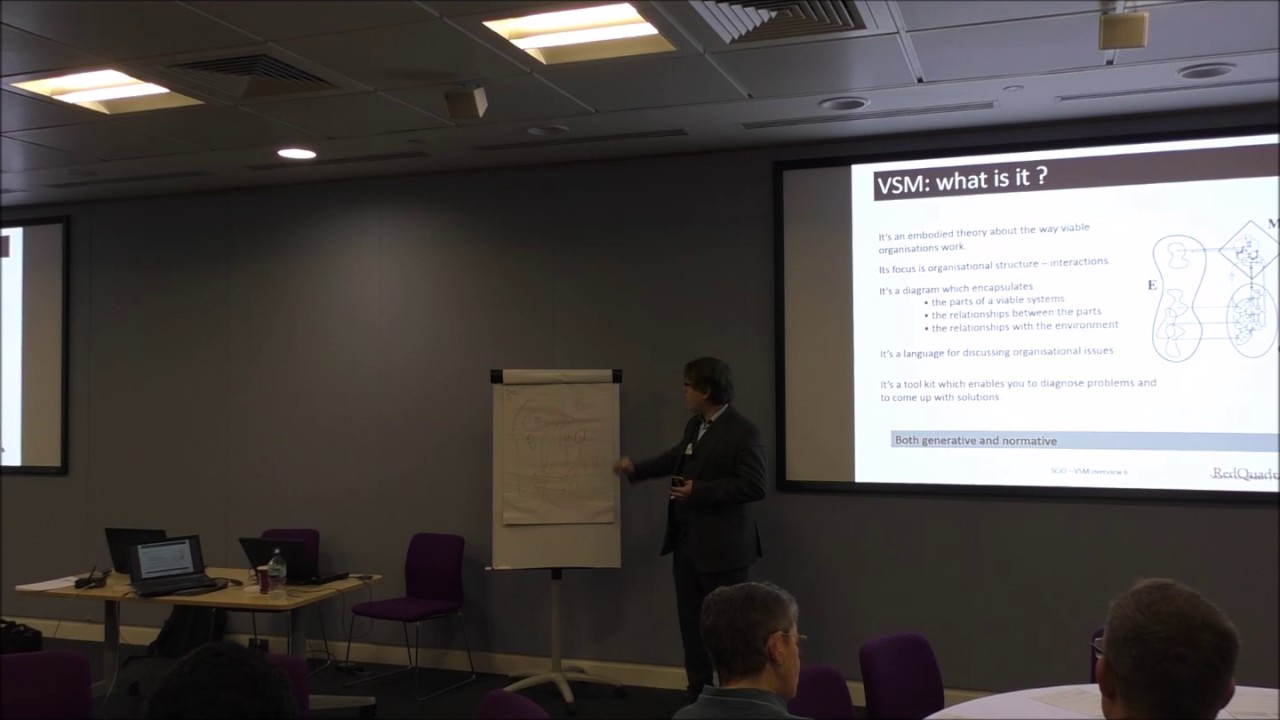
In this 20‑minute lecture Benjamin P. Taylor introduces Stafford Beer’s Viable Systems Model (VSM) to undergraduate students, weaving historical anecdotes, practical teaching experience, and systems‑thinking theory. He contrasts traditional hierarchical org charts with the VSM’s multidimensional view, outlines the five (plus star) functional systems (1‑5, 3), explains their roles in interaction with the environment, internal coordination, resource allocation, future planning, and identity governance, and stresses the importance of recursion—each viable unit contains its own full VSM. Taylor highlights core principles such as Ashby’s Law of requisite variety, the need for balanced information flows, and the dangers of oversimplifying complexity. He situates the VSM among other frameworks (McKinsey 7S, living‑systems theory), uses stories (railroad fatality, Hungarian scouts) to illustrate sense‑making, and shares personal teaching challenges (exam marking, critique of a common VSM tagline). The talk ends with a call for students to focus on the dynamic conversations between the systems rather than merely labeling them.
Chapters
I do actually have to lecture undergraduates about the Viable Systems Model. I do a tiny, tiny part-time thing in applied systems thinking. And not only do I have to lecture undergraduates, I then have to read and mark the exams that they produce as a result of my lecturing on this, which is painful, painful, painful. And if anybody can tell me the origin of a tagline which reads, one criticism of the VSM is that it's overcomplex in grounding and oversimple in practice, which cropped up in about 23% of all the 150— no, 200 exam papers that I marked. I'll be very grateful because I want to hunt that source down and shoot it. Pauline was the guest lecturer on the course this year.
And she liked me better.
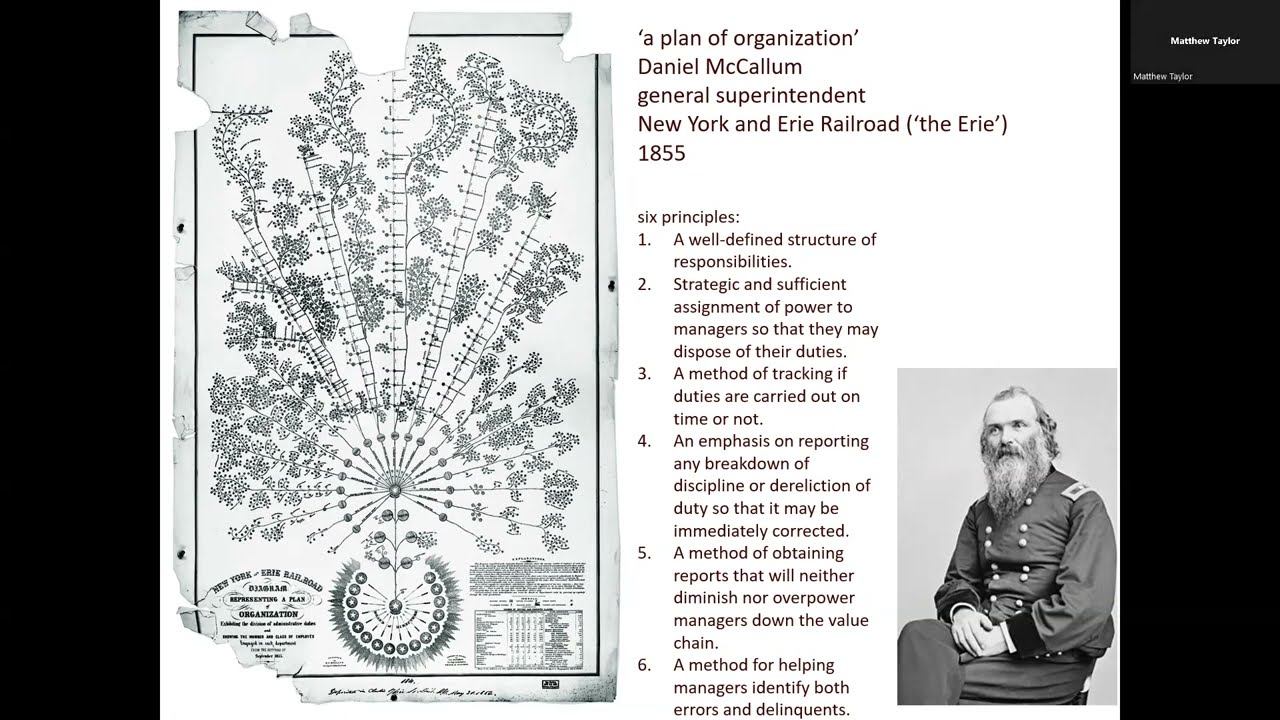
Added more wisdom than all my 5. So I'm going to take you I'm going to take you through a very simple introduction to the VSM, and I'm going to slightly counterpoint it to what Patrick normally does as an introduction, but I recommend his set of slides which are available, I believe, on the members area of the PSIO website as a really good overview and a practical introduction. And if you get to do it, VSM 101 and whatever the second VSM course that PSIO runs, they're absolutely brilliant, really practical hands-on use of the VSM for organisations. This is my version, and I'll do a bit of introduction. Does anybody know what this is? I've used it in a previous thing last time I was here in June. Some people are smiling. So this is allegedly the first ever modern organization chart. And the story goes that this came about as a result of the first railroad fatality. Lots of people got killed in the building of the railroads, but evidently they don't count. And even though the trains were only going about 30 miles an hour, the Lake Erie and New York Railway still managed to have a fatal crash. And there are 2 versions of this story which show 2 possibilities of organizations and gets nicely into thinking about why the VSM is a good, useful model of organizations. One version is that they gave it to the guy who was used to designing switchgears, and he produced a hierarchical modern-day organizational chart, which was very good for lines of reporting and ultimately for responsibility and blame. And I think that story is true, and I think it's quite a good explanation of why modern-day organization charts are not good for either analyzing or building organizations. But there is another version of the story, which is that if you look at that organization chart, if it's truly the same one that we're talking about in the other story, It looks incredibly beautiful, organic, quite emergent, and those things down at the root, this is literally the directors, the board of directors kind of nourishing the organization. And if you read the letter of Daniel McCallum, the superintendent's annual report, which is available online as a PDF from the Library of Congress, and I'll put the link in the slides. It's probably the first non-military example of enterprise architecture, understanding the dynamics and flows within an organization. And what I usually add is that in 1855, this was partly produced in response to the first ever big data revolution. Because of the introduction of the telegraph, it became possible for the first time for head office to interfere in what was happening down the branch lines. So organisations have these 2 possibilities. One is to create models which are utterly false but very good for allocating responsibility and blame. The standard sticks and boxes org chart that we're probably all familiar with. But the other is to create elegantly designed, effective Organisations that are thought of in a sophisticated, multidimensional way and that work elegantly as designed. And that's what the VSM offers the possibility of. Very quickly, I'll just make this point that we are all a bit like the blind men and the elephant in that our experience of organisational life determines not only how we see the organisation— sharp and pointy down the front, stringy and smelly at the back— But also how we're likely to interpret inputs into our part of the organization. Final thing before I get to the actual VSM diagram, I love to tell this story from Carl Weick's Sensemaking in Organizations, classic book. The story is about, I think it's, I'll get all the details wrong but it doesn't matter, I think it's a Hungarian regiment were doing maneuvers in the Swiss Alps. And the sergeant sent this gang out scouting, and then a terrible, terrible storm descended, and after 24 hours, they gave the scouts up for dead. But after the storm lifted a couple of days later, these guys, very bedraggled, very cold, crawled back into camp miraculously alive. And they said to the scouts, how did you survive? We thought you— we gave you up for dead. We were dead. We thought you'd never survive. And the scout said, well, you know, we did think that we were goners. We hunkered down and sort of, you know, said our prayers. And then somebody found in his pocket a map. And with the aid of the map, we found our way. You know, we had hope. We walled ourselves in with snow. We kept as warm as we could. And we eventually found our way back to the camp. And I'll return to this story at the end of these 20 minutes. But it's time to introduce the VSM with that story of the map in mind. And these slides, as I said on the COVID page, are heavily stolen from all the kinds of people in and around SIA who've done introductions to the VSM, and basically anything I could find on the web 4 years ago when I started to do my slides for the undergraduates. Hmm. So VSM is an embodied theory about what's necessary for an organization to be viable in the organization. And it's both diagnostic— you can actually use it to understand how organizations work and what's going wrong with them, what's not quite right— but it's also generative. You can use it to design and to think about the requirements To make organizations, and the thing on the right, which Patrick quite nicely refers to as a mess of spaghetti, is the diagram itself. And you'll see it in a few different forms as I zoom through this. The basic concept is simple. Nice. And and it's this: If an organization, an entity, or a living thing. Is to survive in what we'll call the environment, it has to do a set of things. First is that it has to interact with the environment. Energy of some sort has to come across the organizational barrier into the organization and flow back out. There has to be an interaction with the environment for it to be said to be living or viable. Hopefully you buy that. I'm not going to have much time to go into a lot of details, and there's a lot of things we could discuss in all of this. So you've then got units, units in business, bits of an organism which are interacting with the environment. And the next immediate problem, if you're starting with this bottom-up view, is that these units have got no particular reason to live together inside this organization. And in fact, They might contradict, trip over, get into turf warfare, fight for the same resources. What you end up needing is what we call— those we call the System 1s. And the reason we do this introduction, by the way, is that people throughout the day might refer to Systems 1, 2, 3, 3*, 4, and 5, bits of the VSM, and they might apply it because the heritage of SAIO is quite strongly around the Viable Systems Model. That's why we do this in the first place. So you need what we call System 2 to manage the day-to-day automatic ongoing basic interactions between the System 1s so that they don't trip over each other. At that stage, you've got an organization that almost looks minimally viable and is able to respond to the environment and balance itself in some kind of way. But this organization is not fundamentally viable, meaning existing and continuing to exist in the future, because it has no mechanism for understanding what's going on within the organization and balancing the resources. So we talk about 2 systems that do that: 3-star and 3. And you'll have to, as some people in this room have done, actually read Stafford Beer to understand why it's 3-star and not a different number and all the rest. There is some obvious logic to it though, in that 3-star is the inspection The audit, the understanding from what we're now going to call the metasystem into what we're going to call the organization. So 3-star is the function by which people understand what's happening a couple of levels below them in an organizational hierarchy, by which they wander around and actually find out how the work works. And System 3, which ought to be closely allied to and integrated with System 3-star, is the deliberate allocation of resources according to need across systems 1 and system 2 of the organisation. So what you've got now is an organisation that's able to respond to small shifts in the existing environment, make automatic adjustments here so things balance up quite well, and make deliberate intentional adjustments of resources as we see things changing in the organisational system. What you haven't got is any capability to exist into the future because as soon as the environment changes, the organisation is going to be no longer fit for purpose. So you need another system, that's System 4. Traditionally we say that System 4 looks out into the future, looking into the same environment but looking for the signals that will identify how the environment will change in the future and therefore you can plan. how the organization needs to respond to those future changes. By the way, perhaps these signals at System 1 environment interface could be quite an important part of how the organization needs to change in the future. But we usually have some kind of future environment indicated here on the map. So now everything's perfect, right? You can deal with day-to-day fluctuations, you can make intentional changes, and you can plan for the future. The challenge, of course, is that as soon as you've got one bit of the system— and I emphasize, these are not teams, these are not structural bits, these are not policy strategy. They may be those things, but these are functional things that have to happen that may be staffed or resourced or organized in a way that's entirely inconsistent with a typical org chart. It might be a bit of a person here, a bit of a person here. It might be this person on a Thursday does that. There's all kinds of different ways of mapping this. But as soon as you've got somebody looking out into the future, they want all the resources of the organization in order to transform for the future, whereas the people who are— or the same person, when they are responsible for managing the resources to meet the needs of the here and now, want all the needs there. So in order to avoid conflict between systems 3 and 4, or to mediate that conflict, we call system 5— The observer. The identity of the organization. Not only does it balance the demands of here and now versus the needs of the future, it also identifies what the actual identity of the organization is. I.e., viability means nothing if the organization continues into the future but is in a completely different and no longer identifiable form with what it previously was. So System 5 is preoccupied with balancing these in order for the organization to maintain itself into the future. I've said about 17 things now in just this simple diagram that are all disputable and have quite a lot of interesting debate behind them, but I've only got 10 minutes left, so I'll crack on. Worth saying that the VSM originates in understanding the human body. Patrick says that The brain of the firm was studied in medical school for decades before it started to be studied in management organizations. And hopefully you can see that these 5 or 6 essential systems, essential elements, are a very organic living thing model of an organization. By the way, personally, I found— and I haven't studied it in anything nearly as much detail— The living systems theory, the version of living systems theory that actually talks about living systems and talks about the way life exists and continues to exist within a cell, to be very mechanistic by comparison with the VSM. Which is interesting because a lot of living systems theorists criticize the VSM as being mechanical. I don't think that's the case at all. And also, and the worst thing that I mark people down for in my undergraduate exams, which is a great pleasure, this may look like a hierarchical model. It may look as though you have the plebs down here in the organization and the big brains up here in the metasystem. Okay. That is absolutely not necessarily the case. I understand why some people think it might lead to that kind of direction. But the point here is that these metasystems can be embodied in the structural governance of how people work day to day. They can be the rules on which a— what do you call it— the systems that are modeled on the basis of individual actors and activity. Somebody? Agent-based modeling. Thank you. They can be the rules on which agent-based modeling works. If you look at something like Holacracy or the concept of teal organizations, then all of these principles I hold would absolutely remain true for an organization to be viable. They would just be distributed in a way that does not look recognizably hierarchical. So just because there's a sense that the metasystem is separate from the organization does not mean that That the meta-system is separate in practice. What it does mean is when you're diagnosing using the VSM, if people are trying to have operational inter-unit System 2 discussions and governance strategy and future discussions in the same conversation at the same meeting, that's a pretty good sign of why things are not likely to be working. I hope that makes sense. These are discrete and different things to do. This is managing the day-to-day work. This is intentionally managing the emergent direction of the organization, but they don't have to be done separately in a hierarchical fashion. So I won't go through all of these slides, but I will have to flip through them the way I've got this set up. But really important to understand that there are some really critical information flows in the VSM. Ask Geoff Elliott, and he's available on LinkedIn. If you say anything about these kind of systems, he will appear as if by magic. And he will say— and he's almost always right, often a little bit annoying, but always right— and he will say— he's not here today, is he? Sorry, I'll tell him I said that. And he will say that there are about 30 principles that underlie the Viable Systems Model. And we have a few fairly good attempts at lists of those. I'm not going to go too deeply into those principles, but the point is that you've got complexity of the environment coming into and affecting the organisation here. So if this information channel is not sufficient and these operational units are not able to properly absorb that complexity, i.e., deal with what is allowed to come into the organization as a signal from the environment, then you're going to have trouble. And if the metasystem does not have the complexity to be able to deal with the complexity and the confusion and the challenges which arise in the organization, then you're also going to be in trouble. And if the organisation is not able to deal with the complexity that it allows in, in terms of its future considerations, then that's another sure sign that the organisation is not going to be able to be viable in the future. So these are some explanations that are taken from some other slides about Systems 1, 2, and 3, which are considered to be us and now down and into the organisation, out to the environment. And systems three, four, and five, which are now and/or versus the future. And what I just scribbled on the whiteboard was an attempt to explain some of these core principles that you're seeing on the slide now. Managerial operational environmental varieties diffusing through an institutional system tends to equate. Is a really condensed and powerful way of saying that the complexity that you find here driven into the organization will tend to balance with the complexity that you find here driven into or out of the organization itself. So if you look at all organizations, and I work lots in the public sector and lots of these things happen, where the signals are being so narrowed down and simplified that the complexity of the environment starts to happen not when people are responding to what they think the environment is asking them, but when they have to start dealing with the complexity that's accidentally come into the system because they're dealing with real people's cases that have been categorized into very simplistic categories, then it gets absolutely chaotic in here. And when management tries to oversimplify the way that they manage and tries to attenuate the signal coming from all the complexity in this organization, guess what? More complexity happens in the organization, and you get the kind of chaos and disarray that I often see in organizations that think that everything has to be simple. Okay, so I'll move on. There's a lot to be said about this. Steve has a nice summary of some of this here. Are there adequate resources? Do the functions connect appropriately with each other? Can they balance? And do they actually know what's going on? So there is something to say that the VSM is is a model of a conscious and intentional system. Even if I'm saying we think that we can embed Systems 3, 3*, 4, and 5 in the rule set of how self-organizing units can work down here, one of the principles I think is that this is about some kind of intentional direction by the metasystem. Everybody keeps coming in who knows more 10 times more than me about the VSM. It's hilarious. So, Ashby's Law, which says— and I use this version of it advisedly— control can be obtained only if the variety of the controller is at least as great as the variety of the situation to be contained. The simpler version of that, and I think Beer used the version which is only control Variety can destroy variety. And that sounds— that plays into the concept that this view of the organization is a controlling one, by which people mean top-down directive command and control, which I don't believe is true. But it's an absolutely true law of organizations that You have to have the same amount of complexity in your ability to respond as you allow into the organisation to respond to, otherwise you're going to be in trouble. Perhaps others can expand on that, perhaps we could do a quick question at the end if I haven't landed that properly. But the point about this is, as I said, the complexity coming into the organisation has to be capable of being absorbed here, otherwise it leaks up here. The complexity of the organisation has to be capable of being absorbed here, otherwise it bounces back around and causes more problems. And this is another bit from Steve, really conceptualisation of a very common way of looking at the critical relationships in the organisation and understanding what they are. So the conversation between System 5 and Systems 4 and 3 is about what are we as an organization and what should we become. The conversation between the environment and System 4 is scanning for the future, and so on and so on. I think it's a very nice encapsulation of it. It's from a previous Open Day talk. And so, for example, you can take from this— this is Stephen Parry developed a sense and respond model that merges Lean and reliable systems. Model, something that I'm quite familiar with and just find interesting, which asks 4 questions. Are we actually understanding the demand signals that the environment is giving us? And he works very much with transactional customer-facing environments like IT help desks, contact centers, and so on. And the theory there is if you actually capture the things that the— that your customers are asking you for but you don't do, and you capture it in the customer voice, even if it's ordering off menu and computer says no, you can't actually respond in the here and now, but you listen as an organization. So most organizations systematically deafen themselves to the complex signals coming from the environment that don't exactly meet their delivery categories at the moment. Does that make sense? But if you listen to those, If you make sense of that data, understand what it would mean for the future of the organization, if you're able to transform that into a strategy for how System 1s and 2s and the rest should work in the future, and then make that change, then you'll get an organization which is strongly coupled to whatever environment it's in, but which is able to Evolve in a fairly natural way to meet the needs that the environment is sending you as demand signals. So I think I've done this one before. Apologies, I was jumping around a whole bunch of slides. So really critical principle of the VSM is that of recursion. So these systems needed for viability are needed at every level. Somehow, I don't know why, it becomes really attractive to start using manufacturing examples when you're trying to explain the VSM. Perhaps that's because Stafford Beer cooked it up while he was working for British Steel, I think. But the concept here is that systems 1 to 5 at an organizational level must be replicated. Say if you look at a factory out in the middle of nowhere, that factory has to Manage its interactions with the environment from its perspective as a viable system, as a holon, as a unit within the whole. It has to balance out the different activities it does and make sure that they are regulated, that they don't overlap, that they don't clash. It has to understand what's going on in the system and intentionally manage it, plan for the future of that factory, and maintain its identity and existence. And then if you go down to one production line, If you go down to one production team, even if you go down to an individual in the organization, they have to be able to maintain all of those functions. So one of the things that we can do to kill organizations is to strip the potential of viability away from some of the organizational units by restricting their ability to look out and plan for the future, etc. I had 2 minutes left about a minute ago, so I'll send all these rounds. You don't need to worry too much. This is my attempt to give students who seem to crave this a stepwise way of thinking about applying VSM to an organization. And they usually stop once they've listed what they think each of the systems is equivalent to. But what I'm really interested in and what I think is really valuable is the conversations, the dynamics between each of those systems, as we've talked about before. Stafford Beer was a very interesting character. If you go to the SIO members website, I think you'll probably see, because Pauline has been far more expert and diligent than I was putting them up, Trevor Hilda's presentation about the life of Stafford Beer. He was in the British Army, did yoga before yoga was popular, and he grew this tremendous beard. He was also, if you Google cybersins, spelled in that strange way, attempting to set up this control room for the Chilean economy in the Allende regime. Those chairs, the same chairs that they adapted for the deck of the Starship Enterprise in the very first Star Trek series. That's my fact of the day. I won't go through the system's rules. I think you can read them for yourself. I want to come to the punchline. So if you remember, the Hungarian regiment sent the scouts out, thought they were dead, But miraculously they returned and they said the reason they returned, the reason they had hope, is because one of them found a map in the pocket of his jacket and they hunkered down and they got back. And so the sergeant said, well, let's see this miraculous map that saved your lives. And they took the map out and spread it on the table, and it was a map of the Alps, but it was a map of the Hungarian Alps, not the Swiss Alps. And I don't know what the moral of that story is, but I do think it's well worth thinking about in this context. And the thing I always say to students Is that all models are false and some models are useful. But I would add to that and say that as far as I understand organizations, the VSM seems to be a complete— both necessary and sufficient to explain and understand how organizations work. Aidan Ward came and presented it to a bunch of Red Quadrant consultants one evening, my company, And one of them, trying to be smart, said, is that about the same as the McKinsey 7S model? And Aidan, being a master of tact and diplomacy as he is, said no. And McKinsey 7S is McKinsey trying to be mutually exclusive and collectively exhaustive and list all the things that are needed for a functional organization. And in a sense, they get that right, but they're missing recursivity, they're missing overlap, and they're missing the complexity of the viable systems model. It has 6 moving parts, which is probably 3 more than most people would really ideally like there to be, but it's a model which is as complicated as it needs to be and no more, in my opinion. So I think that's all, and we've run out of time, but I'm really happy. Actually, there are about 15 people in the room who can respond really, really well to your questions, so do ask if you want to clarify anything.
More from Benjamin

How to Transform Public Sector Organisations Through Systems Thinking With Benjamin P. Taylor

Cybernetics is not the banana, part 2 — Benjamin P Taylor with Laksh Raghavan (2025)

Cybernetics is not the banana, part 1 — Benjamin P Taylor with Laksh Raghavan (2025)
04 | Culture, Clarity & Conversations: Leading in Uncertain Times with Benjamin P. Taylor

The Key To High-Performing Teams Based On Trust – Benjamin Taylor | Compass Tech Summit 2023

Benjamin Taylor - Jan 2021 - SCiO Open Event - The 'Four Quadrants' of Thinking Threats
Five core practices for effective organisation - Benjamin Taylor | Stretch Conference 2022