Benjamin Taylor - The Future of Commissioning and Transformation - Public Sector Show
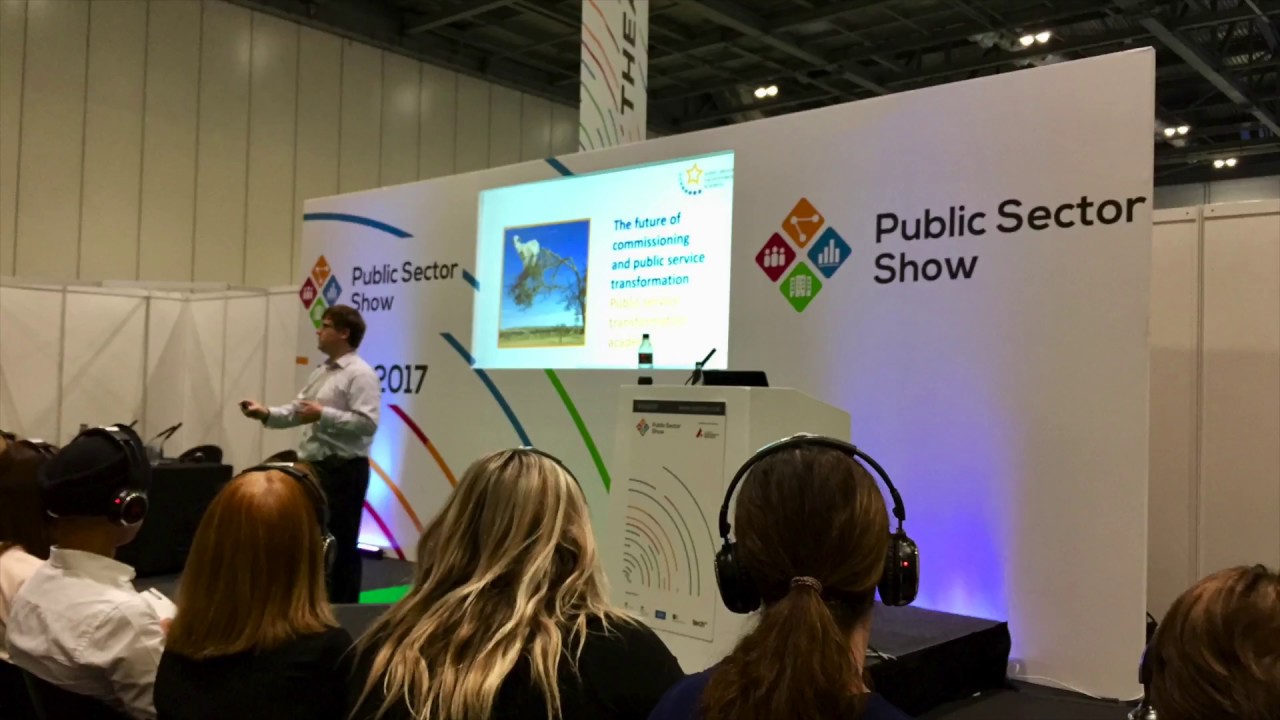
In this 30‑minute keynote Benjamin P. Taylor, founder of the Public Service Transformation Academy (PSTA) and Red Quadrant, critiques the current state of public‑sector commissioning and outlines a practical framework for transforming public services. He argues that much of today’s systems leadership and commissioning rhetoric is empty talk (“bullshit”) and that real change requires a clear theory of how services operate, evidence‑based case studies, and a willingness to experiment. Taylor introduces a “five‑worlds” map – Citizen, Service, Management, Leadership, and Learning – each with a guiding principle: truly listen to citizens and address underlying needs; shift from demand‑driven to outcome‑driven service design; give staff clear limits with maximum freedom; take responsibility for outcomes rather than merely for controllable activities; and demand real‑world feedback through small, time‑boxed experiments. He stresses co‑design with citizens, leveraging community resources, embracing system leadership, and accepting the complexity of public‑service problems. Throughout he shares practical advice (e.g., small tests, clear boundaries, responsibility‑taking) and references case studies (e.g., street‑cleaning, homelessness) to illustrate how these principles can be applied. The talk concludes with a call for humility, collaboration, and continuous learning to truly transform public services.
Chapters
Can I say, it's always very flattering to get a good turnout. Thank you very much for coming along. I realize I have the huge advantage of not being IT, which seems to be a feature of all these things. So I've got the small topic of the future of commissioning, public service transformation, And I'm gonna do as much as I can in 30 minutes, but all of the slides will be available. You'll all get an email 2 weeks after the event from the organizers. But if you want a PDF earlier or you have any questions or any follow-up, just email me. All my contact details are on this presentation. You can take them as we go along. This is me, Benjamin Taylor. I run the Public Service Transformation Academy, which is a not-for-profit running the Cabinet Office Commissioning Academy, and our goal is to build the capability for the public services to transform themselves. I may say more about that as we go. Antlerboy is my tag on all social media. I very much welcome connections. It's not a strange public school or hunting accident. It's an anagram of the short version of my name. I'll leave you to ponder that. And I'm not speaking on behalf of the Cabinet Office or any part of government. I'm speaking as myself. Very important to say that because I'm going to swear. Government's not allowed to swear. I also run Red Quadrant, which is a network consultancy working in public services. I put this up because we run the Campaign Against Consultancy, which is clearly a tongue-in-cheek thing about doing ourselves out of a job. We appeared next to certain other small public service consultancies at this event, and this was a City of London event. Quite proud of this because the Master of the Worshipful Company of Management Consultants actually took me aside for a stern word afterwards, and our banner mysteriously went missing. Nevertheless, tongue-in-cheek because we are consultants, but I believe that my job in Red Quadrant, my job in the PSTA, and your job as public servants is absolutely to do yourselves out of a job, to not be needed anymore. Goals of Red Quadrant are to change consulting and to change public service delivery for the better, to make public services the beacons that people from all different sectors come to, to study. And we're getting some way of the way there, but we're definitely not all the way there yet. The Public Service Transformation Academy is a not-for-profit company limited by guarantee. It's been set up with all of these partners. We bid for and won the contract to deliver the Cabinet Office Commissioning Academy. That's a very good bit of procurement by government because it's a concession contract. We have obligations to them and performance targets, but we get no money to do that. So we're absolutely reliant on you, the good people of the public sector, to see the value of the PSTA and the Commissioning Academy and the other things we do. and actually sign up for the courses. So go and have a look at our website, publicservicetransformation.org, at some point. All of these partners have something unique and valuable to offer in the spirit of public service transformation, but I don't have time to talk you through them all today. This is the premise of my talk today regarding public service transformation. Most of what you hear, I'm afraid to say, is bullshit, right? Most systems leadership is people waving their hands and talking about flocks of birds and ecosystems, and it may be quite inspiring and quite useful, but it doesn't actually give you a prescription for action and for change in public service systems. Most commissioning is bullshit. It's just some version of procurement, which can be a very good thing and not necessarily limited, but commissioning really is about actually thinking about how you achieve public service outcomes. And who's been transformed more than once in their organisational life? Put your hand up. And did it make any difference? Did anything actually change? No, not really, no. Okay, so yeah. I start from that premise, but not everything is bullshit because Things which are good by my standards have a theory of how things operate, a theory of how you can intervene and make a difference, and lots and lots of case studies and examples of where things have gone wrong for you to learn from. So that's my kind of 3 tests. If it hasn't got those things, then don't trust it or give it a bit of a test, but don't expect it to deliver results. I'm giving you 5 principles for the future of commissioning and public service transformation, and they follow a little— I'll give you a little map in a minute, and I'll take you through the map in the rest of the presentation. My 5 principles are in citizen world, in dealing with citizens, listen to, really listen to, and deal with the demand that you're actually receiving in your organizations. And by the way, most organizations are deaf to most of the demand that's coming into them. But you've got to not stop there, because if you're just dealing with demand, you'll do things 80% better than most public service organizations. But if you reach out into citizen world and help people to help themselves, you've got the possibility of doing yourself out of a job. In service world, we're talking about a move from focusing less on the need and the limited funds and how we can get the services to meet the needs, more to thinking about the outcomes and all the resources you have at your disposal and how you can intervene using the resources to achieve the outcomes. I'll talk more about that in case it's not clear. In management world, the secret to good management in my book is about giving people very clear limitations and the maximum freedom within those limitations. If you don't give people limitations, if you give people too much or too little freedom, it paralyzes them and stops them from using their own capability, their brains to deliver. In leadership world, we talk about taking responsibility for the actual outcomes, the actual experiences of the people in your organization and in your public service system. Now that's deeply unfair, right? Because you don't actually have the capability, you don't actually have the responsibility for all of that. You can't actually achieve all of the outcomes. But why I say it's important is because it's the only way to think on a bigger playing field and to actually start to learn about how those outcomes are achieved. We're very good in public services at limiting ourselves, saying, I only want to be judged on what's in my direct control, because that's the only way to fairly judge me. And particularly all the performance regimes have trained us to say, I'm going to limit what I want to be judged on to what I have complete control over. I'm saying that I'm afraid I don't think that is good enough. I don't want you to accept blame, but I want you to accept responsibility because then you can start to learn how to change the actual real outcomes on the ground. And that takes us into the final of the 5 worlds, which is learning world, which is accept nothing less than real-world feedback. So talking about learning world, this is the map. This is taken from my consultancy Red Quadrant, and it's a very simple map with these 5 worlds: citizen world, service world, management world, leadership world, and then learning and improvement and change world. And I'll talk you through these worlds very briefly, but if you want to hear more about it, if you want a copy of these slides earlier, email me. Very happy to engage and follow up. So talking about learning world, there is no learning in this room. We cannot achieve any public service outcomes in this room. We are not in the real world. We're in seminar world, we're in strange technology world, we're in taking a day away from work, and somehow you managed to get the money to come down to London and spend the day actually trying to network and learn, right? You might think you learned some things today, and I really hope you do, not just from me but from other people. The fact that you're here might mean that you're in a learning space, that you actually know you don't have all the answers, which is great. But until you've tested it and proven it in the real world with real people around public service outcomes, I don't think you've got the right to say that you've learned anything. But if we take responsibility for that learning, along with taking responsibility for the outcomes, I think you'll make real incredible progress. In Citizen World, we work from the premise that every single public service is always co-designed with and for the citizen. Sometimes the citizens engaged in our public services are not willing participants, as in justice and incarceration and things like that, but we can't really do it without them. So the citizen is always a part of the service. Therefore, Everything is always co-designed, and the main resource in most public services, whether it's health or whether it's rehabilitation of offenders, is actually the person themselves. And the person themselves in their life, in their family, in their community, and so on. So our mission is to go from the need arising to the positive outcome with as little space, time, steps, system boundaries, handoffs, crap In between as possible, right? And that's what we're really trying to do. And I'll tell you a way to cheat at the end if I remember. Most of the time we are focused on demand. We're not focused on the real demand that people are actually asking for. We're focused on the demand as it translates into the language of our systems and our services. We actually twist that so that we don't hear things that don't fit in our service vocabulary, our book of what we can do. And things that more or less fit, we just bodge them. And bring them into the system anyway, right? But we're focused on trying to deal with that demand. And most people didn't go into public services to be processing demand. It's not a bad thing to do if you do it right, but it's not very fulfilling. Even worse, when we start to think about lack of resources, we get into control and rationing and trying to manage demand. In that really restrictive way, that's very, very depressing, isn't it? I mean, I don't know anybody who really wants to turn up each day to to be an efficient gatekeeper, maintain the barriers against provision of public service. If we look behind the demand, we'll find that there's always a need that drives the demand, a need in somebody's life that leads them to try to have recourse to public services. Dealing with those needs, meeting those needs, is more fulfilling, but it has a really strong shadow side, which is, I think, is not as acknowledged as it should be in public services. It's wanting to be needed, wanting people to have the the needs that you can help with, very prevalent in health and social care. So it's more fulfilling, but actually it risks creating dependency. Bear in mind I'm talking in fairly broad terms here, but I hope you can see the underlying picture. My thesis is, if we look behind the needs to people's purposes in lives, and we understand they're actually trying to achieve something for themselves in their lives, in their context, and we can start to understand that. Now sometimes, it's going to be difficult because we don't necessarily approve of what they're trying to achieve in their lives. It may not even be legal, so we've got to cross that bridge when we come to it. But if we can actually get behind the need and help people to achieve their purposes on their own resources, using their families, using their communities, using the public services that are available freely on tap, that's the real fulfilling work. And I think if you find that work, you're going to really find the joy in public services. Now that sounds like very highfalutin talk, and can we ever get there? Well, I think we actually can. I think we actually are doing it in some of the case studies that the Commissioning Academy has talked about in terms of citizen-centered services. Moving on to service world, I want you to start thinking about a bigger playing field. So traditionally, as I say, we do very cold data analysis of needs. We spend a long time doing the analysis because that's the safe part. That's where you don't have to actually engage with any of the public. Then we do a long-term procurement because we have to buy in volume and we have to negotiate down in order to try to meet as many needs as possible with our limited budgets. But by the time you've done all that analysis and procurement, the world has changed and the services that you're putting in place are probably no longer fit for purpose if they ever were in the first place. And they're certainly on a mass production model. You then run out of resources to do the performance monitoring and management and, you know, keep on top of the contracts. And before you know it, the 5 years of the contract's up and you need to do a 12-month extension so you can go into your analysis phase and plan for the next— you get the idea. So I'm saying we need to move away from looking at the need, demand, and trying to match our resources, stretch our resources, to thinking about the inputs, the resources we have available, not just as our budget, but as the capabilities of the individuals, the communities, what the market has to offer, what technology has to offer, what innovation has to offer, what our partners can do, and what civil society can do if we don't fill the gap. We need to get very, very clear about outcomes and understand that outcomes are complex and problematic, and they're different for individuals and families and streets and neighborhoods and cohorts and communities. But all we're doing in realizing that is moving away from the false certainty of service specifications where at least we know what we're doing into the real uncertainty of trying to actually achieve outcomes for the public. And then instead of saying, how can we spend all the inputs to achieve all the outcomes, we start to think about what are the interventions that will take us from those resources to some of the outcomes. And step by step by step, that means a series of experiments probably. It means lots of small steps to learn. It means not assuming that you can scale up, unfortunately, from successful small experiments, but you can grow things. That will get us to being much more focused on using all the resources to all of the outcomes. It's a bigger playing field if you are procuring street cleansing services. Caroline Wilkins at Oldham says you're going to need a lot of good market engagement specification, good performance management, good analysis. You're going to need to stay on top of the contract, etc., etc., etc. If you are commissioning for clean streets, You may need to procure a street cleansing service as part of that, but you're going to be thinking about what causes people to drop litter, volunteerism that might cause people to pick up litter, behavioural nudges that might make them more or less likely to drop litter, design and position of litter bins, urban design in general, wind tunnels. What does cleanliness of the streets really mean? What counts? What's important to us? Is it actually just the duster going around on Thursday morning spilling the rubbish all over the streets, and then we're paying another bunch of people to pick it up on Thursday afternoon, etc., etc., etc.? You're going to look look at whether enforcement actually really makes a difference or not because nobody really seems to know. So commissioning and thinking about the outcome of clean streets is a very different thing and a broader picture than procuring a street cleansing service. Not to say that really good strategic procurement people haven't always thought that way and always gone upstream and downstream to think about the needs of the community and how we're meeting them through the procurement or outside of a procurement. So really there are 5 fundamental questions if you're looking at any part of the public services. What is the system doing now? What results is it reliably and repeatably producing? But you're only really doing that to get to question 2. What's the actual underlying purpose? What's the thing that we really should be achieving here? Once you've got some idea about that, you can start to think, what's the work that could be done in order to achieve that purpose? And you build up from there. How would we organize and arrange and fund that work? How would we govern? And so on. Then you've got a problem. Because in step 4, the reality of where we are now is probably quite different from how we might really achieve the underlying purpose. And also you're still in learning world. You're not really learning anything until you've put the rubber to the road, as they say, and actually tested these things in real life. So then you're likely to try a series of interventions to actually try to achieve the purpose starting from where you are now, start to move the system. And by the way, this, when you start to look at this as a group of people across an area, is what we call system leadership. It's actually about thinking about how do we as a set of public service leaders or leaders across communities think about how we can achieve the outcomes, how do we apply this as a whole system, a whole place, a whole organisation. One of the things that that means is that you've got to realise that the management of public services is really, truly, fundamentally complex. It is not a technical problem to be solved. Or if we get some of the things to be a technical problem to be solved, the world is still likely to change. So we've got to deal with the wicked messy nature of the problems we're dealing with, the complexity of living real organizations, the complexity of human beings, how people behave predictably, irrationally, and dealing across partners and suppliers as a system. And finally, in leadership world, I'm thinking and encouraging you to think and experiment. How can we take responsibility for the whole thing? Remember, the outcomes for the people in the system and the people who are the recipients of the system without actually taking blame or disabling ourselves by becoming completely overloaded. Part of the answer is to timebox your analysis, do small experiments, run tests, and actually develop real learning about the system. Because it isn't about you as public service leaders, it's about the people who are experiencing and who are delivering the system that you're running. And remember that you never understand an organization or a system until you start to try to change it. If you do start to try to change, you will learn at 3 levels. You'll learn how to do the things better that you're doing now, how to think differently about the problems that you're facing, and possibly how to change our identity as public services. Homelessness is a great example. Many years ago, somebody would come down, you know, a single mother with children, so we have a statutory duty to rehouse, and they would say, my landlord has given me 6 weeks' notice, I'm going to be out on my ear. And we'd say, very sorry to hear that, madam, come back in 6 weeks. And that would lead to a cycle of rehousing, losing jobs, losing schooling, ill health, and so on. Now, thank goodness, we've got the sense to see our role slightly differently, possibly enter into negotiations with the current landlords, keep them in the same house, etc., etc. That's thinking about outcomes, not just about provision of service, and changing our identity, or at least our way of thinking. about how we provide. So think massive, start very small. Do small things to actually learn about the system. In service world, try to meet demand better. In system world, try to help people to help themselves. In management world, think about how you're giving people clear limits and lots of freedom. And in leadership world, learn how you as a leader start to shape the culture. Take responsibility for it all. It might be really depressing to take responsibility for it all at times because things turn out really, really Badly at times, but making a prediction and learning about how to change those outcomes is the only way to make a difference. As you start to make changes and it turns out that you were wrong, that's when you actually learn. So accept you don't have all the answers, give up some control, collaborate, get people to give their discretionary effort by setting them clear freedoms within boundaries, be very honest, listen a lot more, ask more questions. Thank you. Co-design and start from people's strengths and understand that you've got to have hierarchy that works, that supports the frontline. You've got to have accountability. You've got to have limits to what people can do, and you've got to have a plan if you're actually going to learn. We don't talk a lot about power, but we should be really aware that as public servants, we have a lot of power. As commissioners, we tend to define what the outcomes are that are valid. It takes a lot of effort for any system, whether it's public services or community, to stay in the state it's in. So try and pay attention to that and think about how the energy's being invested. I know that's very theoretical. We've got lots of case studies that back some of this up. Search for #BetterCommissioning, all one word, you'll find lots of things. And I very much welcome follow-up conversation and discussion and enjoy the rest of your day. Thank you.
More from Benjamin

How to Transform Public Sector Organisations Through Systems Thinking With Benjamin P. Taylor

Cybernetics is not the banana, part 2 — Benjamin P Taylor with Laksh Raghavan (2025)

Cybernetics is not the banana, part 1 — Benjamin P Taylor with Laksh Raghavan (2025)
04 | Culture, Clarity & Conversations: Leading in Uncertain Times with Benjamin P. Taylor

The Key To High-Performing Teams Based On Trust – Benjamin Taylor | Compass Tech Summit 2023

Benjamin Taylor - Jan 2021 - SCiO Open Event - The 'Four Quadrants' of Thinking Threats
Five core practices for effective organisation - Benjamin Taylor | Stretch Conference 2022