Stepping into the state of transformation webinar
This content was created by Benjamin P Taylor. This content was uploaded by Benjamin P Taylor. This is a YouTube webinar titled "Stepping into the state of transformation webinar" (recorded/posted 2019-05-29) presenting joint findings from the Public Service State of Transformation survey. The session is a webinar/presentation hosted by Emma Fell (Public Sector Solutions Expo) with Benjamin P Taylor (Chief Exec, Public Service Transformation Academy) as the main presenter, joined by contributors including Janice Prentice (Red Quadrant) and Paul Keneally (PSTA). It reviews survey results and discussion on public-sector transformation themes such as austerity and funding pressures, digital adoption and exclusion, commissioning and procurement, supplier sustainability, collaboration vs competition, structural reform, Brexit impacts, workforce resilience, agile approaches, barriers/enablers to transformation, and PSTA learning offers. The format is a live presentation with slide commentary and an extended audience Q&A. Metadata: YouTube content, title provided, created_time 2019-05-29.
Chapters
Hello everyone and welcome to Stepping into the State of Transformation. I'm Emma Fell, Research and Strategic Partnerships at the Public Sector Solutions Expo, and with me is Benjamin Taylor, Chief Exec of the Public Service Transformation Academy, who will be presenting our joint findings from the State of Transformation survey today. This webinar is designed to give you a taste of best practice and the innovative thinking leading the charge in public service transformation today, and considering where the barriers and opportunities are and how best to approach them. This webinar comes ahead of our respective events, the Public Sector Solutions Expo, or PSS, and the Public Service Data Transformation event, whose theme for this year is Helping Each Other Out of the Crisis. Both events aim to support better practice in public sector transformation. I'm going to tell you a little bit about PSS now. So, the Public Sector Solutions Expo is a free event for the public sector professionals in the UK and takes place on the 25th and 26th of June in London at the Excel. We are now in our 9th year of connecting market-leading solution providers with senior procurers, decision-makers, and influencers from across local, central, and wider governments. The event addresses key challenges and signposts opportunities in commissioning and procurement across workforce and leadership, digital and technology, estates, assets, and urban transformation. Visit pssexpo.co.uk to find out more and book your free spot in June. I'll hand over to Ben now to say a few words about the Public Service State of Transformation event taking place next month, and he will begin the presentation.
Thank you very much, Emma. Yeah, Benjamin Taylor here, and this survey for State of Transformation done jointly with Public Sector Solutions Expo is only part of our wider Public Sector State of Transformation process. The Public Service Transformation Academy, in partnership with Connected Places Catapult, and all the partners you can see on the screen, is an organization that supports to help public services to transform themselves. And every year we run a state of transformation process, which consists of this survey, where we're very, very pleased to have Public Sector Solutions Expo join us this year. And I've just been informed that my camera is on, and that's not the intention. Hopefully you can all just see the slides. That's what we're trying to show you. And hopefully you can see the slide about our conference, because the conference is the big event this year happening on Tuesday the 18th of June. If you go to the link on the screen, you can use the code EXTRA30 to get 30% off the ticket prices. That will be a brilliant coming together of over 200 people who are involved in leading public service transformation across public services and across different approaches. And we will also be launching our State of Transformation report, which will contain this information and a set of think pieces and case studies which you can learn from and steal with pride to help you in your transformation work. A word about process during this webinar: we are booked through for an hour and a half, we expect to finish within an hour, but if any of you want to stay and ask further questions, I'm very happy to continue to field them pretty much as long as you want. And if you have a question, you have basically 2 routes. And we would like to ask you to find on your screen or on your app the Q&A slots and queue up your questions by asking a question through the Q&A process. If you think there's anything that you need to bring to our attention more urgently, as an attendee, you should have a function where you can raise your hand. I will probably see that as the facilitator. If not, my colleagues will let me know and we'll come to you and Anita, you've raised your hand. I will just allow you to talk as a test. Anita, can you hear me? You may need to unmute yourself at your end. Hello Anita, did you have a question?
I'm just trying the options actually. Just wanted to try the option.
Brilliant, okay, that's a wonderful example. Thank you. I'm going
to—
that's good news. I will mute you now and I will lower your hand, but thank you very much for that unscripted practice and demo. of how it works. Okay, so I'm going to dive in now quickly into the findings of our survey. So the first point, I'm going to bring in Janice Prentice, the Red Quadrant consultant who did a lot of the survey analysis, to talk about— I'm afraid this is the very short positive news section before we get into the traditional misery— to talk about why people take pride in their work in public services. Janice, are you there?
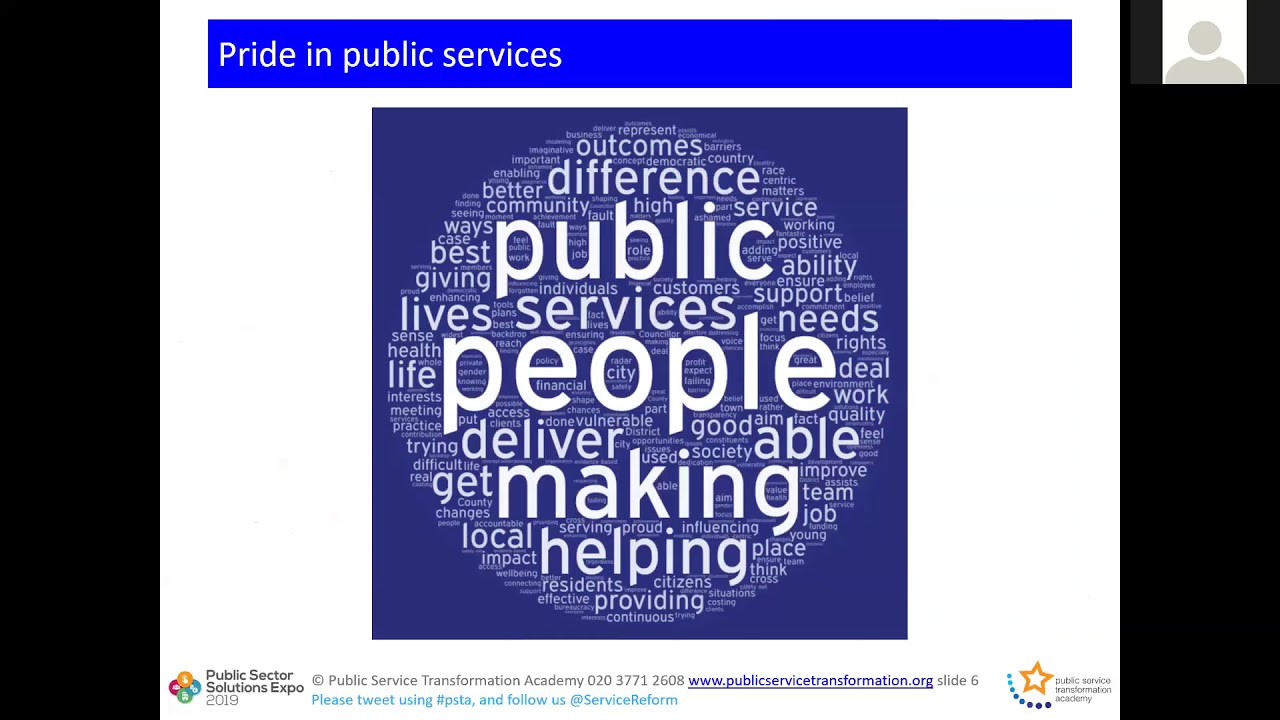
Yes, I'm here. Thanks very much for that, Benjamin. So I think the first thing to say is that the quality and commitment of people working in public services really came through clearly in the survey. In spite of all the change and the pressure of austerity, then 85% of people still believe that public services are being delivered well, and you get a strong feeling of commitment and pride coming through the survey responses. And one of the questions that you can see the data on here is, what makes you proud to work in public services? So in people's answers, they talked about wanting to improve the health and wellbeing of people in their area, or like one respondent simply said, improving lives in the local area. And people are proud of delivering services under difficult financial situations. Or to put it another way, as one respondent said, continuously doing more or better with less and less. So people are proud of delivering positive outcomes for local people and adding social value to individuals and communities. Some respondents talked about the importance to them of helping those who are vulnerable or could be excluded by changes to services, especially when we talked about the move to digital. Many respondents mentioned the importance of considering those who wouldn't be able to easily move to digital services. And respondents said that they're proud of helping individuals who have barriers to access the things that they have a right to, helping people with things that they're unable to do on their own, understanding the needs of the most vulnerable and meeting their needs. And one respondent suggested that if we get it right for the most vulnerable, then we start to get it right for everyone. And I think finally, it's beautifully summed up by one respondent who said that they are proud of having a positive impact on the lives of people who need us most.
Brilliant, thank you, Janice. And we've got a nice Wordle here, which really the words are probably no surprise, but nice to see outcomes as a focus up at the top there, along with the big service, a big focus on people. People and communities is obviously what it's all about in terms of public services. In terms of the quality of public service provision, most people still believe that despite the challenges, services are being delivered well or better, and I should say we'll be zooming through all these findings because you'll all get a copy of the PDF of the full report and you can dig in in detail. It is noticeable that most people have an in-group bias— they believe that their organisation delivers better quality services than the sector in general. However, I'm afraid we now go into some of the challenges of austerity and the rest. Most people feel that things in general in public services will get worse in the next few years, although a fairly healthy proportion of people, 30% or nearly, believe that their own organisation will actually improve. Moving into the challenges facing the sector, as is traditional, it really is finances, resources, which are the big challenge. What's really interesting is that collaboration is presenting as a really big problem in this year's survey, which didn't happen last year. It was more seen as an opportunity and a possibility last year. Brexit is clearly front of mind, and I think drives some of the challenges around politics that we'll see later on. Recruitment and retention, interestingly, has really shot up the agenda as a really significant problem, which I think is quite fascinating, and you can see political uncertainty in there as well. And right down at the bottom, you can see that people are not that focused on devolution at the moment. That's consistent with the stuff about structural change that you'll see in a minute, and quality of buildings and estates and public engagement actually get really interestingly low scores. Moving into structural reform and the concepts of commissioning, that we've bracketed together. This is really quite a striking finding, I think. Most people in public services think that all of the structural reforms of the last few years have been, by and large, unproductive— they have had a negative effect— the biggest one being local government reform. I can only speculate that that's potentially around all the conflicts and the cost of change that's generated. But you can see across the board, the abolition of RDAs, introduction of clinical commissioning groups, police and crime commissioners, by— on a strong balance of opinion, respondents to our survey thought that they were not helpful. The Northern Powerhouse is absolutely neutral. The only 2 that get positive scores are the Midlands Engine and the introduction of LEPs. So you can queue up any Q&A as we go through all of these things. No doubt some of these are going to be quite interesting in terms of what they might mean. I won't read out the quotes here, but clearly people are not convinced that structural reform actually creates new positive thriving conditions in public services, certainly not in the current circumstances. Sorry to say, as somebody who really believes in the possibility of commissioning, that people are still operating under very narrow definitions of commissioning, and the concept is not being received positively on the whole at all, which I think is really important. And as the organisation that runs the Cabinet Office Commissioning Academy, we see all the more value in trying to get the word and the good practice out there. In terms of areas of strengths and weaknesses, I won't go into this in much detail. You can look through in detail when you get the PDF. I think it's interesting that people, perhaps through practice, are really, really strong on managing risk and providing value for money for the taxpayer. And actually, they think that they are reasonably good at collaborating around delivering services, aligning resource to demand. So these things are really demonstrating, I think, the focus on really making do and mending in austerity. Right down at the bottom, we've got moving to integrated services, co-design and co-production, using big data and analytics are all not really successful. And interestingly, that managing demand comes very low, Whereas aligning resources to demand comes high. For me, that suggests that it reflects that we're unable to get upstream and do that prevention and early intervention kind of work that would cut off the demand upstream, but we're able to marshal our resources to deal with it as efficiently as we can possibly manage. Over the next 3 to 4 years, people think that that management of demand will get even harder, providing value for money will get harder, And interestingly, they think that procurement of services efficiently and the stuff around IT and technology and big data might get slightly easier. But I think you can see that people are not looking towards sunlit uplands at the moment. They're actually focused on how can we continue to squeeze out the other bits of value for money. Moving into digital, it's perhaps not surprising but very strongly indicated that people see that most organizations see digital as very, very fundamental to their future. Nobody said it was not at all important, but a bit of a range with a clear focus on how important digital is, but quite a strong focus in the qualitative feedback on digital not being a panacea, being very much— being very important how we do it, how we cut people out of the loop or build services around citizens. Most people expect digital to be even more important in the future, although interestingly, not everybody, only 74%. So a continuing focus on real physical and people and community-based services, I would say. Some quotes here, quite important. People see that the potential of technology around people could be good if we can free up people to do more human interaction, but a lot of concern that people will be going through automated robotic processes. People think that technology shouldn't drive change, but will support the driver of better services, but clearly some fear about not doing digital right, and some real concerns about the people who find it hardest to get access to digital services. And over the next 5 years, a very strong feeling that services will be better, but there will be fewer jobs based on using digital. Views on digital technology and improvement— actually, automation actually improving efficiency— were fairly mixed. Let's move into engaging with markets and suppliers, very central to the Public Sector Solutions Expo and certainly something that we at the PSTA are very, very focused on. This quote kind of sums it up: procurement is still not getting a good name, although there's a recognition that procurement procurement people are trying really hard. The really stark thing for me here is 85% of respondents believe there's a significant risk to the sustainability of key suppliers. So I would say not only are suppliers at risk of going out of business rather insidiously, markets are now being threatened as a whole. Most people agree that pre-engagement with suppliers is a very, very good idea. but people are not that convinced that procurement staff are able or at the moment optimizing the approach, and so we've pushed back somewhat to a cost-based decision-making process. And these quotes kind of sum it up: public sector is improving, but the cost pressure on suppliers means that we're in a context of ongoing instability and risk. What's interesting is that by and large people think engagement of the private sector in public services is about right. A few more people think that there is too much involvement, but again, really interesting that the balance is almost completely balanced when people are thinking about their own organisation. Most people think it's about the right level of private sector engagement, same amount, too much, and too much and too little. When they're thinking about public service as a whole, people tend to be more critical of private sector involvement. And this is a nice little chart which basically says that people strongly agree that there's value of private sector inputs. They are fairly neutral but broadly agree that there's a good range of suppliers that perhaps reflects the difficulties in the market, but people actually are a bit sceptical that private sector can normally deliver services cheaper and better, and that they really get the culture and ethos of public services. So a reminder, queue up any questions and answers that you may have for us to address at the end during the course of this webinar. We didn't want to talk about Brexit, but it's rather thrust upon us. And striking figure here that 52% of people have made plans with regards to procurement following Brexit and 48% have not, and a real range of focus. Some people say, well, we just don't know what's happening yet and therefore we're not able to take action, but quite a few people have some kind of a plan, some contingencies, some task groups, and are following the guidance. People are obviously quite concerned about workforce planning in the future, and future of grants and future procurement are also scored highly. For me, the really— the meat of this, the thing that drives our State of Transformation thinking and our case studies and our think pieces is what is getting in the way and what is enabling transformation at the moment. This gives you the word clouds on a page, and here you can see the drivers are around funding, digital budgets. I think the word lack in there is quite a big one, and so we're being driven by negative drivers on the whole, but digital is a possible enabler and trying to meet the needs of our customers and citizens is important. Barriers are around culture— lack is an even bigger word there, which I think is fascinating— and leadership and politics makes a big appearance for the first time in our survey. So these are the top drivers, and our methodology has changed a bit from 2018 to 2019, but you can see that cultural issues have kind of dropped off the agenda as positive drivers, and austerity, technology, digital, and public pressure have really shot up the agenda, and for the first time policy has appeared as a real driver. In terms of the barriers, cultural issues even more consistent than before, really dominating the picture here as a kind of barrier to transformation. And here are some of the quotes: cynicism, cynicism about the people at the top, we've already done the easy wins, we don't have the overall vision, and we're not engaging with communities and focusing on assets enough. And I think that word lack in both of those wordles kind of sums that up. It's hard to take a strengths-based approach at this moment in public service transformation. In terms of looking to the future, This was a strong comment that we picked out: tapered funding needs to be made available over at least 5 years to allow transformation to be implemented and embedded. You know, a strong appeal to say actually we really need central support to give some oomph and put some backing behind public service transformation as a whole. But overall, in terms of looking into the future, austerity and reduced funding still dominate. Nobody expects austerity to be over. Newly this year, people are becoming slightly perhaps put into a condition of conditioned hopelessness. People don't actually think things will change, and integration as a subject— we may be good at working together, but actual integration of organisations has really dropped way down, right off the agenda. People expect continued reductions in funding and a reduction in size, reduction in non-statutory services, local authorities will go bust is the big message from that. I'm not sure if that's strictly true, we will see, but certainly more local authorities will be doing less and less, I would suggest. So to sum up, we need to listen to citizens as citizens, not just customers, and respect democracy. We still act as if we know best. The aspiration is still there to really engage with communities and citizens, the reality is making things quite a bit harder. People have— we asked, what should the PSTA do to continue to support transformation? And the top ask is to continue to provide shared learning about what works. So our appeal again is to come back to— come along to the conference, go to the Public Sector Solutions Expo as well. However hard it is to get your head up and look beyond the here and now, the urgent cuts and the urgent service changes, we really still need to keep our aspiration to look real transformation. Both of our shows, conferences, are good ways to try to do that, and we hope you'll read the details of this survey and our think pieces and case studies with some interest and come back to us and try and really engage around picking up the knowledge that you need to deliver transformation. So we've got Paul Keneally, the Chief Operating Officer of the Public Service Transformation Academy on the line along with Janice and myself and Emma. I'm going to hand over to Emma. It doesn't look like we've got any Q&A at the moment, but if people can raise their hands or enter Q&A questions, we've got some time now to answer any questions you may have.
Thanks, Benjamin. So I guess we'll start with a question from me. So I guess that's all a lot of information, some of it surprising, maybe some not so much. But what are the main takeaways in terms of good news and main leverage points for positive transformation based on what you're seeing here?
Great, thanks very much for that. The leverage points, I think, are really around stop with the structural reforms already, and, you know, we need to either mitigate the effects or Brexit is coming up as a real barrier, and these are all obviously central. I would say that real funding for supporting knowledge of transformation, even if austerity continues, is critical. I think the leverage areas are very clear, and there's 2 very separate ones, but they really need to be allied and to come together, and they are effectively community development, co-design, co-production, and asset-based approach on the one hand, and on the other hand, the technical ability to do digital data demand analysis, demand management. That's coming, but there's a risk if it's not allied with a strengths-based approach that it will miss the citizen, that it actually won't achieve the results. But if you can bring those 2 things together, a community strengths-based focus with really good digital and data understanding, I think you'll do really well. Okay, so questions coming in here.
Yep, I have a question here. So what are the key messages for the leaders of public service transformation?
So I think, well, just to rehearse a point, Don't be tempted into structural reform. Key messages: you are in a risk-based environment— you probably already know that— but more public service providers will collapse, and markets are collapsing too. Organizations will go bust. Those are not great messages. Prepare for Brexit and for other chaos, and prepare for proper— maintain a good balance of engagement with the private sector, but I think the culture change that enables digital and community asset-based focus are 2 really critical things. It looks like we have some questions in on the Q&A.
Okay, so what is the take-up of agile working as the true Agile Manifesto and development of agile capability when within different local authorities? And that's from Stuart Bolton.
Thanks, Stuart, that's a great question. We've sort of pioneered the use of agile change in public services, and that's continued with us and with a spin-off from Red Quadrant, Basis Limited, but I have to say that I think There is a strong undercurrent of people involved in transformation who really get the principles of understand, create proof of concepts, test, iterate, learn, allow people to be free to actually focus on the delivery. But at the same time, I think that's allied with most of the money and the spending has gone into very transactional Scrum focused entirely on IT implementation, and I don't see a strong prospect of those 2 things coming together in one stream in the future. And so I place more hope— I mean, the digital working has improved by and large, but it hasn't flipped over into a kind of real agile culture change. So I think more of the bottom-up— most of the people who do transformation work are still doing waterfall, but there's a really strong current and people are starting to prove the case for doing iterative improvements, so I'm hoping that that will become more of a cultural theme over the next few years.
Okay, thanks Benjamin. I have another question here from a Tom Alexander. He says, very interested to hear your thoughts on how people in public service can stay resilient after years of this? It is painful for residents, but I am never sure the human cost of those people working in the sector is understood, particularly when hammered by certain sections of the media regularly. That's not really a question, but—
No, there's a lot in that, but I have to say that in our work doing public service transformation in the PSTA and in my consultancy Red Quadrants, the word that comes to mind very often when we engage with people now is trauma. It's sort of a pretty serious word. We're often finding at the operational level and teams of people who are trying to do transformation, they are quite traumatised by their very driving belief in the value of public services, and at the same time the conflict they're feeling with things being difficult, for cultural reasons, with things being shut down for financial reasons, and with the real pain and challenges of the work on the frontline, particularly in the people-focused services. But at the same time, you know, the big economic regeneration where those things get changed for political or financial reasons— people may have put years of their life into cancelled projects. So I don't want to over-egg it, but I think you're right that there's a huge degree of emotional stress. I think people are aware of that, they're supporting each other, they've got much better literacy about mental health and coping and those kind of things. It's a big topic, as is resilience. I mean, so sad that one of the biggest ways you can make money and legitimately support public service transformation is supporting resilience. It's necessary, it's vital, but wouldn't it be better if that problem didn't arise in the first place, if you see what I mean. What I am seeing, particularly in the last 18 months, is a resurgence of real organisational developments and a realisation that this has gone on too long. We've got teams in crisis, we've got people in crisis, we've got organisational change that is really needed, so I think that people are starting to address these issues as well. So I think we're getting somewhere, but it's a major, major issue, and you just have to look at the awful, appalling stuff about— that's come out about the life chances of severely disabled people, about the conditions in some of the care facilities that people are put into, about deprivation of liberty and all the rest, to see that we have a very big problem to deal with.
Another question from Des Brown: What are your thoughts about how commissioning organisations can better encourage collaboration rather than competition?
Thanks, Des, that's a really interesting one. So we are seeing a the future is here but unevenly distributed kind of situation where we've been preaching for at least I think 7 years at National Commissioning Academies, that competition is only one stage and probably a very immature stage of a commissioning approach. And just to put it in a nutshell, we believe that commissioning is not about looking at allocating your ever-decreasing budget for ever-increasing needs. It's about taking an expansive view of the resources you have at your fingertips in terms of being able to marshal citizens, communities, markets, digital innovation, and about thinking really carefully about the real citizen and community outcomes you're there to achieve, and then looking at the interventions between the two. So I think that reframing is a great way where competition is one tool in the, in the tool shed, not necessarily the most important one at all. But, you know, some form of competition and contestability is quite valuable in public services. We shouldn't lose that entirely, but we're seeing more and more people create provider partnerships. We're seeing the introduction in halting ways of integrated care systems. I'm worried that integrated care systems just become monolithic provider blocks again if we're not really careful, as with bringing services in-house. I would say a commissioning approach is all the more important for in-house services, really thinking about your outcomes and having some basic threat of contestability available. So we see people create alliances of providers, engage with providers from the start in much more constructive ways. We're seeing finally the first-ever innovation partnerships in use. Check out our case studies report coming up on June 18th for some examples of that. So I think it's just a question of have a wide view of the possibilities, engage really well with your procurement and commercial people, and focus on outcomes, and focus on how you can marshal all the resources in a way you can learn as much as possible to encourage collaborative collaboration rather than or as well as competition. And if you want to get that going in your area or in your organisation, speak to Paul Keneally at the PSTA. about running a commissioning academy.
Okay, thanks Benjamin. I've got a long one from Jane Eckford. So she says, the idea of listening to citizens as a citizen really chimes with me, as you would expect, and also the idea of stronger communities helping navigate through change as formal institutions radically change or become smaller. She thinks that's where it takes us back to values and strengths-based approach. digital connectivity will be enhanced by higher quality education and capability to make good independent decisions. Is the link between educational opportunity and digital a way forward for stronger communities?
Thanks, Jane. Great, great, very, very Jane question, and nice to see you here and so many familiar names. So let me sort of unpack that a little bit. I think you've put your finger on it, that we need stronger communities, more effective communities, as the formal institutions get smaller and change a lot. I certainly agree that education is a pure good in my point of view. Educating and supporting communities at all levels to use digital tools to help themselves is going to be really, really valuable. So I think that a real focus on education around digital is part of building community engagement and community capacity for sure. That can be a really narrow education and employability and skills-based focus, which I think has its place, but I think the important thing is helping communities to enable themselves through digital and other tools. And if you look at the true transformation examples, and Wigan always features in all of these conversations, there was a really significant investment in community capability in a whole number of areas that saw a massive return on investment against direct public service spending, and I think that sets the example for all of us.
Okay, thank you. So a short— possibly short but possibly sweet— Brexit question here. So is Brexit, pending either way, a real barrier or not A possible excuse for not doing things?
Thanks, Colin. I think— I don't know is the answer. I think Brexit is a genuine, real problem. It could mean ongoing recession for the near future, as far as I can see. could mean, has already meant massive social disturbances. We were running a commissioning academy in Suffolk on the day after the referendum, and the Chief of Police or one of his deputies came into the room and said the first racially motivated attack on a Polish woman had happened at 6 AM that morning after the referendum results, which I think is indicative of the impact it's had on our society and our culture. We will have massive workforce shortages, we will have, depending on what exit deal is agreed, if one is eventually agreed, massive disruption to our supply chains, to our procurement. We've already seen massive impacts on the economy. However, you're right, there's so much that can and needs to be done, so I think Brexit can be used as an excuse, but I think the problem we have at the moment is just that all of central government's time and focus and skills and senior people, and increasingly quite a lot at a local level and across the rest of the institutional scene of public services, has been pulled into trying to wrestle with Brexit. So I think that's really the problem, that's what's happened, all of the energy has had to go there.
Okay, thank you. And question from Colin Wilson: Do you think there are many other natural drivers or additional Agile versus Waterfall in the coming 1 to 3 years? Do you think, other than the efforts and case studies of Agile-preferred practitioners?
Interesting. That's a quite intriguing question. I think that we are seeing a natural move to experimentation and learning rather than the false certainty of plans and reports that often comes with a programmatic approach. I might move on to just address another question directly from that in a minute. And I think that we are seeing a more flexible workforce around transformation, which naturally brings us into those small incremental improvements that can really build into a, into a bigger thing. And I think that we're seeing agility in the broader sense and a learning and experimentation approach, which I take as something very core to true agile, the Agile Manifesto kind of kind of thing, coming through without some of the more egregious branding and accreditation industry that a lot of digital agile implementation has had with it. So yeah, I think those are going to be some drivers of change. I want to just pick up and answer Anita Mukherjee's question here, because it might sound as though I've been hostile to program management waterfall, and her question is, how do you see the role of PMOs in contributing towards the current and future state of transformation. Anita, I think what's really interesting is that like organizational development and HR and some of the truly deep cultural transformational stuff, PMOs have had a hard time of it recently, being cut, often cut out of the picture. And I think people are realizing and rebuilding that along with a learning-based approach, they need to have some good governance and structures and approaches in place Not everything is agile, and I think PMOs are embracing agile as well. I think what PMOs need to be able to do in current and future state of transformation is grapple with— is be able to clearly say that they are both able to do programmatic work, keep things under control, manage the budgets, report accurately on risks and issues, and do truly transformational work which is more emergent, which is inherently truly complex and unpredictable, and I think if a PMO is able to talk to the senior leaders and understand both of those types of change, then it will be providing an incredibly powerful, useful role in public service transformation.
Okay, I have an anonymous question. So what is your view and experience about the challenge of senior leadership buy-in and risk appetite for transformation?
Yeah, that's a really interesting one, and I've got 2 really contradictory answers to that, and both of them are a bit negative. I think there's a group of senior leaders who really signal that they are up for transformation but don't really mean it, and they like the idea and they like the theatre and they really would like real transformation, but it feels just too risky. And I think there's another category of senior leaders who don't really understand the risks and don't understand some of the implications and go for it too hard. What I really mean by that is you can't ever lose your grip on the business as usual, on good basic management, good discipline, strong control of the organization. So I think the people who do this best balance those 2 things. They make their organizational life on a day-to-day basis seem relatively simple, because things are under control, there's very good task and role definition, everybody knows what they're doing, there's good accountability, and therefore they can embark on real transformation. But that real transformation understands all of the complexity and all of the risk involved. So those are the people that I am lucky enough to work with some of, and I love to work with them, but I do always remember that I do always recall that chief executives are not necessarily the most powerful people in their organisations, particularly in local government. They're ostensibly first among equals, they have a big job managing the politicians, and actually they have less direct control and spending power than all of their critical department heads, so a lot of it comes down to the functionality of the senior leadership team, and the ones that are naive and new and not too embedded in the pain of their past conflicts and the trauma of the organisation, but understand that and understand that they're in a honeymoon period, are the ones who find it easiest to move forward constructively. And I just have a great respect for anybody in public services who does anything to do with transformation at the moment. Because it's making life even more complicated rather than just battening down the hatches.
Okay, thanks, Benjamin. I have a question here which segues nicely. So what does PSTA have on offer to support these areas of transformation?
Well, if he's still online and still awake, I'm going to throw over— hey! Hello. Go ahead, Paul. Paul's the Chief Operating Officer of the PSTA.
So, uh, good question, thank you. Um, the— this has been a great exercise in identifying some of the, uh, tuning in to the needs of the sector. So it's— the offer from the PSTA is constantly, uh, evolving and, uh, developing, but it's been good to get this engagement, uh, and for it to inform the approach that we take forward. We have a range of different offers. We have the Commissioning Academy, which Benjamin has already alluded to, which we offer in London 3 times a year, but we also run local Commissioning Academies and are doing so with Greater Manchester and Somerset that bring together that brings together partners from across a local system to join up and to develop their system and begin thinking in terms of collaborative commissioning. We are conscious that the sector— people working in the sector are under a lot of pressure, time pressure, and in order to reflect that and to shape our offer around what people need, We're keen to reach them wherever they are, so we also have a regional academy offer which we tested with the LGA and launched one in the East of England in Cambridge last year, and that was successful, and we're running a second one in the East of England, and we've now— we're now working with East Midlands councils to offer the same thing, and that's really a recognition of people being time poor and the cost of potentially having to travel into London to attend these. So that's the regional academies, and they generally talk about aspects of commissioning in terms of systems change and outcomes-based thinking, but they also look at transformation more broadly. We have an online offer courtesy of Red Quadrant and the Leading Transformation program, and that's an online virtual program which covers 24 modules. On average, they take 2 to 2.5 hours to complete, and they look at a whole range of the sorts of disciplines, concepts, tools, and techniques that you would need to launch a transformation or a change program. So there's a range of different offers there. There's One's an open application one in London. We have open application ones available in all the regions.
Those two together.
And we have an online option. That's, that's an area that we are very keen to develop further in. One area generally that we're finding, and this echoes some of the themes of this research, is the need for greater collaboration. and the challenges therein, the problems that people have around culture change, and our offer and the content that we— that is incorporated into our academies is looking increasingly at behaviors and relationships, and that touches on another theme around resilience. What behaviors do you need? What mindsets, what mentalities do people need to adopt and what works based on the science of behaviour and the evidence. So, but I'm also interested to hear this conversation, and some of the focus and some of the questions have been very, very helpful. We are also beginning to consider offering a 1-day commissioning programme, almost a taster session, Commissioning 101, to make some of our content more accessible, and we are also working with a partner, Fractal Consulting, to offer a 2-day simulation exercise which may suit people who have been through the Academy or are experienced commissioners, which allows them to manage the resources, decisions, data, and flow within a system and experiment in a safe environment to see the consequences of their decisions. So these are all— if you're interested in any of these, whether it be the national programme, the regional programme, Commissioning 101, the online Learning Transformation Programme, or the 2-day simulation, please do feel welcome to get into contact with me directly.
Thank you, Paul. And so over to Emma for the last 2 questions.
So we've got a couple of excellent questions to wrap up today. Thanks to everyone who submitted their questions for Benjamin. So
sorry, I think I was— I think we were both muted then. I'm not sure if we were. I said over to Emma for us to wrap up with the last 2 questions. My fault.
Yeah, I was just thanking everyone for sending in such excellent questions today. We've got time for 2 more. So one from Stuart Bolton: how can the fundamentally high level of risk aversion that exists across the public sector be addressed to enable collaboration and experimentation and learning?
Thanks, Stuart. I think there's a simple answer to that: provide some funding to the Public Service Transformation Academy. And there's another simple answer to that, which is get people to come along to events like the State of Transformation and like Public Sector Solutions Expo and steal with pride. Actually, however hard it is, however much you can't spend much budget on conferences and all the rest, it's incredibly valuable. It's critical, in fact, to actually network and understand and share the knowledge and share the learning, but I think we have to work together to support managed risk and to be really constructive when we see other people trying to do things that are hard and really help each other out of the crisis, as is the title of our conference and report this year.
Okay, well said. And the final question is from Rebecca Gipp: what one or two things could everybody working within the transformation teams across public sector organisations do that would contribute to positive collective impact and improve some of the areas discussed today?
Thanks, Rebecca, great to have you on the call. I guess I would say two things. I would say really be clear about the need to recognise both good clarity, accountability, communications, learning the basics of good management and good organisational practice— never lose sight of that— but at the same time recognise some of the things involved in real complexity and real transformation, working with people at a human level. That might sound a bit abstract, but so often one of these is set against the other, and I think that's a core cultural problem for public service transformation. And I think the second is be a learner. I know you are, I think all the people on this call are. Actually keep yourself focused on the need to share, to learn, and to continually develop your capacity. The state— the Leading Transformation Programme that Paul mentioned, that's this online blended learning thing, and all the work that we do, we talk about having a tool shed of approaches. There's no neat and complete methodology for public service transformation, and there's no single approach that allows you to do a step-by-step way through, but you need a whole lot of tools and approaches at your fingertips. And in answer to the final anonymous question, we always prefer Ferrero Rochers to Cadbury's Creme Eggs. Apart from being better, they tie in with our Public Service Transformation Academy ambassadors. We offer free Ferrero Rocher to those who support our organisation. Do you want to say?
Yeah, thanks everybody for listening today, and those who are listening offline, because this will be available on YouTube afterwards, and we'll be sharing it across PSDA and PSS platforms, so look out for that if you missed anything you wanted to overview.
Brilliant, we're always happy to have follow-up and any questions. Our email addresses are all on this final slide that's been on the screen for some time. Don't forget to book now for the State of Transformation Conference and for Public Sector Solutions Expo 2019. We hope to see you all there, and thank you for so many people for joining us and for staying on the call. It's been an awful lot of fun. Thanks, everybody.
More from Benjamin

How to Transform Public Sector Organisations Through Systems Thinking With Benjamin P. Taylor

Cybernetics is not the banana, part 2 — Benjamin P Taylor with Laksh Raghavan (2025)

Cybernetics is not the banana, part 1 — Benjamin P Taylor with Laksh Raghavan (2025)
04 | Culture, Clarity & Conversations: Leading in Uncertain Times with Benjamin P. Taylor

The Key To High-Performing Teams Based On Trust – Benjamin Taylor | Compass Tech Summit 2023

Benjamin Taylor - Jan 2021 - SCiO Open Event - The 'Four Quadrants' of Thinking Threats
Five core practices for effective organisation - Benjamin Taylor | Stretch Conference 2022